

09 Nov RBI Clarifies No New Checkbook Rules Post-2026
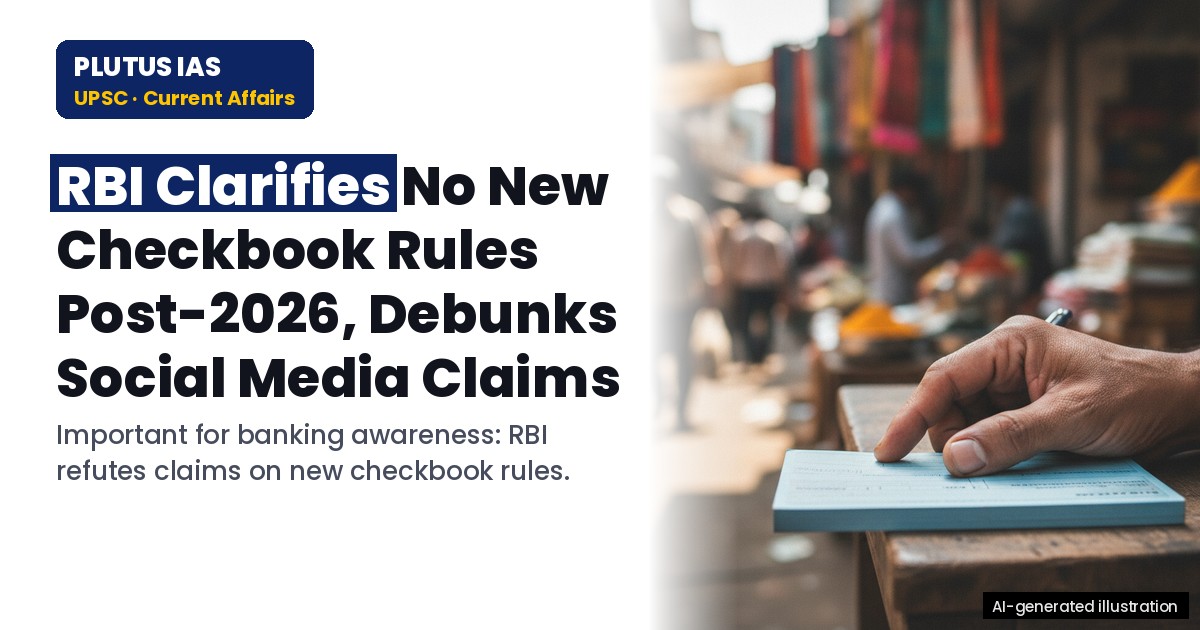
✎ The Reserve Bank of India has clarified that there are no impending changes to the existing Check Truncation System (CTS) checkbooks from January 1, 2027, dismissing social media rumors as factually incorrect.
Subject Relevance — Where This Topic Fits
- GS Paper III — Economy
- Prelims: Reserve Bank of India (RBI), Check Truncation System (CTS), Negotiable Instruments Act, 1881, Payment and Settlement Systems Act, 2007, Digital Payments, Financial Literacy
- Essay: The Role of Central Banks in Maintaining Financial Stability and Public Trust, Technological Advancements and Their Impact on Traditional Banking Instruments
Quick Revision: The Reserve Bank of India has clarified that there are no impending changes to the existing Check Truncation System (CTS) checkbooks from January 1, 2027, dismissing social media rumors as factually incorrect.
Why is this in the news?
The Reserve Bank of India (RBI) recently issued a clarification refuting widespread social media claims regarding an impending change to the existing Check Truncation System (CTS) checkbooks from January 1, 2027. The central bank explicitly stated that no such modifications to the current CTS checkbook standards or security features are being implemented, advising the public to rely solely on official RBI communications for accurate information concerning banking regulations and instruments.
Background
- The RBI is the central banking institution of India, responsible for regulating the country’s monetary policy, issuing currency, and overseeing the financial system.
- Checks are a traditional payment instrument, governed primarily by the Negotiable Instruments Act, 1881, which defines their legal framework and operational aspects.
- The Check Truncation System (CTS) was introduced by the RBI to streamline the check clearing process, reducing the physical movement of checks and enhancing efficiency.
- CTS involves the electronic image of a check being transmitted for clearing, rather than the physical instrument, thereby speeding up the settlement process.
- The RBI frequently issues public advisories and clarifications to counter misinformation and ensure financial literacy among citizens, especially concerning banking operations and regulatory changes.
- Misinformation spread through social media platforms can lead to public confusion and potentially disrupt financial transactions, necessitating prompt official responses from regulatory bodies.
What is the Check Truncation System (CTS)?
- The Check Truncation System (CTS) is a system of check clearing introduced by the Reserve Bank of India (RBI) that facilitates the electronic processing of checks.
- Under CTS, the physical check is truncated (stopped) at the presenting bank, and an electronic image of the check, along with relevant data, is transmitted to the drawee bank through the clearing house.
- This system significantly reduces the time taken for check clearing, typically enabling same-day or next-day clearing, compared to the earlier system that involved physical movement of checks.
- CTS enhances efficiency, reduces operational costs for banks, and minimizes the risks associated with the physical transportation of checks, such as loss or theft.
- The system incorporates various security features and standards to ensure the integrity and authenticity of the electronic images and data, thereby maintaining trust in the payment instrument.
- All checks issued by banks in India are now CTS-2010 compliant, meaning they adhere to specific standards regarding paper quality, watermarks, bank logos, and other security features.
- The implementation of CTS is a part of the RBI’s broader efforts to modernize the payment and settlement systems in India, aligning with global best practices and promoting digital transactions.
Key Features
| Feature | Significance |
|---|---|
| Check Truncation System (CTS) | A system that facilitates the electronic processing of cheques, eliminating the physical movement of the instrument. This enhances efficiency, reduces processing time, and mitigates risks associated with physical handling. |
| Standardised Security Features | Incorporation of uniform security elements in cheques, such as watermarks, void pantographs, and unique cheque numbers, to prevent counterfeiting and fraud. This ensures the integrity and authenticity of payment instruments. |
| Digitalisation of Cheque Clearing | The shift from manual, paper-based cheque clearing to an image-based electronic system. This aligns with broader financial sector objectives of promoting digital transactions and reducing operational costs. |
| RBI’s Role in Financial System Stability | The Reserve Bank of India’s mandate to regulate and supervise the financial system, including payment and settlement systems. Its clarifications on banking norms are crucial for maintaining public trust and operational clarity. |
Why it Matters
Economic Stability and Public Confidence
- The RBI’s clarification regarding the continuity of existing CTS cheque books prevents undue panic and maintains public confidence in the banking system. Unfounded rumours can disrupt financial markets and consumer behaviour.
- Ensuring the stability of payment systems is fundamental for economic transactions. Any perceived uncertainty about cheque validity could impede commercial activities and personal financial management.
Regulatory Clarity and Financial Literacy
- The central bank’s proactive communication addresses misinformation, reinforcing its role as the authoritative source for financial regulations. This is vital for maintaining transparency and preventing fraudulent activities.
- Promoting financial literacy by advising the public to rely solely on official RBI communications helps individuals make informed decisions and protects them from scams or misinterpretations of banking policies.
Efficiency of Payment Systems
- The continued use of the established CTS framework ensures the uninterrupted and efficient functioning of cheque clearing operations. Frequent, unannounced changes to core payment instruments could lead to operational bottlenecks for banks and customers.
- CTS itself represents a significant advancement in payment system efficiency, reducing the time and cost associated with cheque processing compared to the older manual clearing system.
Challenges
1. Misinformation and Disinformation
- The rapid spread of unverified information through social media platforms poses a significant challenge to regulatory bodies in maintaining accurate public discourse.
- Such misinformation can lead to unnecessary anxiety among the populace and potentially disrupt financial transactions if not promptly addressed by authoritative sources.
UPSC Link: Role of media and social networking sites in internal security challenges
2. Public Trust in Financial Institutions
- Persistent circulation of false claims can erode public trust in banking institutions and regulatory bodies, even when clarifications are issued.
- Rebuilding trust necessitates consistent and transparent communication strategies from official channels.
UPSC Link: Government policies and interventions for development in various sectors
3. Operational Disruptions
- If such rumours were to gain widespread credence, it could lead to unnecessary operational burdens on banks, as customers might rush to replace cheque books based on false information.
- This could divert resources from essential banking services and create inefficiencies within the system.
UPSC Link: Indian Economy and issues relating to planning, mobilization of resources
Challenges — UPSC Perspective
| Issue | Concern |
|---|---|
| Social Media Misinformation | Rapid dissemination of unverified claims can create widespread confusion and undermine public confidence in financial systems. |
| Public Trust Erosion | Repeated exposure to false information, even if debunked, can gradually diminish the credibility of official financial communications and institutions. |
| Operational Inefficiency | Unfounded rumours about policy changes can trigger unnecessary public actions, leading to increased workload for banks and potential disruptions in routine operations. |
| Financial Literacy Gap | A segment of the population may lack the critical discernment to differentiate between official announcements and speculative social media content, making them vulnerable to misinformation. |
Way Forward
- Strengthen digital literacy initiatives to equip citizens with the ability to critically evaluate information from diverse sources, especially on social media platforms.
- Enhance the proactive communication strategies of regulatory bodies like the RBI, utilising multiple official channels to disseminate accurate information promptly.
- Establish robust mechanisms for monitoring and identifying the rapid spread of financial misinformation on social media, enabling timely interventions.
- Collaborate with social media platforms to implement features that flag or verify financial information originating from official sources.
- Regularly conduct public awareness campaigns on the importance of relying solely on official government and regulatory websites for financial policy updates.
- Develop simplified, accessible explanations of complex financial regulations to ensure broader public understanding and reduce susceptibility to misinterpretations.
UPSC Value Addition
Keywords for Mains Answer-Writing
Reserve Bank of India · Financial literacy · Consumer protection · Digital banking · Payment systems · Regulatory communication · Misinformation · Public trust · Cheque Truncation System (CTS) · Banking regulations
Concept Flow
Misinformation spreads on social media regarding new cheque book rules. → Public confusion and potential anxiety arise regarding financial instruments. → Reserve Bank of India (RBI) takes cognisance of the circulating claims. → RBI issues official clarification, refuting the false information. → Public is advised to rely solely on official RBI communications. → Stability of payment systems and public confidence are maintained.
Prelims Practice Questions
Q1. Consider the following statements regarding the Reserve Bank of India (RBI):
1. The RBI is responsible for regulating and supervising financial institutions in India.
2. The RBI acts as the government’s banker and debt manager.
3. The RBI is the sole authority for issuing currency notes in India.
How many of the above statements are correct?
- Only one
- Only two
- All three
- None
Answer: All three — Statement 1 is correct: The RBI regulates and supervises commercial banks, cooperative banks, and non-banking financial companies. Statement 2 is correct: The RBI manages the public debt of the central and state governments and conducts banking transactions for them. Statement 3 is correct: Under Section 22 of the RBI Act, 1934, the RBI has the sole right to issue currency notes in India.
Q2. Which of the following is the primary objective of the Cheque Truncation System (CTS) in India?
- To introduce new security features for cheques.
- To reduce the physical movement of cheques.
- To facilitate international cheque clearances.
- To standardize cheque book designs across all banks.
Answer: To reduce the physical movement of cheques. — The primary objective of CTS is to reduce the physical movement of cheques by replacing it with an electronic image of the cheque and associated data, thereby speeding up the clearing process and reducing operational costs.
Mains Practice Question
✍ Examine the role of the Reserve Bank of India (RBI) in maintaining financial stability and consumer confidence in the banking sector. Discuss the challenges posed by misinformation in the digital age and the strategies employed by the RBI to counter it. (15 Marks)
Approach: MODEL-ANSWER SKELETON:
1. **Introduction:** Briefly introduce RBI’s mandate as the central bank and its role in financial stability.
2. **RBI’s Role in Financial Stability:**
* Monetary Policy: Inflation targeting, interest rate management.
* Regulation and Supervision: Licensing, prudential norms, oversight of banks and NBFCs.
* Payment Systems: Ensuring efficient and secure payment infrastructure (e.g., RTGS, NEFT, CTS).
* Lender of Last Resort: Providing liquidity support to banks.
* Foreign Exchange Management: Maintaining external sector stability.
3. **RBI’s Role in Consumer Confidence:**
* Deposit Insurance: DICGC (Deposit Insurance and Credit Guarantee Corporation) for depositor protection.
* Grievance Redressal: Banking Ombudsman Scheme.
* Financial Literacy: Campaigns and initiatives to educate the public.
* Transparency: Issuing clear guidelines and clarifications.
4. **Challenges of Misinformation in the Digital Age:**
* Rapid spread through social media.
* Erosion of public trust in financial institutions.
* Potential for panic and irrational financial decisions.
* Difficulty in distinguishing official information from fake news.
5. **RBI’s Strategies to Counter Misinformation:**
* Proactive Communication: Issuing official press releases, statements on its website and social media (e.g., ‘X’ platform).
* Public Awareness Campaigns: Emphasizing reliance on official sources.
* Fact-Checking: Directly refuting false claims.
* Financial Literacy Initiatives: Empowering citizens with knowledge to discern credible information.
* Regulatory Framework: Strengthening cyber security and data protection norms.
6. **Conclusion:** Summarize the critical importance of RBI’s proactive communication and regulatory vigilance in safeguarding both financial stability and public trust amidst evolving digital challenges.
Source: jagran.com
Generated by AanyaAi for educational purpose.
Related guides on our sites
- Best economics optional coaching for upsc
- Best economics optional teacher for upsc
- How to prepare for GS paper 1 for UPSC CSE mains exam
- Best UPSC coaching for IFOS exam

- अरुणाचल में बुद्ध के पवित्र अवशेष: संस्कृति और विरासत का संगम - November 9, 2026
- AI Race & Democracy: Governance Challenges in Tech - November 9, 2026
- भारत-म्यांमार ‘राहत मित्र’ अभ्यास: HADR में द्विपक्षीय सहयोग - November 9, 2026

No Comments