


11 Aug RBI Governor Urges Banks to Accelerate AI Adoption with Caution
✎ AI adoption in banking must be balanced with robust governance frameworks to mitigate risks such as algorithmic bias, cyber threats, and systemic vulnerabilities, as emphasised by the RBI Governor.
Subject Relevance — Where This Topic Fits
- GS Paper III — Indian Economy and issues relating to Planning, Mobilisation of Resources, Growth, Development and Employment | GS Paper III — Science and Technology — Developments and their Applications and Effects in Everyday Life | GS Paper III — Security Challenges and their Management in Border Areas; Linkages of Organised Crime with Terrorism
- Prelims: Artificial Intelligence (AI), Machine Learning (ML), Regulatory Sandbox, Digital Lending, Cybersecurity, Data Privacy, RBI Guidelines on IT Governance, Financial Stability, Operational Risk, Bias in AI Models
- Essay: The Dual-Edged Sword of Technological Innovation: Balancing Efficiency and Ethical Governance in the Digital Age, Financial Inclusion Through Technology: Opportunities and Challenges in a Data-Driven Economy
Quick Revision: AI adoption in banking must be balanced with robust governance frameworks to mitigate risks such as algorithmic bias, cyber threats, and systemic vulnerabilities, as emphasised by the RBI Governor.
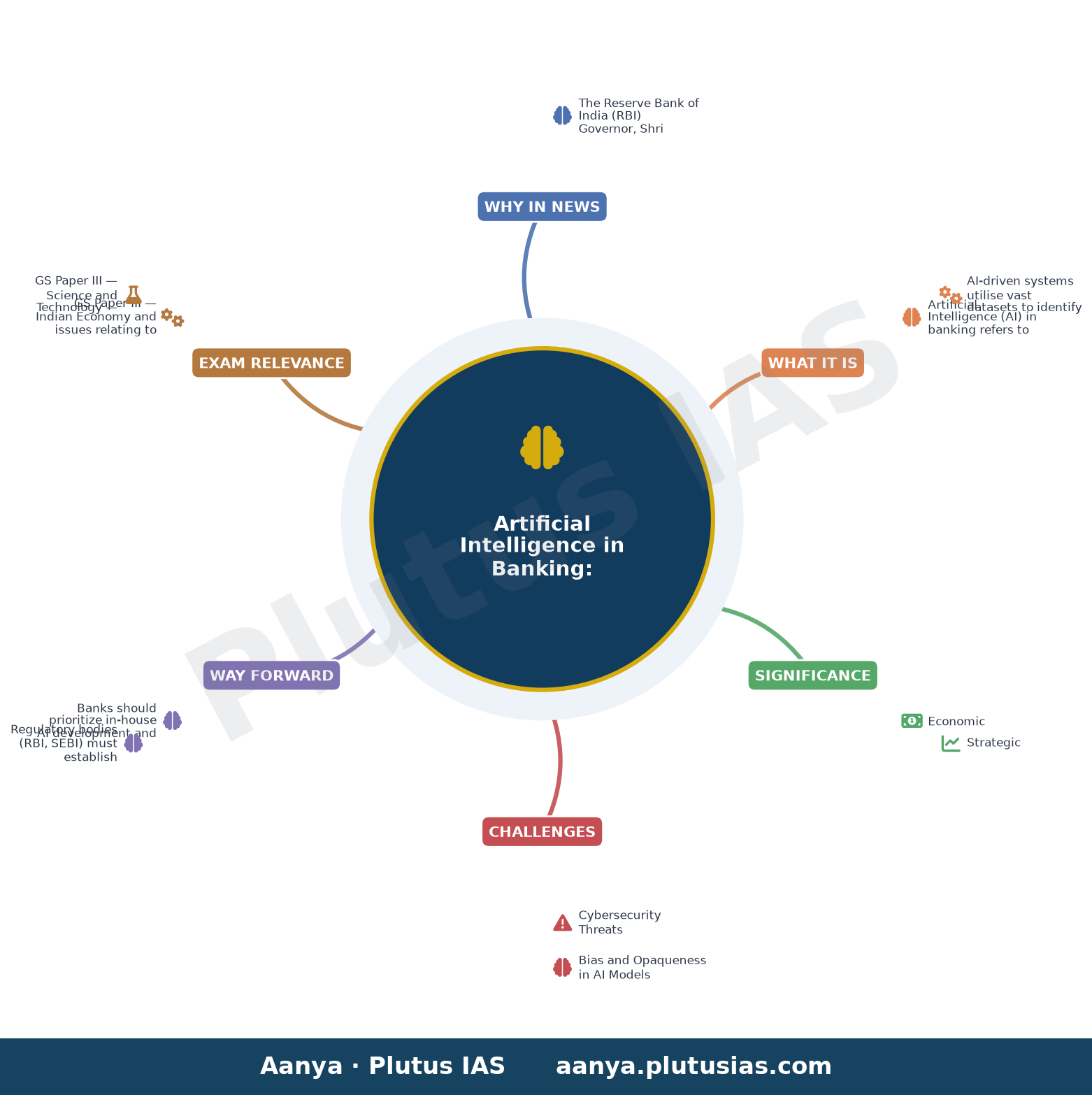
Why is this in the news?
The Reserve Bank of India (RBI) Governor, Shri Sanjay Malhotra, has underscored the critical need for Indian lenders to accelerate investments in artificial intelligence (AI) while simultaneously cautioning against its associated risks. Speaking at an industry event in Mumbai, he emphasised that the adoption of AI must be accompanied by robust safeguards, human oversight, and a deep understanding of the technology’s implications to mitigate threats such as biased decision-making, data privacy breaches, and cybersecurity vulnerabilities. This directive reflects a broader global trend where central banks are grappling with the dual challenges of harnessing AI for efficiency gains and safeguarding financial stability.
Background
- The Indian banking sector has witnessed a rapid digital transformation post-2016, driven by initiatives such as the Unified Payments Interface (UPI), Aadhaar-enabled services, and the push for a cashless economy.
- AI adoption in banking has accelerated due to its potential to enhance operational efficiency, personalise customer services, detect fraud, and optimise credit underwriting processes.
- The RBI, through its regulatory sandbox framework (introduced in 2020), has encouraged innovation in fintech while ensuring consumer protection and systemic stability.
- Globally, central banks and financial regulators are increasingly focusing on AI governance, with the European Union’s AI Act and the Bank of England’s AI principles serving as key reference points.
- Cybersecurity threats in the financial sector have escalated, with ransomware attacks, phishing, and data breaches posing significant risks to financial institutions and their customers.
- The RBI’s Financial Stability Report (December 2025) highlighted concerns over concentration risks in AI model usage and the potential for systemic vulnerabilities arising from over-reliance on third-party vendors.
What is Artificial Intelligence in Banking?
- Artificial Intelligence (AI) in banking refers to the application of advanced algorithms, machine learning, and data analytics to automate, optimise, and enhance financial services, including lending, risk assessment, fraud detection, and customer service.
- AI-driven systems utilise vast datasets to identify patterns, predict customer behaviour, and automate routine tasks, thereby improving efficiency and reducing operational costs.
- Key AI applications in banking include: (a) Credit scoring and underwriting using alternative data sources; (b) Chatbots and virtual assistants for customer support; (c) Fraud detection through anomaly detection algorithms; (d) Algorithmic trading and portfolio management; and (e) Personalised financial advisory services.
- AI models in banking operate through supervised learning (trained on labelled data), unsupervised learning (identifying patterns in unstructured data), and reinforcement learning (optimising decisions through trial and error).
- The adoption of AI in banking is closely tied to the broader digital public infrastructure (DPI) initiatives in India, such as Aadhaar, UPI, and the Account Aggregator Framework, which provide the foundational data and interoperability required for AI-driven innovations.
- AI systems in banking must comply with data protection laws such as the Digital Personal Data Protection Act (DPDP Act, 2023), which mandates consent-based data processing, data localisation norms, and strict penalties for breaches.
- The RBI’s guidelines on IT governance for banks (e.g., Master Direction on Information Technology Governance, Risk, Controls, and Assurance Processes, 2022) require institutions to implement robust AI governance frameworks, including model risk management, explainability requirements, and regular audits.
- The ethical and regulatory challenges of AI in banking include algorithmic bias (e.g., discriminatory lending practices), lack of transparency in decision-making, and the risk of over-reliance on proprietary AI models developed by third-party vendors.
Key Features
| Feature | Significance |
|---|---|
| Accelerated AI adoption by lenders | Enhances operational efficiency, reduces manual errors, and enables faster decision-making in loan processing, risk assessment, and customer service. |
| Investment in AI infrastructure and workforce upskilling | Ensures long-term competitiveness and resilience of the banking sector by fostering technological self-reliance and reducing dependency on external vendors. |
| Human oversight in AI deployment | Mitigates risks of opaque or biased decisions by ensuring that AI-driven processes remain interpretable, accountable, and aligned with regulatory standards. |
| Cybersecurity and data privacy safeguards | Protects customer data, prevents financial fraud, and maintains trust in digital banking systems amid rising cyber threats. |
| Real-time threat intelligence sharing | Enables proactive identification and mitigation of cyber risks, reducing the likelihood of systemic disruptions in the financial sector. |
Why it Matters
Economic
- AI integration in banking can significantly reduce costs by automating routine tasks such as KYC verification, fraud detection, and customer queries, thereby improving profitability.
- Enhanced risk assessment through AI models can lead to more accurate credit scoring, expanding financial inclusion by enabling credit access to underserved segments.
- A resilient banking sector with robust AI governance strengthens investor confidence, attracting both domestic and foreign investment in India’s financial markets.
Strategic
- AI adoption in banking aligns with India’s broader digital transformation goals, including the vision of a ‘Digital India’ and the push for a cashless economy.
- Reducing dependency on foreign AI models and vendors enhances India’s technological sovereignty and reduces vulnerabilities to geopolitical risks.
- Strengthening cybersecurity frameworks in banking safeguards critical infrastructure, which is essential for maintaining economic stability and national security.
Regulatory
- The RBI’s emphasis on human oversight and vendor risk management reflects a proactive approach to regulating emerging technologies in finance, ensuring compliance with global standards.
- Mandating real-time threat intelligence sharing among banks fosters a collaborative ecosystem, reducing systemic risks and improving collective resilience.
- The focus on data privacy and bias mitigation in AI models underscores the need for alignment with existing regulations such as the Digital Personal Data Protection Act, 2023.
Challenges
1. Cybersecurity Threats
- AI systems in banking are prime targets for cyberattacks, including ransomware, phishing, and data breaches, which can lead to financial losses and reputational damage.
- Sophisticated AI-driven attacks, such as deepfake-based fraud, pose new challenges to authentication systems and customer verification processes.
- Dependence on third-party AI vendors increases exposure to supply-chain attacks, where vulnerabilities in external systems can compromise entire banking networks.
UPSC Link: Cybersecurity threats to financial systems
2. Bias and Opaqueness in AI Models
- AI algorithms trained on biased datasets can perpetuate discriminatory lending practices, excluding eligible borrowers based on gender, caste, or geographic factors.
- Lack of transparency in AI decision-making processes (black-box models) undermines regulatory compliance and customer trust, particularly in dispute resolution.
- Regulatory scrutiny of AI models is challenging due to their complexity, requiring standardized frameworks for explainability and auditability.
UPSC Link: Ethical and regulatory challenges in AI adoption
3. Data Privacy and Compliance Risks
- Banks handle vast amounts of sensitive customer data, making them attractive targets for data theft and misuse, which can violate privacy laws such as the DPDP Act, 2023.
- Cross-border data flows in AI-driven banking operations raise jurisdictional challenges, complicating compliance with varying international data protection regulations.
- Inadequate data governance frameworks can lead to unauthorized access, data leaks, or misuse, eroding public confidence in digital banking.
UPSC Link: Data privacy concerns in digital finance
4. Vendor and Model Dependency Risks
- Over-reliance on a limited number of AI vendors creates single points of failure, where a vendor’s operational or financial instability could disrupt banking services.
- Licensing and proprietary constraints in third-party AI solutions may limit a bank’s ability to customize or modify models to suit local regulatory or market needs.
- Vendor lock-in can hinder innovation and flexibility, as banks may struggle to transition to alternative solutions without significant costs or disruptions.
UPSC Link: Third-party risks in financial technology
5. Operational and Systemic Risks
- AI-driven automation can lead to over-reliance on technology, reducing human oversight and increasing the risk of cascading failures in critical banking operations.
- Widespread adoption of similar AI models across banks may create systemic vulnerabilities, where a single flaw or attack vector could affect multiple institutions simultaneously.
- Integration of AI with legacy banking systems may face compatibility issues, leading to inefficiencies or security gaps during transition phases.
UPSC Link: Systemic risks in AI-driven banking
Challenges — UPSC Perspective
| Issue | Concern |
|---|---|
| Cyberattacks on AI systems | Financial fraud, data breaches, and reputational damage due to sophisticated cyber threats. |
| Bias in AI algorithms | Discriminatory lending practices and regulatory non-compliance due to opaque decision-making. |
| Data privacy violations | Unauthorized access to customer data and non-compliance with privacy laws. |
| Vendor dependency | Single points of failure and limited customization due to reliance on external AI models. |
| Systemic vulnerabilities | Cascading operational failures and widespread disruptions due to shared AI risks. |
Way Forward
- Banks should prioritize in-house AI development and upskilling of workforce to reduce dependency on third-party vendors and enhance technological sovereignty.
- Regulatory bodies (RBI, SEBI) must establish standardized frameworks for AI explainability, bias audits, and real-time threat intelligence sharing among banks.
- Strengthen cybersecurity protocols by mandating multi-factor authentication, encryption standards, and regular penetration testing for AI-driven systems.
- Promote public-private partnerships to develop indigenous AI solutions tailored to India’s regulatory and market requirements.
- Enhance consumer awareness programs to educate customers about AI-driven banking processes, data privacy rights, and grievance redressal mechanisms.
- Implement robust data governance policies, including strict access controls, anonymization techniques, and compliance with the Digital Personal Data Protection Act, 2023.
- Encourage banks to adopt a phased approach to AI integration, starting with low-risk applications (e.g., chatbots) before scaling to critical operations (e.g., loan approvals).
UPSC Value Addition
Keywords for Mains Answer-Writing
Artificial Intelligence in banking sector · RBI Governor Sanjay Malhotra · AI adoption risks in financial services · Cybersecurity in banking · Data privacy in financial sector · Regulatory oversight of AI in finance · Financial stability and AI · Ethical AI in banking · AI governance framework · Banking sector vulnerabilities · AI-driven decision-making in finance · Regulatory dilemmas in AI deployment
Concept Flow
RBI Governor’s call for AI adoption in banking → Recognition of efficiency gains and competitive necessity → Identification of risks (cybersecurity, bias, vendor dependency) → Need for regulatory safeguards → Emphasis on human oversight and data privacy → Call for workforce upskilling and infrastructure investment → Long-term goal of a resilient, technologically sovereign financial sector.
Prelims Practice Questions
Q1. Consider the following statements regarding the use of Artificial Intelligence (AI) in the banking sector in India:
1. The RBI Governor has urged lenders to accelerate AI adoption to enhance operational efficiency.
2. The RBI Governor has warned that AI adoption may lead to biased or opaque decision-making.
3. The RBI Governor has stated that dependence on a single technology vendor is advisable for reducing systemic risks.
4. The RBI Governor has highlighted cybersecurity threats as a significant risk associated with AI adoption.
How many of the above statements are correct?
- Only one
- Only two
- Only three
- All four
Answer: All four — Statements 1, 2, and 4 are correct. Statement 3 is incorrect as the RBI Governor cautioned against dependence on a small number of vendors, which could expose the banking system to errors and vulnerabilities.
Q2. Assertion (A): The Reserve Bank of India (RBI) has emphasized the need for stronger safeguards and human oversight in the deployment of Artificial Intelligence (AI) by banks.
Reason (R): The RBI Governor has identified risks such as biased decisions, data privacy threats, and cybersecurity vulnerabilities associated with AI adoption in the banking sector.
In the context of the above two statements, which one of the following is correct?
- Both A and R are true, and R is the correct explanation of A.
- Both A and R are true, but R is not the correct explanation of A.
- A is true, but R is false.
- A is false, but R is true.
Answer: Both A and R are true, but R is not the correct explanation of A. — Both the Assertion (A) and Reason (R) are true. The RBI Governor’s emphasis on safeguards and human oversight (A) is directly linked to the risks identified (R), such as biased decisions, data privacy threats, and cybersecurity vulnerabilities.
Q3. Which of the following risks associated with the adoption of Artificial Intelligence (AI) in the banking sector has been explicitly highlighted by the RBI Governor Sanjay Malhotra?
1. Systemic liquidity crunch
2. Biased or opaque decision-making
3. Geopolitical and trade uncertainties
4. Cybersecurity threats
Select the correct answer using the code below:
- 1 and 2 only
- 2, 3 and 4 only
- 1, 2 and 4 only
- 1, 2, 3 and 4
Answer: 1, 2 and 4 only — The RBI Governor explicitly highlighted risks such as biased or opaque decision-making, geopolitical and trade uncertainties, and cybersecurity threats. Systemic liquidity crunch was not mentioned as a risk associated with AI adoption.
Mains Practice Question
✍ The integration of Artificial Intelligence (AI) in the banking sector is often hailed as a transformative tool for efficiency and innovation. However, its adoption is not without challenges. Critically examine the risks and regulatory dilemmas associated with the deployment of AI in India’s banking sector, with reference to recent RBI directives. (15 Marks)
Approach: MODEL-ANSWER SKELETON:
1. **Introduction (2 Marks)**: Define AI in banking and its potential benefits (e.g., automation, fraud detection, customer service). Reference RBI Governor Sanjay Malhotra’s recent call for accelerated AI adoption in the banking sector.
2. **Risks Identified by RBI (5 Marks)**:
– **Biased or Opaque Decision-Making**: Discuss the risk of algorithmic bias and lack of transparency in AI-driven lending or credit scoring (cite RBI’s concerns).
– **Data Privacy and Cybersecurity**: Highlight vulnerabilities such as data breaches, identity theft, and the misuse of customer data (reference RBI’s emphasis on safeguards).
– **Vendor Dependence**: Explain the systemic risk of over-reliance on a few technology vendors, which could lead to operational failures or errors (as noted by Malhotra).
– **Geopolitical and Trade Uncertainties**: Link AI adoption to broader macroeconomic risks, including geopolitical tensions and trade disruptions.
3. **Regulatory Dilemmas (5 Marks)**:
– **Balancing Innovation and Stability**: Discuss the RBI’s role in fostering innovation while mitigating risks (reference RBI’s push for stronger safeguards and human oversight).
– **Global Precedents**: Compare India’s approach with regulatory frameworks in other jurisdictions (e.g., EU’s AI Act, US regulatory guidelines).
– **Human Oversight**: Emphasize the need for explainable AI (XAI) and human-in-the-loop systems to ensure accountability.
4. **Conclusion (3 Marks)**:
– Summarize the dual-edged nature of AI in banking: a tool for efficiency but requiring robust governance.
– Highlight the RBI’s stance that banks adopting AI must do so with full understanding of its implications, not merely speed.
– Conclude with the need for a balanced regulatory framework that promotes innovation while safeguarding financial stability.
Source: Business Standard
Generated by AanyaAi for educational purpose.

- Gurugram’s groundwater extraction exceeds limit by 212%; HC seeks ban - October 4, 2026
- स्वतंत्रता सेनानी श्यामजी कृष्ण वर्मा की जन्म जयंती पर पीएम का श्रद्धांजलि - October 4, 2026
- KWML’s Feasibility Reports for Water Metro in 18 Cities: UPSC & PCS Insights - October 3, 2026

No Comments