


07 Aug RBI Proposes Leverage Ratio Changes: Key Updates for UPSC & State PCS 2026
✎ The Leverage Ratio is a non-risk-based capital adequacy metric that ensures banks maintain a minimum Tier 1 capital relative to total exposure, serving as a supplementary safeguard against excessive leverage and systemic risk.
Subject Relevance — Where This Topic Fits
- GS Paper III — Indian Economy and issues relating to Planning, Mobilization of Resources, Growth, Development and Employment | GS Paper III — Effects of Liberalization on the Economy, Changes in Industrial Policy and their Effects on Industrial Growth
- Prelims: Leverage Ratio, Basel III, Capital Adequacy Ratio (CAR), Reserve Bank of India (RBI), Commercial Banks, Financial Stability, Risk-weighted Assets (RWA), Prudential Norms, Regulatory Capital, Tier 1 Capital, Tier 2 Capital, Systemically Important Banks (SIBs)
- Essay: The Role of Regulatory Frameworks in Ensuring Financial Stability: A Case Study of RBI’s Leverage Ratio Amendments, Global Financial Governance and National Sovereignty: The Case of Basel III Implementation in India
Quick Revision: The Leverage Ratio is a non-risk-based capital adequacy metric that ensures banks maintain a minimum Tier 1 capital relative to total exposure, serving as a supplementary safeguard against excessive leverage and systemic risk.
Why is this in the news?
The Reserve Bank of India (RBI) has issued a draft notification inviting public comments on the ‘Reserve Bank of India (Commercial Banks – Prudential Norms on Capital Adequacy) Eleventh Amendment Directions, 2026’, which proposes amendments to the Leverage Ratio framework for commercial banks. This amendment aligns the Indian banking sector’s regulatory framework with the ‘Leverage Ratio 2017 Standard’ issued by the Basel Committee on Banking Supervision (BCBS), aiming to enhance financial stability and resilience against systemic risks. The consultation process underscores RBI’s proactive approach to integrating global best practices while addressing domestic financial sector vulnerabilities.
Background
- The Basel Committee on Banking Supervision (BCBS), established in 1974 by the G10 central bank governors, formulates global standards for banking regulation to mitigate systemic risks and enhance financial stability.
- India, as a member of the BCBS, has progressively adopted Basel III norms since 2013 to strengthen the capital adequacy and risk management frameworks of its banking sector.
- The Leverage Ratio, introduced under Basel III, serves as a non-risk-based supplementary measure to the risk-weighted capital requirements, ensuring banks maintain a minimum level of capital relative to their total assets, irrespective of risk weightings.
- The RBI’s Prudential Norms on Capital Adequacy Directions, 2025, form the foundational regulatory framework for commercial banks in India, incorporating Basel III standards.
- The proposed amendment reflects RBI’s commitment to periodic review and alignment with evolving global regulatory standards to address emerging risks in the banking sector.
What is the Leverage Ratio and its Regulatory Significance?
- The Leverage Ratio is a capital adequacy metric defined as the ratio of Tier 1 capital to total exposure, including both on-balance-sheet and off-balance-sheet items, expressed as a percentage.
- It acts as a backstop to risk-weighted capital requirements by imposing a minimum leverage ratio threshold, thereby limiting excessive leverage and reducing systemic risk.
- The Basel III framework introduced the Leverage Ratio in 2010 as part of its broader reforms to address the pro-cyclicality of risk-weighted assets and enhance transparency in banks’ capital structures.
- The ‘Leverage Ratio 2017 Standard’ issued by the BCBS refines the calculation methodology, including adjustments for derivatives exposures, securities financing transactions, and off-balance-sheet items, to ensure consistency and comparability across jurisdictions.
- The proposed amendment aims to formalize the alignment with the BCBS 2017 Standard, ensuring Indian banks adopt a more robust and internationally harmonized leverage framework.
- The Leverage Ratio complements the Capital Adequacy Ratio (CAR) by providing a simpler, yet critical, measure of a bank’s financial health, independent of risk weightings.
- Regulatory compliance with the Leverage Ratio helps prevent excessive risk-taking and ensures banks maintain sufficient capital buffers to absorb shocks, thereby safeguarding depositors and the broader financial system.
Key Features
| Feature | Significance |
|---|---|
| Amendment to Leverage Ratio Framework | Aligns Indian banking norms with the Basel Committee on Banking Supervision’s ‘Leverage Ratio 2017 Standard’ to enhance global harmonisation and systemic stability. |
| Public Consultation Process | Invites stakeholder feedback by August 28, 2026, ensuring regulatory transparency and industry participation in policy formulation. |
| Chapter VII Modification | Specifically targets the Leverage Ratio framework under the Reserve Bank of India (Commercial Banks – Prudential Norms on Capital Adequacy) Directions, 2025, for targeted regulatory refinement. |
| Regulatory Compliance | Ensures Indian commercial banks adhere to internationally accepted capital adequacy standards, reinforcing depositor confidence and financial resilience. |
| Operational Clarity | Provides clear directives for banks to adjust capital structures, reducing ambiguity in compliance and risk management practices. |
Why it Matters
Regulatory Framework
- The amendment underscores India’s commitment to Basel III norms, promoting consistency with global banking standards and mitigating systemic risks.
- Strengthens the Reserve Bank of India’s oversight of commercial banks by introducing stricter capital adequacy benchmarks.
- Enhances the credibility of Indian financial institutions in international markets through alignment with universally recognised prudential norms.
Economic Stability
- By enforcing higher capital buffers, the amendment reduces the likelihood of bank failures, thereby safeguarding depositor wealth and financial stability.
- Mitigates pro-cyclicality in lending by discouraging excessive leverage during economic expansions, thus curbing asset bubbles.
- Contributes to macroeconomic resilience by ensuring banks maintain adequate capital reserves to absorb shocks during downturns.
Global Integration
- Facilitates seamless cross-border banking operations by harmonising Indian regulations with international norms, reducing compliance costs for multinational banks.
- Positions India as a responsible participant in global financial governance, enhancing its influence in standard-setting bodies like the Basel Committee.
- Encourages foreign investment in India’s banking sector by demonstrating adherence to globally accepted prudential standards.
Stakeholder Engagement
- The public consultation process democratises regulatory policymaking, allowing banks, financial institutions, and experts to shape the final framework.
- Promotes a consultative approach to governance, fostering trust between regulators and regulated entities.
- Enables the RBI to incorporate ground-level insights, ensuring the amendment is practical and implementable.
Challenges
1. Implementation Complexity
- Banks may face operational challenges in recalibrating capital structures to meet the revised leverage ratio requirements without disrupting lending activities.
- Smaller banks with limited capital buffers could struggle to comply, potentially leading to consolidation or exit from the sector.
- Requires significant IT infrastructure upgrades to monitor and report leverage ratios in real time, posing cost and technical challenges.
UPSC Link: GS3: Banking Sector Reforms
2. Economic Growth Trade-offs
- Higher capital requirements may reduce banks’ risk-weighted asset growth, constraining credit availability and potentially slowing economic expansion.
- In a low-growth environment, stricter norms could exacerbate liquidity constraints, particularly for MSMEs and retail borrowers.
- Balancing financial stability with growth objectives remains a persistent challenge for policymakers.
UPSC Link: GS3: Financial Inclusion
3. Regulatory Arbitrage Risks
- Banks might explore regulatory arbitrage by shifting operations to jurisdictions with less stringent norms, undermining the purpose of the amendment.
- Shadow banking entities could exploit gaps in the framework, creating systemic vulnerabilities outside the purview of traditional banking regulations.
- Ensuring uniform compliance across diverse banking models (public, private, foreign) poses a significant enforcement challenge.
UPSC Link: GS3: Financial Sector Regulation
4. Technological and Human Resource Gaps
- Banks may lack the requisite expertise to implement and monitor leverage ratio compliance, necessitating capacity-building initiatives.
- Integration of new reporting systems with existing core banking solutions could face interoperability issues, delaying compliance timelines.
- Cybersecurity risks may increase as banks expand digital reporting and monitoring capabilities.
UPSC Link: GS3: Digital Banking
5. Macroeconomic Sensitivity
- The amendment’s effectiveness depends on broader macroeconomic conditions, such as interest rate cycles and fiscal policies, which are beyond the RBI’s control.
- Geopolitical risks, such as global financial crises or trade wars, could undermine the stability gains from higher capital adequacy.
- Domestic economic shocks, such as inflation or currency depreciation, may erode banks’ capital buffers, necessitating dynamic regulatory adjustments.
UPSC Link: GS3: Macroeconomic Stability
Challenges — UPSC Perspective
| Issue | Concern |
|---|---|
| Capital Adequacy Compliance | Smaller banks may face difficulties in raising additional capital to meet the revised leverage ratio, leading to consolidation or reduced lending. |
| Operational Disruptions | Banks may need to overhaul internal processes and IT systems to monitor and report leverage ratios, increasing short-term costs and operational risks. |
| Credit Contraction | Stricter capital norms could reduce banks’ risk-weighted asset growth, potentially constraining credit flow to critical sectors like MSMEs and infrastructure. |
| Regulatory Arbitrage | Banks might shift operations to less regulated entities or jurisdictions to bypass the stricter norms, creating systemic risks outside traditional banking oversight. |
| Macroeconomic Sensitivity | The effectiveness of the amendment is contingent on broader economic conditions, which may not always align with regulatory objectives. |
| Technological Gaps | Banks lacking advanced IT infrastructure may struggle to implement real-time monitoring and reporting of leverage ratios, delaying compliance. |
Way Forward
- Banks should proactively assess their capital adequacy positions and develop phased compliance strategies to meet the revised leverage ratio requirements.
- The RBI should provide clear timelines and transitional arrangements to ease the implementation burden on banks, particularly smaller institutions.
- Enhance capacity-building initiatives for bank staff through training programs on leverage ratio compliance and risk management.
- Strengthen cybersecurity frameworks to safeguard digital reporting and monitoring systems, given the increased reliance on technology.
- Monitor macroeconomic indicators closely to assess the impact of the amendment on credit growth and economic activity, adjusting policies as necessary.
- Collaborate with international regulators to address regulatory arbitrage risks and ensure consistent enforcement of prudential norms.
- Promote financial inclusion by designing targeted credit schemes for sectors likely to be affected by stricter capital norms, such as MSMEs.
- Conduct periodic reviews of the amendment’s implementation to identify gaps and propose corrective measures, ensuring continuous improvement.
UPSC Value Addition
Keywords for Mains Answer-Writing
Basel III norms · Leverage Ratio framework · Capital Adequacy · Prudential norms · Commercial banks regulation · Reserve Bank of India (RBI) · Basel Committee on Banking Supervision (BCBS) · Financial stability · Banking sector reforms · Risk-weighted assets · Tier 1 capital · Systemic risk
Concept Flow
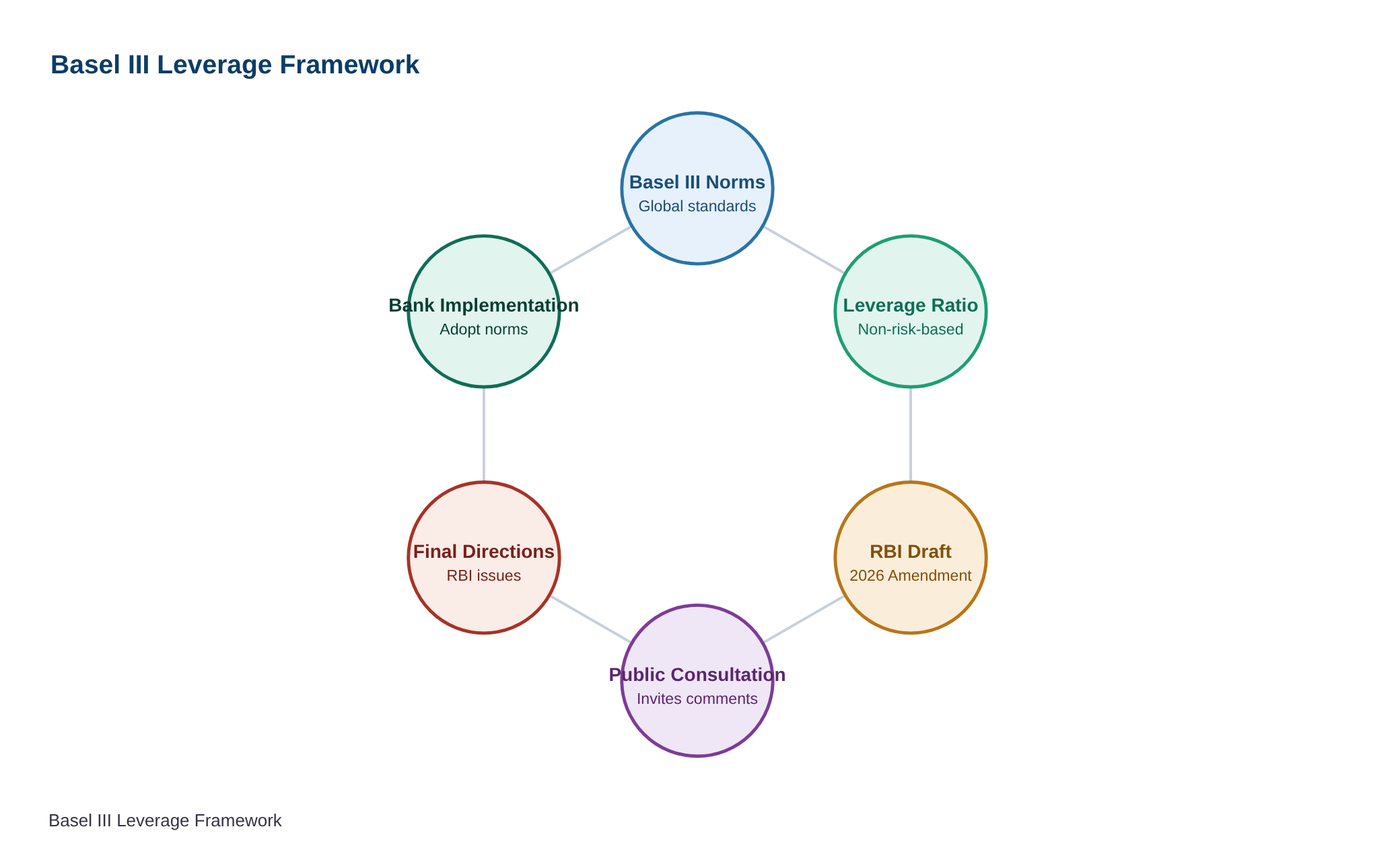
Basel III Norms → Leverage Ratio Framework → RBI’s Draft Amendment → Public Consultation → Final Directions → Implementation by Banks → Enhanced Capital Adequacy → Systemic Stability → Global Financial Standards → Basel Committee on Banking Supervision → ‘Leverage Ratio 2017 Standard’ → RBI Adoption → Alignment with Indian Banking Sector → Reduced Systemic Risks → Capital Adequacy Requirements → Higher Leverage Ratios → Increased Capital Buffers → Reduced Bank Failures → Enhanced Depositor Confidence → Financial Stability → Regulatory Compliance → Public Consultation → Stakeholder Feedback → Policy Refinement → Operational Clarity → Smooth Implementation → Long-Term Stability → Economic Growth → Credit Availability → Lending Constraints → Stricter Capital Norms → Reduced Risk-Weighted Assets → Potential Slowdown in Growth → Technological Integration → Digital Reporting Systems → Real-Time Monitoring → Compliance Assurance → Reduced Operational Risks → Efficient Regulation → Macroeconomic Conditions → Interest Rate Cycles → Fiscal Policies → RBI’s Policy Effectiveness → Adaptive Regulatory Adjustments → Sustainable Stability
Prelims Practice Questions
Q1. Consider the following statements regarding the Leverage Ratio framework in banking regulation:
1. The Leverage Ratio is a non-risk-based measure to supplement risk-based capital requirements.
2. It is designed to constrain the build-up of leverage in the banking sector and provide a safeguard against model risk.
3. The Leverage Ratio is calculated as the ratio of Tier 1 capital to total exposure measure.
4. The framework was first introduced by the Basel Committee on Banking Supervision in 2010.
How many of the above statements are correct?
- Only one
- Only two
- Only three
- All four
Answer: All four — Statements 1, 2, and 3 are correct. Statement 4 is incorrect as the Leverage Ratio framework was introduced in the Basel III framework post-2010, not in 2010 itself.
Q2. Assertion (A): The Reserve Bank of India (RBI) has proposed amendments to the Leverage Ratio framework to align with the Basel Committee on Banking Supervision’s ‘Leverage Ratio 2017 Standard’.
Reason (R): The amendment aims to enhance the risk-weighted capital adequacy norms for commercial banks in India.
Codes:
A. Both A and R are true, and R is the correct explanation of A.
B. Both A and R are true, but R is not the correct explanation of A.
C. A is true, but R is false.
D. A is false, but R is true.
- A
- B
- C
- D
Answer: C — Assertion (A) is true as the RBI has indeed proposed amendments to align with the Basel Committee’s 2017 standard. Reason (R) is also true but is not the correct explanation of (A), as the amendment specifically targets the Leverage Ratio framework, which is a non-risk-based measure, not the risk-weighted capital adequacy norms.
Q3. Match the following terms with their correct descriptions:
Terms:
1. Tier 1 Capital
2. Leverage Ratio
3. Risk-Weighted Assets
4. Basel III
Descriptions:
A. A measure of a bank’s core capital compared to its total assets, excluding risk weights.
B. A global regulatory standard on bank capital adequacy, stress testing, and market liquidity risk.
C. The sum of a bank’s equity capital and disclosed reserves.
D. Assets weighted according to risk to determine the minimum capital requirements.
- 1-C, 2-A, 3-D, 4-B
- 1-D, 2-A, 3-C, 4-B
- 1-B, 2-D, 3-A, 4-C
- 1-C, 2-B, 3-D, 4-A
Answer: 1-C, 2-A, 3-D, 4-B — Correct match: 1-C (Tier 1 Capital is core capital), 2-A (Leverage Ratio is core capital to total assets excluding risk weights), 3-D (Risk-Weighted Assets are assets weighted by risk), 4-B (Basel III is the global regulatory standard).
Mains Practice Question
✍ The Reserve Bank of India (RBI) has proposed amendments to the Leverage Ratio framework for commercial banks, aligning it with the Basel Committee on Banking Supervision’s ‘Leverage Ratio 2017 Standard’. Critically examine the rationale behind this amendment and its implications for India’s banking sector. Also, discuss the role of the Leverage Ratio in ensuring financial stability and its limitations in addressing systemic risks. (15 Marks)
Approach: MODEL-ANSWER SKELETON:
1. **Introduction (2 Marks)**: Define the Leverage Ratio and its purpose as a non-risk-based capital adequacy measure. Briefly introduce the Basel III framework and the role of the RBI in regulating commercial banks.
2. **Rationale for the Amendment (4 Marks)**:
– Alignment with global standards (Basel Committee’s 2017 standard) to enhance comparability and credibility.
– Addressing the build-up of excessive leverage in banks, which was a key lesson from the 2008 financial crisis.
– Supplementing risk-based capital requirements to mitigate model risk and ensure a conservative buffer.
– Enhancing transparency and reducing regulatory arbitrage.
3. **Implications for India’s Banking Sector (4 Marks)**:
– Impact on capital planning and profitability of banks, particularly public sector banks with higher leverage.
– Potential reduction in systemic risk by constraining excessive credit growth.
– Challenges in implementation, including the need for robust data systems and compliance mechanisms.
– Differential impact on banks with varying asset compositions (e.g., retail vs. corporate lending).
4. **Role in Financial Stability (3 Marks)**:
– Acts as a safeguard against excessive leverage, which can amplify financial cycles.
– Provides a simple, transparent metric to monitor bank health independent of risk models.
– Complements risk-weighted capital ratios by addressing the limitations of risk-based measures (e.g., underestimation of risk in complex instruments).
5. **Limitations and Criticisms (2 Marks)**:
– Does not account for asset quality or liquidity risks, which are critical for financial stability.
– May incentivize banks to shift towards riskier assets to meet leverage ratio targets.
– Limited effectiveness in addressing shadow banking or non-bank financial institutions.
6. **Conclusion (1 Mark)**: Summarize the need for a balanced approach that integrates the Leverage Ratio with other prudential norms to ensure holistic financial stability.
Source: RBI
Generated by AanyaAi for educational purpose.

- तमिलनाडु के लिए क्या है ‘एल नीनो’ और उत्तर-पूर्वी मानसून का खतरा? - September 23, 2026
- El Nino & Northeast Monsoon: Impact on Tamil Nadu for UPSC 2026 - September 23, 2026
- हिमाचल में डिजिटल भुगतान क्रांति: बिलासपुर अव्वल, महिलाओं की भागीदारी 93% तक पहुंची - September 23, 2026

No Comments