


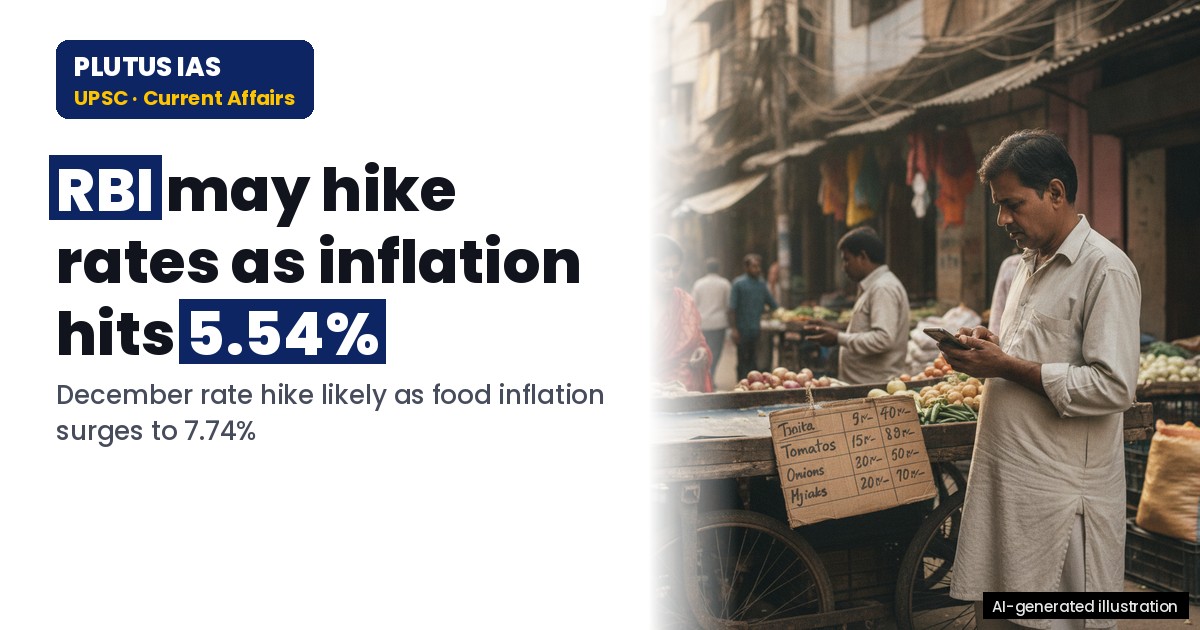
14 Oct RBI Rate Hike Looms as Inflation Hits 5.54% in September
✎ The Monetary Policy Committee (MPC) of the RBI uses the repo rate as its primary tool to anchor inflation expectations, with the Consumer Price Index (CPI) serving as the key metric for policy decisions under the flexible…
Subject Relevance — Where This Topic Fits
- GS Paper III — Indian Economy: Issues Relating to Planning, Mobilization of Resources, Growth, Development and Employment | GS Paper III — Effects of Liberalization on the Economy, Changes in Industrial Policy and their Effects on Industrial Growth
- Prelims: Consumer Price Index (CPI), Monetary Policy Committee (MPC), Repo Rate, Core Inflation, Food Inflation, Wholesale Price Index (WPI), Base Effect, Fiscal Policy, Monetary Policy Transmission, Supply-side Inflation, Demand-side Inflation
- Essay: Inflation and Economic Stability: Balancing Growth and Price Control, The Role of Monetary Policy in Managing Macroeconomic Stability
Quick Revision: The Monetary Policy Committee (MPC) of the RBI uses the repo rate as its primary tool to anchor inflation expectations, with the Consumer Price Index (CPI) serving as the key metric for policy decisions under the flexible inflation targeting framework.
Why is this in the news?
India’s retail inflation, measured by the Consumer Price Index (CPI), rose to 5.54% in September 2026 from 4.83% in August, driven primarily by a sharp increase in food prices to 7.74%. This uptick, coupled with elevated global crude oil prices and rising core inflation, has heightened concerns about the persistence of inflationary pressures. The trajectory of inflation, particularly its second-round effects on non-food categories, has intensified the debate on whether the Reserve Bank of India’s Monetary Policy Committee (MPC) will opt for a rate hike in its December 2026 policy review to anchor inflation expectations and safeguard macroeconomic stability.
Background
- The Consumer Price Index (CPI) is the primary measure of retail inflation in India, used by the Reserve Bank of India (RBI) as the key anchor for its monetary policy decisions under the flexible inflation targeting framework (target range: 2%–6%).
- The Monetary Policy Committee (MPC), constituted under the RBI Act, 1934, meets bi-monthly to decide on policy rates (Repo Rate, Reverse Repo Rate, etc.) based on an assessment of inflation and growth dynamics.
- Food inflation in India is highly volatile due to supply-side constraints such as monsoon variability, agricultural productivity, and logistical bottlenecks, often leading to episodic price surges in essential commodities.
- Global crude oil prices, a key determinant of domestic fuel and transportation costs, have remained elevated in 2026, with the Indian crude oil basket priced at $125.7 per barrel as of October 12, 2026, contributing to cost-push inflation.
- The RBI’s monetary policy stance in recent years has oscillated between accommodative and neutral phases, balancing growth revival post-pandemic with the need to curb inflationary pressures.
- Core inflation, which excludes volatile food and fuel items, stood at 4.3% in September 2026, indicating the broadening of inflationary pressures beyond food items.
What is Inflation and How Does It Impact the Economy?
- Inflation refers to the sustained increase in the general price level of goods and services in an economy over a period of time, eroding the purchasing power of money.
- In India, inflation is primarily measured using the Consumer Price Index (CPI), which tracks changes in the prices of a basket of goods and services consumed by households, including food, fuel, and housing.
- Inflation can be demand-driven (excess aggregate demand over supply) or supply-driven (disruptions in production, supply chains, or external shocks like rising fuel prices).
- The Reserve Bank of India (RBI) uses monetary policy tools—primarily the repo rate—to influence inflation by managing liquidity in the economy and influencing borrowing costs.
- A high inflation environment disproportionately affects vulnerable sections of society, including low-income households, by increasing the cost of essential goods and reducing real incomes.
- Persistent inflation can lead to second-round effects, where higher input costs are passed on to consumers, creating a wage-price spiral and further entrenching inflationary pressures.
- The RBI’s Monetary Policy Committee (MPC) operates under the flexible inflation targeting framework, aiming to keep inflation within a target range of 2%–6% while supporting economic growth.
- Supply-side inflation, such as food price spikes due to monsoon failures or geopolitical disruptions in oil markets, is particularly challenging for monetary policy, as it requires coordinated fiscal and structural interventions.
Key Features
| Feature | Significance |
|---|---|
| Headline CPI Inflation (5.54% in September 2026) | Exceeds the Reserve Bank of India’s (RBI) upper tolerance threshold of 6%, indicating persistent demand-pull and supply-side pressures. |
| Food Inflation (7.74% in September 2026) | Driven by perishable items (onions, ginger, garlic, lemon) and structural supply constraints, amplifying rural distress and household budgetary strain. |
| Core Inflation (4.3% in September 2026) | Excludes volatile food and fuel components, reflecting sustained second-round effects from input cost inflation across manufacturing and services. |
| International Crude Oil Prices ($125.7/barrel) | Elevated global energy costs transmit directly to domestic inflation via fuel subsidies, logistics, and industrial inputs, compounding fiscal pressures. |
| Monetary Policy Committee (MPC) Outlook | Forward guidance on policy rates hinges on inflation trajectory; a potential rate hike (25–50 basis points) aims to anchor inflation expectations and stabilise the currency. |
Why it Matters
Macroeconomic Stability
- Persistent inflation above the 4% target risks de-anchoring inflation expectations, undermining purchasing power and long-term growth prospects.
- A rate hike could tighten financial conditions, reduce aggregate demand, and mitigate imported inflation via currency appreciation.
- The RBI’s credibility in inflation targeting is tested, with implications for sovereign bond yields and foreign portfolio inflows.
Agricultural Supply-side Constraints
- Erratic monsoon patterns (weak rainfall) and elevated temperatures reduce rabi crop output, exacerbating food price volatility.
- Supply chain disruptions for perishable goods (e.g., onions) highlight the need for storage infrastructure and market reforms.
- Climate-induced agricultural shocks amplify rural-urban inequality and food security risks.
Fiscal-Monetary Policy Interface
- Subsidies on fuel and food (implicit or explicit) strain fiscal resources, creating a trade-off between inflation control and social welfare spending.
- Higher policy rates increase the government’s borrowing costs, complicating debt sustainability in a high-deficit environment.
- The RBI’s surplus transfer to the government (dividend) may decline, reducing fiscal space for countercyclical measures.
Global Inflation Spillovers
- Elevated international food and energy prices reflect geopolitical risks (e.g., supply chain disruptions, export restrictions) and global demand dynamics.
- A stronger US dollar (linked to Fed policy) could exacerbate imported inflation in emerging markets like India via trade channels.
- Commodity price volatility necessitates diversified import sourcing and strategic reserves to buffer domestic supply.
Challenges
1. Supply-Side Inflation Management
- Structural bottlenecks in agriculture (e.g., fragmented landholdings, inadequate storage) limit supply elasticity.
- Climate change-induced erratic weather patterns increase the frequency of crop failures and price spikes.
- Policy interventions (e.g., export bans, stock limits) risk distorting markets and discouraging private investment.
UPSC Link: Economic Survey: Agricultural Marketing Reforms
2. Balancing Growth and Inflation
- A premature rate hike could stifle nascent economic recovery, particularly in labour-intensive sectors like MSMEs and exports.
- Persistent inflation erodes real wages, disproportionately affecting low-income households and informal workers.
- Fiscal consolidation (e.g., subsidy rationalisation) may face political economy constraints, delaying structural reforms.
UPSC Link: FRBM Act: Fiscal Consolidation Path
3. Global Energy Price Volatility
- Dependence on crude oil imports exposes India to geopolitical risks and currency depreciation pressures.
- Limited fiscal headroom to cushion fuel price shocks without compromising other developmental expenditures.
- Transition to renewables is constrained by high upfront costs and grid integration challenges.
UPSC Link: NITI Aayog: Energy Transition Strategy
4. Monetary Policy Transmission
- Lagged effects of rate hikes may not immediately curb inflation, raising the risk of overtightening and growth sacrifice.
- Credit channel distortions (e.g., high bank NPAs) weaken the transmission of monetary policy to the real economy.
- Global financial conditions (e.g., US Fed policy) may limit the RBI’s room for manoeuvre.
UPSC Link: RBI Annual Report: Monetary Policy Framework
5. Food Price Management
- Price stabilisation funds (PSF) and minimum support prices (MSP) require alignment with market realities to avoid distortions.
- Public Distribution System (PDS) reforms (e.g., DBT, digitisation) can improve targeting but face implementation challenges.
- Investment in agricultural R&D and post-harvest infrastructure remains suboptimal.
UPSC Link: National Food Security Act: Implementation Challenges
Challenges — UPSC Perspective
| Issue | Concern |
|---|---|
| Erratic Monsoon Patterns | Reduced rabi crop output and elevated food inflation due to climate variability. |
| Perishable Commodity Supply Chains | High wastage and price volatility in items like onions, ginger, and garlic. |
| Fiscal Burden of Subsidies | Strain on government finances from fuel and food subsidies amid high inflation. |
| Global Crude Oil Prices | Transmission of international price shocks to domestic inflation via fuel costs. |
| MPC Credibility in Inflation Targeting | Risk of de-anchoring inflation expectations if policy response is perceived as inadequate. |
| Rural-Urban Inflation Divergence | Higher food price inflation disproportionately impacts rural households with lower disposable incomes. |
Way Forward
- Constitute a high-level inter-ministerial task force to address supply-side bottlenecks in agriculture, focusing on storage, logistics, and market integration.
- Accelerate implementation of the PM-KISAN scheme’s direct benefit transfers (DBT) to enhance rural purchasing power without fuelling inflation.
- Expand the Strategic Petroleum Reserves (SPR) capacity to buffer against global crude oil price volatility.
- Rationalise fuel subsidies through targeted cash transfers, linking them to inflation-adjusted thresholds.
- Enhance the Public Distribution System (PDS) with real-time digitisation and Aadhaar-based authentication to improve targeting efficiency.
- Strengthen climate-resilient agriculture through investment in drought-resistant crop varieties and micro-irrigation (e.g., PM-KUSUM).
- Review the Monetary Policy Committee’s (MPC) forward guidance to ensure transparency and credibility in inflation targeting.
- Promote alternative energy sources (e.g., ethanol blending, solar pumps) to reduce import dependence on crude oil.
UPSC Value Addition
Keywords for Mains Answer-Writing
Monetary Policy Framework · Monetary Policy Committee (MPC) · Consumer Price Index (CPI) inflation · Repo Rate · Core Inflation · Food Inflation · Rabi Crops · Supply-side Inflation · Transmission Mechanism · Inflation Targeting · Central Bank Independence · Demand-pull vs Cost-push Inflation · RBI Act, 1934 · Flexible Inflation Targeting · Output Gap · Inflation Expectations · WPI vs CPI · Monetary Policy Transmission · Inflation Control Measures · Global Commodity Prices
Concept Flow
Erratic monsoon patterns and elevated temperatures → Reduced rabi crop output → Supply constraints in perishable commodities (onions, ginger, garlic) → Surge in food inflation (7.74%) → Upward pressure on headline CPI (5.54%) → Global crude oil prices ($125.7/barrel) → Higher fuel costs → Increased logistics and production expenses → Core inflation rises (4.3%) → Second-round inflation effects across manufacturing and services → Persistent inflation above RBI’s 4% target → De-anchoring of inflation expectations → Risk of wage-price spiral → MPC considers rate hike (25–50 basis points) to anchor expectations → Rate hike → Tighter financial conditions → Reduced aggregate demand → Potential slowdown in GDP growth → Trade-off between inflation control and economic recovery → Fiscal subsidies on fuel and food → Higher government expenditure → Strain on fiscal deficit → Reduced fiscal space for developmental spending → Compromised debt sustainability
Prelims Practice Questions
Q1. Consider the following statements regarding the Monetary Policy Committee (MPC) in India:
1. The MPC is a statutory body established under the Reserve Bank of India Act, 1934.
2. The MPC consists of six members, including three external members appointed by the Government of India.
3. The MPC is chaired by the Governor of the Reserve Bank of India.
4. The primary objective of the MPC is to maintain price stability while keeping in mind the objective of growth.
How many of the above statements are correct?
- Only one
- Only two
- Only three
- All
Answer: All — Statements 1, 2, 3, and 4 are all correct. The MPC is indeed a statutory body under the RBI Act, 1934; it has six members with three external members; it is chaired by the RBI Governor; and its objective includes maintaining price stability alongside growth.
Q2. Assertion (A): The Consumer Price Index (CPI) is the primary measure of inflation in India for monetary policy purposes.
Reason (R): The Reserve Bank of India (RBI) uses CPI inflation as the nominal anchor for its flexible inflation targeting framework.
Options:
A. Both A and R are true, and R is the correct explanation of A.
B. Both A and R are true, but R is not the correct explanation of A.
C. A is true, but R is false.
D. A is false, but R is true.
Answer: ? — Both Assertion (A) and Reason (R) are true. The CPI is indeed the primary measure of inflation used by the RBI for its flexible inflation targeting framework, making R the correct explanation for A.
Q3. Match the following inflation-related terms with their correct definitions:
Column I
1. Core Inflation
2. Food Inflation
3. Supply-side Inflation
4. Demand-pull Inflation
Column II
A. Inflation driven by rising demand exceeding supply.
B. Inflation excluding volatile food and fuel prices.
C. Inflation resulting from disruptions in production or supply chains.
D. Inflation driven by rising prices of food items.
- 1-B, 2-D, 3-C, 4-A
- 1-A, 2-B, 3-C, 4-D
- 1-C, 2-A, 3-D, 4-B
- 1-D, 2-C, 3-B, 4-A
Answer: 1-B, 2-D, 3-C, 4-A — The correct match is: 1-B (Core Inflation excludes volatile food and fuel prices), 2-D (Food Inflation is driven by rising food prices), 3-C (Supply-side Inflation results from production or supply disruptions), and 4-A (Demand-pull Inflation occurs when demand exceeds supply).
Mains Practice Question
✍ The persistence of elevated food inflation in India, driven by supply-side constraints and global commodity price trends, raises critical questions about the efficacy of the flexible inflation targeting regime. Critically examine the challenges posed by food inflation to the monetary policy framework in India, with reference to the role of the Monetary Policy Committee (MPC). Also, outline the structural measures required to mitigate supply-side inflationary pressures. (15 Marks)
Approach: MODEL-ANSWER SKELETON:
1. **Context and Data**: Begin with the recent CPI inflation print (5.54% in September 2026, food inflation at 7.74%) and the drivers (onions, ginger, garlic, lemon, weak monsoon, elevated temperatures). Highlight the global context (FAO Food Price Index, crude oil at $125.7/barrel).
2. **Monetary Policy Framework**:
– Define the flexible inflation targeting regime under the RBI Act, 1934, and the MPC’s mandate (CPI inflation target of 4% ± 2%).
– Explain the limitations of monetary policy in addressing supply-side inflation (e.g., food inflation) due to its demand-management nature.
– Discuss the transmission lag of repo rate changes to CPI inflation, especially for food items.
3. **Challenges Posed by Food Inflation**:
– Supply-side constraints: Erratic monsoon, low soil moisture, rabi crop concerns, and global commodity price shocks.
– Structural issues: Agricultural supply chain inefficiencies, post-harvest losses, and price volatility.
– Inflation expectations: Persistent food inflation can de-anchor expectations, complicating MPC’s task.
4. **Role of MPC**:
– MPC’s dilemma: Balancing growth and inflation, especially when food inflation is supply-driven.
– Forward guidance and communication: How MPC manages expectations in a high-inflation environment.
– International spillovers: Impact of global crude oil and food prices on domestic inflation.
5. **Structural Measures to Mitigate Supply-Side Inflation**:
– Agricultural reforms: Enhancing irrigation, crop diversification, and agricultural R&D.
– Supply chain improvements: Investments in cold storage, logistics, and market integration.
– Price stabilization measures: Buffer stocks, futures trading, and minimum support prices (MSP) reforms.
– Policy coordination: Role of the Ministry of Agriculture and state governments in addressing supply-side bottlenecks.
6. **Conclusion**:
– Reiterate the need for a multi-pronged approach combining monetary policy (MPC’s calibrated response) and structural reforms.
– Emphasize that while the MPC can manage demand-side inflation, supply-side inflation requires coordinated fiscal and structural interventions.
Source: The Indian Express
Generated by AanyaAi for educational purpose.
Related guides on our sites
- Best economics optional coaching for upsc
- Best economics optional teacher for upsc
- How to prepare for GS paper 1 for UPSC CSE mains exam
- Best UPSC coaching for IFOS exam

- सीएक्यूएम ने दिल्ली में धूल प्रदूषण नियंत्रण के लिए उठाए कदम, एमसीडी को मिले निर्देश - October 22, 2026
- India-Australia AUSTRAHIND 2026 Exercise: Key Highlights for UPSC & State PCS - October 22, 2026
- एससीओ बैठक में भारत का आतंकवाद विरोध: क्षेत्रीय सहयोग पर जोर - October 22, 2026

No Comments