


06 Aug RBI seeks feedback on NBFC Credit Facilities Amendment Directions 2026
✎ The RBI's draft amendment directions on NBFC credit facilities signify an ongoing effort to strengthen the regulatory oversight of non-banking financial institutions, ensuring their stability and responsible credit practices…
Subject Relevance — Where This Topic Fits
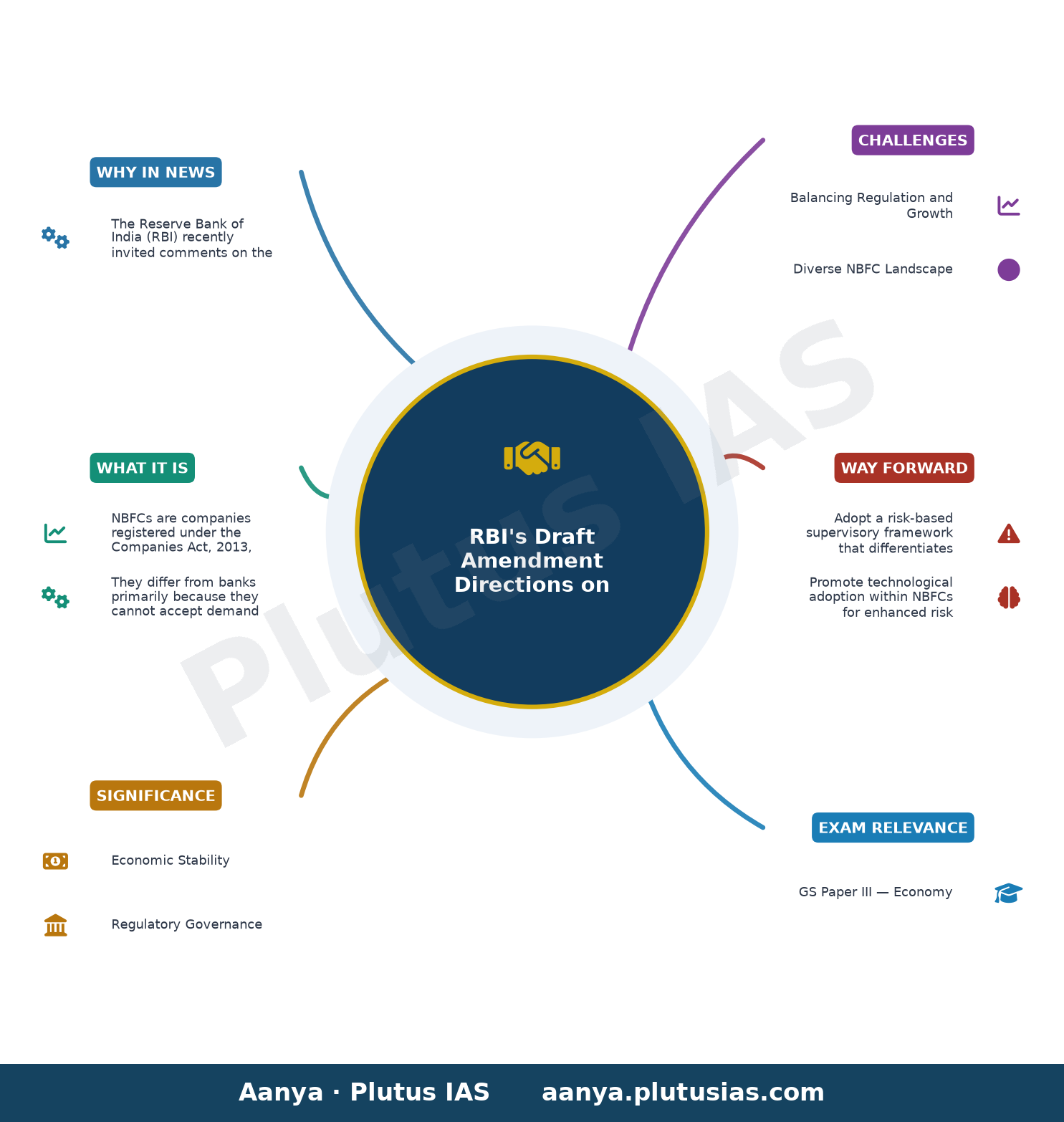
- GS Paper III — Economy
- Prelims: Reserve Bank of India (RBI), Non-Banking Financial Companies (NBFCs), Credit Facilities, Financial Regulation, Monetary Policy, Financial Stability
- Essay: The evolving landscape of financial regulation in India: Balancing innovation with stability., Non-Banking Financial Companies as crucial intermediaries in India’s financial ecosystem.
Quick Revision: The RBI’s draft amendment directions on NBFC credit facilities signify an ongoing effort to strengthen the regulatory oversight of non-banking financial institutions, ensuring their stability and responsible credit practices within the Indian economy.
Why is this in the news?
The Reserve Bank of India (RBI) recently invited comments on the draft “Reserve Bank of India (Non-Banking Financial Companies – Credit Facilities) Amendment Directions, 2026”. This initiative underscores the RBI’s continuous commitment to refining the regulatory framework governing Non-Banking Financial Companies (NBFCs), particularly concerning their credit operations, to ensure financial stability and consumer protection within the dynamic Indian financial sector. The invitation for feedback from regulated entities and other stakeholders highlights a consultative approach to policy formulation.
Background
- The Reserve Bank of India (RBI) is the central bank of India, established in 1935 under the Reserve Bank of India Act, 1934. It is responsible for regulating the monetary policy and financial system of the country.
- Non-Banking Financial Companies (NBFCs) are financial institutions that do not hold a banking license but engage in financial activities such as lending, investment, and other financial services. They play a crucial role in financial inclusion and credit dissemination, particularly to segments underserved by traditional banks.
- The RBI regulates NBFCs under the Reserve Bank of India Act, 1934, and issues various directions and guidelines to ensure their sound functioning, protect depositors’ interests, and maintain financial stability.
- The regulatory framework for NBFCs has undergone significant evolution, adapting to changes in the financial landscape, technological advancements, and emerging risks. This includes norms related to capital adequacy, asset classification, provisioning, and corporate governance.
- The issuance of draft directions for public comments is a standard practice by the RBI, promoting transparency and allowing stakeholders to provide valuable input before finalisation of regulatory changes.
What are Non-Banking Financial Companies (NBFCs)?
- NBFCs are companies registered under the Companies Act, 2013, engaged in the business of loans and advances, acquisition of shares/stocks/bonds/debentures/securities issued by government or local authority or other marketable securities of a like nature, leasing, hire-purchase, insurance business, chit business.
- They differ from banks primarily because they cannot accept demand deposits, do not form part of the payment and settlement system, and cannot issue cheques drawn on themselves.
- NBFCs are categorised based on their liability structure (deposit-taking vs. non-deposit-taking) and the nature of their activity (e.g., Asset Finance Company, Investment Company, Loan Company, Infrastructure Finance Company).
- The regulatory oversight by the RBI aims to ensure that NBFCs operate prudently, maintain adequate capital, manage risks effectively, and contribute positively to the financial system without posing systemic risks.
- NBFCs are crucial for providing credit to various sectors, including micro, small, and medium enterprises (MSMEs), infrastructure projects, and individuals, thereby complementing the role of commercial banks.
- The regulatory framework for NBFCs includes provisions for registration, capital requirements, prudential norms, fair practices code, and corporate governance standards.
Key Features
| Feature | Significance |
|---|---|
| Draft Amendment Directions | Indicates a proactive regulatory stance by the Reserve Bank of India (RBI) to adapt the regulatory framework governing Non-Banking Financial Companies (NBFCs). |
| Focus on Credit Facilities | Suggests potential modifications to norms related to lending operations, capital adequacy, asset classification, or provisioning for NBFCs, impacting their operational landscape and risk management. |
| Invitation for Comments | Highlights the consultative approach adopted by the RBI, soliciting feedback from regulated entities and other stakeholders to ensure comprehensive and effective policy formulation. |
| Regulated Entities and Stakeholders | Encompasses NBFCs, banks, industry associations, financial experts, and potentially consumer groups, whose input is crucial for robust regulatory outcomes. |
| Submission Channels (Connect 2 Regulate, Email) | Demonstrates the RBI’s commitment to facilitating accessible and efficient mechanisms for stakeholder engagement in the policy-making process. |
Why it Matters
Economic Stability
- Strengthening the regulatory framework for NBFCs is crucial for maintaining financial stability, given their increasing interconnectedness with the broader financial system.
- Effective regulation of credit facilities can mitigate systemic risks associated with potential defaults or liquidity crises within the NBFC sector.
Regulatory Governance
- The consultative process enhances transparency and accountability in regulatory policy formulation, aligning with principles of good governance.
- Regular amendments ensure that regulations remain relevant and responsive to evolving market dynamics, technological advancements, and emerging risks in the financial sector.
Financial Inclusion
- NBFCs play a significant role in extending credit to underserved segments and sectors, contributing to financial inclusion.
- Balanced regulations can foster responsible lending practices while ensuring that NBFCs continue to support economic growth and access to finance.
Investor Confidence
- A robust and adaptive regulatory environment instills confidence among domestic and international investors in the Indian financial market.
- Clarity in credit facility norms can improve risk assessment and pricing for NBFCs, attracting capital and facilitating their growth.
Challenges
1. Balancing Regulation and Growth
- The challenge lies in formulating regulations that safeguard financial stability without unduly stifling the growth and innovation potential of NBFCs.
- Overly stringent norms could restrict credit flow, particularly to micro, small, and medium enterprises (MSMEs) and retail borrowers, which are key segments for NBFCs.
UPSC Link: Indian Economy and issues relating to planning, mobilization of resources, growth, development and employment.
2. Diverse NBFC Landscape
- NBFCs comprise a heterogeneous group with varying business models, asset sizes, and risk profiles, making a ‘one-size-fits-all’ regulatory approach challenging.
- Tailoring regulations to address specific risks of different NBFC categories (e.g., microfinance institutions, infrastructure finance companies) requires nuanced policy-making.
UPSC Link: Government policies and interventions for development in various sectors.
3. Implementation and Compliance
- Ensuring effective implementation and compliance across the vast and diverse NBFC sector can be resource-intensive for both regulators and regulated entities.
- Potential for regulatory arbitrage or unintended consequences if the amendments are not clearly articulated and consistently applied.
UPSC Link: Effects of liberalization on the economy, changes in industrial policy and their effects on industrial growth.
Challenges — UPSC Perspective
| Issue | Concern |
|---|---|
| Regulatory Arbitrage | Discrepancies between banking and NBFC regulations could lead entities to exploit loopholes, potentially increasing systemic risk. |
| Impact on Credit Availability | Stricter credit facility norms might inadvertently reduce credit access for certain segments, affecting economic activity. |
| Operational Burden | Increased compliance requirements could impose significant operational and financial burdens on smaller NBFCs. |
| Dynamic Market Conditions | Rapid changes in financial markets and technological advancements necessitate continuous regulatory adaptation, posing a challenge for static rules. |
Way Forward
- Adopt a risk-based supervisory framework that differentiates regulatory requirements based on the size, complexity, and interconnectedness of NBFCs.
- Promote technological adoption within NBFCs for enhanced risk management, data analytics, and compliance reporting.
- Strengthen inter-regulatory coordination with other financial sector regulators to address potential overlaps or gaps in supervision.
- Conduct regular impact assessments of new regulations to evaluate their effectiveness and identify any unintended consequences.
- Foster continuous dialogue with industry stakeholders to gather insights and ensure that regulations are practical and implementable.
- Invest in capacity building for both regulators and regulated entities to effectively understand and implement evolving regulatory standards.
- Emphasize consumer protection mechanisms within the credit facility framework to safeguard borrower interests and promote fair practices.
UPSC Value Addition
Keywords for Mains Answer-Writing
Non-Banking Financial Companies (NBFCs) · Reserve Bank of India (RBI) · Financial Sector Regulation · Credit Facilities · Regulatory Framework · Financial Stability · Monetary Policy · Financial Inclusion · Systemically Important NBFCs · Shadow Banking · Prudential Norms · Regulatory Arbitrage
Concept Flow
RBI identifies potential risks/gaps in NBFC credit facilities. → Draft Amendment Directions are formulated and released for public comment. → Stakeholders submit feedback on the proposed amendments. → RBI reviews feedback and finalizes the Amendment Directions. → New regulations are implemented, impacting NBFC credit operations. → Enhanced regulatory framework contributes to financial stability.
Prelims Practice Questions
Q1. Consider the following statements regarding Non-Banking Financial Companies (NBFCs) in India:
1. NBFCs are regulated by the Reserve Bank of India.
2. NBFCs can accept demand deposits similar to commercial banks.
3. NBFCs are part of the payment and settlement system and can issue cheques drawn on themselves.
How many of the above statements are correct?
- Only one
- Only two
- Only three
- None
Answer: Only one — Statement 1 is correct: NBFCs are regulated by the RBI under the RBI Act, 1934. Statement 2 is incorrect: NBFCs cannot accept demand deposits; they can only accept time deposits. Statement 3 is incorrect: NBFCs are not part of the payment and settlement system and cannot issue cheques drawn on themselves.
Q2. Which of the following is a primary objective of the Reserve Bank of India’s regulatory oversight over Non-Banking Financial Companies (NBFCs)?
- To ensure NBFCs primarily focus on rural credit.
- To prevent regulatory arbitrage and maintain financial stability.
- To enable NBFCs to compete directly with public sector banks.
- To facilitate NBFCs in providing unlimited credit to all sectors.
Answer: To prevent regulatory arbitrage and maintain financial stability. — The RBI’s primary objective in regulating NBFCs is to maintain financial stability, protect depositor interests, and prevent regulatory arbitrage by ensuring a level playing field and mitigating systemic risks.
Mains Practice Question
✍ Examine the significance of Non-Banking Financial Companies (NBFCs) in the Indian financial system. Discuss the rationale behind the Reserve Bank of India’s continuous efforts to refine the regulatory framework for NBFCs, with particular reference to ensuring financial stability. (15 Marks)
Approach: MODEL-ANSWER SKELETON:
1. **Introduction:** Define NBFCs, their role as financial intermediaries, and their growing importance in the Indian economy.
2. **Significance of NBFCs:**
* **Financial Inclusion:** Reaching underserved segments (MSMEs, rural population) where traditional banks may have limited presence.
* **Diversification of Credit:** Providing specialized credit products (e.g., infrastructure finance, gold loans, microfinance, vehicle finance).
* **Competition and Efficiency:** Enhancing competition in the financial sector and promoting efficiency.
* **Economic Growth:** Contributing to capital formation and economic activity.
* **Alternative Funding Sources:** Offering diverse funding avenues beyond traditional banking.
3. **Rationale for RBI’s Regulatory Refinement:**
* **Systemic Risk Mitigation:** Addressing potential contagion risks due to interconnectedness with banks and capital markets.
* **Consumer Protection:** Safeguarding interests of depositors and borrowers.
* **Preventing Regulatory Arbitrage:** Harmonizing regulations to prevent exploitation of differences between banking and NBFC frameworks.
* **Maintaining Financial Stability:** Ensuring prudential norms, asset quality, and capital adequacy to prevent financial crises.
* **Shadow Banking Concerns:** Managing risks associated with the ‘shadow banking’ activities of NBFCs.
* **Evolving Business Models:** Adapting regulations to new business models and technological advancements within the NBFC sector.
* **Proportional Regulation:** Implementing a scale-based regulatory approach (e.g., tiered structure for NBFCs based on size, activity, and systemic importance).
4. **Conclusion:** Summarize the dual role of NBFCs as growth drivers and potential sources of risk, emphasizing the RBI’s dynamic regulatory approach to foster a robust and stable financial ecosystem.
Source: RBI
Generated by AanyaAi for educational purpose.

- कर्नाटक में ‘वंदे मातरम’ विवाद: राज्यपाल ने सीएम से आदेश वापस लेने को कहा - September 22, 2026
- Karnataka Governor vs CM: Vande Mataram GO row explained for UPSC - September 22, 2026
- मध्यप्रदेश कैबिनेट का बड़ा फैसला: हर विधानसभा में स्पोर्ट्स कॉम्प्लेक्स, 15 हजार बसें 2030 तक - September 22, 2026

No Comments