


06 Aug RBI Seeks Feedback on NBFC Credit Facilities Draft Directions 2026
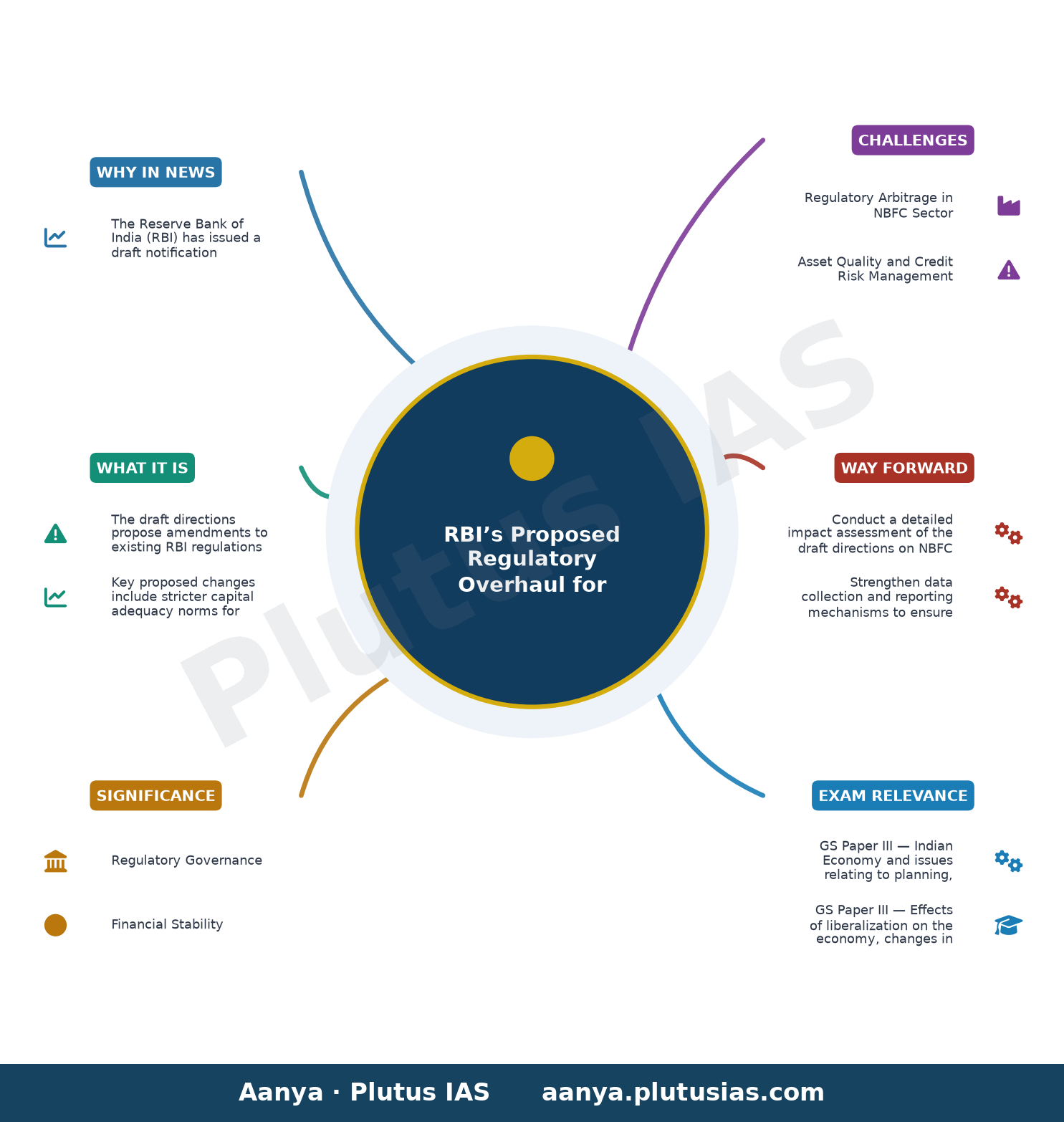
✎ The RBI’s draft directions aim to align NBFC credit norms with Basel III, enhance liquidity buffers, and curb regulatory arbitrage, while inviting stakeholder feedback to refine the regulatory framework.
Subject Relevance — Where This Topic Fits
- GS Paper III — Indian Economy and issues relating to planning, mobilization of resources, growth, development and employment | GS Paper III — Effects of liberalization on the economy, changes in industrial policy and their effects on industrial growth
- Prelims: NBFCs, RBI Directions, Credit Facilities, Financial Stability, Regulatory Arbitrage, Systemically Important NBFCs (SINBFCs), Priority Sector Lending, Credit Risk Management, Basel III Norms
- Essay: Financial sector reforms and their impact on inclusive growth, Balancing innovation and regulation in India’s financial ecosystem
Quick Revision: The RBI’s draft directions aim to align NBFC credit norms with Basel III, enhance liquidity buffers, and curb regulatory arbitrage, while inviting stakeholder feedback to refine the regulatory framework.
Why is this in the news?
The Reserve Bank of India (RBI) has issued a draft notification titled the *Reserve Bank of India (Non-Banking Financial Companies – Credit Facilities) Amendment Directions, 2026*, inviting public comments by August 28, 2026. This regulatory initiative aims to refine the existing framework governing credit facilities extended by Non-Banking Financial Companies (NBFCs), addressing emerging risks in shadow banking while ensuring alignment with broader financial stability objectives. The move reflects RBI’s proactive stance in adapting regulatory norms to evolving financial market dynamics, particularly in the aftermath of global financial shocks and domestic credit market disruptions.
Background
- The NBFC sector has grown significantly in India, contributing over 25% to the country’s financial assets, with total credit outstanding exceeding ₹30 trillion as of FY2025.
- NBFCs play a pivotal role in credit intermediation, especially in underserved segments such as micro, small, and medium enterprises (MSMEs), retail borrowers, and infrastructure financing.
- The RBI has historically regulated NBFCs through a tiered framework, with stricter norms for Systemically Important NBFCs (SINBFCs) to mitigate systemic risks.
- Recent episodes of liquidity stress in the NBFC sector, including the IL&FS crisis (2018) and the DHFL collapse (2019), have underscored the need for robust regulatory oversight.
- The COVID-19 pandemic further exposed vulnerabilities in the NBFC sector, necessitating liquidity support measures such as the Special Liquidity Facility (SLF) and Partial Credit Guarantee Scheme (PCGS).
- Global regulatory trends, including Basel III reforms and the Financial Stability Board’s recommendations, have influenced RBI’s approach to NBFC regulation.
What are the Reserve Bank of India (Non-Banking Financial Companies – Credit Facilities) Amendment Directions, 2026?
- The draft directions propose amendments to existing RBI regulations governing credit facilities extended by NBFCs, aiming to enhance prudential norms, risk management, and disclosure requirements.
- Key proposed changes include stricter capital adequacy norms for NBFCs, particularly those with significant credit exposure to sensitive sectors such as real estate and capital markets.
- The draft directions introduce enhanced liquidity coverage ratio (LCR) and net stable funding ratio (NSFR) requirements for NBFCs, aligning them with Basel III standards.
- Proposed amendments mandate stricter governance frameworks for NBFCs, including board oversight, risk committee composition, and independent audit mechanisms.
- The draft directions seek to curb regulatory arbitrage by harmonizing norms for NBFCs with those applicable to scheduled commercial banks, particularly in areas such as related-party transactions and exposure limits.
- Enhanced disclosure norms are proposed to improve transparency, including detailed reporting on asset quality, provisioning, and off-balance-sheet exposures.
- The directions also address cybersecurity and operational risk management, reflecting the growing digitalization of NBFC operations.
- Public feedback is invited to ensure the final norms balance financial stability with the need to sustain credit growth, particularly in priority sectors.
Key Features
| Feature | Significance |
|---|---|
| Draft Directions on Credit Facilities for NBFCs | Introduces regulatory amendments to govern credit facilities extended by Non-Banking Financial Companies (NBFCs), ensuring alignment with evolving financial stability requirements. |
| Public Consultation Process | Invites feedback from regulated entities and stakeholders by August 28, 2026, via ‘Connect 2 Regulate’ portal or email, ensuring participatory governance in regulatory evolution. |
| Focus on Credit Facilities | Specifically targets the regulatory framework governing credit facilities provided by NBFCs, addressing gaps in existing directions to mitigate systemic risks. |
| Draft Nature of Directions | Presents a draft regulatory instrument, indicating a consultative approach prior to finalisation, allowing stakeholders to influence the final policy outcome. |
| Deadline for Feedback | Stipulates a clear timeline for stakeholder input (August 28, 2026), demonstrating the RBI’s commitment to timely and structured regulatory updates. |
Why it Matters
Regulatory Governance
- Enhances the RBI’s oversight over credit facilities extended by NBFCs, a critical segment of India’s financial ecosystem, thereby strengthening financial stability.
- Demonstrates the RBI’s proactive stance in addressing emerging risks in the NBFC sector through consultative regulatory amendments.
- Ensures that credit facility norms remain dynamic and responsive to macroeconomic and sectoral developments, preventing regulatory lag.
Financial Stability
- Mitigates systemic risks by tightening governance around credit facilities, reducing the likelihood of NBFC defaults and contagion effects.
- Aligns with global best practices in NBFC regulation, particularly in jurisdictions with significant shadow banking sectors.
- Supports the RBI’s broader mandate of maintaining monetary stability and ensuring orderly credit markets.
Stakeholder Engagement
- Fosters transparency and inclusivity in policy formulation by soliciting feedback from regulated entities and other stakeholders.
- Encourages industry participation in regulatory evolution, enhancing compliance and reducing resistance to future directives.
- Provides a structured mechanism for stakeholders to voice concerns and suggest improvements, thereby improving policy effectiveness.
Macroeconomic Impact
- A well-regulated NBFC sector can enhance credit penetration, particularly in underserved segments, without compromising financial stability.
- Prevents excessive leverage in the NBFC sector, which could otherwise lead to asset quality deterioration and financial crises.
- Supports the RBI’s objective of balanced credit growth, aligning with the government’s broader financial inclusion goals.
Challenges
1. Regulatory Arbitrage in NBFC Sector
- NBFCs operate in a regulatory environment that is less stringent than commercial banks, creating opportunities for regulatory arbitrage and excessive risk-taking.
- The absence of harmonised credit facility norms across NBFCs and banks can lead to uneven playing fields and systemic distortions.
- Addressing this challenge requires balancing regulatory strictness with the need to promote financial inclusion and innovation.
UPSC Link: NBFCs and shadow banking risks
2. Asset Quality and Credit Risk Management
- NBFCs are often exposed to higher credit risk due to their focus on segments such as MSMEs and retail borrowers, which are inherently riskier.
- Poor credit risk management in NBFCs can lead to non-performing assets (NPAs), undermining financial stability and investor confidence.
- The draft directions aim to address these risks by imposing stricter norms on credit facilities, but implementation challenges may persist.
UPSC Link: Credit risk and asset quality in NBFCs
3. Systemic Risk Contagion
- The interconnectedness of NBFCs with the broader financial system poses risks of contagion in case of a sector-wide crisis.
- A failure in a large NBFC could trigger liquidity crunches and credit market disruptions, affecting even well-regulated banks.
- The RBI’s draft directions seek to mitigate this by enhancing oversight, but systemic risks require continuous monitoring and adaptive regulation.
UPSC Link: Systemic risk and financial contagion
4. Compliance and Operational Costs
- Stricter regulatory norms on credit facilities may impose additional compliance burdens on NBFCs, increasing operational costs.
- Smaller NBFCs, which lack economies of scale, may face disproportionate challenges in meeting new regulatory requirements.
- Balancing compliance costs with the need for robust regulation is a key challenge for policymakers.
UPSC Link: Regulatory compliance in NBFCs
5. Data Gaps and Monitoring Mechanisms
- The effectiveness of the draft directions depends on the availability of granular data on credit facilities extended by NBFCs.
- Gaps in data collection and monitoring can hinder the RBI’s ability to enforce the new norms effectively.
- Strengthening data infrastructure and reporting mechanisms is essential for the successful implementation of the directions.
UPSC Link: Data gaps in financial sector regulation
Challenges — UPSC Perspective
| Issue | Concern |
|---|---|
| Regulatory Arbitrage | Risk of NBFCs exploiting loopholes in credit facility norms to engage in excessive risk-taking. |
| Asset Quality Deterioration | Potential for NPAs to rise due to inadequate credit risk management in NBFCs. |
| Systemic Contagion | Risk of financial instability spreading from NBFCs to the broader banking system. |
| Compliance Burden | Increased operational costs for NBFCs due to stricter regulatory norms. |
| Data Gaps | Insufficient granular data on credit facilities hindering effective monitoring and enforcement. |
| Innovation vs. Regulation | Balancing the need for innovation in credit products with robust regulatory oversight. |
Way Forward
- Conduct a detailed impact assessment of the draft directions on NBFC operations, particularly for smaller and mid-sized entities.
- Strengthen data collection and reporting mechanisms to ensure granular monitoring of credit facilities extended by NBFCs.
- Enhance stakeholder consultations to address concerns raised by NBFCs regarding compliance costs and operational challenges.
- Develop a phased implementation plan for the draft directions to allow NBFCs adequate time for compliance.
- Collaborate with other financial regulators to harmonise norms across banks and NBFCs, reducing regulatory arbitrage.
- Establish a dedicated grievance redressal mechanism for NBFCs to address implementation challenges and ambiguities.
- Monitor systemic risks in the NBFC sector post-implementation to assess the effectiveness of the new norms.
- Promote financial literacy among borrowers to mitigate credit risk and improve repayment discipline.
UPSC Value Addition
Keywords for Mains Answer-Writing
Non-Banking Financial Companies (NBFCs) · credit facilities · RBI Directions · financial regulation · systemic risk · financial stability · credit growth · regulated entities · financial sector reforms · prudential norms · financial inclusion · monetary policy transmission · financial intermediation · regulatory arbitrage · financial sector governance
Concept Flow
Macroeconomic Context → Growth of NBFC Sector → Regulatory Gaps in Credit Facilities → Systemic Risks → RBI’s Proactive Regulatory Response → Draft Directions on Credit Facilities → Stakeholder Consultation → Finalisation and Implementation → Enhanced Financial Stability
Prelims Practice Questions
Q1. Consider the following statements regarding the Reserve Bank of India (RBI):
1. The RBI is the central bank of India and regulates the banking and financial system.
2. The RBI issues directions to Non-Banking Financial Companies (NBFCs) under the powers conferred by the Reserve Bank of India Act, 1934.
3. The RBI’s regulatory powers over NBFCs are limited to credit disbursement only.
How many of the above statements are correct?
- Only one
- Only two
- All three
- None
Answer: Only two — Statement 1 is correct as the RBI is the central bank of India. Statement 2 is correct because the RBI derives its regulatory powers over NBFCs from the RBI Act, 1934. Statement 3 is incorrect as the RBI regulates NBFCs across multiple facets, including credit disbursement, capital adequacy, and governance.
Q2. Assertion (A): The Reserve Bank of India (RBI) has recently invited public comments on draft directions aimed at amending credit facility norms for Non-Banking Financial Companies (NBFCs).
Reason (R): These amendments are intended to enhance the stability of the financial sector and mitigate systemic risks arising from NBFC operations.
Options:
A) Both A and R are true, and R is the correct explanation of A.
B) Both A and R are true, but R is NOT the correct explanation of A.
C) A is true, but R is false.
D) A is false, but R is true.
Answer: ? — Assertion (A) is true as the RBI has indeed invited comments on draft directions for NBFCs. Reason (R) is also true and correctly explains the purpose of the amendments, which is to enhance financial stability and mitigate systemic risks.
Q3. Match the following regulatory bodies with their primary functions:
Column I (Regulatory Body)
A. Reserve Bank of India (RBI)
B. Securities and Exchange Board of India (SEBI)
C. Insurance Regulatory and Development Authority of India (IRDAI)
D. Pension Fund Regulatory and Development Authority (PFRDA)
Column II (Primary Function)
1. Regulation of insurance sector
2. Regulation of pension funds
3. Regulation of banking and financial sector
4. Regulation of securities market
Options:
A) A-3, B-4, C-1, D-2
B) A-1, B-2, C-3, D-4
C) A-4, B-3, C-2, D-1
D) A-2, B-1, C-4, D-3
Answer: ? — The correct matching is: A (RBI) with 3 (regulation of banking and financial sector), B (SEBI) with 4 (regulation of securities market), C (IRDAI) with 1 (regulation of insurance sector), and D (PFRDA) with 2 (regulation of pension funds).
Mains Practice Question
✍ Critically examine the significance of the Reserve Bank of India’s (RBI) draft directions on credit facilities for Non-Banking Financial Companies (NBFCs) in ensuring financial stability and mitigating systemic risks in India. Also, analyse the potential challenges in their implementation. (15 Marks)
Approach: MODEL-ANSWER SKELETON:
1. **Introduction (2 marks)**: Define NBFCs and their role in India’s financial ecosystem. Highlight the growing importance of NBFCs in credit intermediation and the need for robust regulation.
2. **Rationale for RBI Directions (4 marks)**:
– Discuss the objectives of the draft directions: enhancing prudential norms, addressing regulatory arbitrage, and mitigating systemic risks.
– Explain the RBI’s mandate under the Reserve Bank of India Act, 1934, and the need for proactive regulation in a rapidly evolving financial sector.
– Cite examples of past financial crises (e.g., IL&FS crisis, 2018) where inadequate oversight of NBFCs contributed to systemic risks.
3. **Impact on Financial Stability (4 marks)**:
– Analyse how the directions may curb excessive leverage, improve asset quality, and enhance transparency in NBFC operations.
– Discuss the role of credit growth in financial inclusion and the potential trade-off between stricter norms and credit expansion.
– Reference RBI’s Financial Stability Reports and data on NBFC credit growth to substantiate the argument.
4. **Challenges in Implementation (3 marks)**:
– Highlight operational challenges for NBFCs, including compliance costs, liquidity constraints, and access to funding.
– Discuss the risk of regulatory arbitrage where unregulated entities may exploit loopholes.
– Examine the role of governance and risk management frameworks in ensuring effective compliance.
5. **Conclusion (2 marks)**: Summarise the need for balanced regulation that promotes stability without stifling innovation. Emphasise the RBI’s role as a regulator in maintaining macroeconomic stability.
Source: RBI
Generated by AanyaAi for educational purpose.

- कर्नाटक में ‘वंदे मातरम’ विवाद: राज्यपाल ने सीएम से आदेश वापस लेने को कहा - September 22, 2026
- Karnataka Governor vs CM: Vande Mataram GO row explained for UPSC - September 22, 2026
- मध्यप्रदेश कैबिनेट का बड़ा फैसला: हर विधानसभा में स्पोर्ट्स कॉम्प्लेक्स, 15 हजार बसें 2030 तक - September 22, 2026

No Comments