


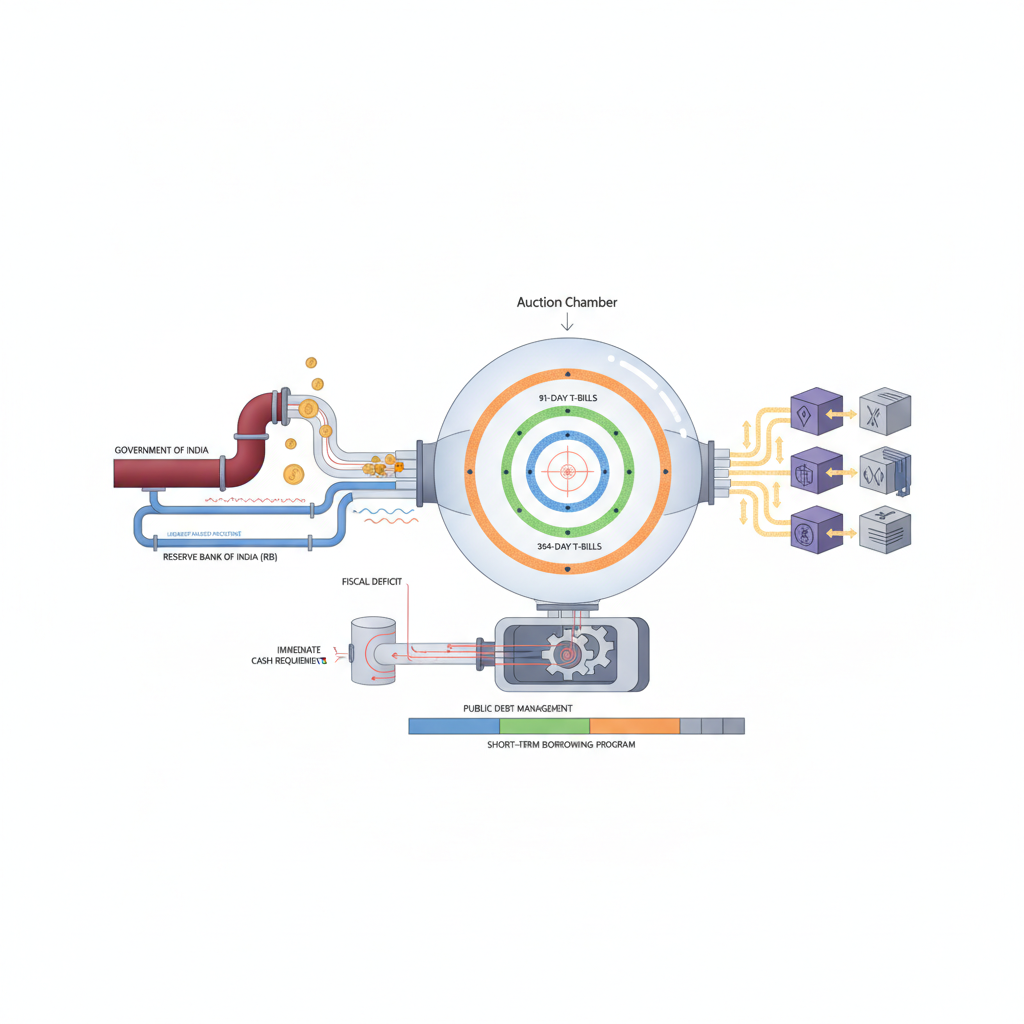
15 Aug RBI to Auction ₹24,000 Crore Treasury Bills: Key Details for UPSC & PCS Aspirants
Treasury BillsFace ValueAuction AmountRedemption Value✎ Treasury Bills are short-term, zero-coupon government securities issued at a discount and redeemed at face value, with maturities of 91, 182, or 364 days, and are auctioned by the RBI to manage public debt and ensure liquidity.
Subject Relevance — Where This Topic Fits
- GS Paper III — Indian Economy: Issues relating to planning, mobilization of resources, growth, development and employment
- Prelims: Treasury Bills (T-Bills), Public Debt Office, RBI Core Banking Solution (E-Kuber), Retail Direct Portal, Non-competitive bidding, Multiple Price Auction, Government Securities (G-Secs), Public Debt Management
- Essay: Role of the Reserve Bank of India in public debt management, Financial inclusion through retail participation in government securities
Quick Revision: Treasury Bills are short-term, zero-coupon government securities issued at a discount and redeemed at face value, with maturities of 91, 182, or 364 days, and are auctioned by the RBI to manage public debt and ensure liquidity.
Why is this in the news?
The Reserve Bank of India (RBI) has announced the auction of 91-day, 182-day, and 364-day Treasury Bills (T-Bills) for a total notified amount of ₹24,000 crore on August 19, 2026. This issuance is part of the Government of India’s short-term borrowing program and reflects the ongoing process of public debt management, liquidity adjustment, and market-based pricing of sovereign securities.
Background
- Treasury Bills are short-term government securities issued by the Government of India to meet its immediate cash requirements and manage the fiscal deficit.
- T-Bills are issued at a discount to their face value and redeemed at par, with the difference representing the interest earned by investors.
- The RBI conducts auctions for T-Bills on behalf of the Government of India, following the framework laid down in the General Notification F.No.4(2)-B(W&M)/2018 dated March 26, 2025, as amended.
- T-Bills are zero-coupon instruments, meaning they do not pay periodic interest but are issued at a discount and mature at face value.
- The auction process ensures transparent price discovery and efficient allocation of government securities to a diverse set of investors.
What are Treasury Bills?
- Treasury Bills (T-Bills) are short-term debt instruments issued by the Government of India with maturities of 91 days, 182 days, and 364 days.
- They are issued at a discount to their face value and redeemed at par, with the difference constituting the return to the investor.
- T-Bills are zero-coupon securities, meaning they do not carry any periodic interest payments.
- The Government of India issues T-Bills to meet its short-term funding requirements and manage liquidity in the financial system.
- T-Bills are issued through auctions conducted by the RBI, which ensures a competitive and transparent pricing mechanism.
- Investors in T-Bills include banks, financial institutions, provident funds, state governments, foreign central banks, and retail investors.
- T-Bills are highly liquid instruments and are considered risk-free as they are backed by the sovereign guarantee of the Government of India.
- The auction process for T-Bills follows either a multiple price method (where successful bidders pay the price they bid) or a uniform price method (where all successful bidders pay the same price).
Key Features
| Feature | Significance |
|---|---|
| Notified Amount (₹24,000 crore) | Demonstrates the Government of India’s borrowing requirement for short-term liquidity management and fiscal deficit financing. |
| Auction Date: 19 August 2026 | Aligns with the RBI’s regular schedule for Treasury Bill issuances, ensuring predictable market access for Government securities. |
| Settlement Date: 20 August 2026 | Ensures timely credit to the Government’s account for meeting immediate expenditure obligations. |
| Non-Competitive Bidding (5% cap for retail investors) | Enhances retail participation in Government securities, promoting financial inclusion and savings mobilization. |
| Price-Based Auction with Multiple Price Method | Allows market-determined pricing, reflecting demand-supply dynamics and risk perceptions of short-term Government debt. |
| E-Kuber System for Electronic Bidding | Facilitates seamless, transparent, and efficient auction process with real-time submission and settlement. |
| Retail Direct Portal Integration | Provides a user-friendly platform for individual investors to participate directly in Government securities markets. |
Why it Matters
Monetary Policy Transmission
- Short-term Treasury Bills serve as a benchmark for interbank lending rates, influencing the broader interest rate structure in the economy.
- Auction outcomes provide signals on liquidity conditions and market expectations of monetary policy stance.
- Helps the RBI in managing liquidity through Open Market Operations (OMOs) and fine-tuning operations.
Fiscal Management
- Enables the Government to meet its short-term cash flow requirements without resorting to long-term borrowing, optimizing debt maturity profile.
- Reduces reliance on Ways and Means Advances (WMA) from the RBI, thereby maintaining fiscal discipline.
- Provides a cost-effective source of funding for the Government, given the relatively lower interest rates on short-term debt compared to longer tenors.
Market Development
- Strengthens the Government securities market, which is the backbone of India’s debt market ecosystem.
- Encourages participation from diverse investor classes, including retail investors, enhancing market depth and resilience.
- Serves as a reference for pricing corporate debt instruments, particularly commercial paper and certificates of deposit.
Investor Diversification
- Offers low-risk investment avenues for institutional investors such as banks, insurance companies, and pension funds.
- Provides retail investors with a secure and liquid investment option, fostering savings culture.
- Attracts foreign investors seeking high-quality, short-term debt instruments in emerging markets.
Challenges
1. Liquidity Risk and Market Volatility
- Short-term Treasury Bills are sensitive to liquidity shocks, which can lead to sudden spikes in yields during periods of stress.
- Volatility in global financial markets may impact domestic investor sentiment, affecting bid-cover ratios and auction outcomes.
- Liquidity constraints in the banking system can limit participation, particularly from smaller banks and non-bank financial institutions.
UPSC Link: GS3: Monetary Policy and Inflation
2. Interest Rate Risk
- Rising interest rates globally or domestically can increase the cost of Government borrowing, impacting fiscal sustainability.
- Longer-term fiscal planning may be disrupted if short-term borrowing costs escalate unexpectedly.
- Reinvestment risk arises if maturing bills need to be rolled over at higher rates.
UPSC Link: GS3: Fiscal Policy and Debt Management
3. Retail Investor Participation Challenges
- Limited financial literacy among retail investors may hinder effective participation in Treasury Bill auctions.
- Technical barriers, such as digital literacy and access to the E-Kuber system or Retail Direct portal, can exclude potential investors.
- Low awareness of the safety and liquidity benefits of Government securities among the general public.
UPSC Link: GS3: Financial Inclusion and Savings
4. Operational and Systemic Risks
- Technical glitches in the E-Kuber system or Retail Direct portal could disrupt auction processes and deter participation.
- Physical bid submission processes are cumbersome and prone to delays, particularly in case of system failures.
- Cybersecurity threats pose risks to the integrity and confidentiality of auction-related data.
UPSC Link: GS3: Digital Governance and Cyber Security
Challenges — UPSC Perspective
| Issue | Concern |
|---|---|
| Liquidity Constraints | Potential reduction in bid-cover ratios, leading to undersubscription and higher borrowing costs for the Government. |
| Global Spillovers | External shocks (e.g., US Fed policy shifts) may trigger capital outflows, affecting domestic liquidity and Treasury Bill yields. |
| Retail Investor Apathy | Low participation from individuals due to lack of awareness or perceived complexity of the auction process. |
| Technological Barriers | Digital divide and insufficient infrastructure may limit access to auction platforms for certain investor segments. |
| Interest Rate Volatility | Sudden changes in monetary policy or inflation expectations can lead to unpredictable auction outcomes. |
| Debt Sustainability | Prolonged reliance on short-term borrowing may strain fiscal health, particularly if fiscal deficit remains high. |
Way Forward
- Strengthen financial literacy programs to enhance retail investor participation in Government securities markets.
- Expand digital infrastructure and provide training to investors on using the E-Kuber system and Retail Direct portal.
- Diversify investor base by introducing tailored products for non-institutional investors, such as micro-Treasury Bills.
- Enhance transparency in auction processes by publishing detailed post-auction reports, including bid-cover ratios and yield trends.
- Monitor global macroeconomic developments to preemptively manage liquidity risks and interest rate volatility.
- Collaborate with SEBI and other regulators to integrate Treasury Bills with other retail investment products for seamless access.
- Conduct periodic reviews of the auction calendar to align with fiscal cash flow requirements and market conditions.
- Promote awareness campaigns highlighting the safety, liquidity, and tax benefits of investing in Treasury Bills.
UPSC Value Addition
Keywords for Mains Answer-Writing
Treasury Bills · Public Debt Management · Government Securities · Monetary Policy Framework · Fiscal Policy · Reserve Bank of India · Money Market Instruments · Non-Competitive Bidding · Retail Direct Scheme · Auction Mechanism · Debt Instruments · Capital Market Reforms
Concept Flow
Government of India identifies short-term borrowing needs → RBI announces auction of Treasury Bills → Investors (institutional and retail) submit bids → Auction results announced (yield and allocation) → Successful bidders make payment → Treasury Bills issued → Government receives funds → RBI manages liquidity through secondary market operations → Investors receive returns at maturity.
Prelims Practice Questions
Q1. Consider the following statements regarding Treasury Bills in India:
1. Treasury Bills are issued by the Government of India to meet short-term financial requirements.
2. Treasury Bills are zero-coupon securities and do not carry any interest rate.
3. The maturity period of Treasury Bills can range from 91 days to 364 days.
4. Treasury Bills are issued only to institutional investors and not to individual retail investors.
How many of the above statements are correct?
- Only one
- Only two
- Only three
- All four
Answer: Only three — Statements 1, 2, and 3 are correct. Treasury Bills are short-term government securities issued to meet fiscal deficits. They are zero-coupon instruments, and their maturity ranges from 91 to 364 days. Statement 4 is incorrect as retail investors can participate in non-competitive bidding through the Retail Direct portal.
Q2. Assertion (A): The Reserve Bank of India (RBI) conducts auctions for Treasury Bills using a multiple price method.
Reason (R): The multiple price method ensures uniform pricing for all successful bidders, promoting transparency and efficiency in the auction process.
Options:
A. Both A and R are true, and R is the correct explanation of A.
B. Both A and R are true, but R is not the correct explanation of A.
C. A is true, but R is false.
D. A is false, but R is true.
Answer: ? — Assertion (A) is true: RBI auctions Treasury Bills using a multiple price method. Reason (R) is false: the multiple price method does NOT ensure uniform pricing; it results in different prices for different successful bidders based on their bids. Uniform pricing is a feature of the single price method.
Q3. Match the following Treasury Bill maturities with their respective notified amounts in the auction announced on August 14, 2026:
Column I (Treasury Bill Maturity) Column II (Notified Amount in ₹ crore)
1. 91-Day Treasury Bill A. ₹8,000 crore
2. 182-Day Treasury Bill B. ₹9,000 crore
3. 364-Day Treasury Bill C. ₹7,000 crore
Options:
A. 1-B, 2-A, 3-C
B. 1-A, 2-B, 3-C
C. 1-C, 2-A, 3-B
D. 1-B, 2-C, 3-A
Answer: ? — The correct match is: 1-B (91-Day Treasury Bill: ₹9,000 crore), 2-A (182-Day Treasury Bill: ₹8,000 crore), and 3-C (364-Day Treasury Bill: ₹7,000 crore).
Mains Practice Question
✍ Examine the significance of Treasury Bills in India’s public debt management framework. How do they facilitate fiscal sustainability and monetary policy transmission? Also, discuss the role of the Reserve Bank of India (RBI) in the issuance and auction mechanism of Treasury Bills. (15 Marks)
Approach: MODEL-ANSWER SKELETON:
1. **Introduction (2 marks)**
– Define Treasury Bills as short-term government securities (zero-coupon, issued by Government of India).
– State their role in financing fiscal deficits and managing liquidity.
2. **Significance in Public Debt Management (5 marks)**
– **Fiscal Sustainability**: Explain how Treasury Bills help bridge short-term revenue-expenditure gaps without resorting to long-term borrowing, reducing interest burden.
– **Market Depth and Liquidity**: Highlight their role in developing the money market, providing benchmark yields for other debt instruments.
– **Diversification of Investor Base**: Discuss participation from institutional investors (banks, PFs, insurance companies) and retail investors (via Retail Direct portal).
– **Cost Efficiency**: Emphasise zero-coupon nature, reducing administrative costs compared to coupon-bearing bonds.
3. **Monetary Policy Transmission (4 marks)**
– **Liquidity Management**: Explain how Treasury Bills auctions absorb excess liquidity or inject funds, aligning with RBI’s liquidity operations.
– **Interest Rate Signaling**: Note their use as a tool for signaling RBI’s policy stance (e.g., during repo rate changes).
– **Yield Curve Influence**: Discuss how their yields influence broader market interest rates, including corporate bonds and loans.
4. **Role of RBI in Issuance and Auction Mechanism (4 marks)**
– **Regulatory Authority**: RBI conducts auctions as the government’s debt manager under the Public Debt Act, 1944.
– **Auction Design**: Explain the multiple price method, competitive vs. non-competitive bidding, and settlement mechanisms.
– **Retail Participation**: Highlight the Retail Direct portal’s role in democratizing access to government securities.
– **Transparency and Efficiency**: Discuss RBI’s role in ensuring fair pricing, preventing market distortions, and maintaining investor confidence.
5. **Conclusion (2 marks)**
– Summarize Treasury Bills’ dual role in fiscal management and monetary policy.
– Acknowledge challenges (e.g., over-reliance on short-term debt, market volatility) and reforms (e.g., introduction of Floating Rate Bonds, GST-linked securities).
Source: RBI
Generated by AanyaAi for educational purpose.

- Gurugram’s groundwater extraction exceeds limit by 212%; HC seeks ban - October 4, 2026
- स्वतंत्रता सेनानी श्यामजी कृष्ण वर्मा की जन्म जयंती पर पीएम का श्रद्धांजलि - October 4, 2026
- KWML’s Feasibility Reports for Water Metro in 18 Cities: UPSC & PCS Insights - October 3, 2026

No Comments