


01 Aug RBI to Auction ₹24,000 Crore T-Bills on Aug 5: Key Details for UPSC & PCS
✎ Treasury Bills are short-term government securities issued at a discount, redeemed at par, and auctioned by the RBI to manage liquidity and fiscal deficits, with yields serving as benchmarks for short-term interest rates.
Subject Relevance — Where This Topic Fits
- GS Paper III — Indian Economy: Money and Banking, Government Budgeting, Fiscal Policy
- Prelims: Treasury Bills (T-Bills), Primary Auction, Non-Competitive Bidding, E-Kuber System, Retail Direct Portal, Fiscal Deficit, Liquidity Management, RBI’s Open Market Operations
- Essay: Role of Central Banks in Economic Stabilisation, Fiscal-Monetary Policy Coordination in India
Quick Revision: Treasury Bills are short-term government securities issued at a discount, redeemed at par, and auctioned by the RBI to manage liquidity and fiscal deficits, with yields serving as benchmarks for short-term interest rates.
Why is this in the news?
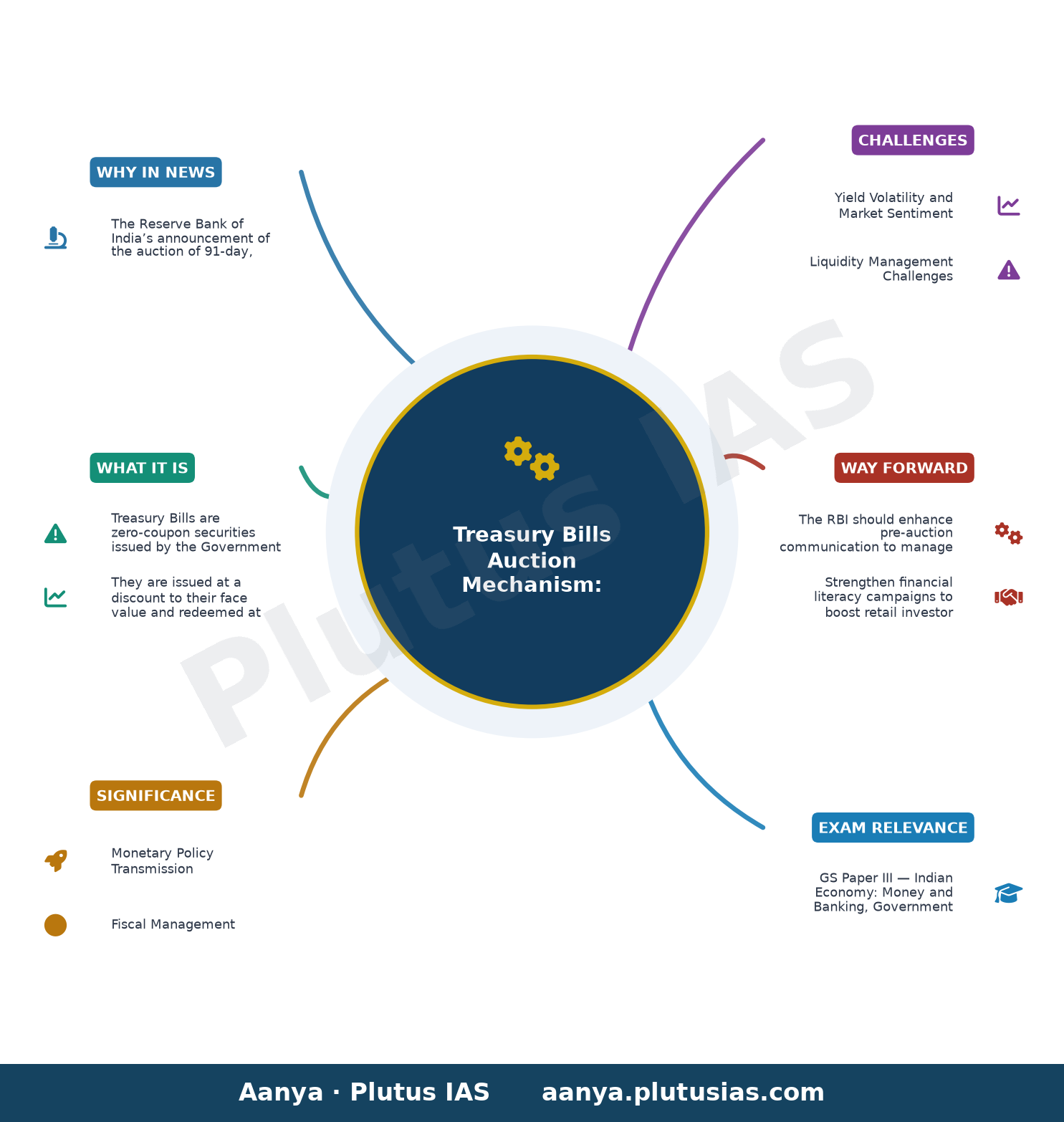
The Reserve Bank of India’s announcement of the auction of 91-day, 182-day, and 364-day Treasury Bills for a notified amount of ₹24,000 crore on August 5, 2026, is significant as it reflects the government’s short-term borrowing strategy and the RBI’s role in managing liquidity and interest rates. This auction is a routine but critical instrument of fiscal policy that influences short-term interest rates, money market dynamics, and investor confidence, making it relevant for UPSC aspirants studying macroeconomic management.
Background
- Treasury Bills are short-term government securities issued by the Government of India to meet its immediate cash requirements and manage fiscal deficits.
- The RBI conducts auctions for T-Bills on behalf of the Government under the provisions of the Government Securities Act, 2006, and the Reserve Bank of India Act, 1934.
- T-Bills are issued at a discount to their face value and redeemed at par, with the difference representing the interest earned by investors.
- The auction mechanism for T-Bills is a key tool for liquidity management, as it helps absorb excess liquidity or inject funds into the system based on monetary policy objectives.
- The notified amount of ₹24,000 crore for the auction aligns with the government’s fiscal deficit targets and borrowing calendar, which is published annually by the Ministry of Finance.
- The RBI’s Retail Direct Portal, launched in November 2021, democratises access to government securities, including T-Bills, for retail investors.
What are Treasury Bills (T-Bills)?
- Treasury Bills are zero-coupon securities issued by the Government of India with maturities of 91 days, 182 days, and 364 days, making them the shortest-term government securities.
- They are issued at a discount to their face value and redeemed at par, with the difference representing the implicit interest rate or yield.
- T-Bills are considered risk-free instruments as they are backed by the sovereign guarantee of the Government of India, ensuring capital safety and assured returns.
- Investors in T-Bills include commercial banks, primary dealers, mutual funds, provident funds, foreign central banks, and retail investors via the Retail Direct Portal.
- The yield on T-Bills is a benchmark for short-term interest rates in the Indian money market and influences the pricing of other debt instruments.
- T-Bills play a crucial role in the government’s cash management operations, helping to bridge temporary mismatches between revenue receipts and expenditure.
- The auction process ensures transparency and market-determined pricing, aligning with the principles of fiscal discipline and monetary policy objectives.
Key Features
| Feature | Significance |
|---|---|
| Notified Amounts | The auction offers ₹9,000 crore (91-Day), ₹8,000 crore (182-Day), and ₹7,000 crore (364-Day) T-Bills, aggregating ₹24,000 crore, ensuring liquidity management and fiscal deficit financing for the Union Government. |
| Auction Mechanism | Price-based auction using the multiple price method ensures market-determined yields, promoting transparency and efficient price discovery for short-term government securities. |
| Non-Competitive Bidding | Retail investors and eligible entities can participate via the Retail Direct portal or E-Kuber system, with a 5% allocation cap for individuals, democratising access to government securities. |
| Settlement Cycle | T-Bills settle within one working day (T+1), aligning with global best practices and enhancing market efficiency for short-term instruments. |
| Participation Channels | Bids are submitted electronically through the RBI’s Core Banking Solution (E-Kuber) or physically in case of system failure, ensuring operational resilience and inclusivity. |
Why it Matters
Monetary Policy Transmission
- T-Bill auctions serve as a primary tool for the RBI to manage liquidity, influence short-term interest rates, and align them with the monetary policy stance (e.g., LAF corridor adjustments).
- Yields on these bills act as benchmarks for other short-term debt instruments, including commercial paper and certificates of deposit, thereby transmitting policy signals to the broader financial system.
- The auction’s timing (August 2026) suggests pre-emptive liquidity management ahead of potential seasonal fiscal pressures or external shocks.
Fiscal Management
- Proceeds from T-Bill auctions contribute to financing the Union Government’s fiscal deficit, particularly for meeting short-term expenditure commitments without resorting to long-term borrowing.
- The staggered maturities (91, 182, 364 days) allow the government to stagger debt rollovers, reducing refinancing risk and optimising debt servicing costs.
- Non-competitive allocations ensure retail participation, broadening the investor base and reducing reliance on institutional investors for deficit financing.
Market Development
- Regular T-Bill auctions deepen the secondary market for government securities, enhancing liquidity and price discovery for short-term instruments.
- Inclusion of retail investors through the Retail Direct portal fosters financial inclusion and cultivates a culture of investment in risk-free assets among the general public.
- The multiple price method ensures fair pricing and discourages collusive bidding, promoting competitive market dynamics.
Global Benchmarking
- T-Bills are globally recognised as low-risk instruments, and their issuance strengthens India’s credibility in international debt markets, particularly for sovereign borrowings.
- Yields on Indian T-Bills are closely monitored by global investors as indicators of India’s macroeconomic stability and risk appetite.
Challenges
1. Yield Volatility and Market Sentiment
- Sudden shifts in global risk sentiment (e.g., US Fed policy changes, geopolitical tensions) can lead to volatility in T-Bill yields, complicating fiscal planning and increasing borrowing costs.
- Domestic factors such as inflation trends, fiscal slippages, or liquidity crunches may erode investor confidence, leading to higher bid-cover ratios or failed auctions.
UPSC Link: GS3: Monetary Policy & Fiscal Policy
2. Liquidity Management Challenges
- Excess liquidity in the banking system may suppress T-Bill yields, reducing their attractiveness to investors and forcing the RBI to absorb surplus funds through tools like variable rate reverse repos.
- Inadequate liquidity can lead to tight bid-cover ratios, necessitating the RBI’s intervention through open market operations (OMOs) or cash reserve ratio (CRR) adjustments.
UPSC Link: GS3: Liquidity Management
3. Retail Investor Participation Barriers
- Despite the Retail Direct portal, low financial literacy and limited awareness among retail investors may restrict participation, limiting the democratisation of government securities.
- Technical glitches or lack of digital access in rural areas can hinder seamless participation, requiring robust IT infrastructure and grievance redressal mechanisms.
UPSC Link: GS2: Financial Inclusion
4. Refinancing and Roll-Over Risk
- A significant portion of short-term debt (e.g., 364-day T-Bills) exposes the government to refinancing risk, where adverse market conditions at maturity could lead to higher borrowing costs.
- Prolonged reliance on short-term debt may signal fiscal imprudence, potentially triggering credit rating downgrades or investor skepticism.
UPSC Link: GS3: Public Debt Management
5. Systemic Risks in Auction Infrastructure
- Dependence on electronic bidding platforms (E-Kuber) introduces operational risks, including cyber threats, system failures, or connectivity issues, which could disrupt auction timelines.
- Physical bid submissions as a fallback mechanism are cumbersome and may not align with the RBI’s push for digital governance.
UPSC Link: GS3: Cyber Security & Digital Governance
Challenges — UPSC Perspective
| Issue | Concern |
|---|---|
| Global Risk Sentiment | Volatility in T-Bill yields due to external shocks (e.g., Fed policy shifts) may increase borrowing costs for the government. |
| Domestic Inflation Trends | Persistent inflation may erode real returns on T-Bills, reducing investor appetite and tightening liquidity. |
| Liquidity Surplus/Deficit | Excess liquidity suppresses yields, while deficits may lead to tight bid-cover ratios, complicating auction outcomes. |
| Retail Investor Awareness | Low financial literacy and digital divide limit participation, undermining the goal of inclusive debt markets. |
| Refinancing Risk | Short-term debt rollovers expose the government to higher borrowing costs if market conditions deteriorate at maturity. |
| Operational Risks | Cyber threats or system failures in E-Kuber could disrupt auction timelines, affecting market stability. |
Way Forward
- The RBI should enhance pre-auction communication to manage market expectations and reduce yield volatility, particularly in the context of global macroeconomic developments.
- Strengthen financial literacy campaigns to boost retail investor participation in government securities, leveraging digital platforms and localised outreach.
- Develop contingency plans for auction infrastructure, including robust cybersecurity measures and redundant systems to mitigate operational risks.
- Diversify the investor base by introducing innovative products (e.g., floating-rate T-Bills) to attract different risk appetites and reduce refinancing risks.
- Monitor liquidity conditions closely and calibrate the auction calendar to align with fiscal needs, avoiding over-reliance on short-term debt instruments.
- Collaborate with SEBI and other regulators to integrate T-Bill markets with broader debt and equity markets, enhancing liquidity and price discovery.
- Conduct periodic reviews of the Retail Direct portal to address technical glitches and improve user experience, ensuring seamless participation for retail investors.
UPSC Value Addition
Keywords for Mains Answer-Writing
Treasury Bills · Government Securities · Public Debt Management · Auction Mechanism · Monetary Policy · RBI Operations · Fiscal Policy · Non-Competitive Bidding · Retail Investors · E-Kuber System · Price-Based Auction · Multiple Price Method · Public Debt Office · Core Banking Solution · Financial Inclusion · Capital Markets · Debt Instruments · Fiscal Responsibility and Budget Management (FRBM) Act
Concept Flow
Union Government’s fiscal deficit → Requires short-term borrowing → T-Bill auctions as primary instrument → RBI conducts auctions to manage liquidity and align with monetary policy → Price-based multiple price method ensures market-determined yields → Yields on T-Bills act as benchmarks for other short-term instruments → Transmit policy signals to financial system → Retail investors participate via Retail Direct portal → Enhances financial inclusion and broadens investor base → Proceeds from auctions finance fiscal deficit → Staggered maturities reduce refinancing risk → Secondary market for T-Bills deepens → Improves liquidity and price discovery → Global investors monitor T-Bill yields → Reflects India’s macroeconomic stability and risk appetite
Prelims Practice Questions
Q1. Consider the following statements regarding the auction of Treasury Bills in India:
1. Treasury Bills are issued by the Reserve Bank of India (RBI) on behalf of the Government of India.
2. The auction of 91-Day, 182-Day, and 364-Day Treasury Bills is conducted using the multiple price method.
3. Retail investors can participate in the auction only through the non-competitive route.
4. The settlement date for the auction is the same as the auction date.
How many of the above statements are correct?
- Only one
- Only two
- Only three
- All four
Answer: Only three — Statements 2 and 3 are correct. Statement 1 is incorrect because Treasury Bills are issued by the Government of India, not the RBI. Statement 4 is incorrect because the settlement date is the day after the auction date.
Q2. Assertion (A): The auction of Treasury Bills in India is conducted through the E-Kuber system, which is the RBI’s Core Banking Solution.
Reason (R): The E-Kuber system ensures transparency and efficiency in the auction process by allowing electronic submission of bids.
Options:
A. Both A and R are true, and R is the correct explanation of A.
B. Both A and R are true, but R is not the correct explanation of A.
C. A is true, but R is false.
D. A is false, but R is true.
Answer: ? — Both the assertion and reason are true. The E-Kuber system is indeed the RBI’s Core Banking Solution used for conducting Treasury Bill auctions, and it ensures transparency and efficiency by enabling electronic bid submission.
Q3. Match the following columns related to Treasury Bills in India:
Column I (Treasury Bill Tenure) Column II (Maximum Allocation for Retail Investors)
A. 91-Day Treasury Bill 1. 5%
B. 182-Day Treasury Bill 2. 10%
C. 364-Day Treasury Bill 3. 5%
Options:
A. A-1, B-3, C-2
B. A-1, B-2, C-3
C. A-3, B-1, C-2
D. A-2, B-1, C-3
Answer: ? — The allocation for retail investors in Treasury Bill auctions is restricted to a maximum of 5% of the notified amount for all tenures (91-Day, 182-Day, and 364-Day).
Mains Practice Question
✍ Examine the significance of the auction mechanism for Treasury Bills in India, with particular reference to the role of the Reserve Bank of India (RBI) and the participation of retail investors. Also, discuss the implications of the multiple price method used in these auctions for market efficiency and price discovery. (15 Marks)
Approach: MODEL-ANSWER SKELETON:
1. **Introduction**: Define Treasury Bills and their role in public debt management and monetary policy.
2. **RBI’s Role**: Explain the RBI’s functions as the manager of public debt, including issuance, auction mechanism, and settlement processes. Highlight the use of the E-Kuber system and the Core Banking Solution.
3. **Auction Mechanism**: Describe the multiple price method, its advantages (price discovery, allocative efficiency), and how it differs from the uniform price method.
4. **Retail Investor Participation**: Discuss the non-competitive bidding route, the 5% allocation cap, and the Retail Direct portal. Explain how this promotes financial inclusion and broadens the investor base.
5. **Market Efficiency and Price Discovery**: Analyze how the multiple price method ensures fair pricing, reduces information asymmetry, and enhances liquidity in the secondary market.
6. **Challenges**: Briefly mention potential challenges such as bid rigging, system failures, and the need for robust technological infrastructure.
7. **Conclusion**: Summarize the importance of the auction mechanism in maintaining fiscal discipline, ensuring transparency, and fostering a deep and liquid government securities market.
Source: RBI
Generated by AanyaAi for educational purpose.

- मध्य प्रदेश में स्वास्थ्य सेवाओं का विस्तार: पीपीपी मॉडल और एमबीबीएस सीटों में वृद्धि - September 19, 2026
- MP’s Health Sector Progress Reviewed by Union Health Minister JP Nadda - September 19, 2026
- ओडिशा में 870 एकड़ में बनेगा ‘सिलिकॉन वैली’, जानिए क्या होगा फायदा - September 19, 2026

No Comments