


24 Jul RBI to Auction ₹24,000 Crore Treasury Bills on July 29, 2026: Key Details for UPSC/PCS
Subject Relevance — Where This Topic Fits
- GS Paper III — Indian Economy: Issues Relating to Planning, Mobilisation of Resources, Growth, Development and Employment | GS Paper III — Money and Banking: Role of RBI, Monetary Policy, Government Securities Market
- Prelims: Treasury Bills (T-Bills), Public Debt Management, RBI’s Open Market Operations, Government Securities, Retail Direct Scheme, E-Kuber System, Non-Competitive Bidding, Multiple Price Method, Primary Auction, Yield Curve
- Essay: The Role of Government Securities in India’s Financial System, Monetary Policy Transmission and Fiscal Discipline: The Case of Treasury Bill Auctions
Quick Revision: Treasury Bills are short-term government securities issued at a discount to face value, with maturities of 91, 182, or 364 days, and are auctioned by the RBI to manage liquidity and fiscal deficits.
Why is this in the news?
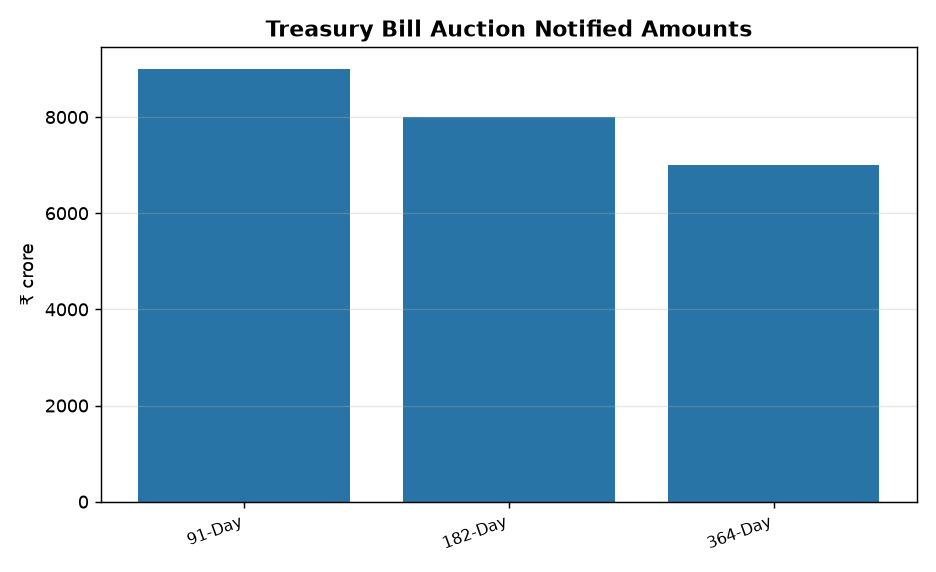
The Reserve Bank of India (RBI) has announced the auction of 91-day, 182-day, and 364-day Treasury Bills (T-Bills) for a notified amount of ₹24,000 crore on July 29, 2026. This auction is significant as it reflects the government’s ongoing strategy to manage short-term fiscal deficits while providing liquidity to the banking system. The auction mechanism, including competitive and non-competitive bidding, underscores the RBI’s role in ensuring efficient price discovery and broad-based participation, including retail investors. The timing of the auction aligns with the RBI’s broader objectives of liquidity management and alignment with monetary policy goals.
Background
- Treasury Bills are short-term government securities issued by the Government of India to meet its immediate cash requirements and manage fiscal deficits. They are issued at a discount to face value and redeemed at par, with the difference representing the interest earned by investors.
- The RBI conducts regular auctions of T-Bills to maintain liquidity in the financial system and to signal its monetary policy stance. The auction of T-Bills is a key instrument under the Public Debt Management (PDM) framework, which aims to minimize the cost of borrowing for the government while ensuring market stability.
- The RBI introduced the Retail Direct Scheme in 2021 to democratize access to government securities, allowing retail investors to participate in T-Bill auctions through the RBI Retail Direct portal. This initiative aligns with the government’s broader financial inclusion agenda.
- The auction process is governed by the General Notification F.No.4(2)-B(W&M)/2018 dated March 26, 2025, which outlines the terms and conditions for participation, including eligibility criteria and allocation limits.
- The RBI’s Core Banking Solution (E-Kuber system) facilitates electronic bidding, ensuring transparency, efficiency, and real-time processing of auction bids. The multiple price method used in the auction ensures fair price discovery based on competitive bids.
- The auction of T-Bills is closely monitored by financial markets as it provides insights into the government’s borrowing requirements and the RBI’s liquidity management strategies, which in turn influence interest rates and market sentiment.
What are Treasury Bills (T-Bills)?
- Treasury Bills are short-term, zero-coupon government securities issued by the Government of India with maturities of 91 days, 182 days, and 364 days. They are issued at a discount to their face value and redeemed at par, with the difference representing the implicit interest rate.
- T-Bills are issued through auctions conducted by the RBI on behalf of the Government of India. The auction process ensures transparent price discovery and efficient allocation of securities.
- The primary objective of T-Bills is to meet the government’s short-term fiscal deficits and manage liquidity in the financial system. They are a key instrument in the Public Debt Management (PDM) framework.
- T-Bills are eligible for inclusion in the Statutory Liquidity Ratio (SLR) requirements of banks, making them attractive for commercial banks and financial institutions.
- The yield on T-Bills is a benchmark for short-term interest rates in the economy and influences the pricing of other financial instruments, including corporate bonds and money market instruments.
- The RBI’s Retail Direct Scheme allows individual investors to participate in T-Bill auctions through the RBI Retail Direct portal, enabling broader participation in government securities.
- T-Bills are highly liquid instruments, as they can be sold in the secondary market before maturity, providing investors with flexibility in managing their portfolios.
- The auction process for T-Bills follows a multiple price method, where successful bidders pay the price they bid, ensuring fair and competitive pricing.
Key Features
| Feature | Significance |
|---|---|
| Tenor of Treasury Bills | The auction includes 91-day, 182-day, and 364-day Treasury Bills, catering to short-term liquidity needs of the Government of India and offering investors varying maturity options for risk and return optimization. |
| Notified Amount | The total notified amount is ₹24,000 crore, distributed across the three tenors, reflecting the Government’s borrowing strategy and market demand assessment for short-term securities. |
| Auction Mechanism | The auction employs a price-based multiple price method, where successful bidders pay the price they bid, ensuring transparency and market-driven pricing for Government securities. |
| Non-Competitive Bidding | Retail investors and eligible entities can participate on a non-competitive basis, with a maximum allocation of 5% of the notified amount, promoting financial inclusion and accessibility to Government securities. |
| Electronic Bidding Platform | Bids must be submitted via the RBI’s Core Banking Solution (E-Kuber system), ensuring efficiency, security, and real-time processing of auction bids. |
| Retail Direct Portal | Individual investors can participate through the Retail Direct portal, providing a user-friendly interface for retail participation in Government securities auctions. |
Why it Matters
Macroeconomic Management
- Facilitates the Government’s short-term borrowing programme, supporting fiscal deficit financing without resorting to long-term debt instruments.
- Provides a benchmark yield curve for short-term interest rates, aiding monetary policy transmission and liquidity management by the Reserve Bank of India.
- Enhances the depth and liquidity of the Government securities market, reducing reliance on ad-hoc borrowing methods.
Investor Participation and Market Development
- Expands retail investor participation in Government securities, fostering a culture of saving and investment among individuals.
- Attracts institutional investors such as provident funds, foreign central banks, and state governments, diversifying the investor base.
- Strengthens the secondary market for Treasury Bills, improving price discovery and reducing transaction costs.
Monetary Policy and Liquidity Framework
- Serves as a tool for the RBI to manage liquidity through open market operations, influencing short-term interest rates and inflation expectations.
- Provides a reference rate for commercial banks and financial institutions, guiding their pricing decisions for loans and deposits.
- Supports the RBI’s liquidity adjustment facility (LAF) by offering collateralized borrowing options for banks.
Fiscal Discipline and Debt Sustainability
- Ensures transparent and competitive borrowing, reducing the cost of Government debt through market-determined yields.
- Promotes fiscal discipline by aligning borrowing with market conditions, avoiding excessive reliance on monetization.
- Contributes to the development of a robust yield curve, essential for pricing long-term Government securities and corporate bonds.
Challenges
1. Liquidity Constraints in Short-Term Markets
- Excessive reliance on short-term borrowing may expose the Government to rollover risks, particularly in volatile market conditions.
- Tight liquidity conditions could lead to higher bid-cover ratios, increasing the cost of Government borrowing.
- Potential mismatch between investor demand and Government borrowing needs may result in under-subscription or oversubscription.
UPSC Link: GS-III: Money and Banking
2. Market Volatility and Interest Rate Risk
- Sudden shifts in monetary policy or global financial conditions can lead to volatility in Treasury Bill yields, affecting investor confidence.
- Retail investors may face challenges in understanding interest rate movements, leading to suboptimal investment decisions.
- Systemic risks such as liquidity crunches or financial crises may disrupt the smooth functioning of the auction process.
UPSC Link: GS-III: Financial Markets
3. Operational and Technological Risks
- Dependence on electronic bidding platforms like E-Kuber introduces risks of technical glitches or cyber threats, potentially delaying auction processes.
- Physical bid submission remains a fallback, but it introduces operational inefficiencies and delays in settlement.
- Ensuring seamless participation for retail investors requires robust digital infrastructure and user-friendly interfaces.
UPSC Link: GS-III: E-Governance
4. Regulatory and Compliance Burden
- Frequent amendments to auction guidelines and terms may create confusion among participants, particularly institutional investors.
- Compliance requirements for non-competitive bidders, such as provident funds and foreign central banks, add administrative overheads.
- Ensuring transparency and fairness in the multiple price auction method requires stringent monitoring and auditing.
UPSC Link: GS-II: Government Policies
Challenges — UPSC Perspective
| Issue | Concern |
|---|---|
| Rollover Risk | Risk of higher borrowing costs due to frequent refinancing of short-term debt in unstable market conditions. |
| Bid-Cover Ratio Fluctuations | Volatility in the ratio of total bids to notified amount, impacting auction success and yield determination. |
| Retail Investor Awareness | Limited financial literacy among retail investors may hinder effective participation in Treasury Bill auctions. |
| Cybersecurity Threats | Potential vulnerabilities in electronic bidding platforms could compromise auction integrity. |
| Regulatory Complexity | Frequent changes in auction guidelines may create compliance challenges for participants. |
| Liquidity Mismatch | Discrepancy between Government borrowing needs and investor demand may lead to auction failures. |
Way Forward
- Enhance financial literacy programs to educate retail investors on the benefits and mechanics of Treasury Bill investments.
- Strengthen cybersecurity protocols for the E-Kuber platform to mitigate risks of technical failures or cyber threats.
- Expand the Retail Direct portal with multilingual support and simplified user interfaces to improve accessibility.
- Conduct periodic reviews of auction guidelines to ensure clarity and reduce compliance burdens for institutional investors.
- Develop secondary market liquidity for Treasury Bills by incentivizing market makers and encouraging inter-bank trading.
- Collaborate with state governments and provident funds to increase non-competitive participation in auctions.
- Monitor global financial conditions and domestic liquidity trends to preemptively adjust borrowing strategies.
- Promote the use of Treasury Bills as collateral in repo transactions to enhance their utility in monetary operations.
UPSC Value Addition
Keywords for Mains Answer-Writing
Treasury Bills · Money Market Instruments · Government Securities · Liquidity Management · Fiscal Policy Instruments · Public Debt Management · Auction Mechanism · Non-competitive Bidding · Retail Direct Scheme · Monetary Policy Transmission · Yield Curve · Fiscal Deficit Financing
Concept Flow
Government’s short-term borrowing requirement → RBI announces Treasury Bill auction → Investors submit bids via E-Kuber system → Auction results announced → Successful bidders pay and receive securities → Secondary market trading enhances liquidity → Yield curve informs monetary policy → Fiscal deficit financing supported.
Prelims Practice Questions
Q1. Which of the following institutions is NOT eligible to participate in the auction of Treasury Bills on a non-competitive basis?
- State Governments
- Union Territories with legislature
- Designated Foreign Central Banks
- Commercial Banks
Answer: Commercial Banks — Commercial banks are not explicitly listed as eligible participants for non-competitive bidding in the auction of Treasury Bills as per the RBI notification. Only State Governments, Union Territories with legislature, eligible Provident Funds, designated Foreign Central Banks, and specified individuals/institutions are permitted.
Q2. What is the maximum allocation limit for individual retail investors in the notified amount of Treasury Bills auction?
- 2%
- 5%
- 10%
- 15%
Answer: 5% — The RBI specifies that individual investors participating on a non-competitive basis are restricted to a maximum allocation of 5% of the notified amount in the Treasury Bills auction.
Q3. Which of the following is the settlement date for the 91-Day Treasury Bill auction scheduled on July 29, 2026?
- July 28, 2026
- July 29, 2026
- July 30, 2026
- July 31, 2026
Answer: July 30, 2026 — The settlement date for the 91-Day Treasury Bill auction, as per the RBI notification, is July 30, 2026, which is the day following the auction date.
Mains Practice Question
✍ Evaluate the significance of Treasury Bills in India’s fiscal policy framework. How does the auction mechanism of Treasury Bills contribute to effective liquidity management and public debt sustainability?
Approach: Begin by defining Treasury Bills as short-term government securities and their role in financing fiscal deficits. Discuss their classification under money market instruments and their impact on the yield curve. Explain the auction mechanism, including competitive and non-competitive bidding, and its role in price discovery and market liquidity. Highlight how Treasury Bills aid in liquidity management by absorbing excess liquidity and their contribution to the development of the government securities market. Conclude by linking their issuance to fiscal sustainability and the broader objectives of public debt management in India.
Source: RBI
Generated by AanyaAi for educational purpose.

- मध्य प्रदेश में स्वास्थ्य सेवाओं का विस्तार: पीपीपी मॉडल और एमबीबीएस सीटों में वृद्धि - September 19, 2026
- MP’s Health Sector Progress Reviewed by Union Health Minister JP Nadda - September 19, 2026
- ओडिशा में 870 एकड़ में बनेगा ‘सिलिकॉन वैली’, जानिए क्या होगा फायदा - September 19, 2026

No Comments