


23 Sep RBI to Sell ₹25,000 Crore Govt Securities via OMO on Sept 28, 2026
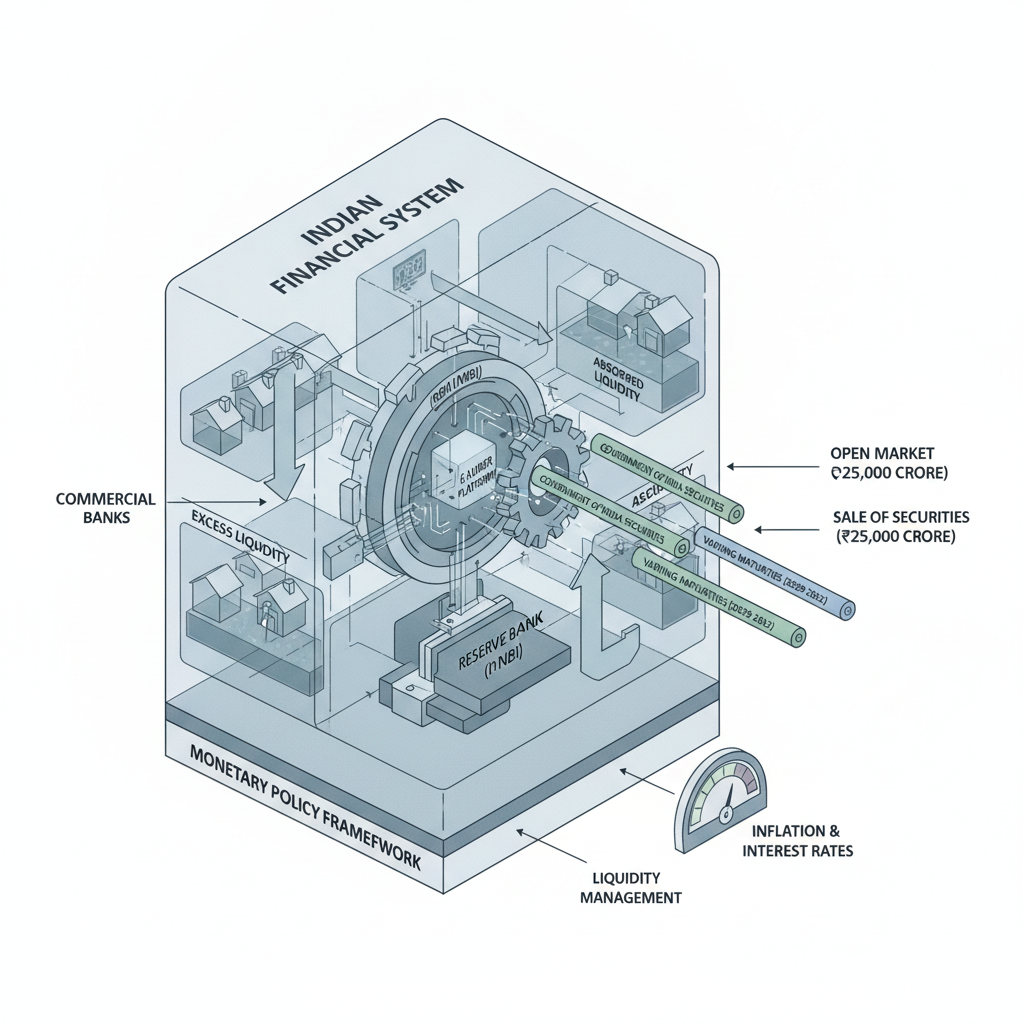
✎ OMOs are a critical tool in the RBI’s liquidity management toolkit, used to absorb or inject liquidity into the banking system by buying or selling government securities, thereby influencing interest rates and inflation dynamics.
Subject Relevance — Where This Topic Fits
- GS Paper III — Indian Economy
- Prelims: Open Market Operations (OMO), Liquidity Adjustment Facility (LAF), Monetary Policy Committee (MPC), Government Securities, RBI’s Core Banking Solution (E-Kuber), Statutory Liquidity Ratio (SLR), Cash Reserve Ratio (CRR), Repo Rate, Reverse Repo Rate
- Essay: Role of the Reserve Bank of India in maintaining macroeconomic stability, Monetary policy tools and their impact on inflation and growth
Quick Revision: OMOs are a critical tool in the RBI’s liquidity management toolkit, used to absorb or inject liquidity into the banking system by buying or selling government securities, thereby influencing interest rates and inflation dynamics.
Why is this in the news?
The Reserve Bank of India (RBI) announced an Open Market Operation (OMO) sale of Government of India securities for an aggregate amount of ₹25,000 crore on September 28, 2026. This operation is part of the RBI’s liquidity management strategy to absorb excess liquidity from the banking system, thereby influencing interest rates and inflation dynamics in the economy. The auction involves the sale of six government securities with varying maturities, ranging from 2029 to 2032, and is conducted through the RBI’s Core Banking Solution (E-Kuber) platform.
Background
- OMOs are a key instrument of monetary policy used by central banks to manage liquidity in the financial system. In India, the RBI conducts OMOs by buying or selling government securities to influence the money supply.
- The RBI’s monetary policy framework, guided by the Monetary Policy Committee (MPC), aims to achieve the twin objectives of price stability and growth. OMOs play a critical role in aligning liquidity conditions with these objectives.
- Excess liquidity in the banking system can lead to inflationary pressures, while deficient liquidity can constrain credit growth. OMOs help the RBI fine-tune liquidity to maintain macroeconomic stability.
- The RBI’s liquidity management is also influenced by factors such as the Statutory Liquidity Ratio (SLR), Cash Reserve Ratio (CRR), and the Repo and Reverse Repo rates, which collectively determine the availability of funds in the banking system.
- OMOs are conducted through auctions, where the RBI invites bids from eligible participants, including commercial banks, primary dealers, and other financial institutions.
- The RBI reserves the right to accept or reject bids partially or fully, ensuring flexibility in liquidity management while maintaining transparency in the auction process.
What is Open Market Operation (OMO)?
- OMO refers to the buying or selling of government securities by the central bank in the open market to regulate the money supply in the economy. In the context of the RBI, OMOs are primarily used to manage liquidity conditions.
- When the RBI sells government securities (as in the current case), it absorbs liquidity from the banking system, reducing the amount of money available for lending and investment. This is typically done to curb inflationary pressures or when excess liquidity is observed.
- Conversely, when the RBI buys government securities, it injects liquidity into the system, making more funds available for banks to lend, thereby stimulating economic activity.
- OMOs are conducted through auctions, where the RBI specifies the aggregate amount of securities to be sold or purchased, and eligible participants submit bids electronically through the RBI’s Core Banking Solution (E-Kuber) platform.
- The RBI’s decision to conduct OMOs is guided by its assessment of liquidity conditions, inflation trends, and the broader macroeconomic environment. The Monetary Policy Committee (MPC) plays a key role in determining the stance of monetary policy, including the use of OMOs.
- OMOs are distinct from other monetary policy tools such as the Repo Rate, Reverse Repo Rate, Cash Reserve Ratio (CRR), and Statutory Liquidity Ratio (SLR), though they are often used in conjunction with these tools to achieve policy objectives.
- The success of OMOs depends on the participation of primary dealers and commercial banks, who act as intermediaries in the government securities market. The RBI’s ability to absorb or inject liquidity effectively hinges on the depth and liquidity of the government securities market.
- OMOs also have implications for the yield curve, as changes in liquidity conditions can influence the pricing of government securities and, consequently, the broader interest rate environment.
Key Features
| Feature | Significance |
|---|---|
| Aggregate amount of ₹25,000 crore | Demonstrates the scale of liquidity absorption aimed at managing inflationary pressures in the economy. |
| Auction of multiple Government of India securities | Facilitates targeted liquidity management by offering a diversified maturity profile for market participants. |
| Electronic bidding via RBI Core Banking Solution (E-Kuber) | Ensures transparency, efficiency, and real-time processing of bids, reducing operational delays. |
| Reserve Bank’s discretion in quantum allocation | Provides flexibility to adjust liquidity absorption based on evolving market conditions and liquidity surplus. |
| Same-day auction result announcement | Enhances market predictability and allows participants to plan liquidity adjustments promptly. |
| Physical bid provision in case of system failure | Ensures continuity of operations while maintaining compliance with RBI’s procedural safeguards. |
Why it Matters
Monetary Policy and Liquidity Management
- The Open Market Operations (OMO) sale is a conventional instrument under the RBI’s liquidity management framework, employed to absorb excess liquidity from the banking system.
- OMOs are critical for maintaining price stability, particularly when inflationary pressures arise from surplus liquidity in the economy.
- The auction of dated Government securities signals the RBI’s intent to tighten monetary conditions without resorting to policy rate changes, which may have broader macroeconomic implications.
- The diversified maturity profile of the securities (2029–2032) allows the RBI to target liquidity across different time horizons, ensuring a balanced approach to liquidity absorption.
Impact on Financial Markets
- OMO sales influence bond yields by reducing the supply of government securities in the secondary market, thereby tightening liquidity conditions.
- The auction may lead to a temporary increase in short-term interest rates, particularly in the money market segment, as banks adjust their liquidity positions.
- Market participants, including banks and primary dealers, may reassess their portfolio strategies in response to the RBI’s liquidity absorption, affecting trading volumes and price discovery.
- The announcement itself serves as a signaling mechanism, communicating the RBI’s stance on liquidity to market participants, which can influence investor sentiment.
Macroeconomic Implications
- Excess liquidity in the system can fuel inflationary pressures by increasing aggregate demand. OMOs act as a countercyclical tool to mitigate such risks.
- The RBI’s liquidity management through OMOs complements its policy rate adjustments, providing a nuanced approach to monetary policy implementation.
- The auction’s timing (September 2026) suggests proactive measures to address potential seasonal liquidity surpluses, such as those arising from government expenditure patterns.
Operational and Procedural Rigor
- The RBI’s structured auction process, including electronic bidding and same-day result announcements, enhances operational efficiency and reduces counterparty risk.
- The provision for physical bids in case of system failure ensures operational resilience, aligning with the RBI’s commitment to maintaining uninterrupted market operations.
Challenges
1. Liquidity Surplus Management
- Prolonged liquidity surplus can lead to mispricing of risk in financial markets, distorting asset valuations and investment decisions.
- The RBI must balance liquidity absorption with the need to avoid excessive tightening, which could stifle economic growth or disrupt credit markets.
- Market participants may exhibit herd behavior during OMO auctions, leading to volatility in bond yields and liquidity conditions.
UPSC Link: Monetary Policy and Inflation Management
2. Market Volatility and Yield Spikes
- OMO sales can trigger short-term spikes in bond yields, particularly if the auction size is perceived as larger than expected by market participants.
- Sudden liquidity tightening may lead to liquidity crunches in specific segments of the financial system, affecting smaller banks or non-bank financial institutions.
- The RBI must ensure that the auction process is transparent and predictable to minimize unintended market disruptions.
UPSC Link: Bond Market Dynamics and Interest Rate Transmission
3. Coordination with Government Borrowing Programmes
- The RBI must align its OMO operations with the Government of India’s borrowing calendar to avoid conflicts between liquidity absorption and debt issuance objectives.
- Excessive OMO sales during periods of high government borrowing could exacerbate market borrowings, leading to higher interest costs for the exchequer.
UPSC Link: Fiscal-Monetary Policy Coordination
4. Technological and Operational Risks
- Dependence on the E-Kuber system for electronic bidding introduces operational risks, including system outages or cyber threats, which could disrupt the auction process.
- The RBI must ensure robust contingency measures, such as the provision for physical bids, to mitigate technological failures.
UPSC Link: Digital Infrastructure in Financial Markets
5. Impact on Banking Sector Liquidity
- Banks with surplus liquidity may face challenges in deploying funds post-OMO, particularly if the auction size is large relative to the banking system’s liquidity position.
- Smaller banks with limited access to alternative liquidity sources may experience disproportionate liquidity constraints, affecting their lending operations.
UPSC Link: Banking Sector Liquidity and Credit Growth
Challenges — UPSC Perspective
| Issue | Concern |
|---|---|
| Liquidity Surplus Persistence | Risk of prolonged excess liquidity distorting monetary transmission and asset prices. |
| Yield Volatility | Potential for sharp increases in bond yields due to unexpected auction outcomes. |
| Government Borrowing Overlap | Conflict between OMO sales and the Government’s borrowing requirements, leading to higher interest costs. |
| Operational Disruptions | Technological failures in the E-Kuber system could delay or disrupt the auction process. |
| Sectoral Liquidity Imbalances | Disproportionate impact on smaller banks or non-bank financial institutions due to liquidity constraints. |
| Market Sentiment Fluctuations | Uncertainty around auction outcomes may lead to speculative behavior, amplifying market volatility. |
Way Forward
- Monitor post-auction liquidity conditions and bond market reactions to assess the effectiveness of the OMO sale in achieving liquidity absorption targets.
- Enhance communication with market participants to clarify the RBI’s liquidity management objectives and auction parameters, reducing speculative behavior.
- Strengthen contingency plans for technological disruptions in the E-Kuber system to ensure uninterrupted auction operations.
- Coordinate with the Government of India to align OMO operations with its borrowing calendar, minimizing conflicts between liquidity absorption and debt issuance.
- Assess the impact of the OMO sale on banking sector liquidity, particularly for smaller banks, and explore targeted measures to mitigate adverse effects.
- Evaluate the transmission of liquidity adjustments to broader financial markets, including money markets and corporate bond segments.
- Review the auction process periodically to incorporate feedback from market participants and improve operational efficiency.
- Analyze the macroeconomic impact of the OMO sale on inflation, growth, and financial stability to inform future policy decisions.
UPSC Value Addition
Keywords for Mains Answer-Writing
Open Market Operations · Government Securities · Liquidity Management · Monetary Policy Framework · Repo Rate · Reverse Repo Rate · Statutory Liquidity Ratio · Market Stabilisation Scheme · Quantitative Easing · Fiscal-Monetary Coordination · Yield Curve Management · Secondary Market Operations
Concept Flow
Excess liquidity in the banking system → RBI identifies liquidity surplus through monetary policy assessments → RBI announces OMO sale of government securities → Market participants submit bids via E-Kuber → RBI allocates securities based on auction results → Successful bidders transfer funds to RBI → Liquidity absorption occurs as funds are withdrawn from the banking system → Bond yields adjust to reflect tighter liquidity conditions → Transmission to broader financial markets and macroeconomic variables (inflation, growth) → RBI monitors outcomes and adjusts future OMO operations as needed.
Prelims Practice Questions
Q1. Consider the following statements regarding Open Market Operations (OMOs) in India:
1. OMOs are conducted by the Reserve Bank of India (RBI) to manage liquidity in the banking system.
2. OMOs involve the sale or purchase of Government of India securities in the secondary market.
3. OMOs are a part of the RBI’s monetary policy tools under the Liquidity Adjustment Facility (LAF).
4. OMOs can only be conducted through physical bids submitted to the RBI.
How many of the above statements are correct?
- Only one
- Only two
- Only three
- All
Answer: Only three — Statements 1, 2, and 3 are correct as OMOs are indeed conducted by the RBI to manage liquidity, involve Government securities in the secondary market, and are part of the LAF. Statement 4 is incorrect because OMOs are conducted electronically through the RBI’s Core Banking Solution (E-Kuber) system.
Q2. Assertion (A): The Reserve Bank of India (RBI) conducts Open Market Operations (OMOs) to influence interest rates in the economy.
Reason (R): OMOs involve the sale or purchase of Government securities, which impacts the money supply and liquidity conditions.
Options:
A. Both A and R are true, and R is the correct explanation of A.
B. Both A and R are true, but R is not the correct explanation of A.
C. A is true, but R is false.
D. A is false, but R is true.
Answer: ? — Both A and R are true, and R correctly explains A. OMOs influence interest rates by altering the money supply and liquidity conditions in the economy.
Q3. Match the following terms related to monetary policy with their correct descriptions:
Column I
1. Repo Rate
2. Reverse Repo Rate
3. Statutory Liquidity Ratio (SLR)
4. Market Stabilisation Scheme (MSS)
Column II
A. Rate at which the RBI borrows money from commercial banks
B. Rate at which the RBI lends money to commercial banks
C. Percentage of net demand and time liabilities that banks must maintain in approved securities
D. Tool used by the RBI to mop up excess liquidity by issuing treasury bills
Options:
1-A, 2-B, 3-C, 4-D
1-B, 2-A, 3-C, 4-D
1-A, 2-B, 3-D, 4-C
1-B, 2-A, 3-D, 4-C
Answer: ? — The correct matches are: 1-B (Repo Rate is the rate at which the RBI lends money to commercial banks), 2-A (Reverse Repo Rate is the rate at which the RBI borrows money from commercial banks), 3-C (SLR is the percentage of net demand and time liabilities that banks must maintain in approved securities), and 4-D (MSS is used by the RBI to mop up excess liquidity by issuing treasury bills).
Mains Practice Question
✍ Examine the role of Open Market Operations (OMOs) in the conduct of monetary policy by the Reserve Bank of India (RBI). How do OMOs interact with other instruments of monetary policy to achieve the objectives of price stability and economic growth? (15 Marks)
Approach: MODEL-ANSWER SKELETON:
1. **Definition and Purpose of OMOs**:
– OMOs as the sale or purchase of Government of India securities in the secondary market by the RBI to regulate liquidity.
– Objectives: Price stability, economic growth, and orderly functioning of financial markets.
2. **Mechanism of OMOs**:
– **Sale of Securities**: Reduces liquidity in the banking system, upward pressure on interest rates.
– **Purchase of Securities**: Injects liquidity, downward pressure on interest rates.
– Reference to the recent OMO sale of ₹25,000 crore on September 28, 2026, as per RBI Press Release 2026-27/1106.
3. **Interaction with Other Monetary Policy Instruments**:
– **Repo Rate and Reverse Repo Rate**: OMOs complement these rates by influencing the overall liquidity conditions.
– **Statutory Liquidity Ratio (SLR)**: OMOs impact the availability of government securities for SLR compliance.
– **Market Stabilisation Scheme (MSS)**: OMOs and MSS both aim to manage liquidity but operate through different instruments (securities vs. treasury bills).
4. **Objectives and Outcomes**:
– **Price Stability**: OMOs help control inflation by managing money supply.
– **Economic Growth**: Lower interest rates (via OMOs) stimulate investment and consumption.
– **Yield Curve Management**: OMOs influence the yield curve by affecting the supply and demand for government securities.
5. **Challenges and Limitations**:
– **Market Depth**: Effectiveness depends on the depth of the government securities market.
– **Coordination with Fiscal Policy**: OMOs must align with fiscal policy to avoid conflicting signals.
– **Global Spillovers**: OMOs may be influenced by global financial conditions.
6. **Conclusion**:
– OMOs are a critical tool in the RBI’s monetary policy toolkit, working in tandem with other instruments to achieve macroeconomic stability. Their role is particularly significant in managing liquidity during periods of volatility or economic stress.
Source: RBI
Generated by AanyaAi for educational purpose.
Related guides on our sites
- Current affairs for upsc 2026
- Best economics optional coaching for upsc
- Best economics optional teacher for upsc
- How to prepare for GS paper 1 for UPSC CSE mains exam

- महाराष्ट्र में त्योहार जुलूसों पर बॉम्बे हाईकोर्ट का बड़ा फैसला: पटाखे, लेजर और संगीत पर रोक - September 24, 2026
- Bombay HC Bans Firecrackers, Music in Maharashtra Processions: Key UPSC Analysis - September 24, 2026
- तमिलनाडु में महिला कर्मचारियों के लिए सवैतनिक माहवारी अवकाश नीति पर HC का आदेश - September 24, 2026

No Comments