


05 Aug RBI’s July 2026 Forward Looking Surveys: Key Insights for UPSC & State PCS Aspirants
✎ The RBI’s Forward Looking Surveys provide critical forward-looking data on consumer sentiment, inflation expectations, and industrial activity, which are essential inputs for monetary policy decisions under the flexible inflation…
Subject Relevance — Where This Topic Fits
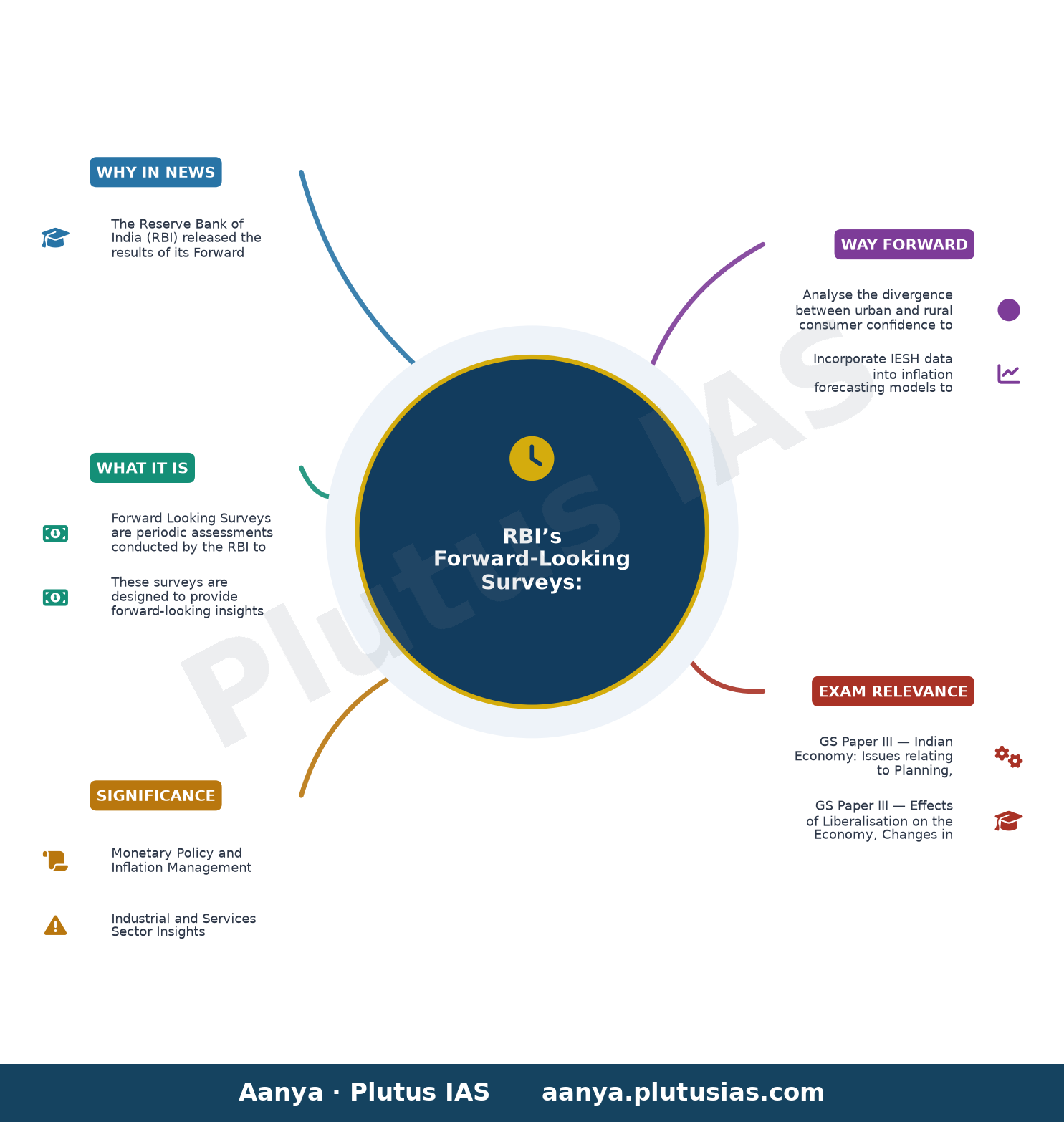
- GS Paper III — Indian Economy: Issues relating to Planning, Mobilisation of Resources, Growth, Development and Employment | GS Paper III — Effects of Liberalisation on the Economy, Changes in Industrial Policy and their Effects on Industrial Growth | GS Paper III — Inclusive Growth and Issues Arising from it | GS Paper III — Government Budgeting
- Prelims: Forward Looking Surveys, Urban Consumer Confidence Survey (UCCS), Inflation Expectations Survey of Households (IESH), Survey of Professional Forecasters, Order Books, Inventories and Capacity Utilisation Survey, Industrial Outlook Survey, Bank Lending Survey, Services and Infrastructure Outlook Survey, Reserve Bank of India (RBI), Monetary Policy Framework, Consumer Price Index (CPI), Wholesale Price Index (WPI), Liquidity Adjustment Facility (LAF), Statutory Liquidity Ratio (SLR), Cash Reserve Ratio (CRR)
- Essay: The Role of Data-Driven Policy in Shaping India’s Economic Future, Balancing Growth and Inflation: The Central Bank’s Dilemma
Quick Revision: The RBI’s Forward Looking Surveys provide critical forward-looking data on consumer sentiment, inflation expectations, and industrial activity, which are essential inputs for monetary policy decisions under the flexible inflation targeting framework.
Why is this in the news?
The Reserve Bank of India (RBI) released the results of its Forward Looking Surveys for July 2026, including the Urban Consumer Confidence Survey (UCCS), Inflation Expectations Survey of Households (IESH), Rural Consumer Confidence Survey (RCCS), and surveys on professional forecasters, manufacturing sector outlook, and bank lending. These surveys provide critical forward-looking insights into consumer sentiment, inflation expectations, and industrial activity, which are pivotal for monetary policy formulation and economic forecasting. Given the RBI’s mandate to maintain price stability and growth, the findings of these surveys are closely monitored by policymakers, market participants, and UPSC aspirants preparing for economic governance-related questions.
Background
- The RBI conducts Forward Looking Surveys periodically to gauge expectations of households, businesses, and professional forecasters, which serve as inputs for monetary policy decisions under the flexible inflation targeting framework.
- The surveys are part of the RBI’s broader data collection mechanism, complementing traditional macroeconomic indicators such as GDP growth, inflation rates, and fiscal metrics.
- Consumer confidence surveys (urban and rural) assess households’ perceptions of current economic conditions and future expectations, influencing consumption and savings behaviour.
- The Inflation Expectations Survey of Households (IESH) directly measures public sentiment on inflation, a key determinant of the RBI’s policy stance under the Monetary Policy Framework.
- The Survey of Professional Forecasters provides aggregated forecasts on macroeconomic variables like GDP growth, inflation, and exchange rates, which are used to refine policy projections.
- Industrial and services outlook surveys assess business sentiment, capacity utilisation, and lending conditions, offering insights into investment and production trends in the real sector.
What are the RBI’s Forward Looking Surveys?
- Forward Looking Surveys are periodic assessments conducted by the RBI to capture expectations of households, businesses, and professional forecasters regarding future economic conditions, inflation, and financial variables.
- These surveys are designed to provide forward-looking insights that complement backward-looking macroeconomic data, enabling the RBI to make informed monetary policy decisions under the flexible inflation targeting framework.
- The Urban Consumer Confidence Survey (UCCS) and Rural Consumer Confidence Survey (RCCS) measure households’ perceptions of current economic conditions, employment prospects, and future expectations, which influence consumption and savings decisions.
- The Inflation Expectations Survey of Households (IESH) specifically tracks households’ expectations of inflation over different time horizons (3 months, 1 year, 5 years), which is critical for the RBI’s inflation targeting mandate.
- The Survey of Professional Forecasters aggregates forecasts from economists and market participants on key macroeconomic variables such as GDP growth, inflation, exchange rates, and interest rates, providing a consensus view of future economic conditions.
- The Order Books, Inventories and Capacity Utilisation Survey (OBICUS) assesses the manufacturing sector’s order books, inventory levels, and capacity utilisation, offering insights into production trends and investment plans.
- The Industrial Outlook Survey (IOS) and Services and Infrastructure Outlook Survey (SIOS) evaluate business sentiment in the manufacturing, services, and infrastructure sectors, including expectations for demand, employment, and capital expenditure.
- The Bank Lending Survey examines banks’ perceptions of credit demand, supply conditions, and lending standards, which are indicative of the transmission of monetary policy to the real economy.
Key Features
| Feature | Significance |
|---|---|
| Urban Consumer Confidence Survey (UCCS) – July 2026 | Measures household sentiment in urban areas, providing forward-looking indicators of consumption trends and economic expectations. |
| Inflation Expectations Survey of Households (IESH) – July 2026 | Assesses household perceptions of future inflation, critical for monetary policy decisions and inflation targeting. |
| Rural Consumer Confidence Survey (RCCS) – July 2026 | Evaluates rural household sentiment, reflecting agricultural income trends and rural demand dynamics. |
| Survey of Professional Forecasters on Macroeconomic Indicators (101st Round) | Aggregates expert forecasts on GDP growth, inflation, and other key macroeconomic variables, aiding policy formulation. |
| Order Books, Inventories and Capacity Utilisation Survey (Q4:2025-26) | Tracks manufacturing sector performance through order books, inventory levels, and capacity utilisation, indicating industrial activity. |
| Industrial Outlook Survey of the Manufacturing Sector (Q1:2026-27) | Provides qualitative insights into manufacturing sector expectations, including production, employment, and investment plans. |
| Bank Lending Survey (Q1:2026-27) | Assesses credit demand and supply conditions from banks, reflecting financial sector health and lending trends. |
| Services and Infrastructure Outlook Survey (Q1:2026-27) | Evaluates expectations in the services and infrastructure sectors, highlighting growth prospects and bottlenecks. |
Why it Matters
Monetary Policy and Inflation Management
- Forward-looking surveys provide empirical inputs for the RBI’s monetary policy decisions, particularly for inflation targeting and liquidity management.
- Household inflation expectations influence wage-price spirals and demand-side inflationary pressures, making IESH critical for policy calibration.
- Professional forecasters’ projections on GDP growth and inflation serve as benchmarks for policy announcements and market communications.
Industrial and Services Sector Insights
- Manufacturing sector surveys (Order Books, Industrial Outlook) offer real-time data on production trends, capacity utilisation, and investment intentions, aiding industrial policy.
- Services and Infrastructure Outlook surveys highlight sectoral growth drivers and constraints, informing targeted interventions in logistics, energy, and digital infrastructure.
- Bank Lending Survey data helps assess credit availability and demand, guiding monetary policy tools like repo rate adjustments or sector-specific credit incentives.
Consumer Sentiment and Economic Stability
- Urban and rural consumer confidence surveys provide early signals of demand-side pressures, influencing fiscal policy and welfare measures.
- Persistent negative sentiment in rural surveys may indicate agrarian distress, necessitating calibrated fiscal interventions (e.g., MSP adjustments, rural employment schemes).
- Discrepancies between urban and rural sentiment can reveal structural economic divides, guiding inclusive growth strategies.
Data-Driven Policy Formulation
- RBI’s forward-looking surveys complement high-frequency indicators (e.g., IIP, CPI) by capturing qualitative expectations, reducing policy lag.
- Aggregated survey data enhances the RBI’s ability to pre-empt economic downturns or overheating, aligning with its mandate under the Reserve Bank of India Act, 1934.
- Cross-sectoral surveys (e.g., manufacturing, services, banking) enable holistic macroeconomic assessments, reducing siloed policy approaches.
Way Forward
- Analyse the divergence between urban and rural consumer confidence to design targeted interventions for rural distress mitigation.
- Incorporate IESH data into inflation forecasting models to refine RBI’s policy stance and communication strategies.
- Use Industrial Outlook Survey results to identify sector-specific bottlenecks (e.g., logistics, credit access) and propose structural reforms.
- Leverage Bank Lending Survey insights to calibrate credit guarantees or priority sector lending norms for MSMEs and infrastructure.
- Integrate Services and Infrastructure Outlook data into the National Infrastructure Pipeline (NIP) to prioritise high-impact projects.
- Conduct periodic cross-survey validation exercises to ensure consistency between qualitative expectations and quantitative high-frequency data.
- Enhance public dissemination of survey findings to improve market transparency and reduce information asymmetry.
UPSC Value Addition
Keywords for Mains Answer-Writing
Reserve Bank of India · Forward Looking Surveys · Urban Consumer Confidence Survey · Inflation Expectations Survey of Households · Rural Consumer Confidence Survey · Survey of Professional Forecasters · macroeconomic indicators · Bank Lending Survey · Industrial Outlook Survey · Services and Infrastructure Outlook Survey · monetary policy transmission · inflation targeting · consumer sentiment · manufacturing sector outlook · credit demand · economic forecasting
Concept Flow
Forward-looking surveys → Data collection from households, businesses, and experts → Aggregation of qualitative expectations → Inputs for RBI’s monetary policy decisions → Transmission to inflation, growth, and credit conditions → Feedback loop into subsequent surveys (e.g., lagged effects of policy changes on sentiment).
Prelims Practice Questions
Q1. Consider the following statements regarding the Reserve Bank of India’s Forward Looking Surveys:
1. The Urban Consumer Confidence Survey (UCCS) measures consumer sentiment in urban areas.
2. The Inflation Expectations Survey of Households (IESH) directly influences the RBI’s monetary policy decisions.
3. The Survey of Professional Forecasters provides projections for key macroeconomic indicators.
How many of the above statements are correct?
- Only one
- Only two
- All three
- None
Answer: All three — Statements 1 and 3 are correct. Statement 2 is incorrect because while IESH provides data on inflation expectations, the RBI’s monetary policy decisions are influenced by multiple factors, not solely this survey.
Q2. Assertion (A): The Bank Lending Survey conducted by the RBI assesses the credit demand and supply conditions in the banking sector.
Reason (R): The survey results are used to inform the RBI’s policy stance on liquidity and interest rates.
Options:
A. Both A and R are true, and R is the correct explanation of A.
B. Both A and R are true, but R is not the correct explanation of A.
C. A is true, but R is false.
D. A is false, but R is true.
Answer: ? — Both A and R are true, and R correctly explains A. The Bank Lending Survey is designed to gauge credit conditions, and its results are a critical input for the RBI’s policy formulation.
Q3. Match the following surveys conducted by the RBI with their primary objective:
Column I (Survey) Column II (Objective)
1. Urban Consumer Confidence Survey (UCCS) A. Assess credit demand and supply in banks
2. Inflation Expectations Survey of Households (IESH) B. Measure consumer sentiment in urban areas
3. Bank Lending Survey C. Gauge household expectations on inflation
4. Industrial Outlook Survey D. Assess manufacturing sector outlook
Options:
A. 1-B, 2-C, 3-A, 4-D
B. 1-A, 2-B, 3-C, 4-D
C. 1-C, 2-A, 3-B, 4-D
D. 1-D, 2-C, 3-A, 4-B
Answer: ? — Correct match: 1-B (UCCS measures urban consumer sentiment), 2-C (IESH gauges household inflation expectations), 3-A (Bank Lending Survey assesses credit conditions), 4-D (Industrial Outlook Survey assesses manufacturing outlook).
Mains Practice Question
✍ The Reserve Bank of India’s Forward Looking Surveys serve as critical inputs for monetary policy formulation by providing forward-looking insights into consumer sentiment, inflation expectations, and sectoral outlook. Critically examine the role of these surveys in shaping India’s monetary policy framework, with particular reference to inflation targeting and credit transmission mechanisms. (15 Marks)
Approach: MODEL-ANSWER SKELETON:
1. **Introduction (2 marks)**
– Define Forward Looking Surveys and their purpose in macroeconomic policy.
– Mention RBI’s mandate under the Reserve Bank of India Act, 1934, and the inflation targeting framework under the Monetary Policy Framework Agreement (2016).
2. **Role in Inflation Targeting (4 marks)**
– Explain the Inflation Expectations Survey of Households (IESH) and its significance in gauging public sentiment on inflation.
– Discuss how inflation expectations influence wage-price spirals and monetary policy credibility.
– Cite the Urjit Patel Committee (2014) recommendations on anchoring inflation expectations.
– Highlight the role of the Survey of Professional Forecasters in providing macroeconomic projections for GDP, inflation, and interest rates.
3. **Role in Credit Transmission (4 marks)**
– Explain the Bank Lending Survey and its utility in assessing credit demand and supply conditions.
– Discuss how the survey informs the RBI’s liquidity management and interest rate decisions under the Liquidity Adjustment Facility (LAF).
– Link the Industrial Outlook Survey and Services & Infrastructure Outlook Survey to sectoral credit growth and investment trends.
– Reference the RBI’s Monetary Policy Report (2025-26) on transmission lags in India’s financial system.
4. **Limitations and Challenges (3 marks)**
– Discuss potential biases in consumer surveys (e.g., optimism bias in UCCS/RCCS).
– Highlight the lag between survey results and policy implementation.
– Note the challenge of balancing forward-looking data with real-time economic conditions.
5. **Conclusion (2 marks)**
– Summarise the indispensable role of these surveys in evidence-based policymaking.
– Emphasise the need for continuous refinement of survey methodologies to enhance their predictive accuracy.
Source: RBI
Generated by AanyaAi for educational purpose.

- नासा-इसरो सहयोग: अंतरिक्ष अनुसंधान में नया मोड़, जानिए क्या है अगला कदम? - September 20, 2026
- NASA highlights ISRO partnership for future space missions in UPSC focus - September 20, 2026
- सीजी सरकार की श्रीरामलला दर्शन योजना: धमतरी के 2,176 श्रद्धालुओं को मिला अयोध्या दर्शन का अवसर - September 20, 2026

No Comments