


31 Jul RBI’s New Guidelines to Curb Fake Indian Currency Notes (FICNs) in Banks
✎ The RBI’s 2026 Master Direction mandates banks to use Note Authentication Machines, impound all counterfeit notes, and report them via FNV Cells, with strict penalties for non-compliance and a deadline of October 31, 2026, for…
Subject Relevance — Where This Topic Fits
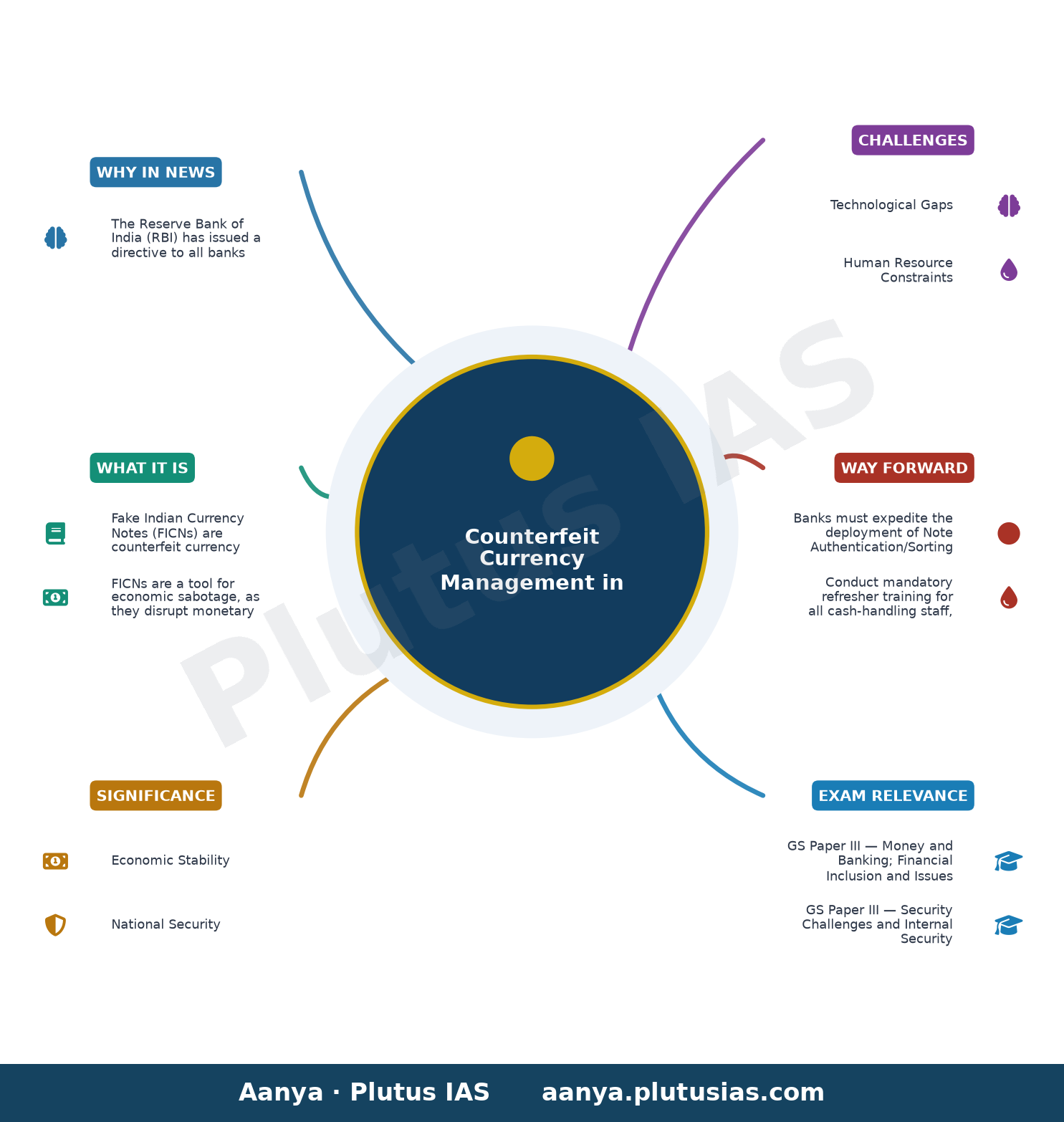
- GS Paper III — Money and Banking; Financial Inclusion and Issues | GS Paper III — Security Challenges and Internal Security
- Prelims: Counterfeit Currency, Fake Indian Currency Notes (FICN), Note Authentication Machines, Forged Note Vigilance Cells (FNV Cell), RBI Master Direction on Counterfeit Notes, Currency Chests, ATM Dispensation, Over-the-Counter Payments, Border Areas Security
- Essay: The Role of Technology in Combating Financial Crimes, Challenges in Maintaining Currency Integrity in a Digital Economy
Quick Revision: The RBI’s 2026 Master Direction mandates banks to use Note Authentication Machines, impound all counterfeit notes, and report them via FNV Cells, with strict penalties for non-compliance and a deadline of October 31, 2026, for staff training.
Why is this in the news?
The Reserve Bank of India (RBI) has issued a directive to all banks on July 31, 2026, emphasizing the inadequacy of existing measures to detect, report, and monitor Fake Indian Currency Notes (FICNs). The directive mandates enhanced training, technological upgrades, and stricter compliance mechanisms to strengthen the detection and reporting framework, highlighting the persistent threat posed by counterfeit currency to India’s financial system and national security.
Background
- Counterfeit currency poses a significant threat to monetary stability, financial integrity, and national security, as it undermines public trust in the currency and facilitates illicit activities such as terrorism financing and money laundering.
- The RBI, as the central monetary authority, is statutorily responsible for regulating and supervising currency management, including the detection and reporting of counterfeit notes under the Reserve Bank of India Act, 1934.
- The proliferation of FICNs has been a persistent challenge, with cross-border smuggling and technological advancements in counterfeiting techniques exacerbating the issue, particularly in border states like Jammu & Kashmir, Punjab, and Rajasthan.
- The RBI’s Master Direction on Counterfeit Notes (April 1, 2026) consolidates existing guidelines and introduces stricter penalties for non-compliance, reflecting the growing urgency to address this menace.
- Banks serve as the first line of defense in detecting counterfeit notes, given their role in currency circulation through branches, ATMs, and currency chests.
- The directive follows a review indicating inadequate efforts by some banks in detecting and reporting FICNs, necessitating a structured and time-bound action plan.
What are Fake Indian Currency Notes (FICNs) and the Regulatory Framework for their Detection?
- Fake Indian Currency Notes (FICNs) are counterfeit currency notes designed to resemble genuine Indian banknotes, often produced with the intent to deceive and circulate in the economy for illicit purposes.
- FICNs are a tool for economic sabotage, as they disrupt monetary stability, erode public confidence in the currency, and facilitate funding of illegal activities such as terrorism, smuggling, and organized crime.
- The detection of FICNs relies on identifying discrepancies in security features, such as watermarks, security threads, latent images, microtext, and intaglio printing, which are unique to genuine banknotes issued by the RBI.
- Banks are required to impound all detected FICNs and report them to the RBI through the Forged Note Vigilance Cells (FNV Cells), which analyze trends and identify hotspots for targeted interventions.
- Penalties for non-compliance include financial penalties for banks.
- The FNV Cells play a pivotal role in monitoring, analyzing, and reporting FICN data, enabling the RBI to devise strategies for capacity-building and outreach in high-risk areas, particularly border districts.
- The directive emphasizes the need for continuous training of cash-handling staff, with a focus on border areas, to ensure real-time detection and reporting of counterfeit notes.
Key Features
| Feature | Significance |
|---|---|
| Impounding of Counterfeit Notes | Mandatory retention of FICNs to prevent circulation and ensure forensic analysis for tracing sources. |
| Machine-Based Authentication | Use of Note Authentication/Sorting Machines in high-risk districts to enhance detection accuracy. |
| Training of Cash-Handling Staff | Focused programmes on security features of genuine banknotes to improve detection capabilities. |
| Forged Note Vigilance Cells (FNV Cells) | Dedicated units to analyse FICN trends, identify hotspots, and guide outreach efforts. |
| Penalty for Non-Compliance | Financial and operational penalties for banks failing to detect, report, or impound FICNs in remittances, ATMs, or over-the-counter transactions. |
Why it Matters
Economic Stability
- Prevents erosion of public trust in currency and financial systems by reducing the circulation of counterfeit notes.
- Mitigates inflationary pressures that could arise from unchecked counterfeit money entering the economy.
- Protects the integrity of monetary policy by ensuring the RBI’s currency management functions remain effective.
National Security
- Counterfeit currency is often linked to transnational organised crime, terrorism financing, and money laundering.
- Detection and reporting mechanisms strengthen border security by identifying FICN hotspots in districts with international borders.
- Supports intelligence agencies in tracing the origin and distribution networks of counterfeit currency.
Institutional Accountability
- Imposes strict compliance requirements on banks, ensuring systemic vigilance against counterfeit currency.
- Enhances transparency by mandating reporting of FICNs to the RBI, enabling data-driven policy interventions.
- Encourages banks to invest in technology and human resources for effective counterfeit detection.
Challenges
1. Technological Gaps
- Inadequate deployment of Note Authentication/Sorting Machines in rural and border-district branches.
- Limited access to advanced counterfeit detection tools in cooperative banks and regional rural banks.
- Dependence on manual inspection in branches lacking machine-based authentication, increasing error rates.
UPSC Link: GS-III: Security Challenges
2. Human Resource Constraints
- Insufficient training and refresher programmes for cash-handling staff, particularly in high-risk areas.
- High turnover rates among bank staff, leading to knowledge gaps in detecting sophisticated counterfeit notes.
- Language barriers and regional variations in staff awareness of security features of banknotes.
UPSC Link: GS-III: Human Resource Development
3. Operational Inefficiencies
- Delayed reporting of FICNs to the RBI, hampering timely forensic analysis and tracing of counterfeit networks.
- Non-compliance with impounding protocols, allowing counterfeit notes to re-enter circulation.
- Inadequate monitoring mechanisms within banks to ensure adherence to RBI guidelines.
UPSC Link: GS-III: Financial Sector Reforms
4. Cross-Border Threats
- Proliferation of high-quality counterfeit notes smuggled across porous borders, particularly in districts with international borders.
- Collusion between counterfeiters and bank employees or security personnel facilitating the circulation of FICNs.
- Inadequate coordination between RBI, banks, and law enforcement agencies in border regions.
UPSC Link: GS-III: Border Management
5. Public Awareness Deficit
- Lack of public education on identifying counterfeit notes, leading to unknowing acceptance and circulation.
- Misconceptions about the legal consequences of possessing or using counterfeit currency.
- Insufficient outreach by banks to educate customers on security features and reporting mechanisms.
UPSC Link: GS-II: Governance and Citizen Awareness
Challenges — UPSC Perspective
| Issue | Concern |
|---|---|
| Technological Lag | Insufficient machine-based authentication in high-risk branches. |
| Training Gaps | Inadequate refresher programmes for cash-handling staff. |
| Reporting Delays | Late submission of FICN data to RBI, hindering forensic analysis. |
| Border Vulnerability | High smuggling of counterfeit notes in districts with international borders. |
| Public Compliance | Low awareness among the public about detecting and reporting FICNs. |
| Institutional Penalties | Reluctance of banks to invest in detection infrastructure due to perceived costs. |
Way Forward
- Banks must expedite the deployment of Note Authentication/Sorting Machines in all border-district branches by December 2026.
- Conduct mandatory refresher training for all cash-handling staff, with priority for border-area branches by September 2026.
- Establish a real-time reporting system for FICNs to the RBI, reducing delays in forensic analysis.
- Strengthen coordination between RBI’s FNV Cells, banks, and law enforcement agencies to trace counterfeit networks.
- Launch public awareness campaigns, including workshops and digital content, to educate citizens on detecting counterfeit notes.
- Institute a quarterly audit mechanism within banks to assess compliance with FICN detection and reporting protocols.
- Develop a reward system for bank employees who report high-quality counterfeit notes or identify hotspots.
- Enhance inter-state and cross-border intelligence-sharing to disrupt counterfeit currency supply chains.
UPSC Value Addition
Keywords for Mains Answer-Writing
Fake Indian Currency Notes (FICNs) · counterfeit currency detection · Reserve Bank of India (RBI) Master Direction · currency authentication mechanisms · Forged Note Vigilance Cells (FNV Cell) · border-area currency monitoring · currency chest balances and ATM dispensations · penalties for non-compliance with RBI directives · currency authentication machines · currency circulation management
Concept Flow
Circulation of Counterfeit Notes → Erosion of Public Trust in Currency → RBI Issues Master Direction on FICN Detection → Banks Implement Detection Protocols → Training of Staff & Deployment of Machines → Improved Detection Rates → Detection of FICNs → Impounding & Reporting to RBI → Forensic Analysis & Tracing of Networks → Identification of Hotspots → Focused Border Security Measures → Disruption of Counterfeit Supply Chains → Public Awareness Campaigns → Reduced Unknowing Acceptance of FICNs → Strengthened Financial System Integrity
Prelims Practice Questions
Q1. Consider the following statements regarding the detection and reporting of Fake Indian Currency Notes (FICNs) as per the RBI Master Direction dated April 1, 2026:
1. Banks are mandated to train all cash-handling staff on the security features of genuine banknotes by October 31, 2026.
2. Branches located in border areas must prioritize training of staff by September 15, 2026.
3. Counterfeit notes detected must be returned to the tenderer to avoid legal complications.
4. Banks failing to comply with detection guidelines may face penalties from the RBI.
How many of the above statements are correct?
- Only one
- Only two
- Only three
- All four
Answer: Only three — Statements 1 and 2 are correct as per the RBI directive. Statement 3 is incorrect because counterfeit notes must be impounded, not returned. Statement 4 is correct as non-compliance may result in penalties.
Q2. Assertion (A): The Reserve Bank of India (RBI) has mandated that all detected Fake Indian Currency Notes (FICNs) must be reported to the Forged Note Vigilance Cells (FNV Cell) for analysis.
Reason (R): The RBI aims to identify hotspots and trends in FICN circulation to strengthen detection mechanisms.
Options:
A. Both A and R are true, and R is the correct explanation of A.
B. Both A and R are true, but R is not the correct explanation of A.
C. A is true, but R is false.
D. A is false, but R is true.
- A
- B
- C
- D
Answer: B — Both Assertion (A) and Reason (R) are true, and Reason (R) correctly explains Assertion (A) as the RBI mandates reporting to analyze trends and hotspots.
Q3. Match the following columns related to RBI directives on Fake Indian Currency Notes (FICNs):
Column I (Directive) | Column II (Compliance Deadline)
———————|—————————
a) Training of all cash-handling staff | 1) September 15, 2026
b) Training priority for border-area branches | 2) October 31, 2026
c) Submission of Action Taken Report (ATR) for border-area training | 3) November 7, 2026
Options:
A. a-2, b-1, c-3
B. a-1, b-2, c-3
C. a-3, b-1, c-2
D. a-2, b-3, c-1
- A
- B
- C
- D
Answer: A — The correct match is: a) Training of all cash-handling staff by October 31, 2026 (2); b) Training priority for border-area branches by September 15, 2026 (1); c) Submission of ATR for border-area training by September 22, 2026 (3).
Mains Practice Question
✍ The Reserve Bank of India (RBI) has recently strengthened its framework for the detection, reporting, and monitoring of Fake Indian Currency Notes (FICNs) through a Master Direction issued on April 1, 2026. Critically examine the efficacy of these measures in addressing the menace of counterfeit currency in India. Also, analyze the challenges that persist despite these directives and suggest measures to further strengthen the system. (15 Marks)
Approach: MODEL-ANSWER SKELETON:
1. **Introduction (2 Marks)**
– Define Fake Indian Currency Notes (FICNs) and their impact on the economy (inflation, terrorism financing, erosion of public trust).
– Mention the RBI Master Direction dated April 1, 2026, and its key provisions (mandatory training, impounding of counterfeit notes, reporting mechanisms, penalties for non-compliance).
2. **Efficacy of RBI Measures (5 Marks)**
– **Strengths:**
– Mandatory training for all cash-handling staff ensures uniform awareness of security features (e.g., micro-text, security thread, watermark).
– Prioritization of border-area branches (training by September 15, 2026) addresses high-risk zones.
– Use of Note Authentication/Sorting Machines in border districts enhances detection accuracy.
– Penalties for non-compliance (e.g., detection in currency remittances to RBI, ATM dispensations) act as deterrents.
– Forged Note Vigilance Cells (FNV Cells) enable data analysis to identify hotspots and trends.
– **Limitations:**
– Training may not be uniformly implemented across all banks, especially in remote areas.
– Over-reliance on machines may lead to false positives or negatives, requiring human oversight.
– Penalties, while stringent, may not be uniformly enforced across all banks.
– Cross-border collaboration with neighboring countries (e.g., Nepal, Bangladesh) remains weak, allowing FICN networks to persist.
3. **Challenges Persisting (5 Marks)**
– **Technological Gaps:**
– Outdated or poorly maintained authentication machines in rural branches.
– Sophistication of counterfeiters in replicating security features (e.g., holograms, latent images).
– **Operational Gaps:**
– Inadequate staffing in FNV Cells to analyze trends and conduct outreach.
– Lack of standardized reporting formats across banks, leading to inconsistencies.
– **Structural Gaps:**
– Limited coordination between RBI, NIA, and state police forces to dismantle FICN syndicates.
– Absence of a national database for FICNs to track and analyze circulation patterns.
4. **Suggested Measures (3 Marks)**
– **Institutional Strengthening:**
– Establish a **National FICN Task Force** under the NIA to coordinate efforts across agencies.
– Mandate **real-time reporting** of FICNs to a centralized RBI database for trend analysis.
– **Technological Upgradation:**
– Deploy **AI-driven authentication systems** in all currency chests and ATMs.
– Regular **audits of Note Authentication Machines** to ensure functionality.
– **Capacity Building:**
– **Quarterly refresher training** for cash-handling staff, with certification.
– **Public awareness campaigns** (e.g., mobile apps, social media) to educate citizens on identifying counterfeit notes.
– **Legal and Policy Reforms:**
– **Strict penalties** for possession or circulation of FICNs, including imprisonment.
– **Enhanced bilateral agreements** with neighboring countries to curb cross-border FICN smuggling.
5. **Conclusion (2 Marks)**
– Reiterate the importance of a **multi-pronged approach** combining technology, training, and inter-agency coordination.
– Emphasize that while the RBI’s directives are a significant step, their success hinges on **effective implementation, technological upgradation, and cross-sectoral collaboration**.
Source: RBI
Generated by AanyaAi for educational purpose.

- यूपी हाईकोर्ट ने स्कूल बस सुरक्षा पर दिया सख्त आदेश, डीएम को 1 माह में रिपोर्ट देने का निर्देश - September 22, 2026
- UP High Court Directs DM & Chief Secretary on School Vehicle Safety: Key Facts for UPSC/PCS - September 22, 2026
- पेरियार टाइगर रिजर्व में 6 नई प्रजातियाँ खोजी गईं, जानिए क्या हैं विशेषताएँ - September 22, 2026

No Comments