


06 Aug RBI’s New Loan Recovery Norms: Key Changes for UPSC 2027
✎ The RBI’s 2026 Amendment Directions mandate ethical, transparent, and proportionate loan recovery practices by regulated entities, effective from 1 January 2027, to balance creditor rights with borrower protection and align with…
Subject Relevance — Where This Topic Fits
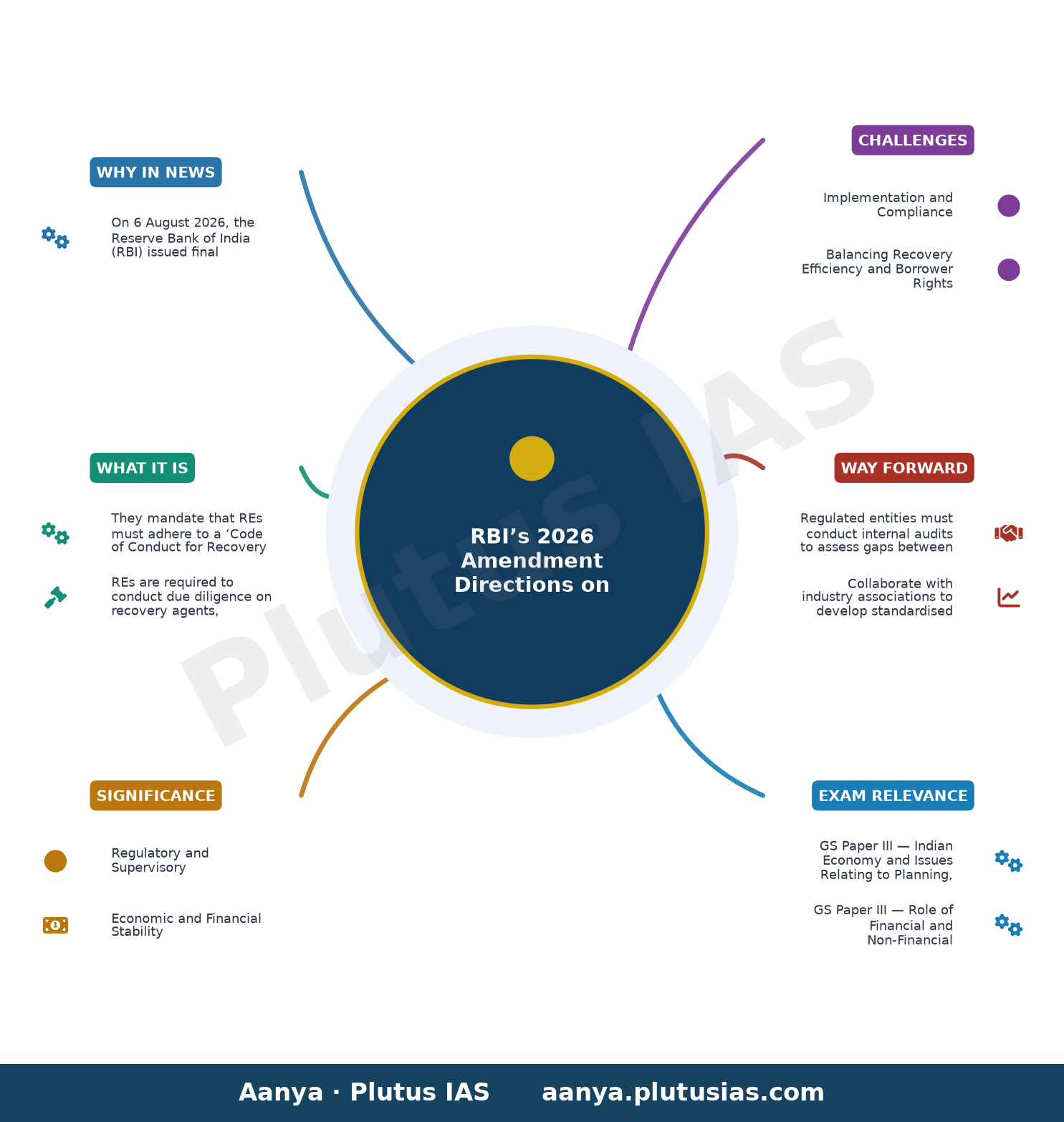
- GS Paper III — Indian Economy and Issues Relating to Planning, Mobilisation of Resources, Growth, Development and Employment | GS Paper III — Role of Financial and Non-Financial Institutions in Economic Development | GS Paper III — Inclusive Growth and Issues Arising from it | GS Paper III — Government Budgeting and Fiscal Policy
- Prelims: Recovery of Loans by Banks and Financial Institutions, RBI’s Regulatory Powers under Section 35A of the Banking Regulation Act, 1949, Fair Practices Code for Lenders, Non-Banking Financial Companies (NBFCs), Urban Co-operative Banks (UCBs), Regional Rural Banks (RRBs), Small Finance Banks (SFBs), Rural Co-operative Banks, Housing Finance Companies (HFCs), Digital Lending and Recovery Mechanisms
- Essay: Ethical Dimensions of Financial Governance: Balancing Duties of Creditors and Rights of Borrowers, The Role of Regulatory Institutions in Ensuring Social Justice in Economic Policies
Quick Revision: The RBI’s 2026 Amendment Directions mandate ethical, transparent, and proportionate loan recovery practices by regulated entities, effective from 1 January 2027, to balance creditor rights with borrower protection and align with global consumer protection standards.
Why is this in the news?
On 6 August 2026, the Reserve Bank of India (RBI) issued final Amendment Directions governing the conduct of regulated entities (REs) in loan recovery and the engagement of recovery agents. These directions, effective from 1 January 2027, follow a draft consultation process initiated on 20 May 2026 and incorporate stakeholder feedback to strengthen borrower protection while ensuring responsible lending practices across banks, NBFCs, co-operative banks, and housing finance companies. The move is part of RBI’s broader regulatory framework to enhance transparency, fairness, and accountability in financial sector operations, particularly in the context of rising digital lending and recovery mechanisms.
Background
- Prior to this amendment, the RBI had issued guidelines on fair practices codes for lenders, including the ‘Fair Practices Code for Lenders’ (2003, revised in 2012) and sector-specific directions for banks and NBFCs to govern loan recovery processes.
- The proliferation of digital lending platforms and fintech innovations has introduced new challenges in loan recovery, necessitating updated regulatory frameworks to address issues such as harassment, coercion, and misuse of borrower data.
- The RBI’s move reflects a growing emphasis on ethical banking and responsible business conduct, particularly in light of increasing complaints related to unethical recovery practices and data privacy violations.
- The directions are applicable to all regulated entities, including commercial banks, small finance banks, local area banks, regional rural banks, urban and rural co-operative banks, all India financial institutions, NBFCs, and housing finance companies.
What are the RBI’s 2026 Amendment Directions on Loan Recovery and Recovery Agents?
- They mandate that REs must adhere to a ‘Code of Conduct for Recovery Agents’, which includes guidelines on professional behaviour, transparency in communication, and prohibition of harassment or coercion during recovery operations.
- REs are required to conduct due diligence on recovery agents, including background checks, training on ethical practices, and regular audits of their conduct to ensure compliance with the directions.
- The directions prohibit the use of force, intimidation, or misrepresentation by recovery agents and mandate that all communication with borrowers must be in a language understood by the borrower and documented for transparency.
- For technology-based recovery mechanisms, such as the use of financed mobile devices for loan recovery, REs must ensure that borrower data is protected, consent is obtained, and mechanisms are in place to address grievances promptly.
- REs are required to establish a grievance redressal mechanism for borrowers, including a designated nodal officer to handle complaints related to recovery practices and a timeline for resolution.
Key Features
| Feature | Significance |
|---|---|
| Fair treatment to borrowers during recovery | Ensures adherence to principles of natural justice and prevents coercive recovery practices, aligning with RBI’s mandate of responsible lending. |
| Code of conduct for recovery agents | Standardises agent behaviour, reduces harassment complaints, and enhances borrower confidence in regulated entities. |
| Due diligence and training for agents | Mandates structured training on legal rights of borrowers, ethical practices, and grievance redressal mechanisms. |
| Technology-based recovery mechanisms | Regulates use of mobile devices for recovery, ensuring data privacy and preventing unauthorised access to borrower information. |
| Effective grievance redressal framework | Institutionalises a structured process for borrower complaints against recovery agents, enhancing accountability. |
Why it Matters
Regulatory and Supervisory
- Strengthens RBI’s oversight on recovery practices across all regulated entities, including NBFCs, co-operative banks, and housing finance companies.
- Harmonises recovery norms with global best practices, particularly in fair debt collection.
- Enhances transparency in recovery operations, reducing systemic risks of misconduct.
Economic and Financial Stability
- Promotes financial inclusion by ensuring borrowers are not deterred by unethical recovery practices.
- Reduces non-performing assets (NPAs) by fostering sustainable repayment behaviour.
- Mitigates reputational risks for regulated entities, thereby stabilising the financial ecosystem.
Consumer Protection
- Upholds borrower rights under the Consumer Protection Act, 2019, and RBI’s Fair Practices Code.
- Curbs harassment and mis-selling by recovery agents, aligning with the spirit of the SARFAESI Act, 2002.
- Encourages ethical lending and borrowing culture, reducing defaults due to distress.
Challenges
1. Implementation and Compliance
- Regulated entities may face operational challenges in aligning existing recovery processes with new directives.
- Monitoring and auditing compliance across diverse entities (e.g., co-operative banks vs. NBFCs) could prove resource-intensive.
- Resistance from recovery agents accustomed to traditional practices may hinder smooth adoption.
UPSC Link: https://upsc.gov.in
2. Balancing Recovery Efficiency and Borrower Rights
- Stringent recovery norms may slow down the resolution of NPAs, impacting credit flow to the economy.
- Risk of borrowers exploiting loopholes in recovery processes to delay repayments.
- Need for a calibrated approach to ensure recovery efficiency without compromising borrower dignity.
UPSC Link: https://upsc.gov.in
3. Technological and Data Privacy Risks
- Regulated entities must ensure robust cybersecurity for technology-based recovery mechanisms.
- Risk of data breaches or misuse of borrower information in digital recovery processes.
- Ensuring compliance with the Digital Personal Data Protection Act, 2023, in recovery operations.
UPSC Link: https://upsc.gov.in
Challenges — UPSC Perspective
| Issue | Concern |
|---|---|
| Operational alignment | Adapting existing recovery frameworks to new RBI directives within the stipulated timeline. |
| Agent resistance | Overcoming reluctance among recovery agents to adopt ethical and transparent practices. |
| Monitoring and enforcement | Ensuring consistent compliance across diverse regulated entities with varying scales of operations. |
| Borrower exploitation | Preventing borrowers from misusing new norms to delay repayments without genuine financial constraints. |
| Data privacy in tech-based recovery | Safeguarding borrower data while leveraging digital tools for recovery operations. |
Way Forward
- Regulated entities must conduct internal audits to assess gaps between current practices and RBI’s new directives.
- Collaborate with industry associations to develop standardised training modules for recovery agents.
- Establish dedicated grievance redressal cells to address borrower complaints promptly and transparently.
- Leverage RBI’s regulatory sandbox to pilot technology-based recovery mechanisms while ensuring compliance with data privacy laws.
- Conduct periodic reviews of recovery agent performance and penalise non-compliance with the code of conduct.
- Sensitise borrowers about their rights under the new framework to foster trust and cooperation.
- Integrate ethical recovery practices into the corporate governance policies of regulated entities.
UPSC Value Addition
Keywords for Mains Answer-Writing
Reserve Bank of India (RBI) · Responsible Business Conduct Directions · Recovery of Loans · Engagement of Recovery Agents · Fair Treatment to Borrowers · Code of Conduct for Recovery Agents · Technology-based Recovery Mechanisms · Regulated Entities (REs) · Financial Sector Regulation · Consumer Protection in Banking · Ethical Debt Recovery · Banking Regulation Act, 1949 · RBI Circulars and Directions · Financial Inclusion and Borrower Rights · Regulatory Framework for NBFCs and Banks
Concept Flow
RBI identifies gaps in ethical recovery practices among regulated entities → Draft amendment directions circulated for stakeholder feedback → Feedback incorporated and final directions issued → Directions enforced from January 1, 2027 → Regulated entities align recovery frameworks with new norms → Borrower rights strengthened and recovery processes standardised.
Prelims Practice Questions
Q1. Consider the following statements regarding the Reserve Bank of India’s (RBI) Amendment Directions on ‘Conduct of Regulated Entities in Recovery of Loans and Engagement of Recovery Agents’:
1. The directions apply exclusively to scheduled commercial banks and exclude cooperative banks.
2. The directions mandate the conduct of due diligence, training, and adherence to a code of conduct for recovery agents.
3. The directions permit the use of technology-based mechanisms for recovery of loan dues, including through financed mobile devices of borrowers.
4. The directions came into effect immediately upon issuance.
How many of the above statements are correct?
- Only one
- Only two
- Only three
- All four
Answer: Only three — Statements 2 and 3 are correct. Statement 1 is incorrect as the directions apply to all regulated entities, including cooperative banks. Statement 4 is incorrect as the directions come into effect from January 1, 2027.
Q2. Assertion (A): The RBI’s Amendment Directions on recovery of loans emphasize fair treatment of borrowers during the recovery process.
Reason (R): The directions aim to balance the rights of lenders with the protection of borrowers from unethical recovery practices.
- Both A and R are true, and R is the correct explanation of A
- Both A and R are true, but R is not the correct explanation of A
- A is true, but R is false
- A is false, but R is true
Answer: Both A and R are true, and R is the correct explanation of A — Both the assertion and reason are true, and the reason correctly explains the assertion. The RBI’s directions explicitly mandate fair treatment of borrowers to prevent unethical recovery practices.
Q3. Match the following columns regarding the RBI’s regulatory framework for recovery agents:
Column I (Regulated Entity Type)
1. Commercial Banks
2. Urban Co-operative Banks
3. Non-Banking Financial Companies (NBFCs)
4. Housing Finance Companies
Column II (Applicable Directions)
A. RBI (Commercial Banks – Responsible Business Conduct) Fourth Amendment Directions, 2026
B. RBI (Urban Co-operative Banks – Responsible Business Conduct) Fourth Amendment Directions, 2026
C. RBI (Non-Banking Financial Companies – Responsible Business Conduct) Third Amendment Directions, 2026
D. RBI (Housing Finance Companies) Third Amendment Directions, 2026
- 1-A, 2-B, 3-C, 4-D
- 1-B, 2-A, 3-D, 4-C
- 1-C, 2-D, 3-A, 4-B
- 1-D, 2-C, 3-B, 4-A
Answer: 1-A, 2-B, 3-C, 4-D — The correct matches are: 1-A (Commercial Banks), 2-B (Urban Co-operative Banks), 3-C (NBFCs), and 4-D (Housing Finance Companies).
Mains Practice Question
✍ The Reserve Bank of India (RBI) has recently issued Amendment Directions on the ‘Conduct of Regulated Entities in Recovery of Loans and Engagement of Recovery Agents’. Critically examine the necessity and implications of these directions for ensuring ethical debt recovery practices in India. Also, analyse how these directions align with the broader objectives of financial inclusion and consumer protection in the banking sector. (15 Marks)
Approach: MODEL-ANSWER SKELETON:
1. **Introduction (2 marks)**
– Context: Rising NPAs and aggressive recovery practices in India’s financial sector.
– Objective of RBI Directions: To regulate the conduct of regulated entities (REs) and recovery agents, ensuring fairness and transparency.
2. **Key Provisions of the Directions (4 marks)**
– Fair treatment of borrowers during recovery (e.g., no harassment, respect for privacy).
– Code of conduct for recovery agents, including due diligence, training, and accountability.
– Restrictions on technology-based recovery mechanisms (e.g., no remote disabling of financed mobile devices).
– Applicability across all REs: Commercial banks, NBFCs, co-operative banks, housing finance companies, etc.
3. **Necessity of the Directions (4 marks)**
– Addressing unethical practices: Examples of coercive recovery methods (e.g., public shaming, threats).
– Protecting vulnerable borrowers: Small farmers, MSMEs, and low-income households.
– Aligning with global best practices: RBI’s adherence to principles of responsible lending and consumer protection.
– Legal basis: Powers under the Banking Regulation Act, 1949, and RBI Act, 1934.
4. **Implications for Financial Inclusion and Consumer Protection (3 marks)**
– Positive impact: Enhanced trust in formal banking systems, reduced distress in borrower communities.
– Challenges: Potential increase in operational costs for REs, need for robust grievance redressal mechanisms.
– Long-term benefits: Sustainable credit culture, reduced NPA stress, and improved borrower-lender relationships.
5. **Critique and Way Forward (2 marks)**
– Gaps: Limited coverage of informal credit sectors (e.g., money lenders).
– Recommendations: Strengthening monitoring mechanisms, public awareness campaigns, and periodic reviews of the directions.
Balance: Present both the strengths and limitations of the directions, supported by RBI’s regulatory philosophy and contemporary challenges in India’s financial sector.
Source: RBI
Generated by AanyaAi for educational purpose.

- राज्यों द्वारा सरकारी प्रतिभूतियों की नीलामी में ₹16,750 करोड़ का सफल संग्रह - September 22, 2026
- RBI Auction Results: State Govt Securities Yield Trends & Implications for UPSC 2026 - September 22, 2026
- सुप्रीम कोर्ट का चुनाव आयोग से बड़ा सवाल: दिल्ली में 33 लाख मतदाताओं को नोटिस देने का क्या आधार है? - September 22, 2026

No Comments