


01 May Reform or Reinforce? The Jurisdiction Debate in PIL
This article covers “Daily Current Affairs”
SYLLABUS MAPPING : GS Paper 2 (Government Policies & Interventions, e-Governance)
FOR PRELIMS : PIL – Meaning, Eligibility, Cases
FOR MAINS : Examine the role of PIL in expanding the horizon of Fundamental Rights in India. Support your answer with at least three landmark judicial precedents.
Why in News?
The Centre has raised concerns over the expanding scope of PIL, arguing that courts are overstepping into policy domains — a debate that sits at the intersection of judicial review, separation of powers, and access to justice.
Origin and history of PIL
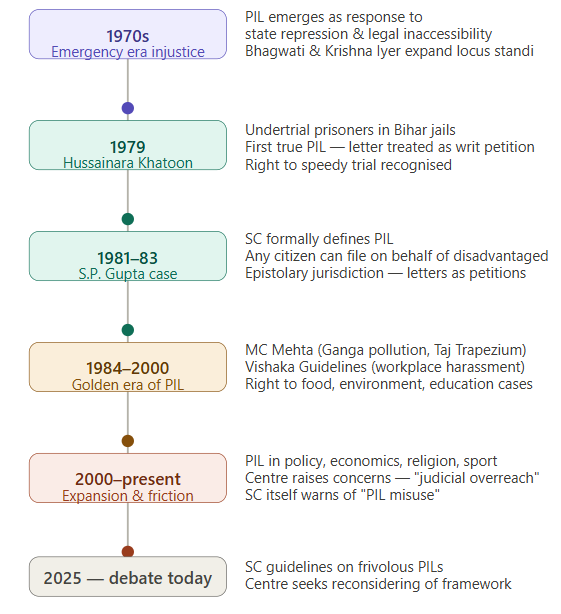
PIL (Public Interest Litigation) emerged in India in the late 1970s as a transformative judicial innovation. The credit goes primarily to Justice P.N. Bhagwati and Justice V.R. Krishna Iyer, who fundamentally reinterpreted locus standi — the traditional requirement that only an aggrieved party could approach a court.
Working mechanism and importance
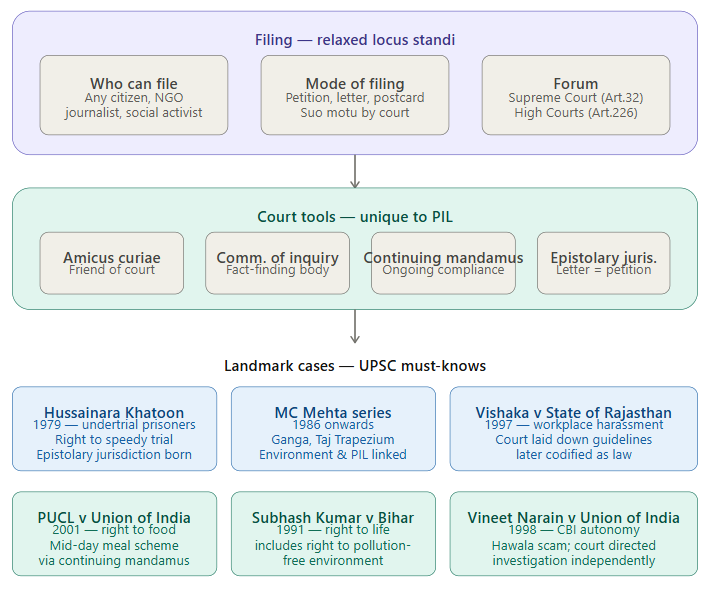
PIL operates through a relaxed procedural architecture embedded in Articles 32 and 226 of the Constitution.
Challenges and the current debate
Judicial Overreach
- Encroachment on executive & legislature domain
- Courts directing policy (e.g., liquor ban on highways, school admissions, urban demolitions)
- Separation of powers eroded — Montesquieu’s trias politica principle challenged
- SC in Subramanian Swamy v Raju (2014): courts must not substitute executive judgment
- SC in Uttaranchal v Balwant Singh Chaufal (2010): listed five abuses of PIL
- Sabarimala & Delhi Sealing — executive-style orders
Frivolous & Motivated PILs
- “PIL” used for personal/political vendetta
- Publicity Interest Litigation — media-driven cases
- PIL to delay infrastructure projects (NHAI, railways)
- SC observation: “Some litigants use PIL as a weapon not a shield”
- Docket explosion — PIL adds to case backlog (4.8 crore cases pending in India, 2024)
- SC imposed costs on frivolous PIL filers (2022)
- Need for preliminary screening mechanism
Democratic & Accountability Concerns
- Non-elected judges making policy — democratic deficit
- Who guards the guardians? Accountability of judiciary absent in PIL context
- Ambush litigation — govt. blindsided in court without proper data or deliberation
- Parliament & state legislatures bypassed
- Federalism concerns: HC PILs against Centre
- Nehru’s question: “Can the court reform society? Or is that legislature’s job?” — now a live debate
Procedural & Structural Gaps
- No codified PIL law — entirely judge-made
- Inconsistent application across High Courts
- Amicus curiae role sometimes partisan
- Court-appointed committees — no statutory basis
- Implementation deficit: PIL orders not enforced (e.g., right to food — hunger deaths continue)
- Suomoto: no adversarial check — judge is both petitioner and adjudicator
Way forward — reform without regression
-
- Law Commission Report 228 (2009) recommends a PIL law defining eligibility, scope & costs.
- Parliament should enact clear locus standi criteria — “genuine public interest” defined by statute.
-
- Preliminary bench to filter PILs before admission — model from UK’s “standing” test & leave requirement.
- Mandatory cost imposition on frivolous PILs; SC Benchbook on PIL already provides guidelines.
-
- Courts should apply Wednesbury unreasonableness test — intervene only when policy is manifestly arbitrary.
- Policy domain (economic, social, defence) must remain with elected bodies — doctrine of deference.
-
- Empowered NHRC, NCSC, NCST, Consumer Forums & NGT to absorb cases from judiciary.
- National Green Tribunal already handles env. PILs — model for sectoral specialisation.
-
- PIL for individual rights violations, custodial deaths, bonded labour, child rights must stay unrestricted.
- Access to justice for the marginalised is a constitutional imperative — Art. 39A (DPSP) mandates it.
Guiding principle: Reform PIL’s scope — not its soulCourts should be the last resort for the voiceless, not the first tool for the resourceful.
Prelims Question
-
- The power of the Supreme Court to entertain PILs is explicitly defined under the Legal Services Authorities Act, 1987.
- In PIL cases, the Supreme Court may adopt an “inquisitorial” approach by appointing commissions to collect evidence when the petitioner lacks resources.
- A PIL can be filed against a private company if it is performing a public function, provided the State is joined as a respondent.
A. 1 and 2 only
B. 2 and 3 only
C. 3 only
D. 1, 2, and 3
Explanation:
- Statement 1 is incorrect: PIL is not defined in any statute or act; it is a judicial innovation based on the interpretation of Articles 32 and 226.
- Statement 2 is correct: The Court often departs from the adversarial system to appoint fact-finding commissions in PILs.
- Statement 3 is correct: While primarily against the “State” (Art 12), a PIL can include a private party if it performs public functions, but the State must be a party to the suit.
Mains Question
“The PIL jurisdiction has shifted from representing the voiceless to becoming a tool for agenda-driven litigation.” In light of recent government submissions, discuss whether the PIL framework needs a fundamental recalibration.

- India’s Youth Unemployment and Education Crisis - August 5, 2026
- India’s Sports Infrastructure and the 2036 Olympics Ambition - August 5, 2026
- Critical Minerals: The Foundation of Strategic Power - August 4, 2026

No Comments