


02 Jan Repealing and Amending Act, 2025: Legislative Housekeeping for a Modern India
This article covers “Daily Current Affairs” and From Repealing and Amending Act, 2025: Legislative Housekeeping for a Modern India
SYLLABUS MAPPING
GS-3- Polity and Governance- Repealing and Amending Act, 2025: Legislative Housekeeping for a Modern India
FOR PRELIMS
What is the Repealing and Amending Act, 2025?
FOR MAINS
Why was the Repealing and Amending Act, 2025, enacted?
Why in the News?
Every legal system is a living record of its past, and India’s statute book is no exception. Over time, it accumulated numerous laws that once served a purpose but gradually lost relevance. Some dated back to 1886, while others were temporary amendment Acts that had already exhausted their utility. As governance modernises—through digital administration, updated postal services, and streamlined procedures—such outdated laws increasingly became a source of interpretational burden rather than legal clarity. Against this backdrop, the Repealing and Amending Act, 2025 steps in as a thoughtful legislative editor, undertaking a quiet but essential clean-up of India’s statute book.

A Balanced Approach: Repeal and Amend
The Act adopts a two-pronged approach—repealing obsolete enactments while amending core laws to remove inconsistencies and update statutory references.
First Schedule: Lists 71 Central Acts (1886–2023) that are repealed permanently because they are obsolete, redundant, or have served their limited purpose.
Second Schedule: Specifies targeted amendments to important existing laws to modernise language, correct drafting errors, and align provisions with present-day administrative realities.
Did You Know?
Since 2014, India has repealed over 1,500 obsolete Central laws, significantly simplifying the legal framework and improving ease of governance.
Clearing the Statute Book
1. Colonial-era enactments and laws superseded by newer legislation.
2. Amendment Acts whose changes are already absorbed into principal Acts, Acquisition and nationalisation laws that have completed their intended objectives.
3. By removing such legislative clutter, the Act improves legal certainty and navigability of statutes.
Refining the Legal Framework Through Targeted Amendments
1. Modernisation of official communication: In the Code of Civil Procedure, 1908 and the General Clauses Act, 1897, outdated references like “registered post” are replaced with “speed post with registration and proof of delivery”, aligning legal procedure with contemporary India Post services.
2. Indian Succession Act, 1925: Section 213 is removed, eliminating community-based disparities in probate requirements and enhancing equality and uniformity in succession law.
3. Disaster Management Act, 2005: The term “prevention” is substituted with “preparation”, accurately reflecting the operational mandate of disaster management authorities and strengthening institutional clarity.
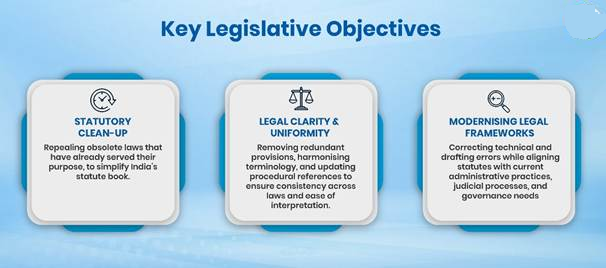
Legislative Objectives of the Amendments
Broadly, the amendments serve three key objectives:
1. Modernisation of administrative and procedural references.
2. Equity and fairness by removing discriminatory or outdated provisions.
3. Clarity and consistency in statutory language to reduce litigation and ambiguity.
Savings Clause: Ensuring Continuity Amid Repeals
A critical feature of the Act is its Savings Clause, which ensures that legal clean-up does not disrupt continuity:
1. Existing rights, liabilities, obligations, and proceedings remain unaffected.
2. Past actions taken under repealed laws continue to remain valid.
3. Jurisdiction of courts, legal procedures, customary practices, privileges, offices, and appointments remain intact.
4. Repealed laws are not revived indirectly.
Q. The Repealing and Amending Act, 2025 reflects legislative housekeeping essential for good governance. Discuss the significance of the Act in improving legal clarity, administrative efficiency, and continuity in India’s governance framework
(250 words)

- Before New Taxes, Make Every Rupee Count: Fiscal Discipline and Outcome-Based Governance in Tamil Nadu - August 20, 2026
- A Palestinian State as the Foundation for Regional Peace - August 20, 2026
- A Vision for an Inclusive Bangladesh: Democracy, Minority Rights and India’s Neighbourhood - August 19, 2026

No Comments