Return of the Cheetah: India’s Science-Led Grassland Restoration Mission

Return of the Cheetah: India’s Science-Led Grassland Restoration Mission

This article covers “Daily Current Affairs” and From  Return of the Cheetah: India’s Science-Led Grassland Restoration Mission

SYLLABUS MAPPING  

GS-3 – Environment, Ecology & Biodiversity- Return of the Cheetah: India’s Science-Led Grassland Restoration Mission

FOR PRELIMS

What were the major reasons behind the extinction of the cheetah in India?

FOR MAINS

What challenges does India face in making the cheetah population self-sustaining?

Why in the News? 
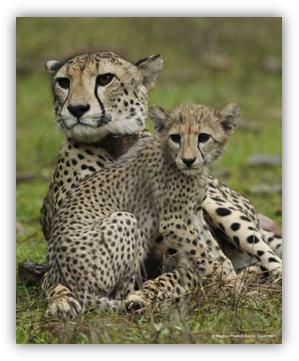
In the golden hues of a September dawn in 2022, eight majestic cheetahs from the Namibian savannas touched down on Indian soil, their paws marking the first steps of a species long absent from the subcontinent. This historic moment, presided over by Prime Minister Shri Narendra Modi at Kuno National Park in Madhya Pradesh, heralded Project Cheetah, the world’s first inter-continental translocation of a large carnivore. Fast-forward to November 2025: Mukhi, the first cheetah cub born on Indian soil, has herself become a mother to five healthy cubs, symbolizing not just biological resurgence but a profound testament to human stewardship over nature’s delicate balance. Launched on September 17, 2022, under the aegis of the Ministry of Environment, Forest and Climate Change (MoEFCC) and spearheaded by the National Tiger Conservation Authority (NTCA), Project Cheetah embodies India’s unwavering commitment to biodiversity restoration. Drawing from the 2013 Action Plan and Supreme Court directives, it seeks to reintroduce the Asiatic cheetah (Acinonyx jubatus, declared extinct in India in 1952) as a flagship species, fostering ecosystem health across vast landscapes.

Historical Context: From Extinction to Renaissance of the Cheetah in India

The cheetah occupies a unique place in India’s ecological and cultural memory. Once celebrated in royal courts as a swift and graceful hunting companion, the Asiatic cheetah (Acinonyx jubatus venaticus) historically roamed across a vast portion of the subcontinent—from Punjab in the north to Tirunelveli in Tamil Nadu, and from Gujarat and Rajasthan in the west to Bengal in the east. Its natural habitats included scrub forests, dry grasslands, savannas, and open arid–semi-arid ecosystems, forming the apex species of India’s grassland biome.
Extinction in Independent India
1. Excessive hunting and sport-killing, including widespread coursing with trained cheetahs
2. Poaching of both adults and prey species
3. Large-scale habitat conversion for agriculture and human settlements
4. Collapse of natural prey base, especially blackbuck and chinkara
5. Low genetic diversity and slow reproductive rate, making populations less resilient to disturbances
The last confirmed sighting of wild cheetahs in India occurred in 1947, when three individuals were shot in the Sal forests of Koriya district (present-day Chhattisgarh). In 1952, the Government of India officially declared the species extinct—marking a profound loss for India’s grassland-savanna ecosystems.

Laying the Groundwork: Choosing Kuno National Park

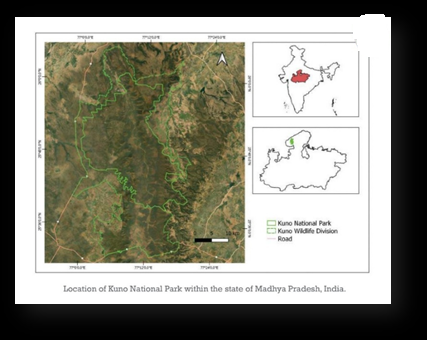
Efforts to revive the cheetah population took shape over several decades, culminating in expert recommendations that identified Kuno National Park (Madhya Pradesh) as the most suitable reintroduction site. The choice was supported by:
Relocation of 24 villages (1,545 families) through incentivised voluntary rehabilitation
Creation of 6,258 hectares of inviolate grassland and open scrub habitat
A landscape with low human density, compatible prey diversity, and ecological contiguity with other protected areas
Kuno thus emerged as the most viable landscape for establishing a free-ranging cheetah population.

A Biodiversity Renaissance: Project Cheetah and Global Alignment

By 2022, India operationalised the long-delayed dream of bringing back the cheetah. The initiative was aligned with:
1. Convention on Biological Diversity (CBD) commitments
2. Global best practices in species recovery and reintroduction science
3. UN Sustainable Development Goal 15 (Life on Land)
India became the first country in the world to attempt a transcontinental wild cheetah introduction, sourcing individuals from genetically diverse southern African populations.

Leadership and Diplomacy: The Role of Prime Minister Narendra Modi

Prime Minister Narendra Modi’s sustained commitment played a decisive role in transforming the project from a vision into a lived reality. His contributions included:

1. Directing the formulation of the 2022 Action Plan for cheetah reintroduction
2. Facilitating pioneering MoUs with Namibia (July 2022) and South Africa (January 2023)
3. Personally releasing the first eight Namibian cheetahs on 17 September 2022 at Kuno National Park
4. Using public platforms like Mann Ki Baat to deepen national awareness and engage citizens
5. Highlighting conservation milestones, including the first cheetah births in 2023 and the historic second-generation litter born in November 2025
His continued oversight ensured technical coordination among forest departments, global experts, and conservation biologists.

Project Status as of December 2025: A New Beginning

India’s cheetah population now comprises 30 individuals:
12 adults
9 sub-adults
9 cubs
This includes:
11 founder stock (imported cheetahs)
19 India-born cheetahs, signalling the beginning of an ecologically stable, breeding population.
The successful birth of second-generation cubs marks a significant step toward establishing a self-sustaining cheetah metapopulation, fulfilling India’s long-term vision of restoring grassland ecosystems and reversing historical biodiversity loss.

Project Cheetah: India’s Global Model of Science-Led, Community-Driven Rewilding

By linking Project Cheetah with Mission LiFE and India’s G20 vision of “One Earth, One Family, One Future,” Prime Minister Narendra Modi has elevated the initiative from a national conservation programme to a global symbol of ecological restoration and climate-aligned rewilding. Personally monitoring its progress, he has ensured that the roar of the cheetah—silent in India for more than 70 years—resounds once again across its ancient grasslands.

Timeline of Key Events (2022–2025)

Date Event / Milestone
17 Sep 2022 First batch of 8 African cheetahs (5 females, 3 males) flown from Namibia to India; released into quarantine enclosures at Kuno National Park (KNP), Madhya Pradesh.
Feb 2023 Second batch of 12 cheetahs translocated from South Africa under a bilateral MoU.
2023 (First 6 months) First cheetah births in India in 70 years—cubs born to imported females.
2024 onwards Phase-wise soft releases into open wilderness as per international protocols.
2024–25 Expansion plans to additional habitats; November 2025: Botswana gifts 8 cheetahs to India.

Objectives & Strategic Framework of Project Cheetah

Category Details
Primary Objective Establish a viable metapopulation of 60–70 cheetahs across 17,000 km² (Kuno–Gandhi Sagar landscape). Restore degraded grassland and open forest ecosystems.
Core Principles Ecological Restoration: Rebuild grasslands/open forests.
Climate Benefits: Enhanced carbon sequestration.
Flagship Approach: Cheetah as umbrella species supporting wider biodiversity.
Founder Stock Introduction (Phase 1) Introduce 12–14 reproductively capable, genetically diverse, predator-wary cheetahs.
Sourced from Namibia & South Africa (and later other African countries).
Initial release in 748 km² core area → expansion to 3,200 km² landscape.
Metapopulation Linkage (Phase 2) Link Kuno National Park with Gandhi Sagar Wildlife Sanctuary (368 km² sanctuary + 2,500 km² habitat).
Long-term target: 60–70 cheetahs across the connected landscape.
Self-Sustaining Growth Aim for 5% annual net population growth.
Expected to reach carrying capacity in 15 years, considering mortality and supplementation.
Budget ₹39 crore allocated for Phase I under Centrally Sponsored Scheme – Project Tiger.
Monitoring Framework Follows IUCN Guidelines (2013).
Uses GPS collars, camera traps, and 734–816 km prey transects for population & habitat monitoring.

Milestones and Achievements: Science-Driven Progress

1. Translocation Milestones

Parameter Details
Total Cheetahs Translocated 20
Source Countries Namibia and South Africa
Transport Indian Air Force C-17 Globemaster
Distance Covered 7,900 km
Morbidity During Transit Zero
Significance World’s longest and most complex live-predator translocation completed successfully

2. Early Breeding Success Indicators

Indicator Explanation
Early reproduction observed Yes — indicates rapid ecological adaptation
Habitat compatibility Grassland–savanna structure suitable
Prey base Adequate for sustainable population
Stress levels Low, showing good adjustment to environment
Biological inference Kuno landscape capable of sustaining long-term cheetah population

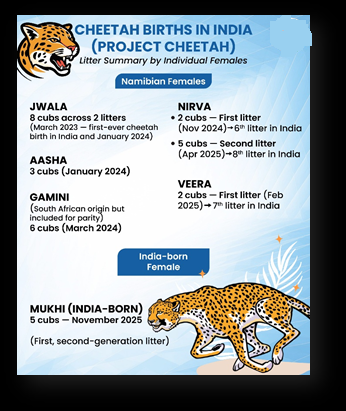
3. Litter Records (2023–2025)

Cheetah (Origin) Litter Details Number of Cubs Notes
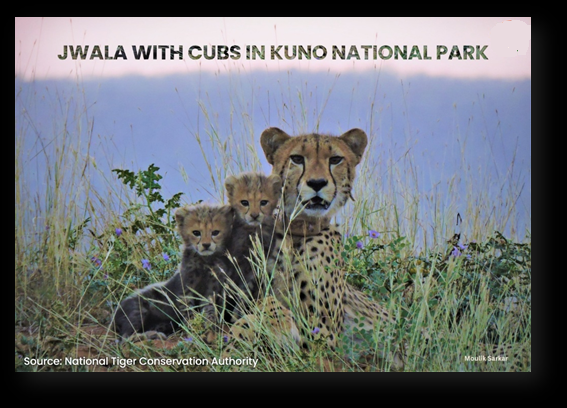
Jwala (Namibia) 2 litters (Mar 2023 & Jan 2024) 8 First two successful litters in India
Aasha (Namibia) Jan 2024 3 Healthy cub survival
Gamini (South Africa) Mar 2024 6 Strong reproductive success
Nirva (Namibia) Nov 2024 (6th litter in India) 2 Continued successful breeding
Apr 2025 (8th litter in India) 5 High litter size
Veera (Namibia) Feb 2025 (7th litter in India) 2 Consistent reproduction
Mukhi (India-born) Nov 2025 5 First second-generation breeding milestone

4. Spatial Ecology (Home-Range Studies)

Individual / Group Home Range (km²) Ecological Significance
Aasha (female) 121 km² Stable female range
Aasha’s sub-adult males 1,508 km² Natural dispersal behaviour
Male coalition Agni–Vayu 1,819 km² Strong territorial establishment
Gamini + 4 cubs 6,160 km² Large movement, healthy habitat use
Jwala + 4 cubs 3,139 km² Good spatial expansion

International Collaboration for Project Cheetah

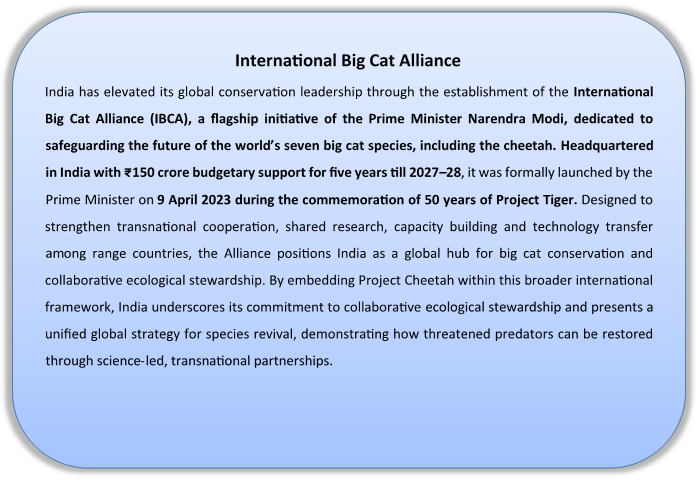
1. International Big Cat Alliance (IBCA)

Component Details
Launch Date 9 April 2023
Financial Support ₹150 crore till 2027–28
Focus Conservation of seven big cat species globally
Key Functions Research cooperation, capacity building, global conservation coordination
Relevance to Project Cheetah Provides international scientific exchange, strengthens global big cat conservation frameworks

2. India–Africa Conservation Diplomacy

Partner Country Year Key Agreements / Actions Significance for Project Cheetah
South Africa Jan 2023 MoU on long-term cheetah translocation, monitoring, veterinary training Builds sustained cheetah source population; ensures scientific transfer and capacity building
Namibia 2022 World’s first intercontinental wild-to-wild cheetah translocation Historic global precedent in carnivore conservation; foundational to Project Cheetah
Botswana 2025 Gift of 8 cheetahs to India Enhances genetic diversity; deepens conservation diplomacy
Joint Initiatives (All African partners) Ongoing Field operations, airlifts, research, training, genetic planning Creates an international cheetah metapopulation model and global conservation alliance

3. Overall International Impact

Aspect Explanation
Global ecological mission Project Cheetah shows that threatened species can be revived through coordinated global efforts
Transnational collaboration Demonstrates pioneering India–Africa conservation partnership
Science-led approach Use of global expertise in genetics, ecology, veterinary science
Model for future reintroductions Sets precedent for future large carnivore rewilding worldwide

Conclusion

Project Cheetah symbolizes the rebirth of an ecological legacy. With thriving breeding, expanding ranges, and strong community stewardship, India has shown that extinct species can return—when science, diplomacy, and public participation converge.
As cheetahs sprint again across India’s grasslands, the world witnesses a powerful message: Rewilding is possible. Restoration is achievable. Hope can be engineered.

Prelims question:

Q. With reference to Project Cheetah, consider the following statements:

1. It is the world’s first inter-continental wild-to-wild translocation of a large carnivore.
2. The first batch of cheetahs under the project was brought to India from South Africa in September 2022.
3. Kuno National Park was chosen as the primary release site because it had already undergone village relocation and grassland restoration.
4. Project Cheetah is being implemented by the National Tiger Conservation Authority (NTCA).
How many of the above statements are correct?
(a) One only
(b) Two only
(c) Three only
(d) All four

Answer: C

Mains Question:

Q.  Project Cheetah is often described as India’s most ambitious ecological rewilding initiative. Discuss how its scientific strategy, international collaborations, and community-driven conservation efforts together make it a global model for species restoration.

                                                                                                                                                                                                                                                                                                                                                                                                                                                                                                                                                                                                                                                                                                                                                                                                                                                                                                                                                      (250 words)

No Comments

Post A Comment