


06 Jan Revised NBS Rates for Rabi 2025–26: Strengthening Soil Health and Farmer Welfare
This article covers “Daily Current Affairs” and From Revised NBS Rates for Rabi 2025–26: Strengthening Soil Health and Farmer Welfare
SYLLABUS MAPPING
GS-3- Agriculture- Revised NBS Rates for Rabi 2025–26: Strengthening Soil Health and Farmer Welfare
FOR PRELIMS
What is the Nutrient-Based Subsidy (NBS) Scheme?
FOR MAINS
What role does the NBS Scheme play in sustainable agriculture?
Why in the News?
The Nutrient-Based Subsidy (NBS) Scheme has been in the news following the Union Government’s approval and notification of revised subsidy rates for phosphatic and potassic (P&K) fertilisers for the Rabi season 2025–26. This decision aims to ensure the availability of essential nutrients at affordable prices for farmers amid global volatility in fertiliser prices and supply chains, while also promoting balanced fertilisation and correcting the excessive use of urea. The revision reflects the government’s dual focus on soil health restoration, crop productivity, and fiscal discipline, in line with its broader strategy for sustainable and climate-resilient agriculture.
Genesis and Rationale of the NBS Scheme
Introduced on 1 April 2010, the NBS Scheme marked a paradigm shift from product-based subsidies to nutrient-based pricing in India’s fertiliser sector.
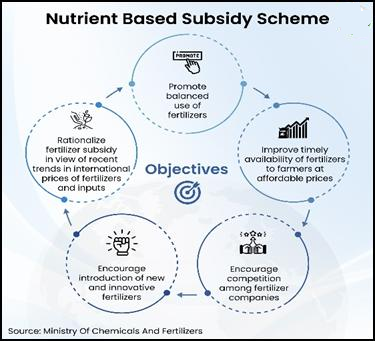
Key Objectives:
1. Promote balanced use of nutrients (N, P, K, S)
2. Prevent soil degradation caused by skewed fertiliser consumption
3. Encourage innovation and competition in the fertiliser market
4. Rationalise subsidy expenditure in line with global price movements
By linking subsidies to nutrient content rather than fertiliser type, the scheme empowers farmers to adopt soil- and crop-specific nutrient management practices.
Core Features of the Nutrient-Based Subsidy (NBS) Framework
| Feature | Key Components | Significance / Impact |
|---|---|---|
| 1. Nutrient-Based Subsidy Structure | Subsidy provided per kg of nutrients: • Nitrogen (N): ₹43.02/kg • Phosphate (P): ₹47.96/kg • Potash (K): ₹2.38/kg • Sulphur (S): ₹2.87/kg |
Promotes balanced fertilisation, discourages excessive use of urea, and improves soil health and nutrient efficiency |
| 2. Expansion of Fertiliser Grades | • 25 P&K grades till Rabi 2023–24 • 28 grades from Kharif 2024 onwards • Inclusion of fortified and complex fertilisers such as: – NPK (11:30:14) + Mg, Zn, B, S – Urea–SSP (5:15:0:10) – Fortified SSP (Mg, Zn, B) |
Enhances micronutrient availability, corrects soil deficiencies, and improves crop yield response and sustainability |
| 3. Decontrolled Pricing with Regulatory Oversight | • Fertiliser companies fix MRPs • Government ensures prices remain reasonable • Subsidy passed on at the point of sale |
Balances market efficiency with farmer protection, ensures affordability while encouraging industry competition |
NBS Rates for Rabi 2025–26: Key Highlights
Effective Period: 1 October 2025 – 31 March 2026
Estimated Budgetary Requirement: ₹37,952.29 crore
DAP Subsidy Increased:
₹29,805/MT (Rabi 2025–26)
₹21,911/MT (Rabi 2024–25)
Strategic Significance:
Shields farmers from global price volatility
Ensures an uninterrupted nutrient supply during peak Rabi season
Supports cereal, oilseed, and pulse production
Promotion of Fortified and Specialty Fertilisers
To tackle micronutrient deficiencies:
Boron: Additional ₹300/MT
Zinc: Additional ₹500/MT
This strengthens:
Crop resilience
Nutrient-use efficiency
Long-term soil fertility
Operational Management and Compliance Mechanisms under NBS
| Mechanism | Key Provisions | Purpose / Outcome |
|---|---|---|
| 1. Price and Cost Monitoring | • Mandatory submission of audited cost data by fertiliser companies • MRP rationality assessed by the Department of Fertilisers (DoF) |
Prevents price manipulation, ensures subsidy reflects actual costs, and safeguards farmer interests |
| 2. Regulation of Profit Margins | • Profit caps prescribed: – Importers: 8% – Manufacturers: 10% – Integrated units: 12% • Excess profits recovered by the government |
Ensures fair returns to industry while preventing rent-seeking and fiscal leakages |
| 3. Transparency at Retail Level | Mandatory disclosure on fertiliser bags: • Maximum Retail Price (MRP) • Subsidy per bag and per kg • Overcharging is punishable under Essential Commodities Act, 1955 |
Enhances consumer awareness, strengthens accountability, and deters black-marketing |
Digital Governance: Integrated Fertiliser Management System (iFMS)
The iFMS platform ensures end-to-end transparency through:
1. Dealer registration
2. Stock and movement tracking
3. Import and production monitoring
4. DBT and MIS integration
Regular Centre–State coordination via video conferences ensures regional equity and timely grievance redressal.
Economic and Fiscal Dimensions
Subsidy Support:
1. ₹2.04 lakh crore allocated between 2022–23 and 2024–25
2. Balances farmer affordability with fiscal sustainability
Market Impact:
1. Encourages domestic manufacturing
2. Reduces import dependence
3. Aligns subsidy policy with global fertiliser trends
Major Achievements under NBS
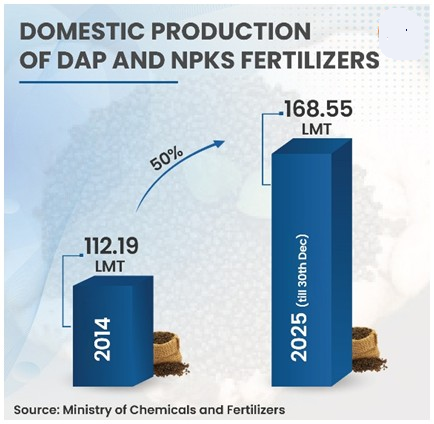
1. Growth in Domestic P&K Production
DAP & NPKS output increased by over 50%
From 112.19 LMT (2014) to 168.55 LMT (2025)
Supports Atmanirbhar Bharat in fertilisers
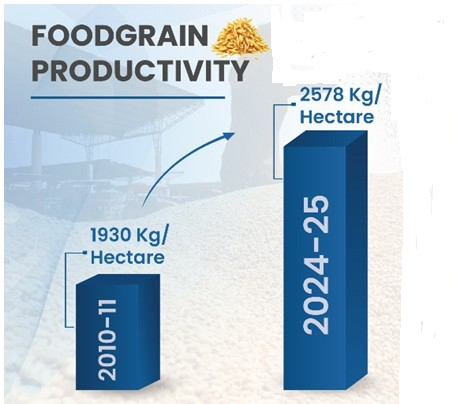
2. Improvement in Soil Health and Crop Productivity
Enhanced multi-nutrient availability
Foodgrain yield increased:
1930 kg/ha (2010–11)
2578 kg/ha (2024–25)
Environmental and Sustainability Dimension
1. Reduces nitrogen overuse and soil degradation
2. Encourages sulphur and micronutrient application
3. Supports climate-resilient and resource-efficient agriculture
4. Aligns with SDG-2 (Zero Hunger) and SDG-12 (Sustainable Consumption)
Conclusion
The Nutrient-Based Subsidy (NBS) Scheme has emerged as a cornerstone of India’s fertiliser and agricultural policy, harmonising productivity, sustainability, and farmer welfare. The Rabi 2025–26 revisions demonstrate a responsive policy approach that balances global market realities with domestic agricultural needs. By expanding fertiliser grades, strengthening domestic production, promoting fortified nutrients, and leveraging digital governance through iFMS, the scheme has significantly improved soil health, crop yields, and fertiliser accessibility.
link: Best ias coaching in delhi
Q. The Nutrient-Based Subsidy (NBS) Scheme represents a paradigm shift in India’s fertiliser subsidy regime. In the context of the revised NBS rates for Rabi 2025–26, examine how the scheme promotes balanced fertilisation, soil health, and sustainable agriculture while addressing fiscal and market challenges
(250 words)

- Before New Taxes, Make Every Rupee Count: Fiscal Discipline and Outcome-Based Governance in Tamil Nadu - August 20, 2026
- A Palestinian State as the Foundation for Regional Peace - August 20, 2026
- A Vision for an Inclusive Bangladesh: Democracy, Minority Rights and India’s Neighbourhood - August 19, 2026

No Comments