


24 Nov Rewiring India’s Power Sector: The Electricity (Amendment) Bill, 2025
This article covers “Daily Current Affairs” and From Rewiring India’s Power Sector: The Electricity (Amendment) Bill, 2025
SYLLABUS MAPPING
GS- 2 – Governance and Polity- Rewiring India’s Power Sector: The Electricity (Amendment) Bill, 2025
FOR PRELIMS
What role will State Electricity Regulatory Commissions (SERCs) play under the new Bill?
FOR MAINS
What is the significance of creating an Electricity Council?
Why in the News?
The Electricity (Amendment) Bill, 2025 has recently gained national attention as the government introduced it to modernize and reform India’s power sector. The Bill marks a significant shift from the traditional monopoly-based electricity supply model to a competitive, performance-driven framework. It aims to ensure reliable, affordable, and high-quality power for all consumers—rural and urban households, farmers, shops, and industries—while promoting transparency, accountability, and efficient use of existing infrastructure. The proposed amendments are expected to strengthen consumer rights, encourage private participation, and create a future-ready electricity ecosystem aligned with India’s growing economic needs.
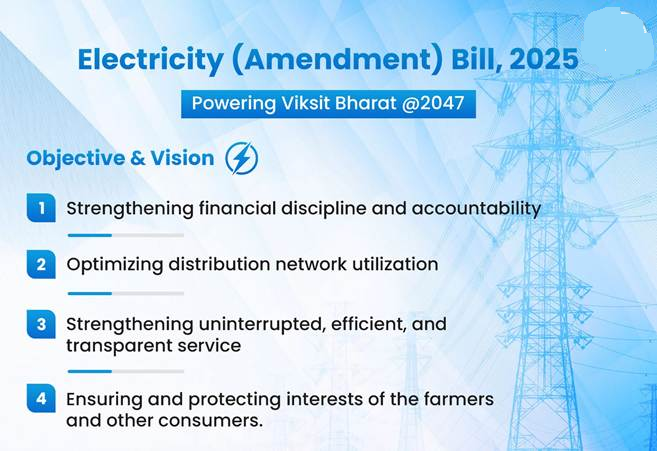
Correcting the Current: The Push Behind the Electricity (Amendment) Bill, 2025
The Electricity (Amendment) Bill, 2025 was introduced to address long-standing structural challenges in India’s power distribution segment. The Bill seeks to reduce inefficiencies, ease the financial distress of distribution companies (discoms), foster competition, ensure cost-optimised network use, and enhance consumer choice. These reforms are intended to create a more competitive, transparent, and financially sustainable power sector.
Key Issues Driving the Amendment
1. Chronic financial losses of discoms: Persistent deficits due to poor billing efficiency, high Aggregate Technical & Commercial (AT&C) losses, and outdated infrastructure have weakened discom viability across several states. Many utilities struggle to pay generators on time, affecting the entire power value chain.
2. Lack of competition in electricity supply: Consumers, especially industrial ones, are tied to a single discom, limiting service quality and innovation. The absence of competitive supply options has kept tariffs high and efficiency low.
3. Distortions due to cross-subsidisation: Industrial and commercial users pay inflated tariffs to subsidise agricultural and domestic consumers.
This has:
increased the cost of manufacturing,
reduced global competitiveness, and
discouraged industrial investment in energy-intensive sectors.
The ISTS Model: Efficient, Fair, and Reliable
India already operates a highly successful Inter-State Transmission System (ISTS), which serves as a model for competitive efficiency and cooperative infrastructure use. The ISTS is built on the principle of shared transmission networks, where both public and private Transmission Service Providers (TSPs)—including Powergrid, a Central Public Sector Undertaking—participate in creating and operating assets.
Under the regulatory oversight of the Central Electricity Regulatory Commission (CERC), TSPs compete for developing ISTS projects, leading to lower capital costs, reduced construction timelines, and improved project execution standards. Importantly, users of the ISTS pay monthly charges that are pooled and fairly redistributed among TSPs based on their respective assets and performance. This transparent settlement system ensures that:
1. No TSP is disadvantaged,
2. Cost recovery is stable and predictable, and
3. System reliability remains consistently high across the national transmission grid.
The ISTS model has emerged as a benchmark for efficient infrastructure development and fair cost-sharing, providing a template for reforms in the distribution sector as envisaged under the Electricity (Amendment) Bill, 2025.
Powering Reform: Core Pillars of the Bill
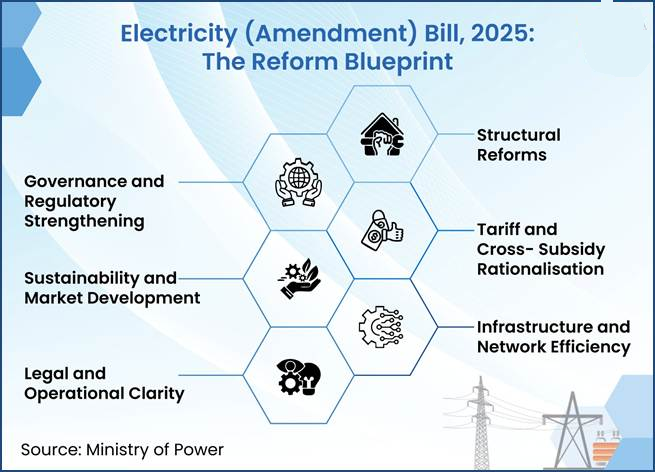
The Electricity (Amendment) Bill, 2025, sets the stage for a more efficient, environmentally and financially sustainable, transparent, and consumer-focused power sector. It blends structural reforms with regulatory clarity to modernise electricity distribution across India. By aligning policy with evolving needs, the Bill aims to deliver quality service, financial discipline, and sustainable growth.
The Bill promotes fair competition between government and private distribution companies in electricity supply, overseen by State Electricity Regulatory Commissions (SERCs). This approach is expected to enhance service quality, boost operational efficiency, and offer electricity supply to the industrial sector at a reasonable cost. By shifting from a monopoly-based supply to performance-driven delivery, it fosters a more accountable and consumer-oriented power sector, while protecting the interests of the farmers and other consumers.
Prelims question:
Q. Consider the following statements about the Inter-State Transmission System (ISTS):
1. Both public and private Transmission Service Providers (TSPs) can participate in ISTS development.
2. ISTS charges are pooled and redistributed among TSPs based on asset performance.
3. ISTS is regulated by the State Electricity Regulatory Commissions (SERCs).
Which of the statements given above are correct?
(a) 1 and 2 only
(b) 2 and 3 only
(c) 1 and 3 only
(d) 1, 2 and 3
Answer: A
Mains Question:
Q. The Electricity (Amendment) Bill, 2025 marks a decisive transition from monopoly to regulated competition in India’s power distribution sector.” Discuss how the Bill aims to reform distribution, rationalise tariffs, and strengthen consumer rights
(250 words)

- RBI’s Shrinking Real-Rate Cushion Amid Rising Inflation and Strong Demand - September 21, 2026
- India’s NGOs at a New Funding Crossroads - September 21, 2026
- Deep-Sea Discovery, Environmental Responsibility - September 19, 2026

No Comments