


26 Sep Rupee Depreciation & FCNR(B) Impact: RBI Report Insights for UPSC Aspirants
✎ The FCNR(B) scheme, through its concessional swap window, temporarily strengthened the rupee in early September 2026, but the gains were reversed by a surge in crude oil prices, highlighting India’s vulnerability to global…
Subject Relevance — Where This Topic Fits
- GS Paper III — Indian Economy: Issues relating to planning, mobilization of resources, growth, development and employment; Inclusive growth and issues arising from it; Government Budgeting; Effects of liberalization on the economy; Changes in industrial policy and their effects on industrial growth; Infrastructure: Energy, Ports, Roads, Airports, Railways etc.; Investment models. | GS Paper III — Money and Banking: Financial Intermediaries including Commercial Banks, NBFCs, Insurance Companies, Pension Funds; Role of RBI; Monetary Policy; Capital Market; Money Market; External Sector; Balance of Payments; Foreign Exchange Reserves; Trade Policy; FDI and FII
- Prelims: FCNR(B) deposits, RBI’s concessional swap window, Liquidity Adjustment Facility (LAF), Headline Inflation, Core Inflation, Foreign Direct Investment (FDI), FDI equity inflows, Crude oil price volatility, Rupee depreciation, Gross Domestic Product (GDP) growth
- Essay: The interplay between global commodity prices and domestic macroeconomic stability, India’s external sector resilience amid global headwinds
Quick Revision: The FCNR(B) scheme, through its concessional swap window, temporarily strengthened the rupee in early September 2026, but the gains were reversed by a surge in crude oil prices, highlighting India’s vulnerability to global commodity price shocks and the RBI’s role in managing exchange rate volatility.
Why is this in the news?
The Reserve Bank of India’s (RBI) monthly bulletin highlights the temporary appreciation of the Indian rupee in early September 2026, driven by substantial FCNR(B) deposit inflows through the RBI’s concessional swap window, followed by a reversal due to a spike in crude oil prices. This episode underscores the sensitivity of India’s exchange rate to global commodity price movements and the role of foreign exchange interventions in managing liquidity and exchange rate stability.
Background
- The FCNR(B) scheme, introduced by the RBI, allows banks to raise foreign currency deposits from non-resident Indians (NRIs) at concessional swap rates to bolster foreign exchange reserves and stabilize the rupee.
- In June 2026, the RBI operationalized a concessional swap window under the FCNR(B) scheme, attracting significant foreign currency inflows as commercial banks mobilized $133 billion.
- The scheme was closed one month ahead of its original September 30, 2026 deadline due to strong participation, reflecting heightened investor confidence and the attractiveness of the concessional terms.
- Crude oil prices, a critical determinant of India’s trade deficit and inflation, surged in late August and early September 2026, driven by geopolitical tensions in West Asia, exerting depreciation pressure on the rupee.
- India’s external sector has faced persistent challenges from elevated global commodity prices, particularly crude oil, which accounts for a significant share of the country’s import bill.
- The RBI’s liquidity management operations, including the Liquidity Adjustment Facility (LAF), play a pivotal role in absorbing surplus liquidity generated by foreign exchange interventions and managing inflationary pressures.
What is the FCNR(B) Scheme?
- The Foreign Currency Non-Resident (Bank) [FCNR(B)] scheme is a foreign exchange deposit scheme introduced by the RBI to enable banks in India to accept deposits from non-resident Indians (NRIs) in designated foreign currencies such as USD, GBP, EUR, JPY, and AUD.
- Deposits under FCNR(B) are maintained in foreign currency, thereby insulating the depositor and the bank from exchange rate risks, as the principal and interest are payable in the same foreign currency.
- The scheme was introduced to attract foreign exchange resources into India, support the balance of payments, and stabilize the rupee by reducing reliance on volatile short-term capital flows.
- Under the concessional swap window introduced in June 2026, banks were offered a swap facility at a concessional rate to convert the foreign currency deposits into rupees, thereby reducing the cost of raising foreign exchange for the banking system.
- The scheme’s closure a month ahead of schedule reflected strong market participation and the RBI’s assessment of achieving its objectives of foreign exchange accumulation and rupee stability.
- FCNR(B) deposits are exempt from the requirement of maintaining a Cash Reserve Ratio (CRR) and Statutory Liquidity Ratio (SLR) for the banks, providing an additional incentive for participation.
- The scheme is governed by the provisions of the Foreign Exchange Management Act (FEMA), 1999, and is subject to periodic review by the RBI to align with evolving macroeconomic conditions.
Key Features
| Feature | Significance |
|---|---|
| FCNR(B) Deposit Scheme | Provided temporary exchange-rate stability by attracting $133 billion in foreign currency deposits, closing one month ahead of schedule due to strong inflows. |
| Crude Oil Price Spike | Elevated global crude prices in September 2026 exerted depreciation pressure on the Indian rupee, reversing earlier gains from FCNR(B) flows. |
| Systemic Liquidity Surplus | FCNR(B) inflows led to surplus liquidity of Rs 4.27 trillion in August, moderating to Rs 4.27 trillion by late September due to tax outflows and RBI measures. |
| Headline Inflation Trend | Headline inflation rose to 4.8% in August 2026, driven by food, beverages, fuel, and core components, indicating persistent price pressures. |
| Resilient GDP Growth | Q1:2026-27 GDP growth remained robust despite external headwinds, supported by sustained domestic demand across industry and services sectors. |
Why it Matters
Exchange Rate Management
- The FCNR(B) scheme demonstrated the RBI’s use of foreign currency deposits to stabilise the rupee during periods of volatility, highlighting the role of capital flows in exchange rate management.
- The reversal of rupee gains due to crude oil price spikes underscores the vulnerability of emerging market currencies to external commodity price shocks.
- Short-term exchange rate stability via FCNR(B) must be balanced against the risks of sudden capital reversals and liquidity surges.
Monetary Policy and Liquidity
- Surplus liquidity generated by FCNR(B) inflows required RBI intervention to moderate excess funds, reflecting the challenges of managing liquidity in a high-inflation environment.
- The moderation of liquidity in September 2026, driven by tax outflows and RBI measures, highlights the interplay between fiscal operations and monetary policy.
- Persistent liquidity surpluses can distort financial markets, necessitating calibrated liquidity absorption tools such as reverse repos or variable rate reverse repos.
Inflation Dynamics
- The uptick in headline inflation to 4.8% in August 2026, driven by food and fuel components, signals the need for vigilant supply-side management and calibrated monetary policy responses.
- Core inflation excluding precious metals has risen from ultra-low levels, indicating broadening price pressures beyond volatile food and fuel items.
- Inflation persistence amid global commodity price volatility necessitates a multi-pronged approach, including supply-side interventions and demand management.
Capital Flows and FDI
- Net FDI inflows reached $7.4 billion in July 2026, the highest in five years, reflecting improved investor confidence and structural attractiveness of India’s services sectors.
- Major FDI recipient sectors—communication, financial, and computer services—align with India’s digital transformation and services-led growth model.
- Mauritius, UAE, and the US accounted for ~70% of FDI equity inflows, underscoring the role of bilateral investment treaties and tax treaties in attracting capital.
Macroeconomic Resilience
- Despite external headwinds such as crude oil price volatility and geopolitical tensions in West Asia, India’s GDP growth remained resilient in Q1:2026-27, supported by domestic demand.
- High-frequency indicators in August 2026 reflected sustained industrial and services sector activity, indicating broad-based economic momentum.
- Resilience in growth amid global uncertainty highlights the importance of domestic demand as a stabilising force in India’s macroeconomic framework.
Challenges
1. Volatility in Global Commodity Prices
- Spikes in crude oil prices directly impact India’s trade balance, inflation, and exchange rate, necessitating strategic reserves and hedging mechanisms.
- Dependence on imported crude exposes the economy to terms-of-trade shocks, requiring diversification of energy sources and promotion of alternative fuels.
- Policy responses must balance immediate stabilisation with long-term structural reforms to reduce import dependency.
UPSC Link: GS III: Indian Economy and issues relating to planning, mobilisation of resources
2. Managing Surplus Liquidity and Inflation Trade-offs
- Excess liquidity from FCNR(B) inflows can fuel asset price bubbles and inflationary pressures, requiring proactive liquidity absorption by the RBI.
- Balancing liquidity management with growth objectives is challenging, especially when fiscal operations (e.g., tax outflows) interact with monetary policy.
- The RBI must calibrate its tools—reverse repos, variable rate repos, and open market operations—to ensure price stability without stifling growth.
UPSC Link: GS III: Monetary Policy and its instruments
3. Exchange Rate Stability vs. Capital Flow Volatility
- Short-term stabilisation via FCNR(B) deposits risks creating dependency on volatile capital flows, which can reverse abruptly during global shocks.
- The RBI faces a dilemma between defending the rupee and preventing excessive currency appreciation, which can harm export competitiveness.
- A flexible exchange rate regime with managed interventions is essential to navigate global financial cycles while safeguarding macroeconomic stability.
UPSC Link: GS III: Balance of Payments and Foreign Exchange Reserves
4. Persistent Inflationary Pressures
- Food and fuel inflation remain structural challenges, requiring targeted supply-side interventions such as agricultural reforms and strategic stock management.
- Core inflation excluding precious metals has risen, indicating second-round effects that may necessitate tighter monetary policy if unchecked.
- Inflation targeting must be complemented by fiscal discipline and structural reforms to address supply bottlenecks.
UPSC Link: GS III: Inflation and its control mechanisms
5. Attracting Sustainable FDI Flows
- While FDI inflows surged in July 2026, ensuring their sustainability requires improving ease of doing business, reducing regulatory uncertainty, and strengthening dispute resolution mechanisms.
- Over-reliance on specific sectors (e.g., services) and source countries (e.g., Mauritius, UAE) poses concentration risks that must be diversified.
- Policy continuity and investor-friendly reforms are critical to maintain FDI momentum amid global economic uncertainties.
UPSC Link: GS III: Foreign Capital and its impact on the economy
Challenges — UPSC Perspective
| Issue | Concern |
|---|---|
| Crude Oil Price Volatility | Impacts trade balance, inflation, and exchange rate stability, requiring strategic reserves and energy diversification. |
| Liquidity Surplus Management | Excess liquidity from FCNR(B) inflows risks inflation and asset price bubbles, necessitating calibrated RBI interventions. |
| Inflation Persistence | Food and fuel inflation remain structural, requiring supply-side reforms and calibrated monetary policy responses. |
| Exchange Rate Stability | Balancing rupee stability with export competitiveness is challenging amid volatile capital flows and global shocks. |
| FDI Sustainability | Ensuring long-term FDI inflows requires improving business environment, regulatory certainty, and sectoral diversification. |
| Macroeconomic Resilience | Maintaining growth amid external headwinds demands robust domestic demand and structural reforms. |
Government Initiatives — Must-Memorise for Prelims
- Foreign Currency Non-Resident (Bank) [FCNR(B)] Deposit Scheme
Way Forward
- Enhance strategic crude oil reserves and diversify energy sources to mitigate volatility impacts on the trade balance and inflation.
- Strengthen liquidity management tools, including variable rate reverse repos and open market operations, to absorb surplus liquidity without disrupting growth.
- Implement targeted supply-side reforms in agriculture and logistics to address structural inflation in food and fuel segments.
- Promote export competitiveness through infrastructure upgrades and trade facilitation measures to offset rupee appreciation pressures.
- Diversify FDI sources by improving ease of doing business, reducing regulatory uncertainty, and expanding investment in manufacturing and green energy.
- Maintain flexible exchange rate policies with judicious interventions to balance stability and export competitiveness.
- Strengthen coordination between fiscal and monetary policies to manage liquidity surges and inflationary pressures effectively.
- Monitor global geopolitical developments and commodity price trends to preemptively adjust macroeconomic policies.
UPSC Value Addition
Keywords for Mains Answer-Writing
Foreign Currency Non-Resident (FCNR) deposits · Rupee exchange rate dynamics · Reserve Bank of India (RBI) liquidity management · Current Account Deficit (CAD) and crude oil prices · Foreign Direct Investment (FDI) trends in India · Monetary Policy Framework · Inflation targeting and food inflation · Capital Account Convertibility · Surplus liquidity and monetary transmission · Fiscal-monetary coordination in India
Concept Flow
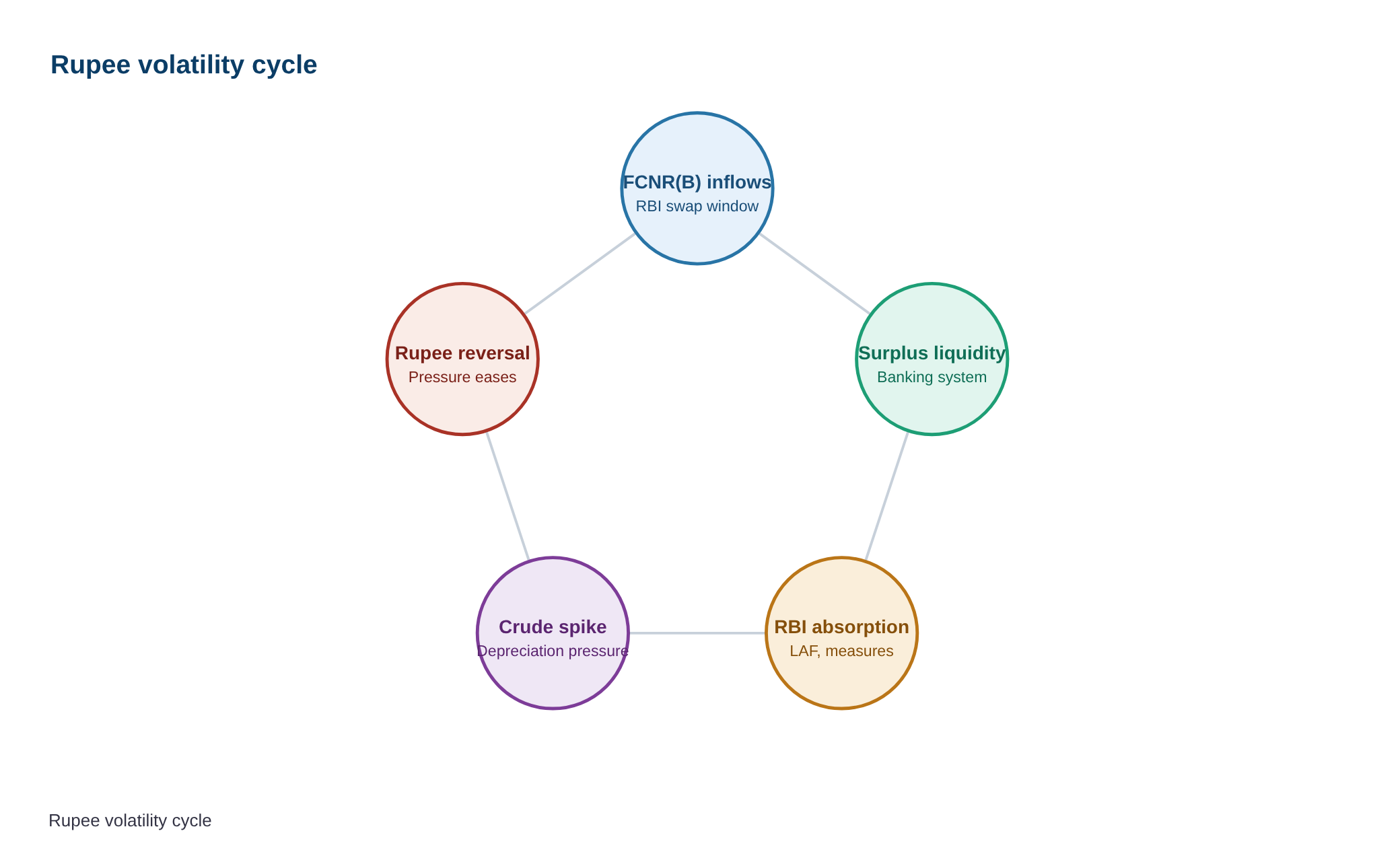
FCNR(B) Deposit Inflows → Surplus Liquidity in Banking System → RBI Liquidity Absorption Measures → Moderation of Liquidity Surplus → Crude Oil Price Spike → Higher Import Costs → Trade Deficit Widening → Rupee Depreciation Pressure → Rupee Depreciation → Imported Inflation → Rise in Headline and Core Inflation → Inflation Uptick → Potential Monetary Policy Tightening → Impact on Growth and Credit Demand → Strong FDI Inflows → Capital Account Surplus → Exchange Rate Stability (Temporary) → Global Geopolitical Tensions → Commodity Price Volatility → Macroeconomic Instability Risks
Prelims Practice Questions
Q1. Consider the following statements regarding the Foreign Currency Non-Resident (FCNR) deposits in India:
1. FCNR deposits are denominated in foreign currencies and are not subject to exchange rate risk for depositors.
2. The RBI’s concessional swap window for FCNR(B) deposits was introduced to attract foreign exchange inflows and stabilise the rupee.
3. FCNR(B) deposits are eligible for interest rate subsidies provided by the Government of India.
4. The FCNR(B) scheme was operationalised in June 2026 and closed one month ahead of its original deadline.
How many of the above statements are correct?
- Only one
- Only two
- Only three
- All four
Answer: All four — Statements 1, 2, and 4 are correct. Statement 3 is incorrect as FCNR(B) deposits do not receive interest rate subsidies from the Government of India; they are subject to market-determined interest rates.
Q2. Which of the following factors contributed to the depreciation of the Indian rupee in September 2026 as per the RBI Bulletin?
A. Surge in Foreign Portfolio Investor (FPI) outflows
B. Spike in global crude oil prices
C. Reduction in Foreign Direct Investment (FDI) inflows
D. Decline in FCNR(B) deposit mobilisation
- A and B
- B and D
- A, B and C
- B only
Answer: B and D — The depreciation of the rupee in September 2026 was primarily driven by the spike in global crude oil prices (Statement B) and the reversal of gains from FCNR(B) deposit flows (Statement D). Statements A and C are not mentioned as contributing factors in the RBI Bulletin.
Q3. Assertion (A): The RBI’s durable liquidity measures in September 2026 moderated surplus liquidity in the banking system.
Reason (R): Surplus liquidity in the banking system is measured by the amount of funds parked by banks in the Liquidity Adjustment Facility (LAF) window.
In the context of the above two statements, which one of the following is correct?
- Both A and R are true, and R is the correct explanation of A
- Both A and R are true, but R is not the correct explanation of A
- A is true, but R is false
- A is false, but R is true
Answer: Both A and R are true, but R is not the correct explanation of A — Both the Assertion (A) and Reason (R) are true. The RBI’s durable liquidity measures in September 2026 did moderate surplus liquidity, and surplus liquidity is indeed measured by funds parked in the LAF window.
Mains Practice Question
✍ The resilience of the Indian economy in recent times has been juxtaposed against volatile global headwinds, including geopolitical tensions and commodity price shocks. In this context, critically examine the role of the Reserve Bank of India’s (RBI) monetary policy framework in maintaining macroeconomic stability, with particular reference to the management of liquidity, exchange rate dynamics, and inflation targeting. (15 Marks)
Approach: MODEL-ANSWER SKELETON:
1. **Introduction (2 Marks)**: Define the RBI’s monetary policy framework under the Flexible Inflation Targeting (FIT) regime (Section 45ZA of the RBI Act, 1934) and its objectives: price stability, growth, and financial stability.
2. **Liquidity Management (3 Marks)**:
– Explain the RBI’s tools: Liquidity Adjustment Facility (LAF), Marginal Standing Facility (MSF), and Open Market Operations (OMOs).
– Discuss surplus liquidity in August 2026 due to FCNR(B) inflows and its moderation in September via durable liquidity measures and tax outflows.
– Highlight the role of the Standing Deposit Facility (SDF) in absorbing excess liquidity.
3. **Exchange Rate Dynamics (3 Marks)**:
– Link the rupee’s volatility to FCNR(B)-driven gains (June-September 2026) and their reversal due to crude oil price spikes and geopolitical tensions.
– Explain the RBI’s approach to managing exchange rate volatility: forex interventions, capital account measures, and the use of reserves (as per the RBI’s ‘Managed Float’ regime).
– Reference the RBI’s 2019-20 Annual Report on forex reserve adequacy and the ‘Guidelines for Foreign Exchange Dealers Association of India (FEDAI)’.
4. **Inflation Targeting (3 Marks)**:
– Discuss headline inflation at 4.8% in August 2026, driven by food, beverages, and fuel components (as per RBI Bulletin).
– Explain the RBI’s inflation targeting mandate (Section 45ZA) with a 4% CPI target (±2%).
– Highlight the challenge of core inflation excluding precious metals rising from ultra-low levels, and the RBI’s response via policy rates and liquidity adjustments.
5. **Critique and Way Forward (4 Marks)**:
– Critically assess the RBI’s balancing act between growth and inflation, especially amid global shocks (e.g., crude oil spikes).
– Discuss the limitations of monetary policy in addressing supply-side inflation (food, fuel) and the need for fiscal-monetary coordination.
– Suggest measures: calibrated forex interventions, strengthening FDI/FPI inflows, and structural reforms to reduce CAD dependence on commodity imports.
**Key Statutes/Committees**:
– RBI Act, 1934 (Sections 45ZA, 45W)
– Monetary Policy Committee (MPC) under Section 45ZB
– Flexible Inflation Targeting Framework (2016)
– RBI’s ‘Guidelines for Foreign Exchange Dealers Association of India (FEDAI)’
**Recent Context**:
– FCNR(B) scheme (June-September 2026)
– Crude oil price volatility (West Asia tensions)
– Surplus liquidity moderation in September 2026
Source: Business Standard
Generated by AanyaAi for educational purpose.
Related guides on our sites
- Best PSIR optional coaching for upsc
- Best economics optional coaching for upsc
- Best PSIR optional teacher for upsc
- Best teacher of PSIR optional for upsc

- Exercise Tarang Shakti 2026: India’s Mega Multi-Nation Air Power Showcase - September 27, 2026
- रबी अभियान 2026: राष्ट्रीय सम्मेलन में केंद्र-राज्य तालमेल पर होगा जोर - September 27, 2026
- Himachal CM Sukhu: All Doctor Vacancies to be Filled by March - September 27, 2026

No Comments