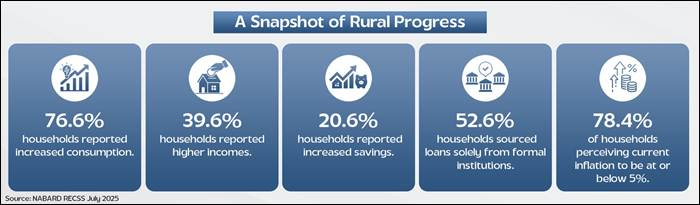
In a clear sign of rural economic momentum, the July 2025 round of the Rural Economic Conditions and Sentiments Survey (RECSS), released by NABARD recently, reveals that 76.6% of rural households reported an increase in consumption, marking a sustained trajectory of consumption-led growth. The RECSS serves as a vital tool to evaluate the real-world impact of various government schemes and rural development programmes.
Rising Incomes and Consumption-Led Growth
Income Growth
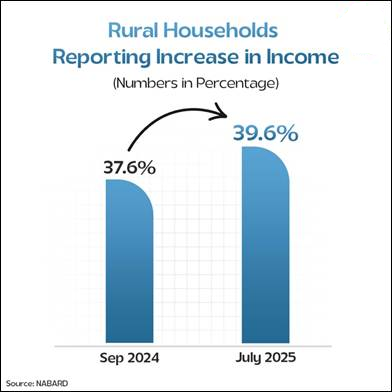
39.6% of surveyed households reported an increase in income during the past year, the highest share across all six rounds of the survey so far.
| Income Increase Bracket (%) |
% of Households Reporting Increase |
| 0–5% |
24.7% |
| 5–10% |
42.5% |
| 10–15% |
14.9% |
| 15–20% |
8.9% |
| Above 20% |
9.1% |
Consumption Expenditure
76.6% of households reported a rise in consumption over the past year. Just 3.2% of households reported a decline in consumption, which is the lowest since this survey started.
This growth is further reinforced by the highest recorded share of monthly income being spent on consumption at 65.57%, up from 60.87% in September 2024.
This reflects enhanced purchasing power and stronger financial confidence of rural households.
(i) Government Support Remains Crucial
Income and spending levels continue to be strongly supported by several fiscal transfer schemes, in both kind and cash, both from the Centre and states. These include subsidies on food, electricity, cooking gas, fertilizers, and support for school needs, transport, meals, pensions, and interest subsidies. On average, these transfers made up about 10% of a household’s monthly income. These interventions significantly enhance household resilience and reduce financial pressure, especially for vulnerable populations.
(ii) Strengthening Financial Health through Increased Savings
20.6% of households reported a rise in financial savings, showing a notable improvement in saving capacity alongside rising incomes.
The reported share of income allocated to savings stood at 13.18%, while loan repayments accounted for 11.85% of household spending.
Together, these numbers point toward a stronger culture of saving and debt management, alongside consumption growth.
Strong Sentiments on Income and Employment Outlook
(i) Short-Term Sentiments (Next One Quarter)
56.4% of rural households expect income levels to improve in the next quarter, the highest across all rounds of the survey so far.
56.2% of rural households anticipate better employment opportunities in the next quarter, reflecting growing optimism across income-generating avenues.
(ii) Long-Term Sentiments (Next One Year)
An all-time high 74.7% of rural households expect their income to increase over the next 12 months.
This reflects a strong sense of confidence and forward-looking positivity, bolstered in part by a favourable monsoon and improving infrastructure.
Expanding Financial Inclusion and Formal Credit Usage
(i) Shift to Formal Lending Channels
Driven by continued policy efforts to promote financial inclusion, rural households increasingly rely on formal institutional sources for credit. A record 52.6% of households reported sourcing loans exclusively from formal financial institutions—banks, cooperatives, NBFCs, MFIs, etc.
Another 26.9% borrowed from both formal and informal sources.
This represents a strong shift away from unregulated lenders, ensuring better borrower protection and reduced cost of credit.
(ii) Decline in Informal Interest Burden
The mean interest rate on informal loans declined to 17.53%, a 30-basis-point drop from the previous round.
Despite being outside the formal system, 30% of rural households paid no interest on such loans—primarily due to borrowing from friends and relatives, indicating community-based financial support.
(iii) Rural Infrastructure Perceived to Be Improving
76.1% of households assessed that rural infrastructure improved over the past year.
This reflects consistent progress in areas such as roads, electricity supply, drinking water, health services, and educational institutions.
Rural Development Priorities: Roads, Education, Water
The top-ranked sectors were
| Rank |
Area of Development |
% of Households Ranking It 1st |
| 1 |
Rural Roads |
46.3% |
| 2 |
Education Facilities |
11.2% |
| 3 |
Drinking Water Supply |
10.0% |
| 4 |
Electricity |
8.6% |
| 5 |
Health Infrastructure |
7.5% |
Declining Inflation Perceptions and Expectations
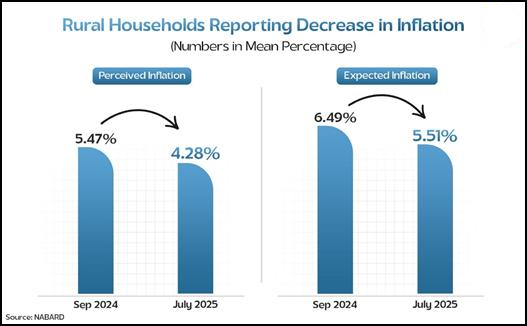
The CPI-rural inflation fell from 3.25% in March to 2.92% in April and further to 2.59% in May. Food inflation also dropped to 1.36% in May. In the July survey, rural households reported a lower inflation perception, averaging (mean value) 4.28%. A majority of households (78.4%) perceived inflation to be at or below 5%, while next-quarter expectations fell to a record low of mean 4.29%. One-year-ahead expectations remained stable at mean 5.51%.
Stable Food Expenditure Patterns
1. The share of food in total monthly consumption expenditure remained stable at a median value of 50%, even with softening rural food inflation.
2. This indicates that rising incomes are being used to diversify spending, without increasing pressure on food budgets.
Comparison of Key Parameters with Round 1 (September 2024)
| Parameter |
Sep 2024 |
Jul 2025 |
What This Means |
| Income Increased (% of Households) |
37.6% |
39.6% |
More families are earning better incomes, and income growth is picking up. |
| Consumption Increased (% of Households) |
80.1% |
76.6% |
Slight dip, but still high — spending remains strong, fueling rural demand. |
| Employment Outlook (Next Quarter) |
52.6% |
56.2% |
Optimism rising — more households expect better job opportunities soon. |
| Income Outlook (Next 12 Months) |
70.2% |
74.7% |
Marked rise in confidence — long-term income expectations are very positive. |
Conclusion
The July 2025 RECSS survey highlights strong growth and optimism in rural India. Incomes and consumption are rising, savings have improved, and more households are accessing formal credit. Sentiments about future income and employment are at their highest levels yet. Government support remains steady, infrastructure is improving, and inflation perceptions are at a record low. Overall, the rural economy is on a confident and upward path.
Prelims Questions





No Comments