


24 Jul Saksham Anganwadi & Poshan 2.0: Services, Portal & Worker Incentives
Subject Relevance — Where This Topic Fits
- GS Paper II — Governance, Social Justice (Welfare Schemes for Vulnerable Sections, Mechanisms, Laws, Institutions and Bodies constituted for the Protection and Betterment of these Vulnerable Sections) | GS Paper III — Economy (Issues relating to Planning, Mobilization of Resources, Growth, Development and Employment)
- Prelims: Mission Saksham Anganwadi and Poshan 2.0, Anganwadi Services, Supplementary Nutrition Programme (SNP), Poshan Tracker, Pankhuri Portal, National Health Mission (NHM), Integrated Child Development Services (ICDS) Scheme
- Essay: The imperative of human capital development for national progress, Bridging the nutrition gap: A cornerstone of India’s demographic dividend
Quick Revision: Mission Saksham Anganwadi and Poshan 2.0 is a restructured, integrated nutrition and early childhood development programme, delivering six core services through Anganwadi Centres, monitored by the Poshan Tracker, and supported by community workers and inter-ministerial convergence.
Why is this in the news?
The Ministry of Women and Child Development has recently launched the ‘Pankhuri Portal’ to facilitate collaboration with various entities for implementing activities under Mission Saksham Anganwadi and Poshan 2.0, Mission Shakti, and Mission Vatsalya. This initiative underscores the government’s commitment to enhancing the delivery of a comprehensive package of six services through Anganwadi Centres nationwide, targeting eligible beneficiaries including children under six years, pregnant women, lactating mothers, and adolescent girls.
Background
- Mission Saksham Anganwadi and Poshan 2.0 is a restructured umbrella scheme under the 15th Finance Commission, integrating components such as nutritional support for children under 6 years, pregnant women, lactating mothers, and adolescent girls (14-18 years).
- It also encompasses Early Childhood Care and Education (3-6 years), Anganwadi infrastructure including modern, upgraded Saksham Anganwadis, the Poshan Abhiyaan, and the Scheme for Adolescent Girls.
- The Anganwadi Services Scheme, a centrally sponsored scheme, was launched in 1975 as part of the Integrated Child Development Services (ICDS) to address malnutrition and health problems in children and women.
- Anganwadi Workers (AWWs) and Anganwadi Helpers (AWHs) are honorary workers selected from the local community, providing voluntary services in child care and development, for which they receive honoraria.
- The Government of India revised the honorarium for AWWs and AWHs in 2018, increasing it from ₹3,000 to ₹4,500 per month for AWWs and from ₹1,500 to ₹2,250 per month for AWHs, with additional performance-based incentives.
- The ‘Poshan Tracker’ digital application was introduced for real-time monitoring and tracking of all Anganwadi Centres, Anganwadi Workers, and beneficiaries against defined indicators under Mission Saksham Anganwadi and Poshan 2.0.
- Three of the six services, namely Immunisation, Health Check-up, and Referral Services, are health-related and delivered through the National Health Mission (NHM) and public health infrastructure.
- The scheme’s reach extends to all eligible registered beneficiaries across the country, with a special focus on adolescent girls (14-18 years) in Aspirational Districts and all districts of the North Eastern Region.
- District-wise details regarding beneficiaries, infrastructure, and service delivery at Anganwadi Centres are publicly accessible via the Poshan Tracker dashboard.
- The ‘Pankhuri Portal’ facilitates collaboration with organizations, individuals, and corporations to implement various activities under Mission Saksham Anganwadi and Poshan 2.0, Mission Shakti, and Mission Vatsalya.
- The scheme is designed to be universal and comprehensive, ensuring that all eligible beneficiaries can register and receive services without hindrance, with Aadhaar-based tracking aiding in accurate identification and elimination of fraudulent entries.
What is Mission Saksham Anganwadi and Poshan 2.0?
- Mission Saksham Anganwadi and Poshan 2.0 is an integrated nutrition support programme launched by the Ministry of Women and Child Development, consolidating previous schemes to enhance nutritional outcomes.
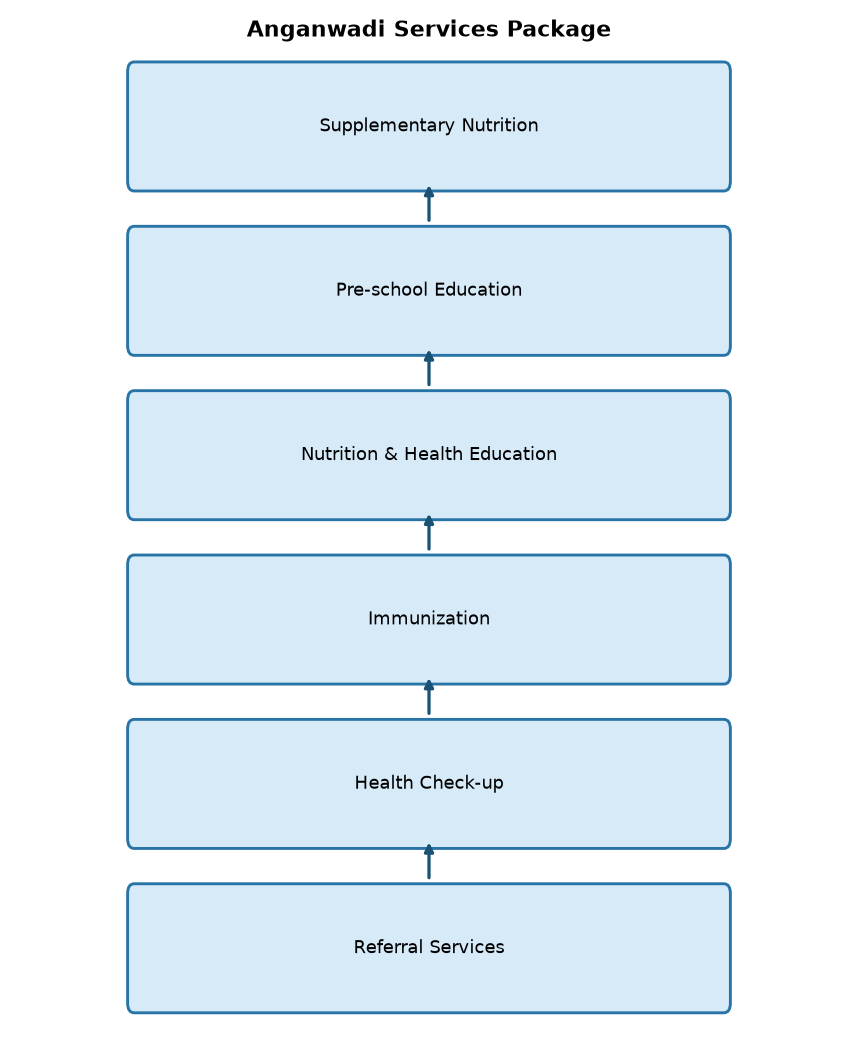
- It provides a package of six core services through Anganwadi Centres: Supplementary Nutrition Programme (SNP), Pre-school Non-formal Education, Nutrition & Health Education, Immunisation, Health Check-up, and Referral Services.
- The target beneficiaries include children under 6 years of age, pregnant women, lactating mothers, and adolescent girls aged 14-18 years, with a specific focus on Aspirational Districts and the North Eastern Region for adolescent girls.
- The mission leverages the ‘Poshan Tracker’ digital application for real-time monitoring of service delivery, beneficiary tracking, and data collection on various parameters such as daily attendance, ECCE activities, growth monitoring, and provision of Hot Cooked Meals (HCM) and Take Home Ration (THR).
- It aims to strengthen Anganwadi infrastructure, including the modernization of Anganwadi Centres, and integrate Early Childhood Care and Education (ECCE) for children aged 3-6 years.
- The scheme emphasizes convergence with the National Health Mission (NHM) for health-related services like immunisation, health check-ups, and referrals, utilizing existing public health infrastructure.
- Anganwadi Workers (AWWs) and Anganwadi Helpers (AWHs), as honorary community workers, are integral to the scheme’s implementation, receiving honoraria and performance-based incentives for their services.
- The recent launch of the ‘Pankhuri Portal’ under this mission seeks to foster partnerships with various stakeholders to enhance the reach and effectiveness of its diverse activities.
- The mission promotes Aadhaar-based tracking for beneficiaries to ensure accurate identification and eliminate fraudulent entries, thereby improving transparency and accountability.
- It is a universal scheme, ensuring equitable access to services for all eligible beneficiaries, with no barriers to registration or receipt of benefits.
Key Features
| Feature | Significance |
|---|---|
| Six-Service Package | Comprehensive provision of supplementary nutrition, pre-school education, health education, immunisation, health check-ups, and referral services to eligible beneficiaries. |
| Reorganisation under 15th Finance Commission | Consolidation of nutritional support for children, pregnant women, lactating mothers, and adolescent girls, early childhood care, Anganwadi infrastructure, Poshan Abhiyaan, and Scheme for Adolescent Girls under Mission Saksham Anganwadi & Poshan 2.0. |
| Pankhuri Portal | Facilitates collaboration with organisations, individuals, and corporations for various activities under Mission Saksham Anganwadi & Poshan 2.0, Mission Shakti, and Mission Vatsalya. |
| Poshan Tracker Digital Application | Enables real-time monitoring and tracking of Anganwadi Centres, workers, and beneficiaries, facilitating data collection for service delivery and scheme implementation review. |
| Aadhaar-based Tracking and eKYC | Ensures accurate beneficiary identification, prevents data leaks, and eliminates fraudulent entries, enhancing transparency and efficiency in service delivery. |
| Performance-Based Incentives for AWWs/AWHs | Monetary incentives provided to Anganwadi Workers and Helpers, in addition to increased honorarium, to motivate and recognise their contributions to community child care and development. |
Why it Matters
Social Welfare and Human Development
- Addresses malnutrition and health deficiencies among vulnerable groups, including children, pregnant women, and lactating mothers, contributing to improved public health outcomes.
- Promotes early childhood care and education, laying a foundational basis for cognitive and social development, which is crucial for long-term human capital formation.
- Empowers adolescent girls through targeted nutritional support and educational interventions, fostering their health and developmental potential.
Governance and Administrative Efficiency
- Leverages technology through the Poshan Tracker for real-time data collection and monitoring, enhancing accountability and enabling evidence-based policy adjustments.
- Streamlines service delivery through a unified package of six services, reducing fragmentation and improving coordination between health and nutrition programmes.
- Ensures transparency and reduces leakages through Aadhaar-based identification and eKYC, optimising resource utilisation and targeting genuine beneficiaries.
Economic Implications
- Investments in early childhood development and maternal health yield long-term economic benefits by reducing healthcare costs and increasing future productivity.
- Provides employment and supplementary income to Anganwadi Workers and Helpers, predominantly women from local communities, contributing to local economic empowerment.
- Reduces the economic burden of malnutrition-related diseases and developmental delays on families and the public health system.
Challenges
1. Data Accuracy and Connectivity
- Ensuring consistent and accurate data entry on the Poshan Tracker, especially in remote areas with limited digital literacy or internet connectivity.
- Maintaining the integrity of real-time monitoring systems against technical glitches and human errors.
UPSC Link: Governance; e-governance applications
2. Inter-sectoral Coordination
- Effective coordination between the Ministry of Women and Child Development and the Ministry of Health and Family Welfare for the seamless delivery of health-related services.
- Harmonising efforts of various government departments and local bodies to ensure comprehensive service provision.
UPSC Link: Issues relating to development and management of Social Sector/Services relating to Health, Education, Human Resources
3. Human Resource Capacity Building
- Continuous training and skill enhancement for Anganwadi Workers and Helpers to effectively utilise digital tools and deliver the full package of services.
- Addressing potential attrition and ensuring adequate staffing levels in Anganwadi Centres.
UPSC Link: Issues relating to development and management of Social Sector/Services relating to Health, Education, Human Resources
4. Infrastructure and Resource Availability
- Ensuring modern, upgraded Anganwadi infrastructure, particularly in underserved regions, to facilitate effective service delivery.
- Adequate and timely provision of supplementary nutrition and other essential resources to all beneficiaries.
UPSC Link: Issues relating to development and management of Social Sector/Services relating to Health, Education, Human Resources
5. Beneficiary Outreach and Acceptance
- Overcoming social and cultural barriers that may hinder beneficiary registration and consistent utilisation of services.
- Ensuring widespread acceptance and adoption of Aadhaar-based tracking and eKYC among all eligible beneficiaries.
UPSC Link: Mechanisms, laws, institutions and Bodies constituted for the protection and betterment of these vulnerable sections
Challenges — UPSC Perspective
| Issue | Concern |
|---|---|
| Digital Divide | Unequal access to technology and digital literacy among Anganwadi workers and beneficiaries, particularly in rural and remote areas, impacting Poshan Tracker utilisation. |
| Quality of Services | Ensuring uniform high standards in the delivery of all six services across diverse geographical and socio-economic contexts. |
| Funding and Resource Allocation | Maintaining consistent and adequate financial support, including state contributions, for the scheme’s comprehensive implementation and infrastructure upgrades. |
| Community Participation | Sustaining active community engagement and ownership to maximise the impact of Anganwadi services and address local needs effectively. |
| Monitoring and Evaluation Gaps | Translating real-time data from Poshan Tracker into actionable insights and timely interventions at the ground level. |
Government Initiatives — Must-Memorise for Prelims
- Mission Saksham Anganwadi and Poshan 2.0
- Mission Shakti
- Mission Vatsalya
- National Health Mission (NHM)
- Poshan Abhiyaan
Way Forward
- Strengthen digital infrastructure and provide comprehensive training to Anganwadi workers for effective utilisation of the Poshan Tracker application.
- Enhance inter-ministerial convergence, particularly between the Ministry of Women and Child Development and the Ministry of Health and Family Welfare, for integrated service delivery.
- Regularly review and update the honorarium and performance-based incentives for Anganwadi Workers and Helpers to ensure fair remuneration and motivation.
- Invest in upgrading Anganwadi infrastructure, including modern facilities and equipment, to create a conducive environment for early childhood care and education.
- Launch targeted awareness campaigns to promote beneficiary registration, Aadhaar-based tracking, and consistent utilisation of the full package of services.
- Establish robust grievance redressal mechanisms to address issues faced by beneficiaries and Anganwadi functionaries promptly.
- Foster greater community participation and local ownership in the planning and implementation of Anganwadi services to ensure relevance and sustainability.
UPSC Value Addition
Keywords for Mains Answer-Writing
Mission Saksham Anganwadi and Poshan 2.0 · Integrated Child Development Services (ICDS) · Supplementary Nutrition Programme (SNP) · Early Childhood Care and Education (ECCE) · Anganwadi Workers (AWWs) and Helpers (AWHs) · Poshan Tracker · National Health Mission (NHM) · Pankhuri Portal · Aspirational Districts Programme · Maternal and Child Health (MCH) · Adolescent Girls Scheme · Digital Public Infrastructure (DPI)
Constitutional & Policy Linkages
- {‘article’: ‘Article 39(f)’, ‘note’: “Children’s healthy development opportunities”}
- {‘article’: ‘Article 47’, ‘note’: ‘Raise nutrition levels, public health’}
Concept Flow
Vulnerable populations identified (children, women, adolescent girls) → Mission Saksham Anganwadi & Poshan 2.0 launched → Six-service package delivered via Anganwadi Centres → Poshan Tracker enables real-time monitoring → Aadhaar-based tracking ensures beneficiary authenticity → Improved nutritional and health outcomes achieved
Prelims Practice Questions
Q1. With reference to Mission Saksham Anganwadi and Poshan 2.0, consider the following statements:
1. It reorganises components of nutritional support for children under 6 years, pregnant women, lactating mothers, and adolescent girls (14-18 years).
2. The package of six services provided includes only nutrition and health-related interventions, excluding education.
3. The Poshan Tracker digital application facilitates real-time monitoring and tracking of Anganwadi Centres, workers, and beneficiaries.
How many of the statements given above are correct?
- Only one
- Only two
- All three
- None
Answer: Only two — Statement 1 is correct as the mission reorganises various nutritional and ECCE components. Statement 2 is incorrect because the package of six services explicitly includes pre-school non-formal education. Statement 3 is correct as Poshan Tracker is designed for real-time monitoring and data collection.
Q2. Which of the following services, provided under Mission Saksham Anganwadi and Poshan 2.0, are delivered through the National Health Mission (NHM) and public health infrastructure?
1. Supplementary Nutrition
2. Immunisation
3. Health Check-ups
4. Referral Services
Select the correct answer using the code given below:
- 1, 2 and 3 only
- 2, 3 and 4 only
- 1 and 4 only
- 1, 2, 3 and 4
Answer: 2, 3 and 4 only — The press release explicitly states that three services, namely immunisation, health check-ups, and referral services, are health-related and provided through the National Health Mission (NHM) and public health infrastructure. Supplementary nutrition is provided directly through Anganwadi Centres.
Mains Practice Question
✍ Mission Saksham Anganwadi and Poshan 2.0 represents a significant restructuring of India’s approach to maternal and child nutrition and early childhood development. Critically examine the objectives and key features of this mission, highlighting its potential to address malnutrition and improve developmental outcomes. Discuss the role of technology, particularly the Poshan Tracker, and community-level workers in its effective implementation, and identify any challenges that might impede its success.
Approach: Candidates should begin by outlining the core objectives and the integrated nature of Mission Saksham Anganwadi and Poshan 2.0, including its consolidation of previous schemes. Subsequently, they should detail the package of six services, emphasising both nutritional and educational components. The role of technology, specifically the Poshan Tracker for real-time monitoring and Aadhaar-based tracking for beneficiary identification, must be discussed. The critical contribution of Anganwadi Workers and Helpers as frontline service providers should also be elaborated. Finally, candidates should critically assess potential challenges such as resource allocation, capacity building, inter-sectoral coordination, and ensuring last-mile delivery in diverse geographical contexts.
Source: PIB (Press Information Bureau)
Generated by AanyaAi for educational purpose.

- तमिलनाडु के लिए क्या है ‘एल नीनो’ और उत्तर-पूर्वी मानसून का खतरा? - September 23, 2026
- El Nino & Northeast Monsoon: Impact on Tamil Nadu for UPSC 2026 - September 23, 2026
- हिमाचल में डिजिटल भुगतान क्रांति: बिलासपुर अव्वल, महिलाओं की भागीदारी 93% तक पहुंची - September 23, 2026

No Comments