


19 Jul SC Demands Status Report on CBSE OSM Glitches, Citing Student Frustration
Subject Relevance — Where This Topic Fits
- GS Paper II — Governance, Constitution, Polity, Social Justice | GS Paper IV — Ethics, Integrity, and Aptitude
- Prelims: Supreme Court, CBSE, On-Screen Marking (OSM), Judicial Review, Right to Education, Accountability, Capacity Building Commission, Public Grievances, Digital Governance
- Essay: The role of judiciary in upholding administrative accountability and ensuring citizen-centric governance., Leveraging technology in education: Promises, pitfalls, and the imperative of robust implementation.
Quick Revision: The Supreme Court’s intervention in the CBSE OSM glitches underscores the judiciary’s role in ensuring administrative accountability and the imperative for robust, citizen-centric implementation of e-governance initiatives in education.
Why is this in the news?
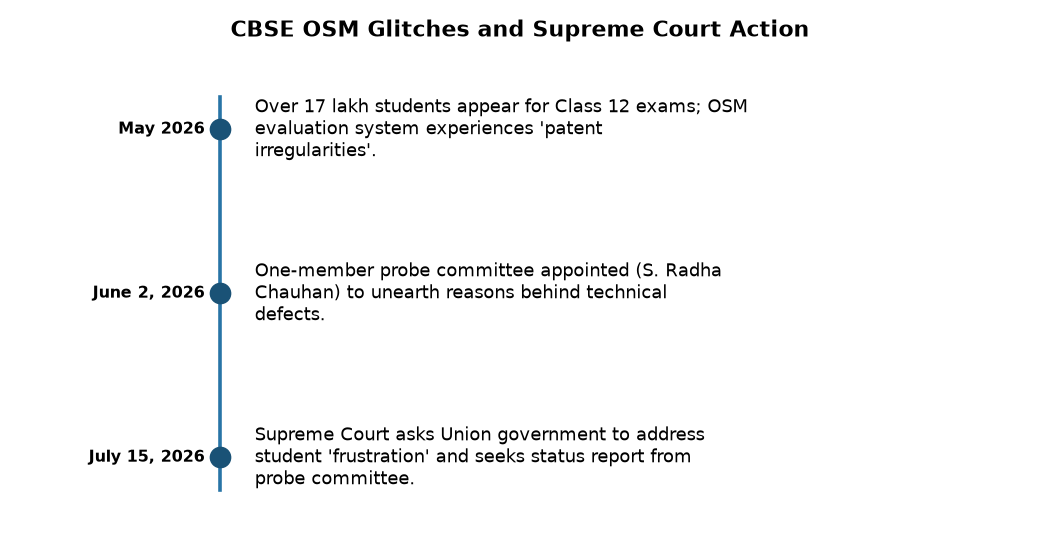
The Supreme Court recently intervened in the matter of widespread glitches and irregularities in the Central Board of Secondary Education’s (CBSE) On-Screen Marking (OSM) system for Class 12 examinations in 2026. Expressing concern over the ‘frustration’ faced by students, the Court directed the Union government to submit a status report on the progress of a one-member probe committee, headed by retired IAS officer S. Radha Chauhan, tasked with investigating the technical defects and systemic failures. This judicial intervention underscores the critical importance of administrative efficiency and accountability in public service delivery, particularly in the sensitive domain of education.
Background
- The CBSE implemented the On-Screen Marking (OSM) system for Class 12 answer sheets for the first time in 2026, aiming to enhance efficiency and accuracy in evaluation.
- Following the examinations, numerous complaints emerged from students and parents regarding ‘patent irregularities,’ including illegible scanning of answer sheets, unchecked answers, and difficulties in accessing evaluated scripts.
- A petition was filed in the Supreme Court by Rakesh Binjola, highlighting ‘systematic negligence/failure resulting in a breach of duty of care’ and seeking individual responsibility for the widespread issues.
- The petition noted that over 17 lakh students appeared for the Class 12 exams, with the CBSE covering 29,000 schools in India and 257 schools across 25 foreign countries, indicating the vast scale of impact.
- The Union government, acknowledging ‘anomalies in implementation,’ appointed a one-member probe committee headed by S. Radha Chauhan, Chairperson of the Capacity Building Commission, on June 2, 2026, to investigate the matter.
- The Supreme Court, while acknowledging the government’s right to formulate policy, emphasized the need for ‘improvements for seamless implementation’ and sought a status report by July 24, 2026.
What is On-Screen Marking (OSM)?
- On-Screen Marking (OSM) is a digital evaluation system where scanned images of answer scripts are displayed on a computer screen for examiners to mark.
- It aims to replace the traditional manual evaluation of physical answer sheets, offering potential benefits in terms of speed, accuracy, and transparency.
- In an OSM system, answer sheets are first scanned and converted into digital images, which are then distributed electronically to evaluators.
- Evaluators use specialized software to mark the answers, assign scores, and often provide feedback directly on the digital image.
- Key features often include real-time monitoring of evaluation progress, automated tabulation of marks, and the ability to re-evaluate specific questions or entire scripts digitally.
- It can facilitate centralized monitoring of evaluation quality, standardization of marking schemes, and reduced logistical challenges associated with physical answer sheet handling.
- The system typically requires robust IT infrastructure, secure data handling protocols, and comprehensive training for evaluators to ensure effective and error-free operation.
- OSM is increasingly adopted by various examination bodies globally to modernize and streamline their assessment processes.
Key Features
| Feature | Significance |
|---|---|
| Digital Scanning of Answer Sheets | Enables remote evaluation, reduces physical handling, and creates digital archives. |
| On-Screen Evaluation Interface | Provides examiners with a digital platform to mark, annotate, and score answers, potentially improving legibility and consistency. |
| Centralized Monitoring | Allows examination bodies to track evaluation progress, identify discrepancies, and ensure adherence to marking schemes in real-time. |
| Automated Mark Tabulation | Minimizes human error in totaling marks and speeds up the result processing, enhancing efficiency. |
| Secure Data Management | Aims to protect student data and evaluation records through digital security protocols, reducing risks of loss or tampering. |
| Potential for Audit Trails | Digital records can provide a clear audit trail of who evaluated what and when, aiding in transparency and accountability. |
Why it Matters
For Students and Education System
- Ensures fairness and transparency in evaluation, which is crucial for students’ academic and career trajectories.
- Upholds the sanctity of examinations and public trust in educational institutions.
- Addresses student ‘frustration’ and mental stress caused by systemic failures, promoting a supportive learning environment.
- Contributes to the overall quality and credibility of the national education system.
For Governance and Public Administration
- Reinforces the principle of administrative accountability and the duty of care owed by public bodies to citizens.
- Highlights the importance of robust implementation strategies for technological interventions in governance.
- Demonstrates the judiciary’s role in safeguarding fundamental rights and ensuring good governance.
- Promotes a culture of continuous improvement and responsiveness within government agencies.
For Digital India and E-Governance Initiatives
- Serves as a critical case study for the challenges and prerequisites of successful digital transformation in public services.
- Emphasizes the need for adequate training, infrastructure, and pilot testing before large-scale deployment of e-governance solutions.
- Underscores that technology is an enabler, but its effectiveness is contingent on meticulous planning and human oversight.
- Provides valuable lessons for other government departments embarking on similar digital initiatives.
Challenges
1. Technological Implementation Gaps
- Inadequate infrastructure: Lack of robust servers, stable internet connectivity, and reliable scanning equipment.
- Software glitches: Bugs in the OSM software leading to illegible scans, incomplete uploads, or incorrect data processing.
- Scalability issues: Difficulty in managing the high volume of answer sheets and evaluators, especially for national-level exams.
UPSC Link: GS Paper III — Science and Technology; GS Paper II — Governance
2. Human Resource and Training Deficiencies
- Lack of formal training for evaluators: Examiners unfamiliar with the digital interface, leading to errors and inefficiency.
- Resistance to change: Evaluators accustomed to traditional methods may struggle with new digital processes.
- Insufficient technical support: Lack of readily available assistance for evaluators facing technical issues during marking.
UPSC Link: GS Paper IV — Ethics and Human Interface; GS Paper II — Social Justice
3. Accountability and Oversight
- Fixing individual responsibility: Difficulty in pinpointing accountability for systemic failures in a large, multi-stakeholder system.
- Lack of robust audit mechanisms: Insufficient systems to track and verify each step of the evaluation process.
- Delayed grievance redressal: Slow response to student complaints, exacerbating ‘frustration’ and distrust.
UPSC Link: GS Paper II — Governance; GS Paper IV — Probity in Governance
4. Ethical and Transparency Concerns
- Data integrity: Risks associated with ensuring the authenticity and immutability of digital answer sheets and marks.
- Fairness in evaluation: Concerns about potential biases or inconsistencies introduced by the digital medium if not properly managed.
- Access and equity: Ensuring that students from diverse backgrounds, including those abroad, have equitable access to the system and redressal mechanisms.
UPSC Link: GS Paper IV — Ethics, Integrity, and Aptitude; GS Paper II — Social Justice
Challenges — UPSC Perspective
| Issue | Concern |
|---|---|
| Illegible Scanning | Directly impacts evaluator’s ability to accurately assess answers, leading to potential under-marking. |
| Unchecked Answers | Indicates systemic oversight failure, potentially leading to incorrect scores and affecting student results. |
| Inability to Upload Scripts | Fundamental failure of the digital system, preventing evaluation and causing immense stress to students. |
| Lack of Evaluator Training | Compromises the quality and consistency of evaluation, as examiners are unprepared for the new digital environment. |
| Systematic Negligence | Points to a broader failure in planning, execution, and oversight by the examination body. |
| Breach of Duty of Care | Implies that the institution failed in its fundamental responsibility to students, potentially leading to legal and ethical ramifications. |
Government Initiatives — Must-Memorise for Prelims
- Digital India Programme
- National Education Policy (NEP) 2020
- Sarva Shiksha Abhiyan (SSA)
- Samagra Shiksha Abhiyan
- National Digital Education Architecture (NDEAR)
- SWAYAM (Study Webs of Active Learning for Young Aspiring Minds)
- Diksha Platform
- National Programme on Technology Enhanced Learning (NPTEL)
- Capacity Building Commission (CBC)
- Right to Education Act, 2009
Way Forward
- Conduct a comprehensive, independent audit of the OSM system, identifying root causes of failures and recommending specific technical and procedural improvements.
- Implement mandatory and rigorous training programs for all evaluators, ensuring proficiency in using the digital marking interface and understanding protocols.
- Establish a robust, multi-tiered grievance redressal mechanism with clear timelines for resolution, accessible to students and parents.
- Strengthen IT infrastructure, including server capacity, network stability, and data security protocols, to ensure seamless and secure operation.
- Pilot test new technological interventions on a smaller scale before national rollout, incorporating feedback for iterative improvements.
- Fix individual and institutional accountability for systemic failures, fostering a culture of responsibility and diligence.
- Enhance transparency by providing students with easy access to their evaluated digital answer scripts and detailed mark breakdowns.
- Leverage the Capacity Building Commission’s expertise to develop a long-term strategy for digital transformation in examinations, focusing on human-centric design and robust implementation.
UPSC Value Addition
Keywords for Mains Answer-Writing
Administrative Accountability · Judicial Intervention · E-Governance Challenges · Digital Transformation · Educational Reforms · Public Service Delivery · Systemic Failures · Duty of Care · Capacity Building · Grievance Redressal · Transparency in Governance · Student Welfare
Constitutional & Policy Linkages
- Article 21A: Right to Education
- Article 32: Right to Constitutional Remedies (Supreme Court)
- Article 226: High Court’s Power to Issue Writs
- Right to Education Act, 2009: Legal framework for education
- Administrative Tribunals Act, 1985: For service matters
- Information Technology Act, 2000: Digital security and data protection
Concept Flow
Introduction of On-Screen Marking (OSM) by CBSE. → Widespread glitches and irregularities reported by students. → Student/parent files petition in Supreme Court highlighting ‘frustration’ and ‘systematic negligence’. → Supreme Court intervenes, seeks status report from Union Government. → Government acknowledges ‘anomalies’, appoints probe committee. → Judicial oversight aims to ensure administrative accountability and improve system implementation. → Recommendations from probe committee lead to reforms in OSM system.
Prelims Practice Questions
Q1. With reference to the recent news regarding CBSE’s On-Screen Marking (OSM) system, consider the following statements:
1. The Supreme Court intervened after widespread glitches were reported in the Class 12 examinations in 2026.
2. The OSM system was implemented for the first time by CBSE without any prior pilot testing.
3. A one-member probe committee headed by a retired IAS officer has been appointed to investigate the issues.
Which of the statements given above is/are correct?
- A. 1 and 2 only
- B. 2 and 3 only
- C. 1 and 3 only
- D. 1, 2 and 3
Answer: C. 1 and 3 only — Statement 1 is correct: The Supreme Court did intervene regarding the glitches in 2026. Statement 2 is incorrect: The news states it was implemented for the first time, but does not explicitly mention lack of pilot testing, though the issues suggest it. The petition mentioned evaluators were not given formal training. Statement 3 is correct: S. Radha Chauhan, a retired IAS officer and chairperson of the Capacity Building Commission, heads the probe committee.
Q2. The Capacity Building Commission (CBC) in India is primarily associated with which of the following objectives?
Which of the statements given above is/are correct?
1. Enhancing the capacity of civil servants and public administration.
2. Regulating the curriculum for school education boards.
3. Promoting digital literacy among rural populations.
Select the correct answer using the code given below:
- A. 1 only
- B. 1 and 2 only
- C. 2 and 3 only
- D. 1, 2 and 3
Answer: A. 1 only — Statement 1 is correct: The Capacity Building Commission (CBC) was established to improve human resource management practices in government and enhance the capacity of civil servants. Statement 2 is incorrect: Regulating school curricula is primarily the domain of bodies like NCERT and state education boards. Statement 3 is incorrect: While digital literacy is important, it’s not the primary mandate of the CBC, which focuses on civil service capacity.
Mains Practice Question
✍ The recent Supreme Court intervention regarding CBSE’s On-Screen Marking (OSM) system highlights critical issues of administrative accountability and the challenges of technological adoption in public service delivery. Discuss the implications of this judicial scrutiny for governance in India, and suggest comprehensive measures to ensure robust and citizen-centric implementation of e-governance initiatives. (250 words)
Approach: Begin by briefly outlining the context of the Supreme Court’s intervention and the nature of the OSM glitches. Then, delve into the implications for governance, focusing on administrative accountability, the judiciary’s role in upholding rights, and the need for ethical governance. Subsequently, discuss the challenges inherent in technological adoption, such as infrastructure, human resource training, and oversight. Conclude by suggesting comprehensive measures, including robust pilot testing, continuous evaluator training, strong grievance redressal mechanisms, and clear accountability frameworks, to ensure successful and citizen-centric e-governance.
Source: The Hindu
Generated by AanyaAi for educational purpose.

- DFPD extends Special Campaign 6 to achieve governance targets - October 24, 2026
- डीडीडब्ल्यूएस ने जल जीवन मिशन 2.0 के तहत सामुदायिक जल प्रबंधन को मजबूत किया - October 24, 2026
- J&K’s Drug-Free Model & Welfare Schemes: A Blueprint for UPSC Exam - October 24, 2026

No Comments