


01 Nov SEBI’s 3 Conditions for Calcutta Stock Exchange Revival: Key Details for UPSC & PCS
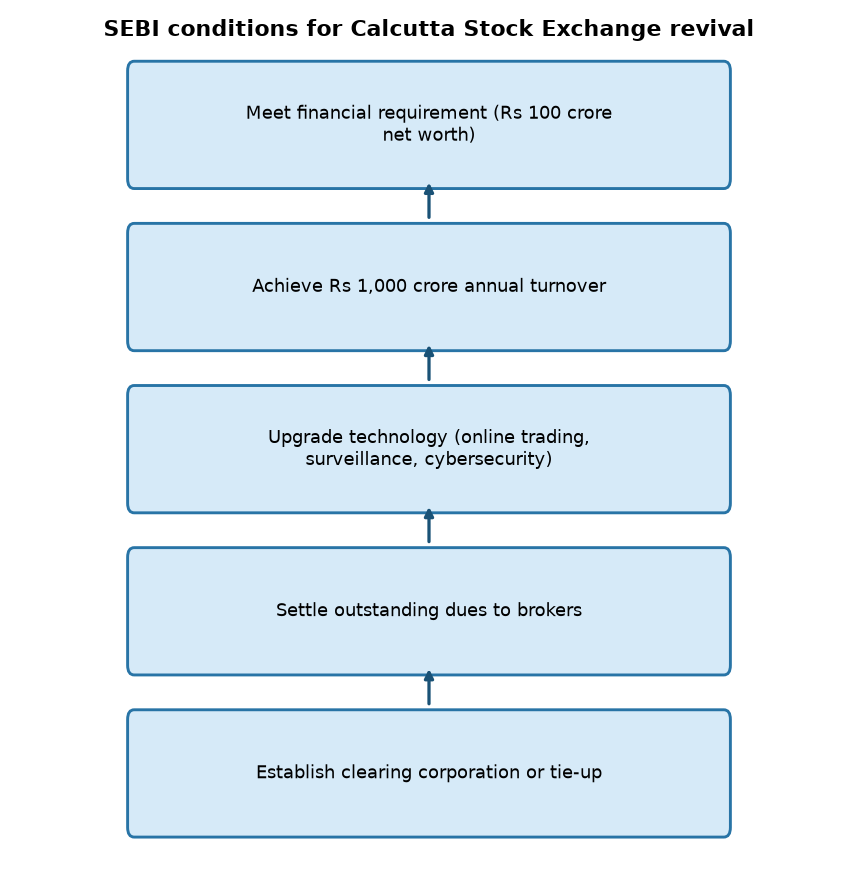
✎ SEBI’s revival framework for regional stock exchanges like the CSE mandates strict financial, technological, and regulatory compliance to ensure market integrity, investor protection, and sustainable operations.
Subject Relevance — Where This Topic Fits
- GS Paper III — Indian Economy and Issues Relating to Planning, Mobilisation of Resources, Growth, Development and Employment | GS Paper III — Role of External State and Non-State Actors in Creating Challenges to Internal Security
- Prelims: Securities and Exchange Board of India (SEBI), Regional Stock Exchanges, Capital Markets, Net Worth Requirements, Screen-Based Trading, Clearing Corporation, Cybersecurity Framework, Financial Regulation
- Essay: The Role of Regulatory Institutions in Sustaining Financial Markets, Challenges in Reviving Legacy Financial Institutions in a Globalised Economy
Quick Revision: SEBI’s revival framework for regional stock exchanges like the CSE mandates strict financial, technological, and regulatory compliance to ensure market integrity, investor protection, and sustainable operations.
Why is this in the news?
The Securities and Exchange Board of India (SEBI) has recently outlined stringent financial, technological, and regulatory conditions for the potential revival of the Calcutta Stock Exchange (CSE), which has been non-operational since 2013–14. This development highlights the evolving regulatory oversight of regional stock exchanges in India, the challenges in reviving legacy financial institutions, and the broader implications for market integrity and investor protection under SEBI’s framework.
Background
- The Calcutta Stock Exchange (CSE) was once a prominent regional stock exchange in India, contributing to the development of capital markets in Eastern India.
- Regional stock exchanges across India have faced declining trading volumes, operational inefficiencies, and regulatory challenges, leading to the closure or merger of several such exchanges over the past two decades.
- The Securities and Exchange Board of India (SEBI), established under the SEBI Act, 1992, is the statutory regulator for the securities market in India, responsible for protecting investor interests and promoting the development of the securities market.
- SEBI’s regulatory powers include registration, inspection, and enforcement actions against stock exchanges, intermediaries, and listed entities to ensure compliance with securities laws and market integrity.
- The suspension of trading on the CSE since 2013–14 reflects broader structural issues in regional exchanges, including low liquidity, outdated infrastructure, and failure to adapt to technological advancements in trading systems.
- SEBI’s intervention in the revival of regional exchanges is part of its mandate to ensure orderly and transparent functioning of the securities market, while balancing the need for market development and investor protection.
What is the Calcutta Stock Exchange (CSE) and its Revival Framework?
- The Calcutta Stock Exchange (CSE) is a legacy regional stock exchange, historically significant for its role in mobilising capital for industries in Eastern India.
- Trading on the CSE has been suspended since 2013–14 due to declining turnover, operational inefficiencies, and failure to meet regulatory requirements, including those related to technology and financial health.
- SEBI, as the statutory regulator, has prescribed three primary conditions for the revival of the CSE: stringent financial requirements, robust technological infrastructure, and full compliance with regulatory norms.
- Financial requirements include a minimum net worth of ₹100 crore for the exchange and an average annual turnover of ₹1,000 crore to ensure financial viability and sustainability.
- Technological requirements mandate the implementation of an online, screen-based trading system, online surveillance capabilities, cybersecurity controls, and a nationwide network of trading members with adequate facilities.
- Regulatory compliance includes the settlement of all outstanding dues to brokers and stakeholders, and the establishment of a separate clearing corporation or an arrangement with an existing one for trade settlement.
- SEBI’s framework for revival is designed to ensure market integrity, transparency, and investor protection, while also addressing the structural challenges faced by regional stock exchanges.
- The revival process is contingent upon the CSE’s ability to demonstrate a sustainable business model, attract sufficient trading volumes, and comply with SEBI’s regulatory oversight.
Key Features
| Feature | Significance |
|---|---|
| Minimum net worth of ₹100 crore | Ensures financial viability and capacity to absorb operational risks, aligning with SEBI’s prudential norms for stock exchanges. |
| Average annual turnover of ₹1,000 crore | Demonstrates sustainable trading activity, critical for maintaining liquidity and investor confidence in the exchange. |
| Online, screen-based trading system | Mandates adoption of modern trading infrastructure to ensure transparency, efficiency, and compliance with SEBI’s technological standards. |
| Online surveillance capabilities | Enables real-time monitoring of trading activities to detect market manipulation, insider trading, or other malpractices, safeguarding market integrity. |
| Cybersecurity controls and cyber-resilient framework | Protects against cyber threats, ensuring the security of trading data, investor information, and financial transactions. |
| Separate clearing corporation or tie-up with existing one | Ensures robust post-trade settlement mechanisms, reducing counterparty risks and enhancing trust in the exchange’s operations. |
Why it Matters
Economic Significance
- Revival of regional stock exchanges like CSE can decentralise financial markets, reducing dependence on Mumbai-centric trading hubs and promoting regional economic growth.
- Enhanced liquidity in regional markets may attract local investors, SMEs, and startups, fostering broader capital market participation.
- Strengthening of regional exchanges can improve price discovery for regional stocks, benefiting local industries and investors.
- SEBI’s stringent revival conditions underscore its commitment to maintaining high regulatory standards across all exchanges, regardless of size or historical prominence.
Regulatory Significance
- SEBI’s role in reviving CSE highlights its mandate to regulate and revitalise dormant or underperforming exchanges while ensuring investor protection.
- The conditions set by SEBI reflect a shift towards outcome-based regulation, where exchanges must demonstrate operational and financial viability before resuming activities.
- The revival process exemplifies SEBI’s proactive approach to market development, balancing revival incentives with strict compliance requirements.
Technological Significance
- Mandating modern trading and surveillance infrastructure ensures CSE’s alignment with global best practices in securities market operations.
- Cyber-resilient frameworks are critical to prevent disruptions in trading activities, which could erode investor confidence and market stability.
- Investments in technology are essential for CSE to compete with national-level exchanges and digital-first trading platforms.
Challenges
1. Financial Viability and Sustainability
- CSE’s historical turnover of ₹90 crore (2013–14) falls far short of the required ₹1,000 crore, raising questions about its ability to attract sufficient trading volumes.
- Meeting the minimum net worth requirement of ₹100 crore may require substantial capital infusion, which could be challenging given the exchange’s current financial health.
- Sustaining operations post-revival will depend on CSE’s ability to attract new listings, retain existing ones, and compete with larger exchanges.
UPSC Link: GS3: Indian Economy and issues relating to planning, mobilisation of resources
2. Technological and Infrastructure Upgrades
- Developing an online, screen-based trading system and robust surveillance mechanisms requires significant technological investment and expertise.
- Cybersecurity risks are heightened during the revival phase, necessitating a robust framework to prevent breaches or disruptions.
- Establishing a nationwide network of trading members with adequate facilities demands logistical and operational coordination.
UPSC Link: GS3: Science and Technology- developments and their applications
3. Regulatory Compliance and Market Trust
- CSE must settle all outstanding dues to brokers and stakeholders, which may involve resolving long-standing financial disputes or liabilities.
- Gaining SEBI’s approval requires demonstrating compliance with all regulatory requirements, including those related to market integrity and investor protection.
- Rebuilding market trust post-suspension (since 2013–14) will be critical to attracting investors and ensuring sustained trading activity.
UPSC Link: GS3: Role of external state and non-state actors in creating challenges
4. Competition from National Exchanges
- CSE will compete with established national exchanges like NSE and BSE, which have superior infrastructure, liquidity, and brand recognition.
- Attracting high-quality listings and retaining trading volumes may prove difficult without a clear competitive advantage or niche focus.
- Regional exchanges must innovate to differentiate themselves, such as by specialising in local industries or SMEs.
UPSC Link: GS3: Indian Economy and issues relating to planning
5. Legal and Operational Risks
- The revival process may face legal challenges, such as disputes over ownership, governance, or compliance with past regulatory actions.
- Operational risks, including cyber threats, system failures, or regulatory breaches, could undermine the exchange’s credibility and lead to renewed suspensions.
UPSC Link: GS2: Structure, organization and functioning of the Executive
Challenges — UPSC Perspective
| Issue | Concern |
|---|---|
| Financial sustainability | Inability to meet the ₹1,000 crore turnover threshold or ₹100 crore net worth requirement could derail revival efforts. |
| Technological obsolescence | Legacy systems may not meet SEBI’s modern trading and surveillance standards, requiring costly upgrades. |
| Market trust deficit | Prolonged suspension since 2013–14 may have eroded investor confidence, making it difficult to attract trading volumes. |
| Regulatory compliance burden | Strict SEBI conditions demand significant resources, expertise, and time to fulfil, delaying revival. |
| Competition from national exchanges | NSE and BSE’s dominance in liquidity and infrastructure poses a significant competitive threat to CSE. |
| Cybersecurity vulnerabilities | Inadequate cyber-resilient frameworks could expose the exchange to attacks, disrupting trading and eroding trust. |
Way Forward
- Conduct a detailed financial audit and capital infusion plan to meet SEBI’s net worth requirement of ₹100 crore.
- Develop a phased business plan outlining strategies to achieve the ₹1,000 crore annual turnover threshold within a specified timeline.
- Invest in modern trading infrastructure, including an online, screen-based system, real-time surveillance, and cybersecurity frameworks.
- Establish a clearing corporation or formal tie-ups with existing ones to ensure robust post-trade settlement mechanisms.
- Engage with SEBI proactively to address regulatory concerns and demonstrate compliance with all revival conditions.
- Explore niche opportunities, such as specialising in regional SMEs or local industries, to differentiate CSE from national exchanges.
- Strengthen governance structures to ensure transparency, accountability, and stakeholder trust during the revival process.
- Collaborate with industry associations, brokers, and investors to build confidence and attract trading volumes post-revival.
UPSC Value Addition
Keywords for Mains Answer-Writing
Securities and Exchange Board of India (SEBI) · regulatory framework for stock exchanges · financial viability of stock exchanges · technology and cybersecurity in capital markets · regional stock exchanges in India · business model sustainability · screen-based trading system · clearing corporation for stock exchanges · net worth and turnover criteria for stock exchanges · capital market regulation in India · orderly execution of trades · investor protection in securities markets · resumption of trading operations · SEBI chairman powers and functions · capital market infrastructure in India
Concept Flow
Historical prominence of CSE → Decline in trading volumes and suspension of operations (2013–14) → SEBI’s decision to revive exchanges → Imposition of stringent revival conditions → CSE’s need to meet financial, technological, and regulatory requirements → Revival as a modern, compliant exchange → Enhanced regional liquidity and investor participation → Contribution to decentralised financial markets.
Prelims Practice Questions
Q1. Consider the following statements regarding the regulatory powers of the Securities and Exchange Board of India (SEBI):
1. SEBI mandates a minimum net worth of Rs 100 crore for a stock exchange to operate.
2. SEBI requires stock exchanges to maintain an average annual turnover of Rs 1,000 crore to continue operations.
3. SEBI has the authority to suspend trading on any stock exchange if it fails to meet regulatory requirements.
4. SEBI is empowered to establish clearing corporations for stock exchanges without consulting the exchanges.
How many of the above statements are correct?
- Only one
- Only two
- Only three
- All four
Answer: Only three — Statements 1, 2, and 3 are correct as per SEBI’s regulatory framework for stock exchanges. Statement 4 is incorrect because SEBI cannot unilaterally establish clearing corporations without due process and consultation.
Q2. Assertion (A): The Securities and Exchange Board of India (SEBI) is the sole regulator for the securities market in India.
Reason (R): SEBI derives its powers from the Securities Contracts (Regulation) Act, 1956, and the SEBI Act, 1992.
Options:
A. Both A and R are true, and R is the correct explanation of A.
B. Both A and R are true, but R is not the correct explanation of A.
C. A is true, but R is false.
D. A is false, but R is true.
Answer: ? — Assertion (A) is true as SEBI is the primary regulator for the securities market in India. Reason (R) is also true and correctly explains why SEBI is the sole regulator, as these Acts provide the legal framework for its powers.
Q3. Match the following regulatory requirements with their respective descriptions:
Column I (Requirement)
A. Minimum net worth
B. Average annual turnover
C. Screen-based trading system
D. Clearing corporation
Column II (Description)
1. Ensures orderly execution of trades through an online platform
2. Mandatory for a stock exchange to operate, set at Rs 100 crore
3. Responsible for settlement of trades and risk management
4. Must achieve Rs 1,000 crore to continue operations
- {‘A-2, B-4, C-1, D-3’: True}
- {‘A-1, B-3, C-2, D-4’: False}
- {‘A-4, B-2, C-3, D-1’: False}
- {‘A-3, B-1, C-4, D-2’: False}
Answer: {‘A-2, B-4, C-1, D-3’: True} — The correct match is: A (Minimum net worth) – 2 (set at Rs 100 crore), B (Average annual turnover) – 4 (must achieve Rs 1,000 crore), C (Screen-based trading system) – 1 (ensures orderly execution of trades), D (Clearing corporation) – 3 (responsible for settlement of trades).
Mains Practice Question
✍ The Securities and Exchange Board of India (SEBI) has stipulated stringent financial, technological, and regulatory conditions for the revival of the Calcutta Stock Exchange (CSE). Critically examine the rationale behind these conditions and their implications for the capital market ecosystem in India. Also, analyse how these conditions align with SEBI’s broader objectives of investor protection and market integrity. (15 Marks)
Approach: MODEL-ANSWER SKELETON:
1. **Introduction (2 marks)**: Briefly define SEBI’s role as the regulator of India’s securities market and its mandate under the SEBI Act, 1992 and the Securities Contracts (Regulation) Act, 1956. State the context: revival of the CSE and SEBI’s conditions.
2. **Rationale behind SEBI’s conditions (5 marks)**:
– **Financial viability**: Minimum net worth (Rs 100 crore) and average annual turnover (Rs 1,000 crore) to ensure sustainability and prevent systemic risks.
– **Technological infrastructure**: Requirement for a screen-based trading system, online surveillance, and cybersecurity controls to modernise trading platforms and mitigate operational risks.
– **Regulatory compliance**: Establishment of a clearing corporation or tie-up with an existing one for orderly settlement of trades, and settlement of outstanding dues to brokers to uphold investor confidence.
– **Market integrity**: Conditions aim to prevent market manipulation, fraud, and ensure transparency.
3. **Implications for the capital market ecosystem (5 marks)**:
– **Positive**: Enhances investor protection, promotes market efficiency, and ensures compliance with global standards (e.g., G20 principles for financial markets).
– **Challenges**: High financial and technological barriers may deter smaller exchanges from revival, leading to consolidation in the market. Potential reduction in regional financial hubs if revival fails.
– **Broader impact**: Strengthens SEBI’s regulatory oversight and aligns with its objective of creating a robust, transparent, and resilient capital market.
4. **Alignment with SEBI’s objectives (3 marks)**:
– **Investor protection**: Conditions like clearing corporations and settlement of dues directly address investor grievances and reduce systemic risks.
– **Market integrity**: Technological and regulatory requirements ensure fair and orderly trading, reducing the likelihood of market abuse.
– **Sustainability**: Financial viability conditions ensure that exchanges operate on a sound footing, reducing the risk of collapse.
5. **Conclusion (1 mark)**: Summarise the need for balanced regulation that fosters market growth while ensuring stability and investor trust.
Source: The Indian Express
Generated by AanyaAi for educational purpose.
Related guides on our sites
- Best economics optional coaching for upsc
- Best economics optional teacher for upsc
- How to prepare for GS paper 1 for UPSC CSE mains exam
- Best UPSC coaching for IFOS exam

- SEBI’s 3 Conditions for Calcutta Stock Exchange Revival: Key Details for UPSC & PCS - November 1, 2026
- राजस्थान सरकार ने 3,319 पार्कों के रखरखाव के लिए प्रस्तुत की नई योजना - November 1, 2026
- Pre-emptive air pollution curbs in NCR: Causes and CAQM measures - November 1, 2026

No Comments