


11 Aug Second Phase of Pravasi Insurance Scheme for NRKs to Launch on August 18
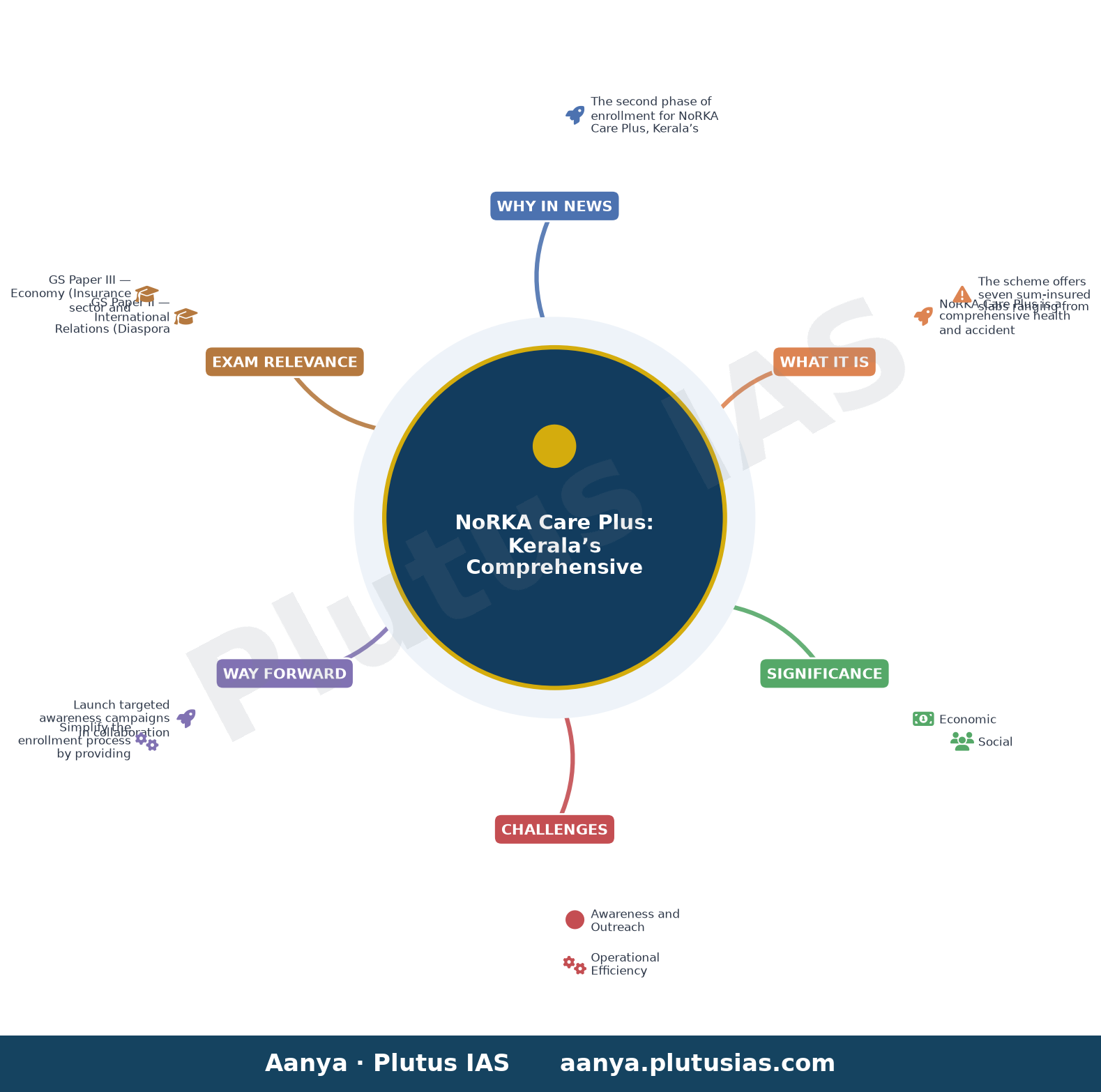
✎ NoRKA Care Plus is Kerala’s flagship health and accident insurance scheme for expatriate Keralites, offering seven sum-insured slabs (₹5 lakh to ₹1 crore), cashless treatment at 24,000+ hospitals, and dependent coverage…
Subject Relevance — Where This Topic Fits
- GS Paper II — International Relations (Diaspora engagement and welfare) | GS Paper III — Economy (Insurance sector and public-private partnerships) | GS Paper II — Governance (Citizen-centric schemes and service delivery)
- Prelims: NoRKA (Non-Resident Keralites Affairs), Pravasi ID, Cashless treatment, United India Insurance Company, Public Sector Undertaking (PSU), Health insurance slabs, NRK (Non-Resident Keralite), NoRKA-ROOTS
- Essay: The role of diaspora communities in national development and welfare schemes, Public-private partnerships in delivering social security: opportunities and challenges
Quick Revision: NoRKA Care Plus is Kerala’s flagship health and accident insurance scheme for expatriate Keralites, offering seven sum-insured slabs (₹5 lakh to ₹1 crore), cashless treatment at 24,000+ hospitals, and dependent coverage, implemented via NoRKA-ROOTS in collaboration with United India Insurance Company.
Why is this in the news?
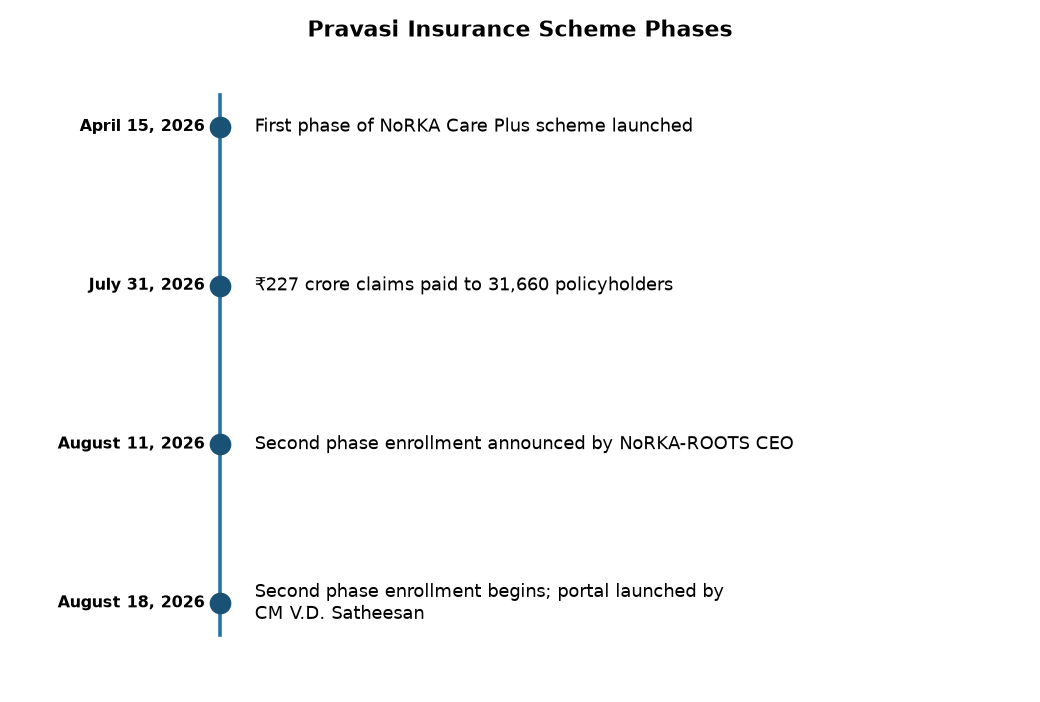
The second phase of enrollment for NoRKA Care Plus, Kerala’s flagship health and accident insurance scheme for expatriate Keralites, commences on August 18, 2026. This phase extends coverage for the remaining eight months of the policy period (August 18, 2026, to April 14, 2027) and introduces revised premium structures, reflecting the scheme’s evolving operational dynamics and its commitment to sustaining high claim settlement rates (99.38% as of July 31, 2026). The launch underscores the state government’s focus on leveraging diaspora networks for inclusive welfare delivery and strengthening health security for Non-Resident Keralites (NRKs).
Background
- NoRKA Care Plus was introduced in April 2026 as an enhanced version of NoRKA Care, expanding coverage to include accident insurance and higher sum insured options, with a focus on cashless treatment across a vast network of hospitals.
- As of July 2026, over 1.62 lakh expatriate families from 138 countries have enrolled, with claims amounting to ₹227 crore disbursed to 31,660 policyholders, indicating robust uptake and trust in the scheme.
- The scheme aligns with Kerala’s broader strategy to harness diaspora contributions for state development, including remittances, knowledge transfer, and social sector investments.
What is NoRKA Care Plus?
- NoRKA Care Plus is a comprehensive health and accident insurance scheme launched by the Government of Kerala under the Department of Non-Resident Keralites Affairs (NoRKA) to provide financial protection to expatriate Keralites (NRKs) and their eligible dependents.
- The scheme offers seven sum-insured slabs ranging from ₹5 lakh to ₹1 crore, enabling policyholders to choose coverage based on their risk assessment and financial capacity.
- Eligibility is extended to Non-Resident Keralites aged 18–70 holding a valid NoRKA Pravasi ID, Student ID, or NRK ID, ensuring targeted outreach to the diaspora community.
- Dependent coverage is available under higher slabs (₹10 lakh to ₹1 crore), allowing policyholders to include their parents or spouse (up to age 80) under the same policy, enhancing family-centric welfare.
- The scheme provides cashless treatment at approximately 24,000 hospitals across India, including over 688 hospitals in Kerala, ensuring accessibility and reducing out-of-pocket expenses for policyholders.
- Enrollment is facilitated through the NoRKA-ROOTS website (www.norkaroots.kerala.gov.in) and dedicated mobile applications for iOS and Android, promoting digital inclusivity and ease of access.
- The second phase of enrollment (August 18–September 18, 2026) extends coverage for the remaining eight months of the policy period (August 18, 2026–April 14, 2027), with revised premium structures to reflect the updated coverage period.
- The scheme is implemented in partnership with United India Insurance Company, a public sector undertaking, ensuring financial stability, claim settlement efficiency, and adherence to regulatory standards.
Key Features
| Feature | Significance |
|---|---|
| Coverage Slabs | Provides flexible insurance options ranging from ₹5 lakh to ₹1 crore, catering to diverse financial capacities and healthcare needs of expatriate Keralites. |
| Eligibility Criteria | Extends coverage to Non-Resident Keralites aged 18–70 with valid NoRKA Pravasi ID, Student ID, or NRK ID, ensuring inclusivity for students and workers abroad. |
| Family Inclusion | Allows inclusion of parents or spouse (up to age 80) under policies from ₹10 lakh to ₹1 crore, addressing the healthcare needs of dependents. |
| Cashless Treatment Network | Facilitates cashless treatment at ~24,000 hospitals nationwide, including 688+ in Kerala, enhancing accessibility and reducing out-of-pocket expenses. |
| Claim Settlement Rate | Achieves a 99.38% claim settlement rate, demonstrating operational efficiency and reliability of the scheme for beneficiaries. |
Why it Matters
Economic
- Strengthens foreign exchange inflows by providing a safety net for expatriate Keralites, thereby encouraging remittances and economic stability for their families in Kerala.
- Reduces financial vulnerability among NRK families, mitigating the risk of debt or distress sales of assets due to medical emergencies abroad.
Social
- Enhances social security for a vulnerable demographic—expatriate workers—who often face higher healthcare costs and limited access to local insurance schemes.
- Promotes inclusive growth by ensuring healthcare coverage for dependents, including elderly parents, who may not qualify for standalone insurance policies.
Administrative
- Demonstrates the efficacy of state-led welfare schemes in addressing the needs of diaspora communities, setting a precedent for similar initiatives in other states.
- Leverages public-private partnerships (e.g., with United India Insurance Company) to deliver scalable and efficient insurance services.
Policy
- Aligns with the broader framework of the Government of India’s initiatives for Non-Resident Indians (NRIs), such as the Pravasi Bharatiya Divas and Overseas Citizen of India (OCI) card schemes.
- Complements Kerala’s existing welfare schemes for expatriates, such as the ‘Pravasi Welfare Fund,’ by adding a critical healthcare component.
Challenges
1. Awareness and Outreach
- Limited awareness among expatriate communities, particularly in remote or less digitally connected regions, may hinder enrollment despite the scheme’s benefits.
- Linguistic and cultural barriers in communication could impede effective dissemination of information about enrollment processes and claim procedures.
UPSC Link: GS2: Welfare schemes for vulnerable sections
2. Operational Efficiency
- Maintaining a high claim settlement rate (99.38%) requires robust backend processes, including timely verification of documents and coordination with hospitals.
- Ensuring seamless cashless treatment across 24,000 hospitals demands continuous monitoring and grievance redressal mechanisms to address discrepancies.
UPSC Link: GS2: Government policies and interventions
3. Sustainability
- The scheme’s long-term viability depends on balancing premium affordability with adequate coverage, especially for lower-income expatriates.
- Fluctuations in the global economy or currency exchange rates may impact the purchasing power of NRKs, necessitating periodic reviews of premium structures.
UPSC Link: GS3: Indian Economy and issues relating to planning
4. Data Security and Privacy
- Handling sensitive personal and medical data of expatriates requires stringent compliance with data protection laws, such as the Digital Personal Data Protection Act, 2023.
- Cybersecurity threats to the enrollment portal or mobile applications could compromise beneficiary information, necessitating robust IT infrastructure.
UPSC Link: GS3: Science and Technology
Challenges — UPSC Perspective
| Issue | Concern |
|---|---|
| Enrollment Gaps | Potential under-enrollment due to lack of awareness or complex eligibility criteria, particularly among marginalised expatriate groups. |
| Claim Rejections | Risk of claim rejections due to incomplete documentation or discrepancies in medical records, leading to beneficiary dissatisfaction. |
| Premium Affordability | Higher premiums for larger coverage slabs may deter lower-income expatriates from opting for comprehensive insurance. |
| Hospital Network Gaps | Limited cashless treatment facilities in certain regions or countries may restrict access for expatriates working outside India. |
| Regulatory Compliance | Ensuring adherence to local laws in host countries while providing coverage abroad may pose legal complexities. |
Way Forward
- Launch targeted awareness campaigns in collaboration with expatriate associations, Indian missions abroad, and social media platforms to enhance enrollment.
- Simplify the enrollment process by providing multilingual support and step-by-step guides on the NoRKA-ROOTS portal and mobile applications.
- Conduct periodic reviews of premium structures to ensure affordability while maintaining adequate coverage, possibly introducing subsidies for lower-income groups.
- Strengthen the grievance redressal mechanism by establishing dedicated helplines and online portals for tracking claims and resolving disputes.
- Expand the hospital network by onboarding additional healthcare providers, particularly in regions with high concentrations of expatriate Keralites.
- Implement data encryption and cybersecurity protocols to safeguard beneficiary information and comply with data protection regulations.
- Monitor and publish quarterly reports on claim settlement rates, enrollment trends, and beneficiary feedback to ensure transparency and accountability.
UPSC Value Addition
Keywords for Mains Answer-Writing
Non-Resident Keralites Affairs (NoRKA) · Pravasi insurance scheme · NoRKA Care Plus · expatriate health insurance · cashless treatment · United India Insurance Company · Kerala government welfare schemes · insurance claim settlement · public sector insurance undertakings · digital governance in welfare delivery
Concept Flow
Identification of healthcare vulnerability among expatriate Keralites → Formulation of NoRKA Care Plus scheme → Collaboration with United India Insurance Company → Launch of enrollment portal and mobile apps → Phase-wise enrollment (April 2026 onward) → Claim settlement and feedback integration → Expansion of hospital network and outreach → Policy refinement based on beneficiary data.
Prelims Practice Questions
Q1. Consider the following statements regarding the NoRKA Care Plus scheme:
1. It is a health and accident insurance scheme exclusively for Non-Resident Keralites.
2. The scheme is implemented in collaboration with a private sector insurance company.
3. Enrollment for the second phase is open from August 18 to September 18, 2026.
4. The scheme provides cashless treatment at hospitals across India, including Kerala.
How many of the above statements are correct?
- Only one
- Only two
- Only three
- All four
Answer: All four — Statements 1, 3, and 4 are correct. Statement 2 is incorrect as the scheme is implemented in collaboration with United India Insurance Company, a public sector undertaking.
Q2. Assertion (A): The NoRKA Care Plus scheme offers insurance coverage under seven slabs ranging from ₹5 lakh to ₹1 crore.
Reason (R): The scheme includes coverage for parents of the policyholder or their spouse up to the age of 80 under policies ranging from ₹10 lakh to ₹1 crore.
Options:
A. Both A and R are true, and R is the correct explanation of A.
B. Both A and R are true, but R is not the correct explanation of A.
C. A is true, but R is false.
D. A is false, but R is true.
Answer: ? — Both A and R are true, but R is not the correct explanation of A. The assertion states the range of slabs, while the reason provides additional eligibility criteria for coverage.
Q3. Match the following columns related to the NoRKA Care Plus scheme:
Column I (Coverage Slab) Column II (Eligibility for Parents/Spouse)
A. ₹5 lakh 1. Not eligible
B. ₹10 lakh 2. Eligible up to age 80
C. ₹15 lakh 3. Eligible up to age 70
D. ₹1 crore 4. Eligible up to age 60
Options:
A. A-1, B-2, C-3, D-4
B. A-1, B-2, C-4, D-3
C. A-2, B-1, C-3, D-4
D. A-1, B-3, C-2, D-4
Answer: ? — The correct match is: A-1 (₹5 lakh slab does not include parents/spouse), B-2 (₹10 lakh slab includes parents/spouse up to age 80), C-3 (₹15 lakh slab includes parents/spouse up to age 70), D-4 (₹1 crore slab includes parents/spouse up to age 60).
Mains Practice Question
✍ Critically examine the significance of the NoRKA Care Plus scheme in addressing the healthcare needs of Non-Resident Keralites. Also, discuss the role of digital governance in enhancing the accessibility and efficiency of such welfare schemes. (15 Marks)
Approach: MODEL-ANSWER SKELETON:
1. **Introduction (2 marks)**: Define the NoRKA Care Plus scheme, its objectives, and the target beneficiaries (Non-Resident Keralites aged 18-70). Highlight its launch and implementation by the Kerala government in collaboration with United India Insurance Company.
2. **Healthcare Coverage and Benefits (4 marks)**:
– Outline the seven slabs of insurance coverage (₹5 lakh to ₹1 crore).
– Explain the inclusion of parents/spouse up to age 80 under higher slabs.
– Discuss the provision for cashless treatment at 24,000 hospitals across India, including 688 in Kerala.
– Mention the claim settlement rate of 99.38% and the financial outlay (₹227 crore paid to 31,660 policyholders as of July 31, 2026).
3. **Impact on Expatriate Community (4 marks)**:
– Address the challenges faced by Non-Resident Keralites in accessing healthcare in India.
– Highlight the scheme’s role in providing financial security and reducing out-of-pocket expenses.
– Discuss the scheme’s reach (1.62 lakh expatriate families from 138 countries enrolled).
4. **Digital Governance and Accessibility (3 marks)**:
– Explain the role of the NoRKA-ROOTS portal and mobile applications in streamlining enrollment and claims.
– Discuss how digital platforms enhance transparency, reduce bureaucratic delays, and improve service delivery.
– Reference the scheme’s alignment with the broader goal of leveraging technology for inclusive governance.
5. **Challenges and Future Prospects (2 marks)**:
– Acknowledge potential challenges such as digital divide, awareness gaps, and sustainability of premiums.
– Suggest measures for further improvement, such as expanding hospital networks, increasing premium subsidies, or integrating with national health schemes.
Source: The Hindu
Generated by AanyaAi for educational purpose.

- Gurugram’s groundwater extraction exceeds limit by 212%; HC seeks ban - October 4, 2026
- स्वतंत्रता सेनानी श्यामजी कृष्ण वर्मा की जन्म जयंती पर पीएम का श्रद्धांजलि - October 4, 2026
- KWML’s Feasibility Reports for Water Metro in 18 Cities: UPSC & PCS Insights - October 3, 2026

No Comments