


07 May Skyroot Aerospace Becomes India’s First Space-Tech Unicorn
This article covers “Daily Current Affairs”
SYLLABUS MAPPING : GS Paper 3 : Economy and Science and Tech
FOR PRELIMS : About Skyroot Aerospace, India’s Private Space Ecosystem, Private Space Sector Policy Framework
FOR MAINS : India’s private space sector has witnessed rapid transformation from a government-monopoly model to a vibrant public-private ecosystem within a decade. Trace the evolution of India’s space policy framework, evaluate the role of startups like Skyroot Aerospace and Agnikul Cosmos in this transformation, and assess how India can position itself as a global hub for commercial space activities. (15 M)
Why in News?
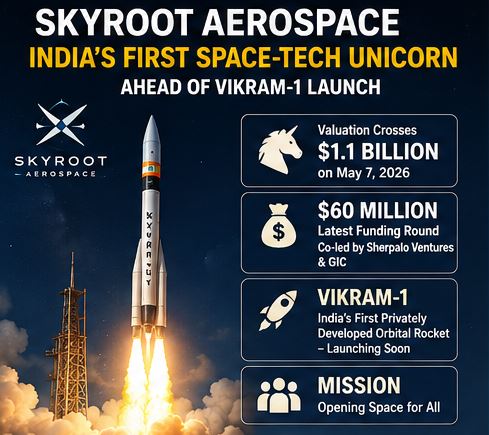
On May 7, 2026, Hyderabad-based spacetech startup Skyroot Aerospace achieved a landmark double milestone — it became India’s first space-technology unicorn after raising $60 million in a new funding round, pushing its valuation to $1.1 billion. This came just weeks ahead of the anticipated launch of Vikram-1, which is set to become India’s first privately developed orbital rocket. The funding round was co-led by Sherpalo Ventures (founded by Ram Shriram, one of Google’s earliest backers) and GIC (Singapore’s sovereign wealth fund), with participation from funds managed by BlackRock, Arkam Ventures, Playbook Partners, Shanghvi Family Office, and the founders of the Greenko Group.
About Skyroot Aerospace — Origin, Founders, and Vision
Founding Story
-
-
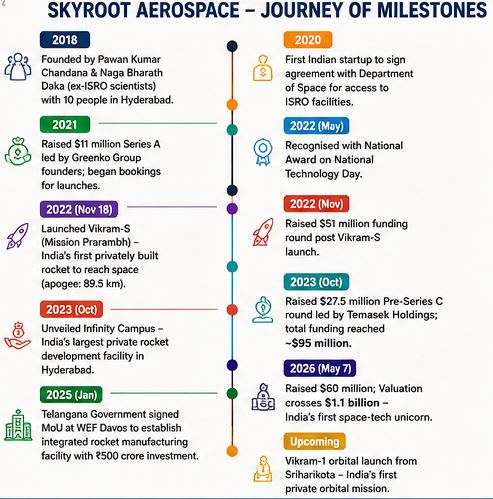
- Skyroot Aerospace was founded in July 2018 in Hyderabad by Pawan Kumar Chandana and Naga Bharath Daka — both former scientists and engineers from the Indian Space Research Organisation (ISRO).
- The company started with a team of barely 10 people operating out of a small office in Kondapur, Hyderabad, incubated at T-Hub and supported by T-Works — Telangana’s flagship startup and prototyping ecosystems.
- Early supporters included CureFit founders Mukesh Bansal and Ankit Nagor, former WhatsApp CBO Neeraj Arora, and former Google executive Amit Singhal.
-
Core Mission
-
-
- Skyroot’s stated mission is “Opening Space for All” — positioning itself as a provider of affordable, dedicated, on-demand satellite launch services, particularly for the rapidly expanding small and medium satellite market.
- The company has drawn a deliberate contrast with large, multi-payload rockets by positioning itself as a “space cab” — offering precise, customised orbital placement to specific satellite clients rather than mass launches.
-
Name and Identity
-
-
- The Vikram series of rockets is named after Dr. Vikram Sarabhai — the visionary scientist widely regarded as the father of India’s space programme, who built India’s first rocket launch station at Thumba in the 1960s.
- The company’s Infinity Campus — a 6-acre private rocket manufacturing and integration facility in Hyderabad — was inaugurated by Prime Minister Modi and represents India’s largest private rocket factory.
-
Mission Prarambh — Vikram-S (2022): The Breakthrough
-
-
- On November 18, 2022, Skyroot launched its Vikram-S rocket from the Satish Dhawan Space Centre, Sriharikota — in a mission named Prarambh (“The Beginning” in Sanskrit).
- The single-stage, solid-fuel, spin-stabilised suborbital rocket reached a peak altitude of 89.5 km and a range of 121.2 km — crossing the Kármán line (officially considered the boundary of space at 100 km, though this flight approached it) and marking India’s first private rocket to reach near-space.
- The rocket carried three customer payloads — from BAZOOMQ (Armenia), Space Kidz India, and N-Space Tech India — demonstrating commercial payload capability.
- Vikram-S was built with an all-carbon fibre core structure and 3D-printed components, manufactured in just two years.
- At the time of launch, Skyroot became the first Indian private company to launch a rocket into space.
-
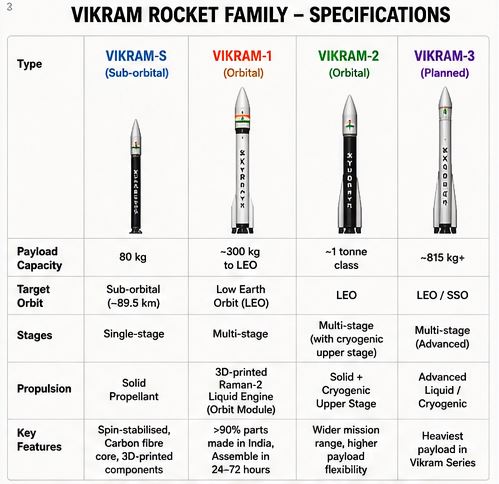
Vikram Rocket Family — Technical Specifications
| Rocket | Type | Payload Capacity | Target Orbit | Key Features |
|---|---|---|---|---|
| Vikram-S | Sub-orbital (demo) | 80 kg | Sub-orbital (~89.5 km) | Single-stage, solid propellant, carbon fibre |
| Vikram-1 | Orbital (upcoming) | ~300 kg to LEO | Low Earth Orbit (LEO) | Multi-stage, 3D-printed Raman-2 liquid engine, all-carbon composite body |
| Vikram-2 | Orbital (in development) | ~1 tonne class | LEO | Advanced cryogenic upper stage, wider mission range |
| Vikram-3 | Orbital (planned) | ~815 kg+ | LEO/SSO | Largest in the family |
-
- More than 90% of components used in Vikram-1 are manufactured domestically in India.
- Rockets in the Vikram series can reportedly be assembled and ready for launch within 24–72 hours, depending on the rocket and payload — a critical competitive advantage over traditional launch providers.
- The Raman-2 engine — a 3D-printed liquid engine used in the orbit adjustment module of Vikram-1 — represents a significant advance in Indian private aerospace manufacturing.
Why Is This Significant? — Multi-Dimensional Importance
India’s Private Space Ecosystem Comes of Age
-
-
- As of 2025, India has over 400+ space startups — up from just 1 in 2014 — with cumulative private investment exceeding ₹3,000 crore.
- Skyroot’s unicorn status sends a clear market signal: India’s deep-tech / spacetech sector can attract world-class capital at global valuations.
- Other well-funded Indian spacetech companies include Agnikul Cosmos, Pixxel, Dhruva Space, Bellatrix Aerospace, and Digantara — building launch vehicles, satellites, and space situational awareness systems.
-
Vikram-1 — India’s Private Orbital Debut
-
-
- If Vikram-1’s launch succeeds, India will join a very small club of nations where private companies have independently developed and launched orbital rockets — currently dominated by the US (SpaceX, Rocket Lab) and increasingly challenged by China’s private sector.
- This would reduce India’s dependence on ISRO for commercial satellite launches and open a cost-competitive domestic alternative for small satellite operators.
-
Global Space Economy Opportunity
-
-
- The global space economy is valued at approximately $600 billion and is projected to triple by 2030 to over $1.8 trillion.
- The small satellite launch market is the fastest-growing segment, driven by constellations for communications, earth observation, IoT connectivity, and navigation.
- India’s cost-to-performance ratio in aerospace manufacturing — reinforced by globally competitive engineering talent — gives Indian launch providers a structural advantage.
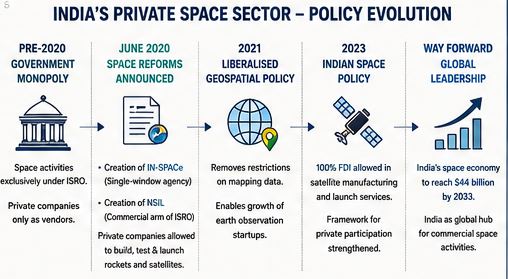
- India’s projected space economy is expected to reach $44 billion by 2033 (per IN-SPACe and Arthur D. Little).
-
Aatmanirbhar Bharat in Deep-Tech
-
-
- More than 90% of Vikram-1’s components are domestically manufactured — embodying the “Make in India” philosophy in one of the most technologically demanding sectors.
- Skyroot’s success validates the model of ISRO alumni-led entrepreneurship — a model that can unlock decades of government-funded R&D as commercial intellectual capability.
-
Employment and Skill Development
-
-
- Skyroot has grown from 10 people in 2018 to over 350 engineers today — creating high-quality, high-paying aerospace engineering jobs in India that would previously have required emigration to NASA, ESA, or SpaceX.
-
India’s Private Space Sector — Policy Framework and Evolution
Pre-2020: The Government Monopoly Era
-
-
- Before 2020, India’s space sector was exclusively government-operated under ISRO. Private companies could only participate as vendors/contractors to ISRO — they could not independently build and launch rockets or operate satellites.
- This model, while producing remarkable achievements (Chandrayaan, Mangalyaan, PSLV), constrained commercial scale and innovation pace.
-
Space Sector Reforms (2020–2023) — Opening the Cosmos
-
-
- In June 2020, the Indian government announced historic space sector reforms as part of Aatmanirbhar Bharat, including:
- Creation of IN-SPACe (Indian National Space Promotion and Authorisation Centre) as a single-window, independent nodal agency within the Department of Space to facilitate and regulate private participation.
- Creation of NewSpace India Limited (NSIL) as ISRO’s commercial arm.
- Allowing private companies to independently design, build, test, and launch rockets and satellites.
- Opening ISRO’s infrastructure (launch pads, test facilities) for private use.
- Indian Space Policy 2023 further formalised the framework, including 100% FDI allowance in satellite manufacturing and launch services.
- Liberalised Geospatial Data Policy (2021) removed previously onerous restrictions on mapping data, enabling a new generation of earth observation startups.
- In June 2020, the Indian government announced historic space sector reforms as part of Aatmanirbhar Bharat, including:
-
IN-SPACe — The Enabler
-
-
- IN-SPACe (Indian National Space Promotion and Authorisation Centre) serves as the regulatory and promotional agency for private space activities.
- It provides authorisations, facilitates access to ISRO infrastructure, and promotes India’s private sector in international markets.
- Skyroot was the first private company to sign a formal agreement with IN-SPACe/Department of Space for access to ISRO’s testing facilities.
-
Other Key Players in India’s New Space Ecosystem
| Company | Focus Area | Notable Achievement |
|---|---|---|
| Agnikul Cosmos | Launch vehicles | First 3D-printed semi-cryogenic engine in India (Agnilet) |
| Pixxel | Hyperspectral satellites | India’s first private hyperspectral earth observation constellation |
| Dhruva Space | Satellite platforms & deployers | Satellite modules launched on ISRO and international rockets |
| Bellatrix Aerospace | Propulsion systems | Electric and green propulsion for satellites |
| Digantara | Space situational awareness | Building India’s first commercial space traffic monitoring system |
Key Challenges Ahead for Skyroot and India’s Private Space Sector
Technical Risk of Vikram-1’s First Orbital Flight
-
-
- Orbital launches are exponentially more complex than suborbital flights. Achieving orbital velocity (~7.9 km/s) requires sustained multi-stage propulsion, precision guidance, and complex stage separation — all first-time achievements for Skyroot.
- In the global context, many private launch companies have experienced first-flight failures before achieving orbital success.
-
Competition from Global Players
-
-
- SpaceX’s Falcon 9 and Rocket Lab’s Electron have established themselves as the benchmark for small-to-medium payload launches. Skyroot must demonstrate not just capability but competitive pricing and reliability to win international customers.
-
Regulatory and Clearance Delays
-
-
- India still lacks a comprehensive Space Activities Act — the legislative backbone for long-term regulatory certainty in areas like liability, spectrum, insurance, and debris mitigation. Until this is enacted, legal ambiguities remain.
-
Profitability Horizon
-
-
- Skyroot remained in the pre-revenue stage as of FY25 (March 2025), with losses widening to ₹99.70 crore due to sustained R&D investment. The company needs successful commercial launches to begin revenue generation.
-
Infrastructure Gaps
-
-
- India has limited dedicated private launch infrastructure. While the upcoming Kulasekarapattinam spaceport in Tamil Nadu (being developed by ISRO for small satellite launches) will add capacity, private spaceports under dedicated private control remain absent.
-
Prelims Question
Q. With reference to Skyroot Aerospace and India’s private space sector, consider the following statements:
- Skyroot Aerospace was founded by former ISRO scientists Pawan Kumar Chandana and Naga Bharath Daka in 2018.
- Mission Prarambh, launched in November 2022, was India’s first private orbital mission.
- IN-SPACe (Indian National Space Promotion and Authorisation Centre) functions under the Department of Space as a single-window agency for private sector participation.
- The Vikram rocket series is named after Dr. Vikram Sarabhai, the father of India’s space programme.
Which of the statements given above are correct?
(a) 1, 2 and 4 only
(b) 1, 3 and 4 only
(c) 2, 3 and 4 only
(d) 1, 2, 3 and 4
Correct Answer: (b) 1, 3 and 4 only
Explanation:
- Statement 1 is CORRECT. Skyroot was indeed founded in July 2018 by Pawan Kumar Chandana and Naga Bharath Daka, both former ISRO scientists.
- Statement 2 is INCORRECT. Mission Prarambh (Vikram-S, November 2022) was a sub-orbital demonstration mission — it did not achieve orbit. It is celebrated as India’s first private rocket to reach near-space (apogee ~89.5 km). India’s first private orbital mission is the upcoming Vikram-1 flight.
- Statement 3 is CORRECT. IN-SPACe was established in 2020 as a single-window, independent, nodal agency functioning within the Department of Space to facilitate and promote private sector participation in space activities.
- Statement 4 is CORRECT. The Vikram series of rockets is named in honour of Dr. Vikram Sarabhai, the visionary scientist who founded India’s space programme in the 1960s.
Mains Questions
“Skyroot Aerospace becoming India’s first space-tech unicorn ahead of the Vikram-1 orbital launch represents not just a startup milestone but a strategic inflection point for India’s position in the global space economy.” Critically examine this statement, highlighting the role of government policy reforms, private sector innovation, and remaining challenges in India’s commercial space sector. (15 M)

- India’s Youth Unemployment and Education Crisis - August 5, 2026
- India’s Sports Infrastructure and the 2036 Olympics Ambition - August 5, 2026
- Critical Minerals: The Foundation of Strategic Power - August 4, 2026

No Comments