


11 Aug SMILE Scheme: Govt Strengthens Rehabilitation Framework for Beggars
✎ The SMILE-Beggary scheme operationalises constitutional and judicial directives by integrating rehabilitation, skill development, and livelihood support for persons engaged in begging, with a focus on dignity and social inclusion.
Subject Relevance — Where This Topic Fits
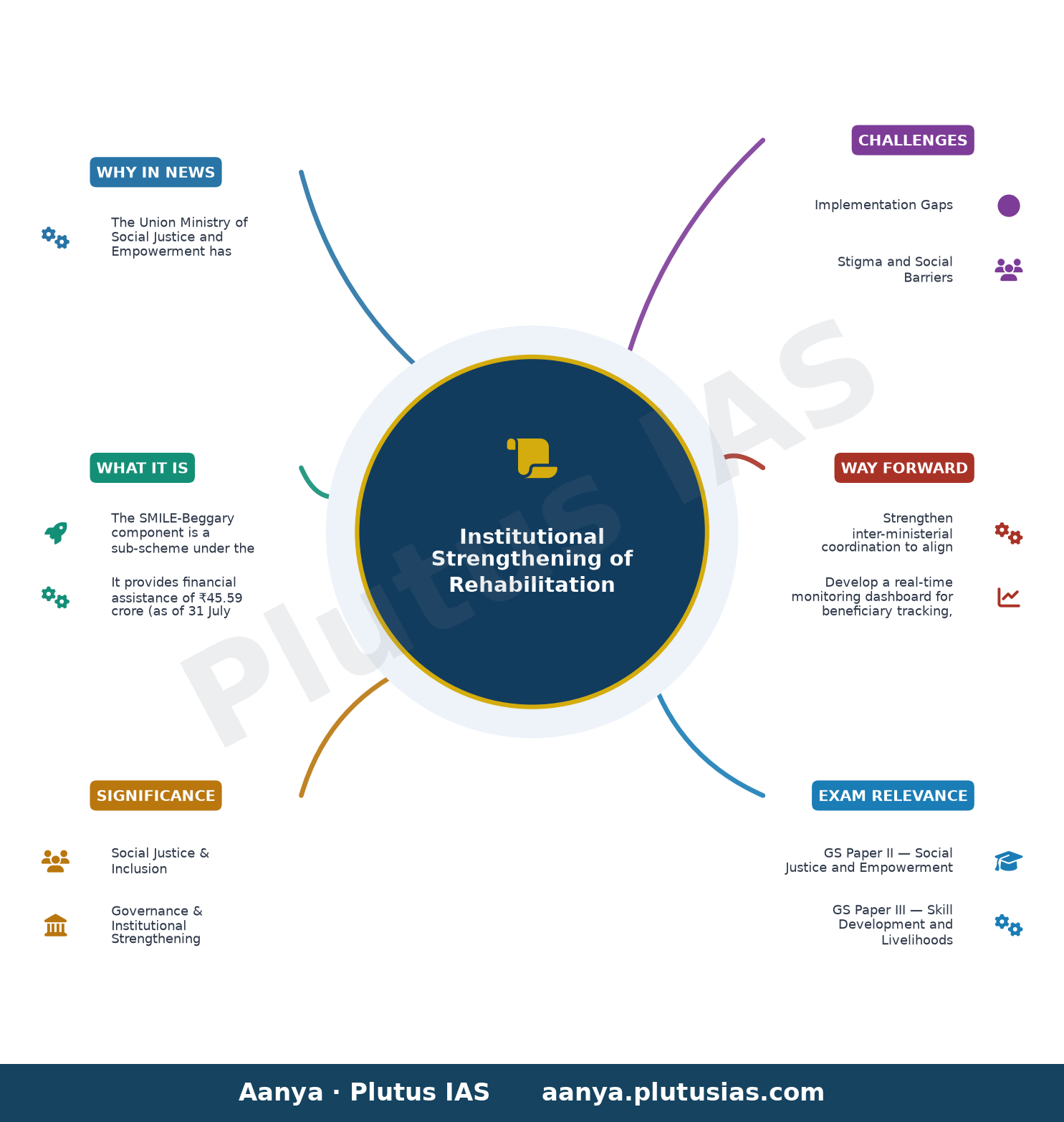
- GS Paper II — Social Justice and Empowerment | GS Paper III — Skill Development and Livelihoods
- Prelims: SMILE Scheme, Beggary Act, 1959, Deendayal Antyodaya Yojana-National Urban Livelihoods Mission (DAY-NULM), National Urban Livelihoods Mission (NULM), Social Justice and Empowerment Ministry, National Consultative Committee, Model Guidelines for Rehabilitation of Persons Engaged in Begging
- Essay: Social justice and inclusive development: Bridging the gap between policy and ground reality, Rehabilitating marginalised communities: A governance imperative
Quick Revision: The SMILE-Beggary scheme operationalises constitutional and judicial directives by integrating rehabilitation, skill development, and livelihood support for persons engaged in begging, with a focus on dignity and social inclusion.
Why is this in the news?
The Union Ministry of Social Justice and Empowerment has strengthened the institutional framework for the care, rehabilitation, and social reintegration of persons engaged in begging under the SMILE (Support for Marginalised Individuals for Livelihood and Enterprise) – Beggary component. This follows judicial directives from the Supreme Court in *M.S. Pather v. Government of NCT Delhi* (2025) and reflects a structured policy response to address systemic vulnerabilities among marginalised urban populations.
Background
- Beggary has historically been criminalised under colonial-era legislation such as the Bombay Prevention of Begging Act, 1959, which has faced criticism for its punitive approach rather than rehabilitation.
- The Supreme Court of India, in *M.S. Pather v. Government of NCT Delhi* (2025), directed the Union Government to frame comprehensive guidelines for the rehabilitation of persons engaged in begging, emphasising dignity, rights, and social inclusion.
- The SMILE scheme was launched on 23 October 2023 as a central sector scheme under the Ministry of Social Justice and Empowerment, integrating welfare measures for marginalised groups including persons engaged in begging.
- The scheme aligns with constitutional provisions such as Articles 15(3), 21, and 41, which mandate state action for the welfare and rehabilitation of vulnerable sections.
- Urban poverty and livelihood insecurity are exacerbated by lack of access to formal employment, housing, and social protection, necessitating targeted interventions like SMILE-Beggary.
- The National Urban Livelihoods Mission (NULM), now subsumed under DAY-NULM, provides a complementary framework for skill development and livelihood support for urban poor, including those at risk of begging.
What is the SMILE-Beggary Scheme?
- The SMILE-Beggary component is a sub-scheme under the SMILE umbrella, launched to address the rehabilitation needs of persons engaged in begging through a rights-based, dignity-centric approach.
- It provides financial assistance of ₹45.59 crore (as of 31 July 2026) to 10,446 individuals, including 2,824 children, for rehabilitation, skill development, and social reintegration.
- Financial outlays are distributed as ₹40.04 crore to implementing authorities/urban local bodies and the remainder for administrative and scheme-related expenditures.
- The scheme offers vocational training tailored to beneficiaries’ age, physical and mental condition, and local livelihood opportunities, covering trades such as carpentry, tailoring, sanitation services, food vending, and e-rickshaw driving.
- Children rescued under the scheme receive age-appropriate care, education, counselling, and family reintegration support, excluding them from vocational training interventions.
- Livelihood support includes assistance in forming self-help groups, accessing bank finance for micro-enterprises (e.g., tiffin stalls, spice production, vegetable vending), and linking beneficiaries to financial institutions.
- Model Guidelines for Rehabilitation of Persons Engaged in Begging, issued on 13 April 2026, provide a comprehensive framework for dignified, rights-based rehabilitation, aligning with judicial directives.
Key Features
| Feature | Significance |
|---|---|
| Financial Allocation (₹45.59 crore) | Provides fiscal resources for comprehensive rehabilitation, including administrative and implementation costs. |
| Rehabilitation Coverage (10,446 individuals) | Ensures structured support for destitute individuals, including children, through institutional and community-based interventions. |
| Vocational Training (e.g., tailoring, carpentry, e-rickshaw driving) | Equips beneficiaries with marketable skills aligned with local livelihood opportunities, enhancing employability. |
| Self-Help Groups (SHGs) Formation | Facilitates collective entrepreneurship, financial inclusion, and sustainable income generation through group-based enterprises. |
| Standardised Guidelines (April 2026) | Establishes uniform protocols for dignified rehabilitation, supervision, and monitoring of shelters and beneficiaries. |
Why it Matters
Social Justice & Inclusion
- Addresses systemic marginalisation of destitute individuals by ensuring access to rehabilitation, healthcare, and social reintegration.
- Prioritises child welfare through age-appropriate care, education, and family reunification, aligning with constitutional Directive Principles (Article 39(f)).
- Promotes gender-sensitive rehabilitation by including vocational training in sectors with high female participation (e.g., tailoring, food vending).
Governance & Institutional Strengthening
- Demonstrates a multi-ministerial approach, integrating inputs from health, urban development, and skill ministries for holistic solutions.
- Enhances transparency and accountability through standardised guidelines and state-wise data dissemination.
- Aligns with judicial directives (e.g., *M.S. Pather v. NCT Delhi*) to ensure rights-based rehabilitation and dignified living conditions.
Economic Empowerment
- Facilitates financial inclusion by linking beneficiaries to banking institutions and government schemes for entrepreneurship (e.g., Mudra loans).
- Supports local economies through group-based enterprises (e.g., tiffin stalls, handicrafts), fostering community-level economic resilience.
- Reduces long-term dependency on public welfare by enabling sustainable livelihoods through skill development.
Challenges
1. Implementation Gaps
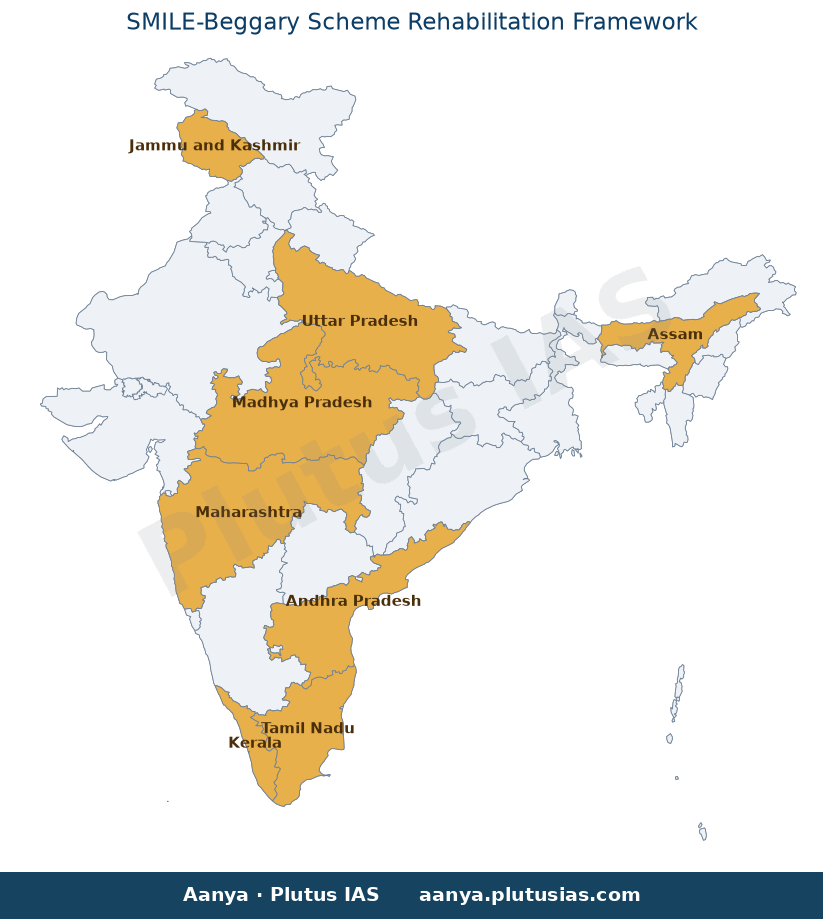
- Variations in state-wise rehabilitation outcomes (e.g., Tamil Nadu: 1,557 vs. Kerala: 418 beneficiaries) highlight disparities in execution.
- Ensuring sustained post-training employment and income stability remains a critical challenge.
- Monitoring and evaluation mechanisms for long-term impact assessment need strengthening.
UPSC Link: GS2: Centre-State Relations
2. Stigma and Social Barriers
- Deep-rooted societal stigma against destitute individuals may impede social reintegration despite rehabilitation efforts.
- Cultural and regional attitudes towards certain vocations (e.g., sanitation work) may limit employment opportunities.
- Addressing intersectional vulnerabilities (e.g., gender, disability) requires targeted interventions.
UPSC Link: GS1: Social Empowerment
3. Resource Mobilisation
- Dependence on central funds may strain state budgets, particularly for states with high beneficiary loads.
- Ensuring equitable distribution of funds across urban and rural areas requires robust fiscal planning.
- Leveraging Corporate Social Responsibility (CSR) funds from private enterprises could supplement public resources.
UPSC Link: GS3: Resource Mobilisation
4. Data and Monitoring
- Lack of real-time data on post-rehabilitation outcomes (e.g., employment status, recidivism rates) hampers evidence-based policymaking.
- Standardising data collection across states is essential for comparative analysis and policy refinement.
- Integrating Aadhaar and other digital IDs could streamline beneficiary tracking and reduce leakages.
UPSC Link: GS2: E-Governance
5. Vocational Alignment
- Mismatch between trained skills and local market demands may render vocational training ineffective.
- Rapid technological changes (e.g., automation) could render certain vocations obsolete without upskilling.
- Ensuring access to modern training infrastructure (e.g., digital literacy) is critical for future-readiness.
UPSC Link: GS3: Skill Development
Challenges — UPSC Perspective
| Issue | Concern |
|---|---|
| State Disparities in Implementation | Uneven distribution of beneficiaries and resources across states. |
| Post-Training Employment Sustainability | Risk of beneficiaries reverting to destitution due to lack of stable income. |
| Stigma and Social Exclusion | Cultural barriers hindering social reintegration despite rehabilitation. |
| Vocational Training-Reality Mismatch | Skills imparted may not align with local economic opportunities. |
| Resource Constraints | Limited fiscal space for scaling up interventions in high-need states. |
Way Forward
- Strengthen inter-ministerial coordination to align rehabilitation efforts with national skill development initiatives (e.g., PMKVY).
- Develop a real-time monitoring dashboard for beneficiary tracking, employment outcomes, and recidivism rates.
- Expand public-private partnerships to augment vocational training infrastructure and job placement support.
- Standardise state-wise rehabilitation protocols to reduce implementation disparities and ensure uniformity.
- Launch targeted campaigns to combat stigma and promote social inclusion of rehabilitated individuals.
- Integrate digital literacy and financial inclusion modules into vocational training for future-readiness.
- Conduct periodic impact assessments to refine programme design and address emerging challenges.
UPSC Value Addition
Keywords for Mains Answer-Writing
SMILE-Bhikshavritti Yojana · Comprehensive Rehabilitation Framework for Beggars · Deendayal Antyodaya Yojana-National Urban Livelihoods Mission (DAY-NULM) · Social Justice and Empowerment Ministry · Beggary Prevention · Skill Development for Marginalised Groups · Institutional Care and Rehabilitation · National Consultative Committee on Beggary · Supreme Court directives on beggary · Urban Poverty Alleviation · Vocational Training for Vulnerable Groups · Social Reintegration of Marginalised Individuals · State-wise Rehabilitation Data · Model Guidelines for Beggary Prevention · Livelihood Support for Urban Poor
Constitutional & Policy Linkages
- Article 41: Directive Principle on public assistance for destitute individuals.
- Article 46: Directive Principle on educational and economic upliftment of weaker sections.
Concept Flow
Destitution and social exclusion → Government intervention via SMILE-Beggary Scheme → Financial allocation and institutional framework → Identification and rehabilitation of beneficiaries → Vocational training and skill development → Self-help groups and entrepreneurship → Social reintegration and dignified livelihood → Long-term economic empowerment and reduced recidivism.
Prelims Practice Questions
Q1. Consider the following statements regarding the SMILE-Bhikshavritti Yojana:
1. The scheme is implemented under the Deendayal Antyodaya Yojana-National Urban Livelihoods Mission (DAY-NULM).
2. It aims to provide vocational training to rehabilitated beggars based on their age, aptitude, and local livelihood opportunities.
3. The scheme mandates the formation of self-help groups exclusively for women beneficiaries.
4. Under the scheme, financial linkages are facilitated for beneficiaries to start group-based enterprises.
How many of the above statements are correct?
- Only one
- Only two
- Only three
- All four
Answer: Only three — Statements 1, 2, and 4 are correct. Statement 3 is incorrect as the scheme does not mandate self-help groups exclusively for women; it supports group-based enterprises for all beneficiaries.
Q2. Assertion (A): The SMILE-Bhikshavritti Yojana includes provisions for the rehabilitation of children rescued from beggary.
Reason (R): The scheme provides age-appropriate care, education, and family reintegration for rescued children, excluding them from vocational training interventions.
In the context of the above two statements, which one of the following is correct?
- Both A and R are true, and R is the correct explanation of A
- Both A and R are true, but R is not the correct explanation of A
- A is true, but R is false
- A is false, but R is true
Answer: Both A and R are true, and R is the correct explanation of A — Both A and R are true, and R correctly explains A as the scheme explicitly excludes rescued children from vocational training to focus on their education and reintegration.
Q3. Match the following pairs related to the SMILE-Bhikshavritti Yojana:
Column I (State/UT) Column II (Number of Adult Beneficiaries Rehabilitated)
A. Tamil Nadu 1. 1,557
B. Madhya Pradesh 2. 1,135
C. Uttar Pradesh 3. 884
D. Maharashtra 4. 817
Select the correct match:
- A-1, B-2, C-3, D-4
- A-2, B-1, C-4, D-3
- A-3, B-4, C-1, D-2
- A-4, B-3, C-2, D-1
Answer: A-1, B-2, C-3, D-4 — The correct match is A-1 (Tamil Nadu: 1,557), B-2 (Madhya Pradesh: 1,135), C-3 (Uttar Pradesh: 884), and D-4 (Maharashtra: 817).
Mains Practice Question
✍ The SMILE-Bhikshavritti Yojana represents a paradigm shift in India’s approach to addressing beggary by moving beyond punitive measures to a rights-based, rehabilitative framework. Critically examine the institutional, legal, and policy dimensions of this scheme, with particular reference to its alignment with constitutional obligations and Supreme Court directives. Also, assess its potential to ensure sustainable livelihoods for marginalised individuals. (15 Marks)
Approach: MODEL-ANSWER SKELETON:
1. **Constitutional and Legal Foundations** (3 Marks)
– Article 21 (Right to Life and Dignity) and Article 41 (Directive Principles of State Policy) as the constitutional basis for rehabilitation.
– Supreme Court’s directives in *M.S. Patter v. NCT Delhi* (2025) mandating humane treatment and rehabilitation of beggars.
– Role of the Ministry of Social Justice and Empowerment in framing guidelines.
2. **Policy Framework and Institutional Mechanisms** (4 Marks)
– SMILE-Bhikshavritti Yojana as a component of DAY-NULM, integrating livelihood support and social reintegration.
– National Consultative Committee: composition (Ministries of Law & Justice, Health, Housing, Women & Child Development, Skill Development, NHRC, NGOs, and State representatives).
– Model Guidelines (April 2026): focus on humane, dignity-based rehabilitation, institutional care, and supervision of shelters.
3. **Implementation and Outcomes** (4 Marks)
– Financial outlay: ₹45.59 crore released (till July 2026), with ₹40.04 crore to implementing authorities.
– Rehabilitation data: 10,446 individuals (7,622 adults, 2,824 children) rehabilitated across states (e.g., Tamil Nadu: 1,557 adults).
– Vocational training: skills like carpentry, tailoring, sanitation services, and group-based enterprises (e.g., tiffin stalls, vegetable carts).
4. **Challenges and Critique** (3 Marks)
– **Sustainability**: Reliance on group-based enterprises and financial linkages may be vulnerable to market fluctuations.
– **State Capacity**: Variability in implementation across states (e.g., Tamil Nadu vs. Jammu & Kashmir).
– **Stigma and Social Reintegration**: Long-term acceptance of rehabilitated individuals in communities.
5. **Way Forward** (1 Mark)
– Strengthening convergence with other schemes (e.g., PM SVANidhi for street vendors, PM KISAN for farmers).
– Expanding data-driven monitoring and grievance redressal mechanisms.
– Community awareness campaigns to reduce stigma and foster social inclusion.
Source: PIB (Press Information Bureau)
Generated by AanyaAi for educational purpose.

- Gurugram’s groundwater extraction exceeds limit by 212%; HC seeks ban - October 4, 2026
- स्वतंत्रता सेनानी श्यामजी कृष्ण वर्मा की जन्म जयंती पर पीएम का श्रद्धांजलि - October 4, 2026
- KWML’s Feasibility Reports for Water Metro in 18 Cities: UPSC & PCS Insights - October 3, 2026

No Comments