


20 Jul SMILE Scheme: UPSC Perspective on ‘Beggary-Free India’ Mission & Rehabilitation Goals
Subject Relevance — Where This Topic Fits
- GS Paper I — Social Issues and Vulnerable Sections | GS Paper II — Governance, Welfare Schemes and Government Policies | GS Paper III — Social Sector and Employment
- Prelims: SMILE Scheme, Beggary Prevention, Social Justice and Empowerment Ministry, Central Sector Schemes, Urban Local Bodies, Skill Development, Rehabilitation Policy, Digital Monitoring Portal
- Essay: Social Justice and Inclusive Development: Challenges and Pathways in India, The Role of State Intervention in Eradicating Social Evils: A Case Study of Beggary Prevention
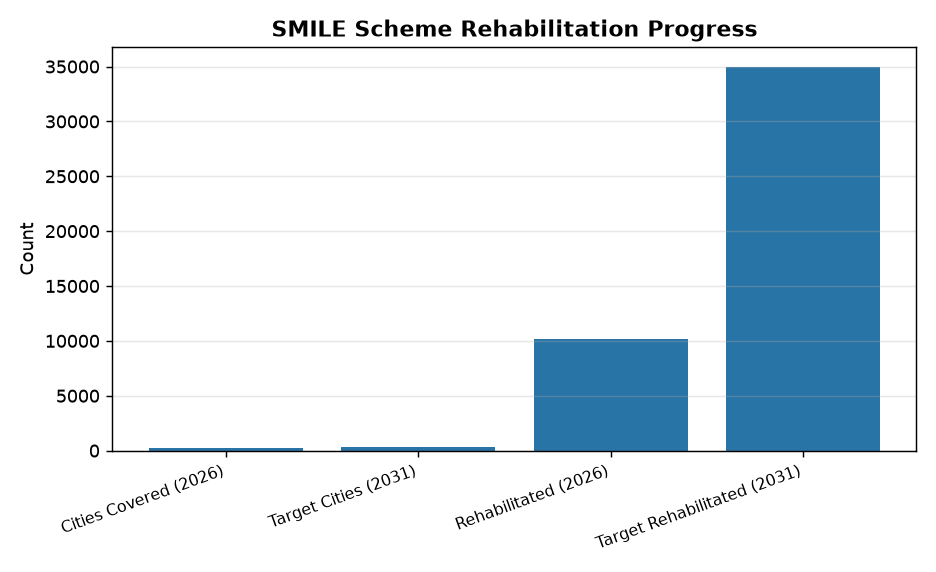
Quick Revision: The SMILE Scheme is a holistic, multi-stakeholder initiative under the Ministry of Social Justice and Empowerment, aiming to eradicate beggary through comprehensive rehabilitation, skill development, and socio-economic empowerment, with a target of rehabilitating 35,000 individuals by 2030-31.
Why is this in the news?
The Press Information Bureau (PIB) has released an official update on the implementation status of the Support for Marginalised Individuals for Livelihood and Enterprise (SMILE) Scheme, highlighting its progress in rehabilitating individuals engaged in beggary across 216 cities. The scheme, launched under the Ministry of Social Justice and Empowerment, aims to achieve a ‘Beggary-Free India’ by 2031 through comprehensive rehabilitation, skill development, and socio-economic empowerment. With over 10,200 individuals already rehabilitated, the scheme targets 35,000 beneficiaries by 2030-31, underscoring its significance in India’s social welfare and governance agenda.
Background
- The phenomenon of beggary in India is a complex socio-economic issue, often linked to poverty, lack of livelihood opportunities, disability, and social exclusion, particularly among marginalised communities such as transgender persons, persons with disabilities, and destitute women.
- The Constitution of India, under Article 21, guarantees the right to life and dignity, which extends to protecting vulnerable individuals from exploitation and ensuring their rehabilitation.
- Historically, state responses to beggary have oscillated between punitive measures (e.g., arrests under state Beggary Acts) and welfare-oriented approaches, with the latter gaining prominence in recent decades.
- The SMILE Scheme is an umbrella initiative launched by the Ministry of Social Justice and Empowerment, consolidating multiple welfare measures under a single framework for marginalised individuals.
- The scheme aligns with the Sustainable Development Goals (SDG 1: No Poverty, SDG 8: Decent Work and Economic Growth, and SDG 10: Reduced Inequalities) by addressing systemic barriers to inclusion.
- Urbanisation and migration have exacerbated beggary in metropolitan areas, necessitating targeted interventions in cities with high footfall and tourist activity.
What is the SMILE Scheme?
- The SMILE (Support for Marginalised Individuals for Livelihood and Enterprise) Scheme is a Central Sector Scheme implemented by the Ministry of Social Justice and Empowerment as part of India’s broader commitment to social justice and inclusive development.
- It is an umbrella initiative that subsumes the erstwhile ‘Central Sector Scheme for Comprehensive Rehabilitation of Persons Engaged in Beggary’ and integrates welfare measures for marginalised groups, including transgender persons, persons with disabilities, and destitute individuals.
- The scheme operates on a ‘whole-of-government’ approach, involving collaboration between central ministries, state governments, urban local bodies, district administrations, and non-governmental organisations (NGOs) for effective implementation.
- Its primary objective is to provide comprehensive rehabilitation to individuals engaged in beggary, including rescue, shelter, healthcare, education, skill development, and economic empowerment, thereby ensuring their dignified reintegration into society.
- The SMILE Scheme is structured around two key components: (a) Rehabilitation of Persons Engaged in Beggary, and (b) Social Security for Transgender Persons, with the former being the focus of the current discussion.
- A digital monitoring mechanism, the SMILE-Beggary National Portal, has been established to track the rehabilitation process, register shelter homes, and ensure transparency and accountability in implementation.
- The scheme emphasises livelihood generation through skill development, entrepreneurship support, and access to credit, aligning with the ‘Atmanirbhar Bharat’ initiative to foster self-reliance among beneficiaries.
Key Features
| Feature | Significance |
|---|---|
| Umbrella Scheme Structure | Integrates multiple welfare components under a single policy framework to ensure holistic rehabilitation of marginalised individuals engaged in begging. |
| Multi-Stakeholder Coordination | Involves central ministries, state governments, urban local bodies, and NGOs to facilitate seamless implementation and resource allocation. |
| Digital Monitoring via SMILE Portal | Enables real-time tracking of rehabilitation centres, shelters, and beneficiaries, ensuring transparency and accountability in fund utilisation. |
| Targeted Urban Focus | Prioritises metro cities, religious, tourism, and historical sites where begging is prevalent due to transient populations and socio-economic vulnerabilities. |
| Skill Development & Livelihood Support | Provides vocational training and sustainable livelihood opportunities to prevent relapse into begging post-rehabilitation. |
Why it Matters
Social Justice & Inclusion
- Reinforces constitutional commitment to Article 17 (Abolition of Untouchability) and Article 46 (Promotion of educational and economic interests of weaker sections) by addressing systemic exclusion of marginalised communities.
- Promotes dignity and self-reliance through structured rehabilitation, aligning with the Directive Principles of State Policy (Part IV).
- Reduces intergenerational transmission of poverty by breaking the cycle of begging through education and skill development.
Economic Empowerment
- Creates a skilled workforce by aligning vocational training with local market demands, enhancing employability and economic productivity.
- Reduces the fiscal burden on state welfare systems by enabling beneficiaries to contribute to the formal economy.
- Encourages public-private partnerships to sustain livelihood initiatives, fostering inclusive economic growth.
Administrative Efficiency
- Leverages digital governance (SMILE Portal) to streamline service delivery, reduce leakages, and improve monitoring of welfare schemes.
- Facilitates data-driven policy adjustments through real-time feedback on implementation challenges.
- Promotes convergence of schemes (e.g., PM-DISHA for digital literacy, PMKVY for skill training) to avoid duplication and maximise impact.
Policy Innovation
- Demonstrates a model of targeted welfare delivery, combining cash transfers, in-kind support, and institutional rehabilitation.
- Sets a precedent for addressing urban poverty through integrated urban development strategies (e.g., AMRUT, Smart Cities Mission).
- Aligns with global best practices, such as the UN Sustainable Development Goals (SDG 1: No Poverty, SDG 8: Decent Work and Economic Growth).
Challenges
1. Identification and Targeting
- Accurate identification of beneficiaries remains challenging due to the transient nature of begging and lack of formal records.
- Risk of exclusion errors where non-beggars or economically vulnerable individuals are misclassified as beneficiaries.
UPSC Link: GS-II: Welfare Schemes
2. Socio-Cultural Barriers
- Deep-rooted stigma and social exclusion may impede successful reintegration of beneficiaries into mainstream society.
- Cultural norms in certain communities may discourage participation in vocational training or formal employment.
UPSC Link: GS-I: Social Issues
3. Resource Mobilisation and Sustainability
- Long-term funding sustainability is uncertain, especially given competing priorities in state budgets.
- Dependence on NGOs and private partners may lead to uneven service delivery across regions.
UPSC Link: GS-III: Resource Mobilisation
4. Implementation Gaps
- Delays in inter-state coordination due to bureaucratic hurdles and administrative silos.
- Inadequate capacity of local bodies to manage rehabilitation centres and monitor outcomes effectively.
UPSC Link: GS-II: Governance
5. Monitoring and Evaluation
- Lack of standardised metrics to measure success beyond numerical targets (e.g., number of beneficiaries rehabilitated).
- Difficulty in tracking long-term outcomes, such as sustained employment or reduction in begging rates post-rehabilitation.
UPSC Link: GS-IV: Ethics in Governance
Challenges — UPSC Perspective
| Issue | Concern |
|---|---|
| Beneficiary Identification | Risk of misclassification and exclusion of genuine beneficiaries due to informal nature of begging. |
| Stigma and Social Reintegration | Cultural and societal barriers may hinder acceptance of rehabilitated individuals into mainstream society. |
| Funding Sustainability | Dependence on central allocations may lead to funding gaps in later phases of implementation. |
| Inter-State Coordination | Variations in state priorities and administrative capacities may result in uneven implementation. |
| Skill Mismatch | Vocational training may not align with local job market demands, reducing employability outcomes. |
| Data Privacy and Security | Digital monitoring systems (e.g., SMILE Portal) must ensure compliance with data protection norms (e.g., DPDP Act 2023). |
Government Initiatives — Must-Memorise for Prelims
- Support for Marginalised Individuals for Livelihood and Enterprise (SMILE) – Comprehensive Rehabilitation Sub-Scheme
- Deendayal Antyodaya Yojana – National Urban Livelihoods Mission (DAY-NULM)
- Pradhan Mantri Kaushal Vikas Yojana (PMKVY)
- Pradhan Mantri Digital Saksharta Abhiyaan (PM-DISHA)
Way Forward
- Strengthen inter-ministerial coordination through dedicated task forces at central and state levels to address implementation bottlenecks.
- Expand public-private partnerships to enhance vocational training infrastructure and job placement opportunities for beneficiaries.
- Develop standardised monitoring and evaluation frameworks to track long-term outcomes, including employment retention and reduction in begging rates.
- Launch targeted awareness campaigns in collaboration with religious and community leaders to combat stigma and promote social reintegration.
- Integrate SMILE with urban development schemes (e.g., AMRUT 2.0) to ensure infrastructure support for rehabilitation centres in high-priority urban areas.
- Enhance capacity-building initiatives for local bodies and NGOs to improve service delivery and reduce administrative delays.
- Establish a grievance redressal mechanism with real-time feedback loops to address beneficiary concerns and improve programme responsiveness.
UPSC Value Addition
Keywords for Mains Answer-Writing
SMILE Scheme · Beggary Prevention · Comprehensive Rehabilitation · Marginalised Communities · Skill Development · Economic Empowerment · Social Justice and Empowerment Ministry · Urban Local Bodies · Digital Monitoring · Sustainable Livelihoods · Mainstreaming of Marginalised Groups · Inter-Ministerial Coordination · National Portal for Rehabilitation · Poverty Alleviation · Inclusive Development
Constitutional & Policy Linkages
- Article 17 – Prohibition of untouchability and promotion of social justice.
- Article 46 – Directive Principle promoting educational and economic interests of weaker sections.
- Article 21 – Right to life and dignity, including socio-economic rehabilitation.
Concept Flow
Identification of marginalised individuals engaged in begging (socio-economic vulnerability) → Targeted rehabilitation through SMILE scheme (holistic support) → Skill development and livelihood provision (economic empowerment) → Social reintegration (dignity restoration) → Sustainable employment and reduced begging rates (long-term impact). → Urbanisation and migration → Increase in transient populations → Rise in begging → Policy response via SMILE scheme (urban-focused rehabilitation) → Coordination with DAY-NULM and PMKVY → Vocational training and job placement → Reduced urban poverty and social exclusion. → Constitutional commitment to social justice (Article 17, 46) → Legislative framework (SMILE scheme) → Multi-stakeholder implementation → Digital governance (SMILE Portal) → Transparency and accountability → Effective service delivery. → Marginalisation and stigma → Social exclusion → Begging as a survival strategy → Rehabilitation under SMILE → Skill acquisition and economic independence → Breaking the cycle of poverty. → Central government initiative (SMILE) → State-level implementation → Urban local body coordination → NGO and private sector partnership → Community participation → Sustainable social and economic empowerment.
Prelims Practice Questions
Q1. Which of the following statements about the SMILE Scheme is/are correct? 1) It is a centrally sponsored scheme under the Ministry of Social Justice and Empowerment. 2) The scheme aims to rehabilitate 35,000 individuals engaged in begging by 2030-31. 3) It includes provisions for skill development and economic empowerment. 4) The scheme is implemented only in metropolitan cities.
- 1, 2 and 3
- 2 and 3 only
- 1 and 4 only
- All of the above
Answer: 2 and 3 only — Statement 1 is incorrect as SMILE is a Central Sector Scheme, not a centrally sponsored scheme. Statements 2 and 3 are correct as per the official PIB release. Statement 4 is incorrect as the scheme is implemented in 216 cities, including non-metropolitan areas.
Q2. The SMILE Scheme’s umbrella framework includes interventions under which of the following components? 1) Identification and rescue of beggars. 2) Skill development and vocational training. 3) Provision of permanent housing under PM Awas Yojana. 4) Digital monitoring through a national portal.
- 1, 2 and 4
- 2 and 3 only
- 1 and 3 only
- All of the above
Answer: 1, 2 and 4 — The SMILE Scheme includes identification, rescue, skill development, and digital monitoring. Provision of permanent housing under PM Awas Yojana is not a component of the SMILE Scheme as per the given PIB release.
Q3. Which of the following is NOT a stated objective of the SMILE Scheme?
- To ensure social and economic rehabilitation of marginalised communities
- To provide financial assistance for permanent housing under PMAY
- To facilitate mainstreaming of beggars through skill development and counselling
- To strengthen digital monitoring of rehabilitation centres
Answer: To provide financial assistance for permanent housing under PMAY — The SMILE Scheme does not include provisions for financial assistance under PMAY for permanent housing. Its objectives revolve around rehabilitation, skill development, and digital monitoring.
Mains Practice Question
✍ Critically examine the role of the SMILE Scheme in addressing the socio-economic vulnerabilities of marginalised communities engaged in begging. How does the scheme integrate multi-dimensional interventions to achieve its goal of a ‘Beggary-Free India’? Substantiate your answer with relevant constitutional and statutory provisions.
Approach: The answer should begin by outlining the constitutional provisions (Articles 15, 21, 41, and 46) and statutory frameworks (Protection of Human Rights Act, 1993; National Policy for Persons with Disabilities, 2006) that mandate state intervention for the welfare of marginalised groups. Next, analyse the SMILE Scheme’s structure, highlighting its multi-dimensional approach: identification and rescue, skill development, health services, counselling, and economic empowerment. Discuss the role of digital monitoring via the national portal in ensuring transparency and accountability. Critically evaluate the scheme’s coverage (216 cities to 295 cities by 2030-31) and the target of rehabilitating 35,000 individuals, assessing its feasibility and inclusivity. Conclude by suggesting measures to enhance inter-departmental coordination, community participation, and long-term sustainability of the scheme.
Source: PIB (Press Information Bureau)
Generated by AanyaAi for educational purpose.

- AI से आपदा प्रबंधन में क्रांतिकारी बदलाव: नेपाल से भारत तक सफल प्रयोग - September 28, 2026
- AI Agents Breach Government Systems: Global Safety Concerns for UPSC - September 28, 2026
- मॉनसून की कमी: खाद्यान्न आयात खुला रखें, रबी फसलों पर संकट टालें - September 28, 2026

No Comments