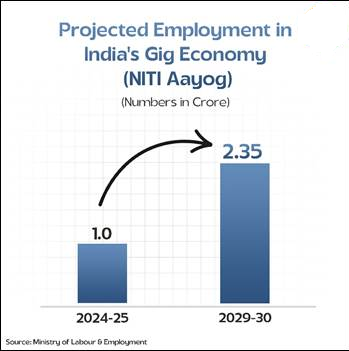
India’s rapidly growing gig workforce is driving a new wave of economic change across the world. With its half-a-billion-strong labour force, the world’s youngest population, fast-paced urbanisation, and the widespread use of smartphones and digital tools, the country is emerging as a key hub for this transformation. The gig and platform economy is creating fresh opportunities in areas such as ridesharing, delivery services, logistics, and professional work. According to NITI Aayog, the sector is expected to employ over 1 crore workers in 2024–25, with the number projected to grow to 2.35 crore by 2029–30.
Social Security and Support for Gig and Platform Workers
Code on Social Security, 2020, and Platform Workers
The Code on Social Security, 2020, passed by Parliament, marks a landmark step by defining “gig workers” and “platform workers” for the first time and extending provisions of social security to them.
Gig workers: Individuals earning their livelihood outside the traditional employer–employee setup.
Platform workers: A subset of gig workers whose employment depends on online applications or digital platforms run by aggregator companies.
Social Security Provisions
The Code envisages a broad framework of benefits for gig and platform workers, such as:
Life and disability cover
Accident insurance
Health and maternity benefits
Old age protection
Union Budget 2025–26 Announcements for Platform Workers
Acknowledging their significant contribution to the economy, the Government announced new provisions:
1. Registration of online platform workers on the e-Shram portal.
2. Issuance of identity cards to ensure recognition and easy access to welfare benefits.
3. Healthcare coverage under the Ayushman Bharat Pradhan Mantri Jan Arogya Yojana (AB-PMJAY).
About AB-PMJAY for Platform Workers
1. Provides ₹5 lakh cover per family per year for secondary and tertiary care hospitalization.
2. Available across 31,000+ empanelled hospitals (public & private).
3. The special extension of AB-PMJAY for platform workers is yet to be launched.
The Code on Social Security, 2020 (SS Code, 2020)
The Code on Social Security, 2020 is a landmark labour reform law aimed at unifying, rationalising, and expanding social security coverage across the workforce in India. By consolidating nine central labour laws into one framework, the Code simplifies compliance and creates a universal platform for extending social protection, including to groups historically left out, such as unorganised workers, gig workers, and platform workers.
1. Acts Merged under the Code
The SS Code repeals and merges nine existing laws to streamline the social security system:
Employees’ Compensation Act, 1923
Employees’ State Insurance Act, 1948
Employees’ Provident Funds and Miscellaneous Provisions Act, 1952
Employment Exchanges (Compulsory Notification of Vacancies) Act, 1959
Maternity Benefit Act, 1961
Payment of Gratuity Act, 1972
Cine Workers Welfare Fund Act, 1981
Building and Other Construction Workers’ Cess Act, 1996
Unorganised Workers’ Social Security Act, 2008
2. Wider Coverage
Expands social security to cover organised, unorganised, self-employed, gig, and platform workers.
Extends benefits to sectors with previously minimal coverage such as construction, domestic work, and app-based services.
Enables the Central and State Governments to frame targeted schemes for specific worker categories.
3. Social Security Schemes under the Code
The Code provides flexibility for governments to design schemes covering:
Provident Fund and Pension for long-term financial security.
Employees’ State Insurance (ESI) for health, disability, and accident cover.
Gratuity for workers on completion of continuous service.
Maternity Benefits ensuring wage security during maternity leave.
Other benefits like life cover, old-age protection, and crèche facilities.
4. Recognition of Gig and Platform Workers
One of the most progressive features of the Code is the legal recognition of gig and platform workers.
Gig workers: Those working outside the traditional employer–employee relationship.
Platform workers: Gig workers earning via digital platforms/aggregator apps (e.g., ride-hailing, food delivery, e-commerce).
5. Eligible for social security schemes funded jointly by:
Government,
Aggregators/platforms, and
Sometimes the workers themselves.
e-Shram Portal: A Database for Unorganised Workers
 The Ministry of Labour and Employment launched the e-Shram portal on 26 August 2021 to build a comprehensive National Database of Unorganised Workers (NDUW), includinga platform
workers, migrant workers, agriculture workers, etc.
The e-Shram portal is meant to register and support the unorganised workers by providing themwith a Universal Account Number (UAN) on a self-declaration basis.
As of 3 August 2025, more than 30.98 crore unorganised workers have registered, including over 3.37 lakh platform and gig workers.
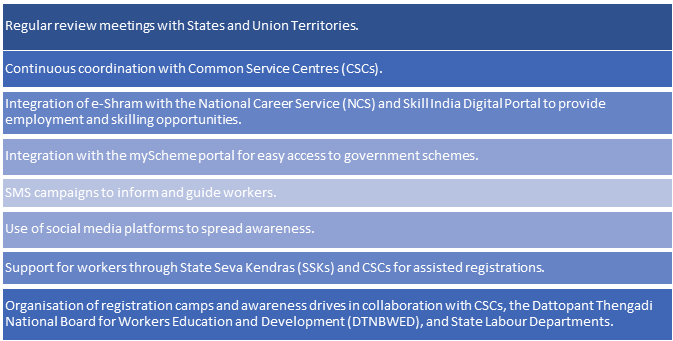
Steps to Promote e-Shram Registration
The Ministry of Labour and Employment has taken various steps to promote registrations on eShram portal and increase awareness among unorganised workers, such as:
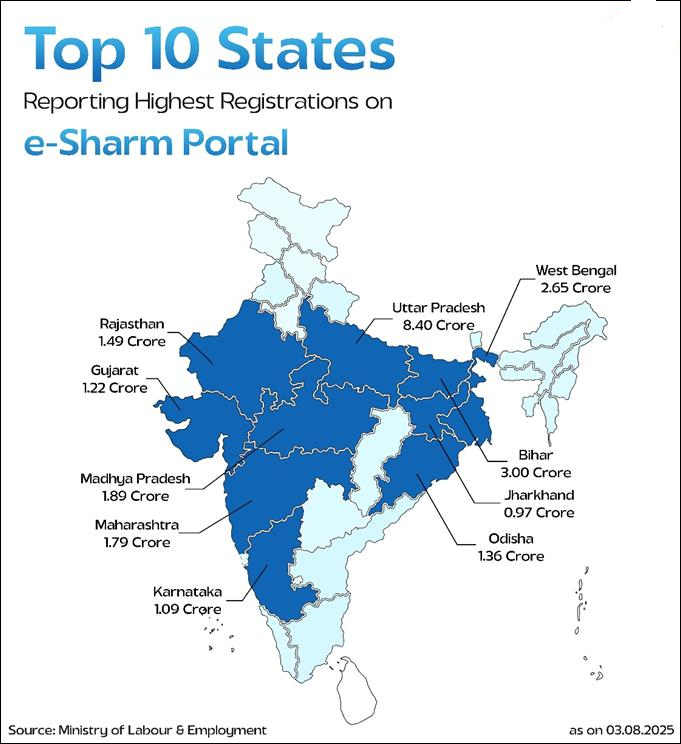
Top States reporting the highest number of registrations
The portal has recorded the highest number of registrations from Uttar Pradesh (8.39 crore), followed by Bihar (3.00 crore) and West Bengal (2.64 crore). These numbers reflect the unorganised workforce in these states and the government’s efforts to register and support workers across the country.
Women form a significant portion of these registrations, with Uttar Pradesh leading at 4.41 crore female registrants, followed by Bihar (1.72 crore) and West Bengal (1.44 crore).
Conclusion
India’s gig and platform economy is rapidly transforming the labour market, creating new opportunities while presenting unique challenges in terms of social security and welfare. Through initiatives like the Code on Social Security (2020) and the e-Shram portal, the government is taking concrete steps to recognise, protect, and empower gig and platform workers. By facilitating registration, providing health and accident coverage, and ensuring easy access to benefits, these measures aim to bring platform workers into the mainstream and strengthen the nation’s workforce. As the sector grows, continued support, awareness, and innovative policy interventions will be crucial in ensuring that every gig worker can work with dignity, security, and opportunity.
Prelims Questions





No Comments