21 Aug SOIL HEALTH CARD: “Swasth Dharaa, Khet Haraa” Over 25 Crore Soil Health Cards Distributed Across the Country
Posted at 21 Aug 2025
in
Current Affairs
by Suhani
This article covers “Daily Current Affairs” and the Topic SOIL HEALTH CARD: “Swasth Dharaa, Khet Haraa” Over 25 Crore Soil Health Cards Distributed Across the Country
SYLLABUS MAPPING:
GS-3- Agriculture- SOIL HEALTH CARD: “Swasth Dharaa, Khet Haraa” Over 25 Crore Soil Health Cards Distributed Across the Country
FOR PRELIMS
What is the Soil Health Card Scheme? How does it help farmers in improving soil fertility and crop productivity?
FOR MAINS
What role do Soil Testing Laboratories and Village Level Soil Testing Labs play in the success of the Soil Health Card Scheme?
Why in the News?
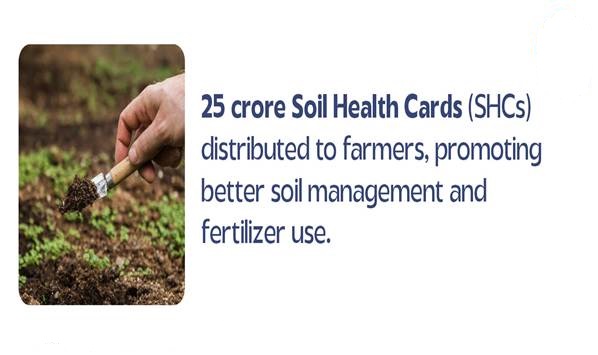
The Soil Health Card Scheme, launched in 2015 during the International Year of Soils, has completed a decade of implementation and achieved significant milestones. By July 2025, more than 25 crore cards have been distributed to farmers across the country, enabling balanced use of fertilisers and improved soil management. The Government has provided ₹1706.18 crore to States and UTs to support the scheme, which was merged with Rashtriya Krishi Vikas Yojana in 2022–23 as ‘Soil Health and Fertility’. Large-scale soil mapping has also been undertaken, covering nearly 290 lakh hectares, including 40 aspirational districts. Additionally, 1,987 village-level soil fertility maps have been created across 21 States and UTs to guide farmers in adopting sustainable practices.
UNDERSTANDING SOIL HEALTH CARD
A Soil Health Card is a printed report given to farmers for each of their land holdings. It shows the condition of the soil by testing 12 key parameters, namely Nitrogen, Phosphorus, Potassium, Sulphur (Macro-nutrients); Zinc, Iron, Copper, Manganese, Boron (Micro – nutrients); and pH (Acidity or Basicity), EC (Electrical Conductivity) and OC (Organic Carbon). The scheme helps farmers understand what their soil needs through regular testing and provides guidance every 2 years. Each card gives farmers a clear picture of the nutrient status of their land. It also suggests the right amount of fertilisers, bio-fertilisers, organic inputs, and soil treatments to help them take better care of their soil over time.
SOIL SAMPLING AND TESTING PROCESS
Soil samples are taken from a depth of 15–20 cm using a V-shaped cut, collected from four corners and the centre of the field. Samples are collected in a grid of 2.5 hectares in irrigated areas and 10 hectares in rain-fed areas using GPS tools and revenue maps. Sampling is done after harvest of Rabi and Kharif crops, or when there is no standing crop in the field. Trained personnel, agriculture department staff, or students from agricultural colleges collect the samples.
QUALITY ASSURANCE AND COSTS
1% of the samples are cross-checked in referral laboratories for quality assurance.
The central government provides ₹190 per sample to cover costs for collection, testing, soil health card generation, and distribution.
CARD VALIDITY
A Soil Health Card is issued once every 3 years.
The next card in the following cycle captures changes in soil health over time.
Objectives of Soil Health Card Scheme
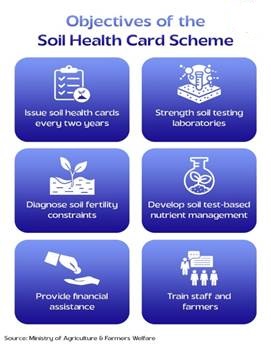
| Objective |
Details |
| Regular Soil Health Assessment |
Provide every farmer with a Soil Health Card once every two years to identify nutrient gaps and improve fertiliser practices. |
| Strengthening Soil Testing Infrastructure |
Enhance Soil Testing Laboratories, involve agricultural students, and collaborate with ICAR and State Agricultural Universities. |
| Uniform Sampling & Fertiliser Recommendations |
Use uniform sampling methods across states and design fertiliser recommendations at taluka/block level. |
| Promotion of Nutrient Management |
Encourage soil test-based nutrient management to improve nutrient-use efficiency in crops. |
| Financial Assistance for Farmers |
Support farmers to correct nutrient deficiencies and adopt balanced, integrated nutrient management practices. |
| Capacity Building & Training |
Train district/state officers and progressive farmers to spread awareness on proper nutrient use at grassroots level. |
APPLICATION PROCESS
SOIL HEALTH CARD PORTAL
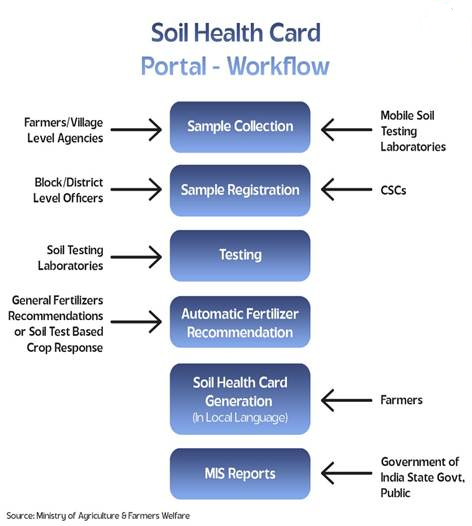
The Soil Health Card Portal is an online and mobile-based platform created for the Ministry of Agriculture and Farmers Welfare, Government of India. It helps generate Soil Health Cards in a standard format that can be used across the country. The cards are available in 22 languages, 5 dialects, and in local units to make them easy for farmers to understand
SOIL TESTING LABORATORIES
As part of the scheme, soil samples are collected from various farms and tested in approved Soil Testing Laboratories (SLT). These tests follow the guidelines set under the scheme. The results are then uploaded to the National Soil Health Card portal. This portal is used to register samples, store test reports and create Soil Health Cards. It also provides fertiliser recommendations and helps track the overall progress of the programme.
The guidelines for setting up Village Level Soil Testing Labs (VLSTLs) were released on 22.06.2023.
These labs can be established by rural youth or community-based groups such as Self Help Groups (SHGs), schools, and agricultural universities.
Individuals applying must be between 18 and 27 years of age.
Self Help Groups and Farmer Producer Organisations (FPO) are also eligible to apply.
Applications are reviewed and approved by the District Level Executive Committee.
As of February 2025, a total of 665 village-level soil testing labs has been set up across 17 states in India.
SCHOOL SOIL HEALTH PROGRAMME
The Department of Agriculture and Farmers Welfare set up soil health labs in 20 schoolsin rural areas as part of a pilot programme. Learning modules were prepared for students from Classes 6 to 12, as well as for teachers. The aim is to make students aware about soil health for sustainable agriculture practices. These were shared with schools to support the training process.
Both students and teachers were trained to collect soil samples, carry out tests, and generate Soil Health Cards using a mobile app developed specially for this programme. School students collected the soil, tested it in the lab, and created the health cards. They also played a key role in sharing the recommendations of these cards with farmers, helping them understand how to use fertilisers wisely and choose the right crops. As of 24th July 2025, 1,021 schools are implementing the School Soil Health Programme, with 1,000 soil testing labs set up and 132,525 students enrolled.
TECHNOLOGICAL ADVANCEMENTS
| Technological Advancement |
Details |
| Upgraded SHC Portal with GIS |
Portal now includes Geographic Information System (GIS), enabling soil test results to be viewed on interactive maps. |
| Mobile Application (SHC Mobile App) |
Introduced for ease of use by farmers and officials; ensures smooth implementation and monitoring. |
| Restricted Soil Sample Collection |
App restricts collection to the designated village-level operator’s area, ensuring accuracy and accountability. |
| Automatic Geo-Tagging |
Captures exact latitude and longitude of soil sample location, removing manual entry errors. |
| Unique QR Code for Samples |
Each soil sample is assigned a QR code linking it directly to test results on the portal. |
| Automated Result Uploads |
Geo-tagged laboratories upload test results directly to the central system, ensuring transparency and tamper-proof records. |
| Digital Workflow (Post-April 2023) |
All soil samples collected via the mobile app; SHCs generated through upgraded digital portal. |
| Developed by NIC |
Entire system created as a web-based workflow application by the National Informatics Centre (NIC) for nationwide digitisation. |
Conclusion
The Soil Health Card Scheme has transformed how farmers think about their land. It has brought scientific understanding into hands of millions of farmers, helping them make better decisions and improve their livelihoods. The data-driven approach of the scheme has reduced input costs, boosted productivity, and promoted long-term soil care. By connecting testing labs, digital tools, schools, and communities, the scheme has created a robust system that puts the farmer at the centre. As India moves towards climate-resilient and sustainable agriculture, the Soil Health Card Scheme remains a model of how data, awareness, and grassroots support can together lead to real change. Continued investment and innovation under the scheme will be key to building a future where Indian soils stay fertile, healthy, and productive for generations to come.
Prelims Questions
Q. With reference to the Soil Health Card Scheme, consider the following statements:
1. It was launched in 2015 during the International Year of Soils.
2. A Soil Health Card contains information on both macro and micronutrients of soil.
3. The scheme has been merged with Rashtriya Krishi Vikas Yojana as ‘Soil Health and Fertility’ since 2022–23.
Which of the statements given above is/are correct?
(a) 1 and 2 only
(b) 2 and 3 only
(c) 1 and 3 only
(d) 1, 2, and 3
Answer: D
Mains Questions
Q. The Soil Health Card Scheme has completed a decade of implementation in 2025. Discuss its objectives, technological advancements, and role in promoting sustainable agriculture in India.
(250 words, 15 marks)





No Comments