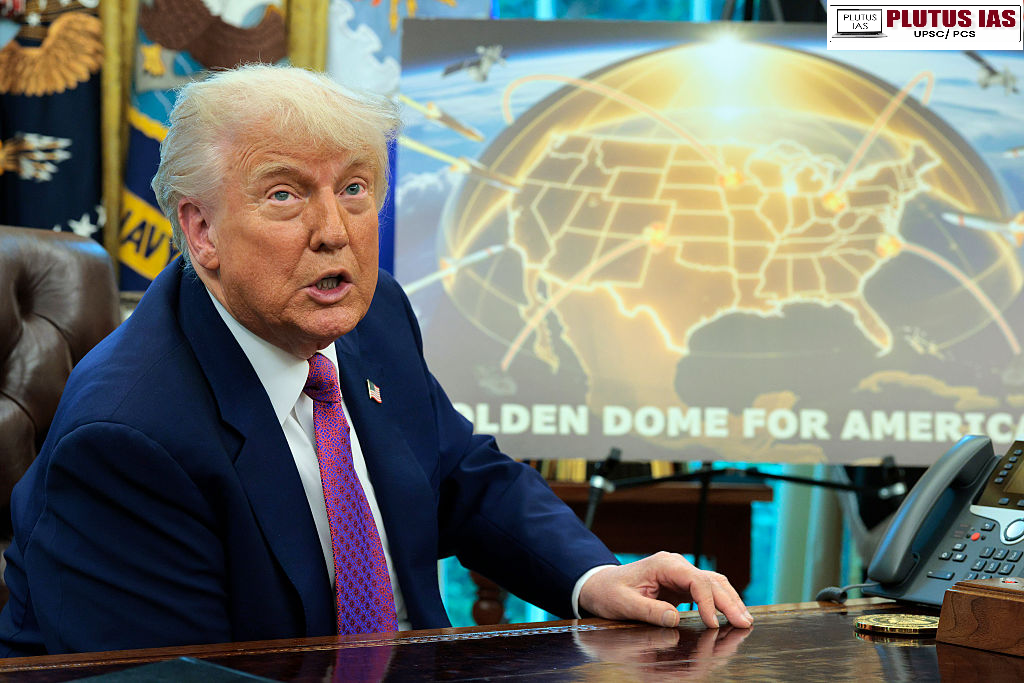
The Golden Dome missile defence shield, a $175 billion U.S. program announced by former President Donald Trump, has drawn attention for its ambitious plan to build a multi-layered space and land-based defence network. It seeks to intercept ICBMs, hypersonic weapons, and cruise missiles during their boost and midcourse phases. The Pentagon presented its blueprint to defence contractors, with firms like SpaceX, Lockheed Martin, and L3Harris as key contenders. The system is being compared to both Israel’s Iron Dome and Reagan’s Star Wars initiative. However, doubts remain over its feasibility, funding, and impact on global strategic stability.
Historical Context
1. Cold War roots: Missile defence ideas emerged during the U.S.–Soviet rivalry, where the fear of nuclear-tipped ICBMs led to early defence research.
2. ABM Treaty (1972): The U.S. and USSR agreed to limit missile defences to maintain Mutually Assured Destruction (MAD), preventing destabilization.
3. Reagan’s SDI (1983): Popularly called Star Wars, it envisioned space-based lasers and interceptors to neutralize Soviet nuclear missiles.
4. SDI challenges: The program collapsed due to high costs, unproven technology, treaty violations, and political opposition.
5. Post-Cold War efforts: The U.S. pursued limited systems like National Missile Defence and withdrew from the ABM Treaty in 2002 to develop larger-scale defences.
6. Current U.S. systems: Ground-Based Midcourse Defence (GMD), THAAD, Aegis, and Patriot provide layered but regionally limited coverage.
7. Israeli Iron Dome inspiration (2011): Its battlefield success against rockets and drones influenced Trump’s vision for a nationwide U.S. shield.
Concept and Objectives
1. Core aim: Build a comprehensive homeland defence shield against evolving threats like ICBMs, hypersonics, and cruise missiles.
2. Four-layer architecture: Space-based interceptors, enhanced GMD, new land-based sites, and limited-area/population defence.
3. Space-based intercept layer: Hundreds of satellites with sensors, interceptors, or lasers to strike missiles during their early trajectory.
4. Boost-phase focus: Attempt to destroy missiles during their slow, predictable climb, a breakthrough compared to existing midcourse-only systems.
5. Enhanced GMD: Existing interceptors in California and Alaska upgraded with better kill vehicles and sensors for midcourse interception.
6. New land-based layers: Five new interceptor sites (3 in continental U.S., 1 in Hawaii, 1 in Alaska) for added redundancy.
7. Limited area/population defence: Integration of Patriot systems, new radars, and common launchers to shield cities and critical infrastructure.
1. Space-based sensors: A constellation of satellites to provide continuous global tracking of missile launches.
2. Space-based interceptors: Orbital weapons or platforms capable of striking ICBMs in the boost or midcourse phase.
3. Directed-energy weapons: Use of lasers or high-powered microwaves to destroy missiles at high speed without running out of ammunition.
4. Artificial Intelligence (AI): AI-enabled autonomous tracking and decision-making to handle multiple simultaneous threats.
5. Satellite constellations: Modeled after systems like Starlink, ensuring redundancy and rapid data-sharing across nodes.
6. Major challenges: Boost-phase interception is extremely difficult because it requires precise timing and positioning.
7. Hypersonic tracking issues: Differentiating between real warheads, decoys, and hypersonic glide vehicles remains a key technological hurdle.
Strategic & Security Significance
1. Homeland protection: Provides the U.S. with a shield against nuclear and missile attacks, a long-standing strategic goal.
2. Counter to adversaries: Directly aimed at the missile arsenals of China, Russia, North Korea, and Iran.
3. Deterrence credibility: Enhances U.S. nuclear posture by adding defensive credibility to offensive capabilities.
4. Strategic signaling: Projects U.S. technological superiority, reassuring allies and deterring adversaries.
5. MAD disruption: Undermines Mutually Assured Destruction (MAD), which has been the foundation of nuclear stability since the Cold War.
6. Arms race risks: Could trigger adversaries to develop more MIRVs, hypersonics, and decoy technologies to overwhelm defences.
7. Extended deterrence: Allies (Japan, NATO) may seek integration, making it a tool for global U.S. security leadership.
Economic & Industrial Aspects
1. Massive investment: Estimated cost of $175 billion+, one of the largest U.S. defence projects ever.
2. Defence contractors: Key players include SpaceX, Lockheed Martin, Raytheon (RTX), L3Harris, Palantir, and Anduril.
3. Spin-off benefits: Research may drive advances in space tech, AI, directed-energy, and satellite systems.
4. Job creation: Large-scale R&D and manufacturing are expected to create thousands of jobs across defence hubs.
5. Risk of overruns: Past U.S. missile defence programs faced delays, cost escalation, and limited effectiveness.
6. Opportunity cost: High spending may divert resources from other defence or domestic needs.
7. Private-sector role: Heavy involvement of commercial space firms (like SpaceX) raises questions about ownership and military–industrial dependence.
Political & Policy
1. Trump’s framing: Presented as a patriotic promise to shield Americans from nuclear threats.
2. Congressional debates: Initial request of $25 billion tied to a larger $150 billion defence package.
3. Partisan divides: Republicans largely supportive; Democrats more sceptical on cost and feasibility.
4. Election politics: Trump used it as a campaign promise, linking it to his “America First” defence vision.
5. Arms control issues: Potentially violates ABM Treaty principles and could complicate New START extensions.
6. International law: Raises concerns about militarization of outer space, opposed by many global treaties.
7. Future administrations: Uncertain if successors would continue, scale down, or cancel the program, depending on priorities.
Global & Diplomatic Implications
1. Challenge to Nuclear Parity: Russia and China see the Golden Dome as undermining strategic balance.
2. Risk of New Arms Race: Could accelerate development of MIRVs, hypersonics, and decoys by adversaries.
3. NATO Dimension: Allies may push for joint integration or extended U.S. coverage.
4. Comparative Models: Israel’s Iron Dome seen as an inspiration, but with limited scope.
5. Rival Systems: Russia’s S-500 and China’s HQ-19 viewed as countermeasures.
6. UN & Global Debates: Space weaponization discussions likely to intensify.
7. Arms Control Credibility: May weaken U.S. position in global arms-control negotiations.
Feasibility & Criticisms
1. Unproven Technology: Boost-phase interception still lacks practical success.
2. Space Weaponization Hurdles: Technical, legal, and financial barriers are immense.
3. Testing Challenges: Simulating real-world missile threats remains difficult.
4. Financial Concerns: Risk of massive expenditure reminiscent of Reagan’s SDI.
5. Symbolic vs. Practical: Critics argue it’s more about politics than operational defense.
6. Adversary Escalation: May provoke Russia/China to expand missile stockpiles.
7. Operational Realism: Many experts doubt its battlefield viability.
Way Forward
1. Incremental Evolution: Likely to progress as upgrades, not as a complete shield.
2. Integration with Existing Systems: GMD, THAAD, and Aegis to be strengthened with space sensors.
3. Timeline of Development: Full realisation could take 10–20 years.
4. Hypersonic Focus: Priority likely on countering hypersonic glide vehicles first.
5. Revival of Strategic Vision: Seen as a symbolic return to Reagan-era “Star Wars” ambitions.
6. Tech Leadership Test: Will test U.S. dominance in space-defence technologies.
7. Dependent on Political Will: Success hinges on sustained funding, innovation, and bipartisan support





No Comments