


01 Sep Standing Committee Slams BharatNet Progress: Only 30% GPs Connected
✎ Digital Bharat Nidhi (DBN), formerly USOF, is a non-lapsable fund aimed at ensuring universal telecom connectivity in rural, remote, and underserved areas through schemes like BharatNet, 4G saturation projects, and Aspirational…
Subject Relevance — Where This Topic Fits
- GS Paper II — Governance, Constitution, Polity, Social Justice and International Relations (Telecom Sector Governance and Policy) | GS Paper III — Infrastructure, Science and Technology, Economic Development (Telecom Infrastructure, Digital Public Infrastructure)
- Prelims: Universal Service Obligation Fund (USOF), Digital Bharat Nidhi (DBN), BharatNet, 4G Saturation Project, Aspirational Districts Programme, Comprehensive Telecom Development Plan for North Eastern Region (CTDP-NER), Left Wing Extremism (LWE) affected areas, gram panchayats, third-party audits, tender finalisation, forest clearances
- Essay: Digital infrastructure as a catalyst for inclusive development in India, Balancing security imperatives with the imperative of universal digital connectivity
Quick Revision: Digital Bharat Nidhi (DBN), formerly USOF, is a non-lapsable fund aimed at ensuring universal telecom connectivity in rural, remote, and underserved areas through schemes like BharatNet, 4G saturation projects, and Aspirational Districts Programme.
Why is this in the news?
The Standing Committee on Communications and Information Technology presented a comprehensive report on August 6, 2026, reviewing the performance of schemes and projects under the Digital Bharat Nidhi (DBN), formerly known as the Universal Service Obligation Fund (USOF). The report highlights critical gaps in implementation, utilisation, and coverage of telecom infrastructure across rural, remote, and security-sensitive regions, underscoring the need for systemic reforms to achieve the objective of universal digital connectivity.
Background
- The Universal Service Obligation Fund (USOF) was established in 2002 to provide financial support for telecom services in rural and remote areas, ensuring equitable access to telecommunication facilities.
- The USOF was rebranded as Digital Bharat Nidhi (DBN) in 2024 to align with the broader digital transformation agenda of the Government of India, expanding its mandate to include support for research and development in telecommunication technologies alongside its core objective of enhancing telecom connectivity in underserved areas.
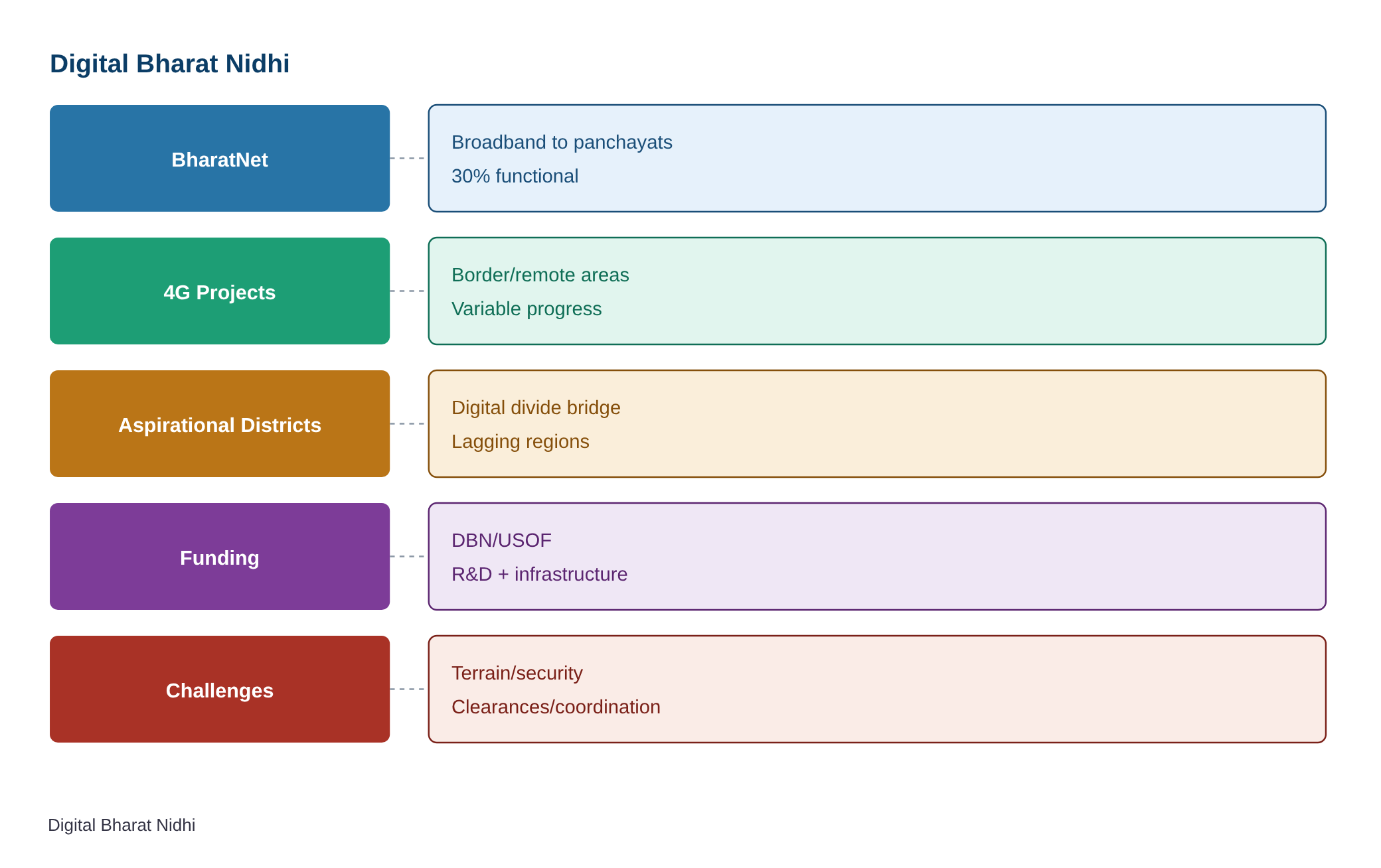
- The DBN funds several flagship schemes, including BharatNet (aimed at providing broadband connectivity to all gram panchayats), 4G mobile projects in border and remote areas, and the Aspirational Districts Programme to bridge the digital divide in lagging regions.
- As of February 2026, significant disparities persist in the implementation of these schemes, with only 30% of gram panchayats having functional BharatNet connections and variable progress in 4G saturation projects across different regions.
- The report underscores the challenges of deploying telecom infrastructure in difficult terrains, security-sensitive areas, and regions affected by insurgency, which have impeded the timely commissioning of towers and other critical assets.
- The Standing Committee’s observations reflect broader governance challenges in public-private partnerships, regulatory clearances, and inter-ministerial coordination, which are critical to the success of telecom infrastructure projects.
What is Digital Bharat Nidhi (DBN)?
- Digital Bharat Nidhi (DBN) is a non-lapsable fund to promote universal access to telecommunication services in rural, remote, and underserved areas of India.
- The DBN replaced the Universal Service Obligation Fund (USOF) in 2024, expanding its scope to include financial support for research and development in telecommunication technologies, in addition to its traditional role in subsidising telecom services in unserved and underserved areas.
- The primary objective of DBN is to ensure that no citizen is left behind in the digital revolution by providing affordable and reliable telecom connectivity, thereby bridging the digital divide and fostering inclusive growth.
- The DBN funds several key schemes, including BharatNet (for broadband connectivity in gram panchayats), 4G saturation projects (to extend 4G coverage to uncovered villages), and the Aspirational Districts Programme (to prioritise digital connectivity in socio-economically lagging districts).
- The DBN also supports projects in security-sensitive areas, such as Left Wing Extremism affected areas and border outposts, where connectivity is critical for both developmental and security imperatives.
- The fund operates through a competitive bidding process, where telecom service providers (both public and private) are selected to implement projects under the DBN’s financial support, ensuring efficiency and accountability in fund utilisation.
Key Features
| Feature | Significance |
|---|---|
| Digital Bharat Nidhi (DBN) | A centrally funded corpus (formerly Universal Service Obligation Fund) to finance telecom infrastructure, connectivity, and R&D in underserved and remote areas, including border regions and aspirational districts. |
| BharatNet Programme | A flagship initiative under DBN to provide broadband connectivity to all gram panchayats, aiming for universal last-mile access in rural India. |
| 4G Mobile Projects in Remote Areas | DBN-funded initiatives to extend 4G connectivity to uncovered villages, border outposts, and Left Wing Extremism-affected regions, enhancing digital inclusion and security. |
| Aspirational Districts Scheme | A targeted programme under DBN to prioritize connectivity in socio-economically lagging districts, aligning with broader development goals. |
| Comprehensive Telecom Development Plan for North Eastern Region | A DBN-supported plan to address telecom gaps in the Northeast, focusing on terrain-specific and insurgency-sensitive deployment challenges. |
Why it Matters
Economic
- Enhances rural digital inclusion, enabling e-governance, telemedicine, and e-commerce, thereby fostering economic growth in underserved regions.
- Reduces the digital divide, promoting equitable access to digital services and opportunities across geographies.
- Supports R&D in telecommunication technologies, potentially positioning India as a leader in affordable and indigenous telecom solutions.
Strategic/Defence
- Strengthens connectivity in border areas and Left Wing Extremism-affected regions, aiding security operations and governance.
- Ensures redundancy and resilience in telecom networks for critical infrastructure and emergency response systems.
Social
- Improves access to education, healthcare, and financial services through reliable connectivity, particularly in remote and tribal areas.
- Facilitates the delivery of welfare schemes and citizen-centric services, enhancing transparency and accountability.
Governance
- Aligns with the Digital India vision by bridging the urban-rural digital divide and promoting last-mile connectivity.
- Supports the implementation of the Right to Broadband as an enabler of other fundamental rights, including education and information access.
Challenges
1. Implementation Bottlenecks in BharatNet
- Only 30% of gram panchayats had functional BharatNet connections as of February 2026, with 77% of these being usable for broadband, indicating low utilisation.
- Delays in tender finalisation and disputes with implementation agencies have slowed progress.
- Capacity constraints of agencies and delays in obtaining land clearances hinder timely deployment.
UPSC Link: GS-III: Infrastructure – Energy, Ports, Roads, Airports, Railways
2. Connectivity Challenges in Security-Sensitive Areas
- As of February 2026, 93% of planned 4G towers in Left Wing Extremism-affected areas and 42% in border outposts were commissioned, leaving significant gaps.
- Difficult terrain, security constraints, and delays in forest clearances pose logistical and operational hurdles.
- Lack of a coordinated mechanism between ministries and agencies exacerbates clearance delays.
UPSC Link: GS-III: Security Challenges – Left Wing Extremism
3. Coverage and Service Quality Gaps in Remote Areas
- Only 61% of planned towers were commissioned under the 4G saturation project, and 81% under the Aspirational Districts scheme, indicating underperformance.
- Third-party audits revealed coverage gaps, weak signal strength, and duplicate infrastructure, compromising service quality.
- Inadequate field-level monitoring and delayed action on audit findings exacerbate these issues.
UPSC Link: GS-III: Infrastructure – Telecommunication
4. Terrain and Insurgency-Related Challenges in the Northeast
- As of February 2026, only 68% of planned 2G towers were installed under the Comprehensive Telecom Development Plan for the Northeast.
- Difficult terrain, insurgency issues, and poor service quality hinder effective deployment.
- Frequent road expansions necessitate the shifting of optical fibre cables, leading to repeated disruptions.
UPSC Link: GS-II: Developmental Challenges in the Northeast
5. Institutional and Procedural Delays
- Multi-layered approval processes and inter-ministerial coordination gaps delay project implementation.
- Lack of accountability mechanisms for implementation agencies contributes to inefficiencies.
- Insufficient capacity-building for local agencies to handle complex telecom infrastructure projects.
UPSC Link: GS-II: Government Policies and Interventions
Challenges — UPSC Perspective
| Issue | Concern |
|---|---|
| Low Utilisation of BharatNet | Only 30% of gram panchayats have functional connections, with 77% being usable for broadband. |
| Security Constraints in Deployment | 93% of 4G towers commissioned in LWE-affected areas, leaving gaps due to terrain and security challenges. |
| Forest and Land Clearance Delays | Delays in obtaining clearances for tower installation and optical fibre laying impede progress. |
| Service Quality Gaps | Coverage gaps, weak signals, and duplicate infrastructure identified in third-party audits. |
| Terrain-Specific Challenges in the Northeast | 68% of planned towers installed, with issues like insurgency and frequent road expansions. |
| Institutional Coordination Gaps | Lack of a unified mechanism between ministries and agencies to fast-track clearances. |
Government Initiatives — Must-Memorise for Prelims
- BharatNet Programme
- 4G Mobile Projects in Remote and Border Areas
- Aspirational Districts Scheme (Telecom Component)
- Comprehensive Telecom Development Plan for North Eastern Region
Way Forward
- Conduct state-wise performance audits of BharatNet to identify bottlenecks and rectify implementation gaps.
- Enhance utilisation of BharatNet by promoting household connections and leasing unused network capacity to private players.
- Streamline tendering and contract finalisation processes to reduce delays in project initiation.
- Establish a dedicated coordination mechanism between the Ministry of Communications, state governments, and security agencies to expedite clearances in sensitive areas.
- Strengthen field-level monitoring and third-party audits to ensure service quality and address coverage gaps proactively.
- Provide logistical and security support to implementation agencies in Left Wing Extremism-affected and border regions.
- Accelerate the deployment of towers in the Northeast by addressing terrain-specific challenges and insurgency-related constraints.
- Promote indigenous R&D in telecommunication technologies to reduce dependency on foreign solutions and enhance cost-effectiveness.
UPSC Value Addition
Keywords for Mains Answer-Writing
Digital Bharat Nidhi (DBN) · Universal Service Obligation Fund (USOF) · BharatNet Programme · 4G Mobile Connectivity in Remote Areas · Left Wing Extremism Affected Areas · Aspirational Districts Scheme · Comprehensive Telecom Development Plan for North Eastern Region · Telecom Infrastructure Deployment Challenges · Standing Committee on Communications and Information Technology · Public-Private Partnership in Telecom Sector · Universal Service Support Policy · Rural Broadband Connectivity
Concept Flow
Universal Service Obligation Fund (2002) → Renamed Digital Bharat Nidhi (2024) → Funds telecom infrastructure and R&D. → DBN allocates resources to BharatNet, 4G projects, and Aspirational Districts Scheme → Aim: Universal last-mile connectivity. → Implementation challenges (delays, terrain, security) → Low utilisation and service gaps → Committee recommendations for audits and coordination. → Addressing bottlenecks → Enhanced connectivity → Digital inclusion and socio-economic development. → Strengthening institutional mechanisms → Faster clearances and accountability → Sustainable telecom infrastructure.
Prelims Practice Questions
Q1. Consider the following statements regarding the Digital Bharat Nidhi (DBN):
1. DBN was earlier known as the Universal Service Obligation Fund (USOF).
2. DBN aims to support telecom services in rural and remote areas only.
3. DBN also funds research and development in telecommunication technologies.
4. BharatNet is a key scheme funded under DBN.
How many of the above statements are correct?
- Only one
- Only two
- Only three
- All four
Answer: All four — Statements 1, 3, and 4 are correct. Statement 2 is incorrect as DBN aims to support telecom services in all underserved areas, including border and security-sensitive regions.
Q2. Assertion (A): The Standing Committee on Communications and Information Technology recommended a state-wise performance audit of BharatNet.
Reason (R): The Committee noted delays in tender finalisation and disputes with implementation agencies as key challenges in BharatNet’s progress.
Options:
A. Both A and R are true, and R is the correct explanation of A.
B. Both A and R are true, but R is not the correct explanation of A.
C. A is true, but R is false.
D. A is false, but R is true.
Answer: ? — Both Assertion (A) and Reason (R) are true, and R correctly explains A as the Committee recommended state-wise performance audits to address the challenges highlighted in R.
Q3. Match the following schemes with their respective objectives under the Digital Bharat Nidhi (DBN):
Column I (Scheme) | Column II (Objective)
——————|———————-
A. BharatNet | 1. Extend 4G connectivity to uncovered villages
B. 4G Saturation | 2. Provide broadband connectivity to all gram panchayats
C. Aspirational Districts Scheme | 3. Support telecom services in border and remote areas
D. Comprehensive Telecom Development Plan for North Eastern Region | 4. Develop telecom infrastructure in the North Eastern Region
Options:
A. A-2, B-1, C-4, D-3
B. A-2, B-1, C-3, D-4
C. A-1, B-2, C-3, D-4
D. A-3, B-1, C-2, D-4
Answer: ? — Correct matches: A-2 (BharatNet aims to provide broadband connectivity to all gram panchayats), B-1 (4G Saturation aims to extend 4G connectivity to uncovered villages), C-3 (Aspirational Districts Scheme aims to extend 4G connectivity to uncovered villages, aligning with security-sensitive areas), D-4 (Comprehensive Telecom Development Plan for North Eastern Region aims to develop telecom infrastructure in the North Eastern Region).
Mains Practice Question
✍ Critically examine the performance of the Digital Bharat Nidhi (DBN) in bridging the digital divide in India. Also, analyse the key challenges highlighted by the Standing Committee on Communications and Information Technology in its 2026 report and suggest measures to enhance its efficacy. (15 Marks)
Approach: MODEL-ANSWER SKELETON:
1. **Introduction (2 marks)**: Define Digital Bharat Nidhi (DBN) and its objectives, including its evolution from the Universal Service Obligation Fund (USOF). Highlight the dual mandate: extending telecom services to underserved areas and promoting R&D in telecommunication technologies.
2. **Performance of DBN (5 marks)**:
– **BharatNet**: Progress as of February 2026 (30% functional GPs, 77% with broadband usage). Issues: delays in tendering, disputes with agencies, land clearances, and low utilisation.
– **4G Mobile Projects**: Progress in Left Wing Extremism-affected areas (93% towers commissioned), border outposts (42%), and Aspirational Districts (81% towers commissioned). Challenges: difficult terrain, security constraints, forest clearances, and logistical limitations.
– **North Eastern Region**: Progress in 2G towers (68% installed). Issues: insurgency, poor service quality, and road expansion.
3. **Key Challenges (4 marks)**:
– **Implementation Bottlenecks**: Delays in tendering, disputes with agencies, and capacity constraints.
– **Regulatory and Land Clearances**: Delays in obtaining land clearances and forest clearances.
– **Security and Logistical Constraints**: Difficult terrain, insurgency, and security concerns in border and LWE-affected areas.
– **Service Quality Issues**: Coverage gaps, weak signal strength, and duplicate infrastructure identified in third-party audits.
4. **Measures to Enhance Efficacy (4 marks)**:
– **Streamlining Procurement**: Timely tendering, contract finalisation, and dispute resolution mechanisms.
– **Capacity Building**: Enhancing the capacity of implementation agencies and providing logistical and security support.
– **Inter-Ministerial Coordination**: Establishing a coordination mechanism to fast-track clearances and resolve bottlenecks.
– **Monitoring and Auditing**: Conducting state-wise performance audits, increasing household connections, and leasing unused network capacity. Strengthening field-level implementation and acting on audit findings.
5. **Conclusion (1 mark)**: Emphasise the need for a multi-pronged approach involving policy reforms, institutional strengthening, and stakeholder collaboration to realise the vision of a digitally inclusive India.
Source: PRS Legislative Research
Generated by AanyaAi for educational purpose.
Related guides on our sites
- Best PSIR optional coaching for upsc
- Best PSIR optional teacher for upsc
- Best teacher of PSIR optional for upsc
- Best PSIR optional coaching in delhi for UPSC

- HAL ने IAF को दो LCA ट्रेनर विमान सौंपे: सुरक्षा तैयारी में बड़ा कदम - September 19, 2026
- HAL delivers two LCA trainer jets to IAF: Key for UPSC & State PCS - September 19, 2026
- एनसीएल द्वारा शुरू हुआ ‘विशेष अभियान 6.0’: स्वच्छता और ई-कचरा प्रबंधन पर जोर - September 19, 2026

No Comments