


08 Aug Sugarcane Growers Urge PM to Strengthen Ethanol Policy for Farmers’ Welfare
✎ The Ethanol Blending Programme (EBP) aims to achieve 20% ethanol blending in petrol by 2025-26, reducing crude oil imports by ₹4 lakh crore while enhancing farmers’ incomes and promoting environmental sustainability.
Subject Relevance — Where This Topic Fits
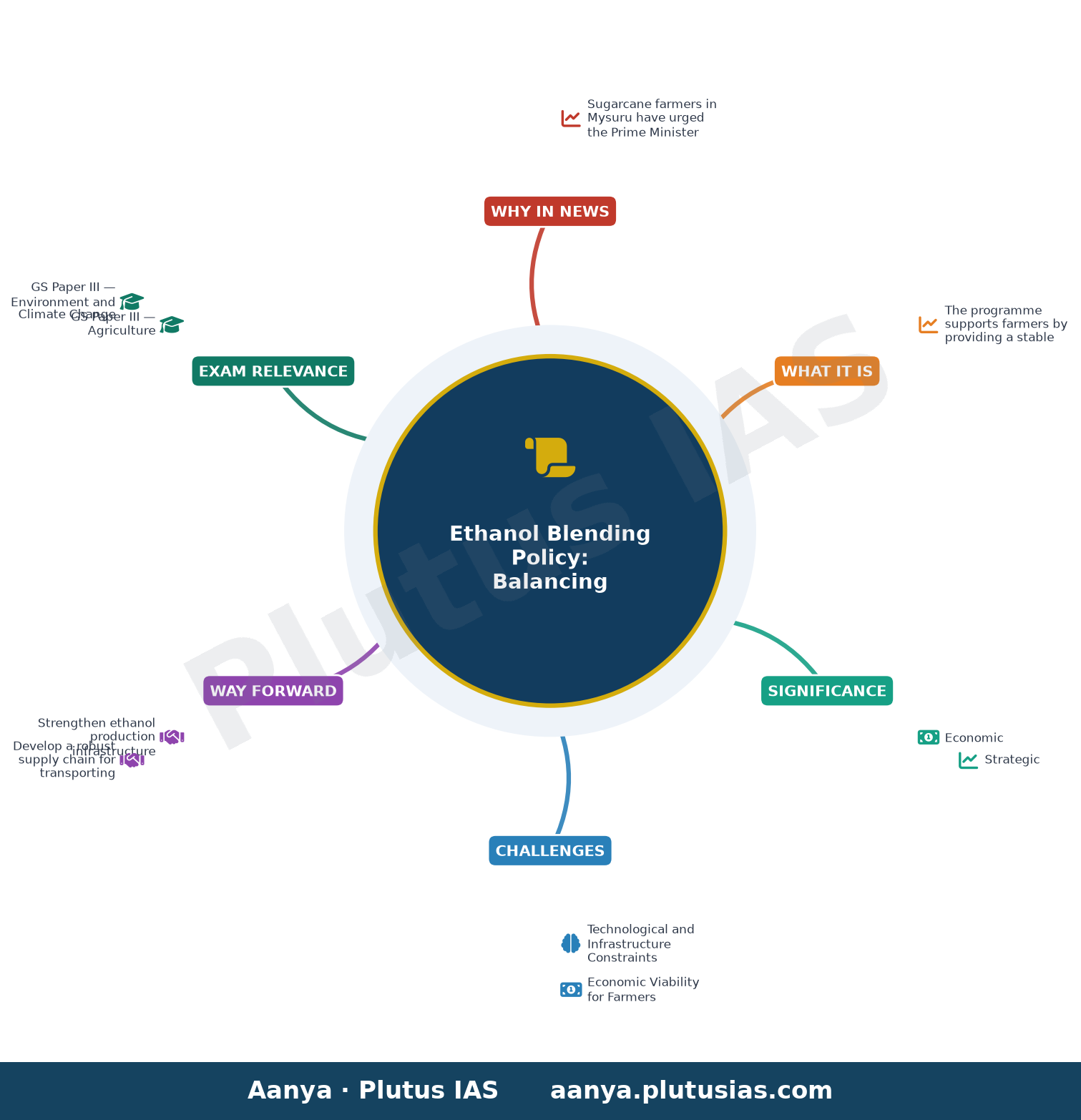
- GS Paper III — Agriculture | GS Paper III — Environment and Climate Change | GS Paper III — Indian Economy and Issues Relating to Planning, Mobilisation of Resources, Growth, Development and Employment | GS Paper III — Infrastructure: Energy
- Prelims: Ethanol Blending Programme (EBP), National Policy on Biofuels 2018, Sugarcane pricing and Fair and Remunerative Price (FRP), Renewable Energy Certificate (REC), Pradhan Mantri JI-VAN Yojana, Blending Targets under EBP, Sugarcane-based ethanol vs grain-based ethanol, Sustainable Aviation Fuel (SAF), Carbon neutrality and net-zero emissions
- Essay: India’s Energy Transition: From Import Dependence to Self-Reliance, Balancing Agricultural Prosperity and Environmental Sustainability in Policy Design
Quick Revision: The Ethanol Blending Programme (EBP) aims to achieve 20% ethanol blending in petrol by 2025-26, reducing crude oil imports by ₹4 lakh crore while enhancing farmers’ incomes and promoting environmental sustainability.
Why is this in the news?
Sugarcane farmers in Mysuru have urged the Prime Minister to maintain the Centre’s ethanol blending policy, emphasising its role in enhancing farm incomes, reducing crude oil imports, and promoting environmentally sustainable fuel alternatives. The farmers’ plea comes amid criticism alleging adverse impacts on vehicle engines and fuel efficiency, highlighting the policy’s significance in India’s broader energy and agricultural strategies.
Background
- The Ethanol Blending Programme (EBP) in India was launched in 2003 and expanded under the National Policy on Biofuels 2018, aiming to achieve 20% ethanol blending in petrol by 2025-26.
- The policy prioritises ethanol production from surplus agricultural feedstocks such as sugarcane, rice, maize, and damaged foodgrains to reduce import dependence and support farmers’ incomes.
- Sugarcane, a water-intensive crop, is a key feedstock for ethanol in India, with the Fair and Remunerative Price (FRP) mechanism ensuring minimum support prices for farmers.
- The policy aligns with India’s commitments under the Paris Agreement to reduce carbon emissions and transition towards a low-carbon economy.
- Criticism of the policy includes concerns over engine compatibility, fuel efficiency reduction, and potential diversion of foodgrains for fuel, necessitating a balanced approach.
- The government has incentivised ethanol production through schemes like the Pradhan Mantri JI-VAN Yojana, which supports second-generation ethanol projects.
What is the Ethanol Blending Programme (EBP) and its significance?
- The programme supports farmers by providing a stable market for surplus agricultural produce, thereby enhancing rural incomes and reducing agrarian distress.
Key Features
| Feature | Significance |
|---|---|
| Ethanol blending policy | Promotes domestic production of ethanol from sugarcane, rice, maize, and other agricultural produce, reducing reliance on imported crude oil. |
| Focus on sugarcane cultivation | Enhances farmers’ income by creating a stable demand for sugarcane, a water-intensive crop, while supporting rural economies. |
| Environmentally friendly fuel | Ethanol is a cleaner-burning fuel compared to gasoline, contributing to reduced vehicular emissions and improved air quality. |
| Foreign exchange savings | Lower crude oil imports due to ethanol blending can save approximately ₹4 lakh crore annually, strengthening the national economy. |
| Public infrastructure investment | Foreign exchange savings from reduced oil imports can be redirected toward essential public services and infrastructure development. |
Why it Matters
Economic
- Enhances farmers’ income by creating a guaranteed market for sugarcane and other agricultural feedstocks.
- Reduces India’s import bill for crude oil, conserving foreign exchange reserves.
- Stimulates rural economies by promoting agro-based industries and allied sectors.
- Encourages investment in ethanol production infrastructure, creating employment opportunities.
Strategic
- Reduces dependence on imported crude oil, enhancing energy security.
- Promotes self-reliance in fuel production, aligning with the ‘Atmanirbhar Bharat’ initiative.
- Supports India’s commitments to climate change mitigation through reduced carbon emissions.
Environmental
- Ethanol blending reduces vehicular emissions, contributing to improved air quality.
- Promotes sustainable agricultural practices by utilising agricultural residues for ethanol production.
Social
- Empowers sugarcane farmers by providing a stable and remunerative market for their produce.
- Supports rural livelihoods by creating secondary income sources through agro-industrial linkages.
Challenges
1. Technological and Infrastructure Constraints
- Limited ethanol production capacity in India, necessitating significant investment in distilleries and storage facilities.
- Inadequate supply chain infrastructure for transporting agricultural feedstocks to ethanol plants.
- Dependence on seasonal availability of sugarcane, which may lead to supply fluctuations.
UPSC Link: GS3: Infrastructure and Industrial Policy
2. Economic Viability for Farmers
- Farmers face increased input costs (water, fertilisers) for sugarcane cultivation, which may not be fully offset by ethanol blending benefits.
- Price volatility in the sugar and ethanol markets could impact farmers’ income stability.
- High initial capital investment required for setting up ethanol plants may deter private sector participation.
UPSC Link: GS3: Agricultural Marketing and Pricing
3. Environmental Concerns
- Large-scale sugarcane cultivation may lead to water scarcity, particularly in water-stressed regions like Maharashtra and Karnataka.
- Ethanol production from maize and rice could compete with food security, raising ethical concerns.
- Potential for increased agricultural runoff and soil degradation due to intensive farming practices.
UPSC Link: GS3: Environmental Pollution and Degradation
4. Policy and Regulatory Challenges
- Need for harmonised policies across states to ensure consistent ethanol blending targets and incentives.
- Regulatory hurdles in land acquisition and environmental clearances for ethanol plants.
- Lack of uniform pricing mechanisms for ethanol, leading to market distortions.
UPSC Link: GS2: Government Policies and Interventions
5. Public Perception and Misinformation
- Opposition from certain quarters alleging adverse effects of ethanol on vehicle engines and fuel efficiency.
- Lack of awareness among farmers about the benefits and implementation of ethanol blending policies.
- Resistance from traditional fuel lobbies and stakeholders invested in fossil fuel-based industries.
UPSC Link: GS2: Role of Civil Society in Governance
Challenges — UPSC Perspective
| Issue | Concern |
|---|---|
| Ethanol blending targets | Achieving the mandated 20% ethanol blending by 2025-26 may face supply chain bottlenecks. |
| Sugarcane pricing | Minimum Support Price (MSP) for sugarcane may not align with ethanol pricing, creating market distortions. |
| Feedstock availability | Reliance on sugarcane alone may not suffice; diversification into maize and rice poses logistical challenges. |
| Vehicle compatibility | Compatibility of existing vehicle engines with higher ethanol blends (E10, E20) remains a concern. |
| Water resource management | Sugarcane cultivation is water-intensive, exacerbating water scarcity in drought-prone regions. |
| Policy coherence | Inconsistent state-level policies on ethanol blending and sugar pricing may hinder national objectives. |
Government Initiatives — Must-Memorise for Prelims
- National Policy on Biofuels 2018
- Ethanol Blended Petrol (EBP) Programme
- Pradhan Mantri JI-VAN Yojana
Way Forward
- Strengthen ethanol production infrastructure through public-private partnerships to meet blending targets.
- Develop a robust supply chain for transporting agricultural feedstocks to ethanol plants, including cold storage facilities.
- Implement dynamic pricing mechanisms for ethanol to ensure fair remuneration for farmers while maintaining market stability.
- Promote research and development in second-generation ethanol (from agricultural residues like bagasse and rice straw) to reduce feedstock competition.
- Conduct large-scale awareness campaigns for farmers on the benefits of ethanol blending and sustainable farming practices.
- Harmonise state-level policies on ethanol blending and sugar pricing to ensure policy coherence and avoid market distortions.
- Invest in water-efficient irrigation techniques and agroforestry to mitigate the water footprint of sugarcane cultivation.
UPSC Value Addition
Keywords for Mains Answer-Writing
Ethanol Blending Policy 2023 · Sugarcane and Ethanol Economy · Agricultural Diversification · Energy Transition in India · Farmers’ Income and Subsidies · Biofuels under National Policy on Biofuels 2018 · Ethanol as a Clean Fuel · Ethanol Blending Targets (2025-2030) · Farmers’ Associations and Policy Advocacy · Foreign Exchange Savings from Biofuels · Sugarcane Cultivation and Water Use · Ethanol Production from Sugarcane, Rice, and Maize · Ethanol Blending and Engine Efficiency Debate · National Biofuel Coordination Committee (NBCC) · Ethanol Blending and Climate Change Mitigation
Concept Flow
Sugarcane cultivation → Ethanol production → Ethanol blending policy → Reduced crude oil imports → Foreign exchange savings → Investment in public infrastructure → Farmers’ income enhancement → Rural economic growth → Increased demand for agro-based industries → Employment generation → Ethanol blending → Reduced vehicular emissions → Improved air quality → Climate change mitigation → Policy implementation → Public-private partnerships → Infrastructure development → Technological advancements → Opposition and misinformation → Policy resistance → Need for awareness campaigns → Farmer education and empowerment → Water-intensive sugarcane cultivation → Water scarcity → Need for sustainable farming practices → Policy interventions
Prelims Practice Questions
Q1. Consider the following statements regarding the Ethanol Blending Policy in India:
1. The policy aims to achieve 20% ethanol blending with petrol by 2025.
2. Ethanol can be produced from sugarcane, rice, and maize.
3. The policy is expected to reduce India’s crude oil import bill by approximately ₹4 lakh crore annually.
4. The National Biofuel Coordination Committee (NBCC) is the nodal body for implementing the policy.
How many of the above statements are correct?
- Only one
- Only two
- Only three
- All four
Answer: All four — Statements 1, 2, and 4 are correct. Statement 3 is incorrect as the estimated savings from reduced crude oil imports due to ethanol blending is approximately ₹1 lakh crore annually, not ₹4 lakh crore.
Q2. Assertion (A): The Ethanol Blending Policy in India is primarily aimed at reducing the country’s dependence on imported crude oil.
Reason (R): Ethanol blending increases the octane rating of fuel, thereby improving engine efficiency and reducing fuel consumption.
- Both A and R are true, and R is the correct explanation of A
- Both A and R are true, but R is not the correct explanation of A
- A is true, but R is false
- A is false, but R is true
Answer: A is true, but R is false — Assertion (A) is true as the policy aims to reduce crude oil imports. Reason (R) is also true but does not correctly explain the assertion, as the primary goal is not engine efficiency but import substitution.
Q3. Match the following agricultural commodities with their primary use in ethanol production in India:
Column I (Commodity) Column II (Primary Use)
A. Sugarcane 1. Molasses
B. Rice 2. Broken Rice
C. Maize 3. Starch (via grain processing)
D. Cassava 4. Starch (via tubers)
Choose the correct match:
- A-1, B-2, C-3, D-4
- A-2, B-1, C-4, D-3
- A-1, B-2, C-4, D-3
- A-4, B-3, C-2, D-1
Answer: A-1, B-2, C-3, D-4 — Sugarcane is primarily used for molasses (A-1). Rice is used in the form of broken rice (B-2). Maize is processed for starch (C-3), and cassava is used for starch via tubers (D-4).
Mains Practice Question
✍ Critically examine the rationale behind India’s Ethanol Blending Policy, highlighting its economic, environmental, and agricultural implications. Also, discuss the challenges in its implementation and suggest measures to enhance its effectiveness. (15 Marks)
Approach: MODEL-ANSWER SKELETON:
1. **Rationale for the Policy**:
– **Economic**: Reduce crude oil imports (target: 20% blending by 2025-26), save foreign exchange (₹1 lakh crore annually), and boost farmers’ income through alternative revenue streams.
– **Environmental**: Lower greenhouse gas emissions (ethanol is a cleaner fuel), reduce air pollution, and promote sustainable agriculture.
– **Agricultural**: Diversify cropping patterns to reduce water-intensive sugarcane cultivation and utilize surplus agricultural produce (e.g., rice, maize).
2. **Key Provisions and Targets**:
– National Policy on Biofuels (2018) and its amendments (2022) set blending targets (10% by 2022, 20% by 2025-26).
– Ethanol production from sugarcane (molasses), rice (broken rice), maize (starch), and other feedstocks.
– Role of the National Biofuel Coordination Committee (NBCC) in implementation.
3. **Challenges in Implementation**:
– **Supply-side**: Seasonal availability of feedstocks (e.g., sugarcane), competition with sugar production, and logistical constraints.
– **Demand-side**: Engine compatibility concerns (older vehicles), limited ethanol supply in rural areas, and price volatility.
– **Policy gaps**: Inconsistent pricing mechanisms, lack of long-term contracts, and insufficient infrastructure for ethanol storage and distribution.
4. **Suggestions for Enhancement**:
– **Policy**: Introduce a stable pricing mechanism (e.g., linking ethanol prices to crude oil prices), expand feedstock options (e.g., agricultural waste), and incentivize second-generation ethanol production.
– **Infrastructure**: Develop ethanol blending terminals, expand storage facilities, and improve last-mile connectivity.
– **Awareness**: Educate farmers and consumers on the benefits of ethanol blending and dispel myths about engine efficiency.
5. **Conclusion**:
– Balance economic, environmental, and agricultural goals while addressing implementation challenges. The policy holds significant potential but requires coordinated efforts from government, industry, and farmers.
Source: The Hindu
Generated by AanyaAi for educational purpose.

- आंध्र प्रदेश में चार नए पुलिस आयुक्तालयों को कैबिनेट की मंजूरी, जानिए क्या होंगे फायदे - September 23, 2026
- Andhra Pradesh to get 4 new Police Commissionerates: Key UPSC insights - September 23, 2026
- AI आधारित ‘HEADS’ से भारत में अवसाद जांच में क्रांति: जानिए कैसे होगा मदद - September 23, 2026

No Comments