


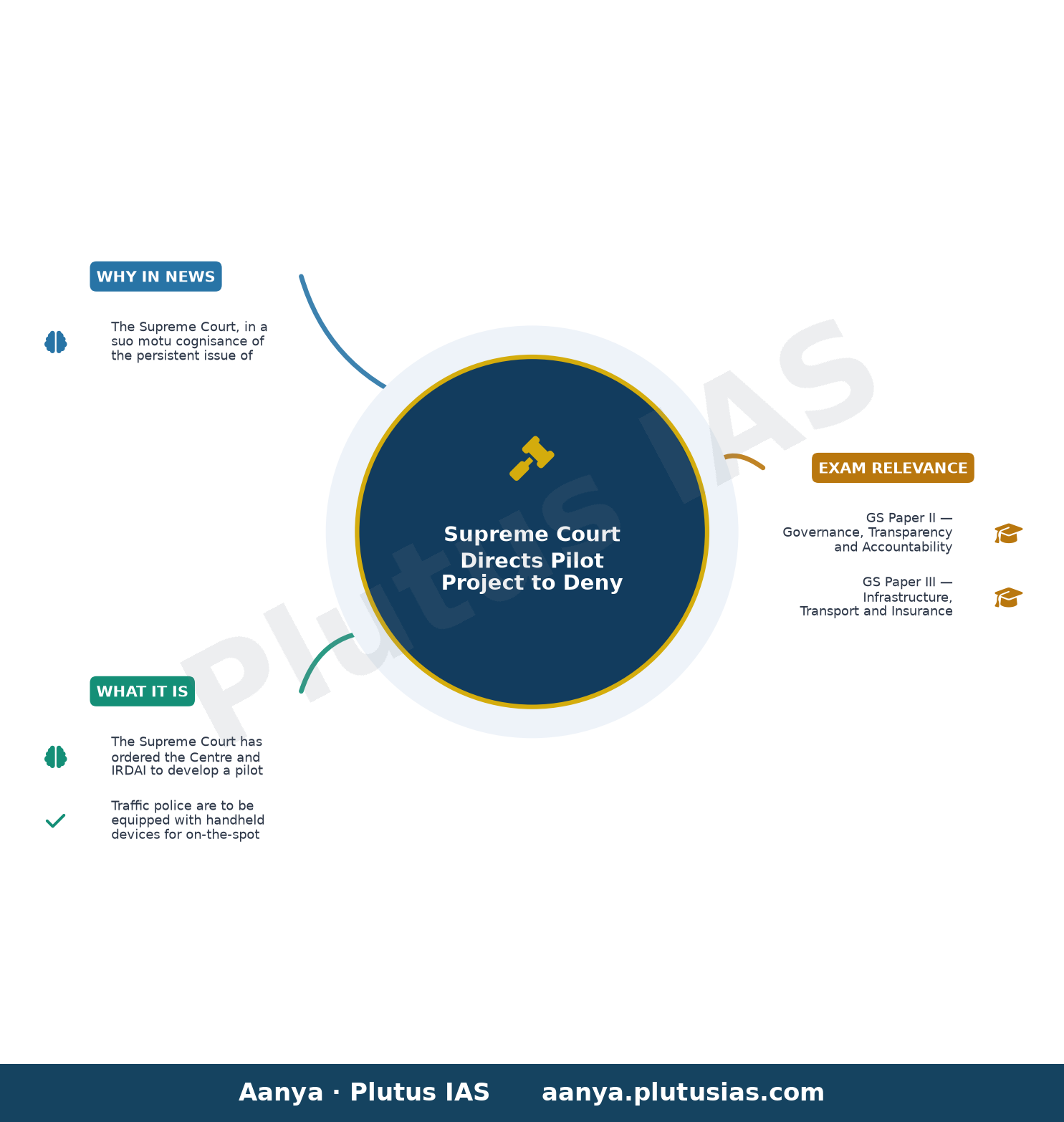
04 Aug Supreme Court Directs Pilot Project to Deny Fuel to Uninsured Vehicles
✎ The Supreme Court’s directive to deny fuel to uninsured vehicles is a judicial intervention to enforce Section 146 of the Motor Vehicles Act, 1988, by leveraging ANPR integration with insurance databases for real-time compliance…
Subject Relevance — Where This Topic Fits
- GS Paper II — Governance, Transparency and Accountability | GS Paper III — Infrastructure, Transport and Insurance Sector Reforms | GS Paper III — Government Policies and Interventions for Development in various sectors
- Prelims: Motor Vehicles Act, 1988 (Section 146 — Compulsory Insurance), IRDAI (Insurance Regulatory and Development Authority of India), VAHAN portal, ANPR (Automatic Number Plate Recognition), Third-Party Motor Insurance, Compensation for Road Accident Victims, MoRTH (Ministry of Road Transport and Highways), Fuel Supply Regulations
- Essay: The Role of Judicial Intervention in Public Policy: Balancing Efficiency and Justice, Insurance as a Social Security Mechanism: Bridging Gaps in Public Welfare
Quick Revision: The Supreme Court’s directive to deny fuel to uninsured vehicles is a judicial intervention to enforce Section 146 of the Motor Vehicles Act, 1988, by leveraging ANPR integration with insurance databases for real-time compliance checks and e-challan generation.
Why is this in the news?
The Supreme Court, in a suo motu cognisance of the persistent issue of uninsured vehicles on Indian roads, has directed the Centre and IRDAI to formulate a pilot project linking fuel supply to insurance status. This directive, issued on August 4, 2026, aims to enforce mandatory third-party motor insurance under Section 146 of the Motor Vehicles Act, 1988, while addressing the systemic delays in compensating road accident victims. The order underscores the judiciary’s proactive role in addressing governance gaps in public safety and insurance compliance.
Background
- The Motor Vehicles Act, 1988, mandates third-party insurance for all motor vehicles under Section 146 to ensure compensation for accident victims, yet approximately 56% of vehicles on Indian roads remain uninsured as per judicial observations.
- Uninsured vehicles contribute to prolonged litigation and financial hardship for victims, as statutory compensation is often delayed or denied due0 to non-compliance with insurance norms.
- The Insurance Regulatory and Development Authority of India (IRDAI) regulates the insurance sector, including motor insurance policies, but enforcement of mandatory insurance remains a challenge.
- The Ministry of Road Transport and Highways (MoRTH) maintains the VAHAN portal, a centralised database of vehicle registrations, while the Insurance Information Bureau (IIB) tracks insurance status.
- Automatic Number Plate Recognition (ANPR) systems are already deployed for traffic enforcement but lack integration with insurance databases for real-time verification.
- The Ministry of Petroleum and Natural Gas has expressed in-principle approval for linking fuel supply to insurance status, enabling enforcement through petrol pumps.
What is the Supreme Court’s Directive on Fuel Denial for Uninsured Vehicles?
- The Supreme Court has ordered the Centre and IRDAI to develop a pilot project where uninsured vehicles are denied fuel at petrol pumps until valid insurance is obtained, leveraging the Ministry of Petroleum and Natural Gas’ approval.
- Traffic police are to be equipped with handheld devices for on-the-spot verification of insurance status, enhancing enforcement efficiency and reducing human discretion in compliance checks.
- The court has emphasised the need to expedite the disposal of pending motor accident compensation cases to ensure timely justice for victims, addressing systemic delays in the judicial process.
- The pilot project aims to nudge vehicle owners towards maintaining valid third-party insurance, thereby reducing the financial burden on accident victims and the exchequer.
- The directive aligns with the broader objective of the Motor Vehicles Act, 1988, to ensure that victims of road accidents are compensated without prolonged litigation or financial distress.
- The Supreme Court has highlighted that the current enforcement mechanisms are inadequate, as evidenced by the high percentage of uninsured vehicles, necessitating innovative, technology-driven solutions.
- The order reflects the judiciary’s proactive stance in addressing governance gaps in public safety, insurance compliance, and judicial efficiency.
UPSC Value Addition
Keywords for Mains Answer-Writing
Motor Vehicles Act, 1988 · Mandatory Third-Party Insurance · Supreme Court Judgment on Uninsured Vehicles · Automatic Number Plate Recognition (ANPR) for Enforcement · Insurance Information Bureau (IIB) · VAHAN Portal Integration · Compensation for Road Accident Victims · Section 146 of Motor Vehicles Act · Technology-Driven Enforcement Mechanisms · Pilot Project for Fuel Denial to Uninsured Vehicles · IRDAI and MoRTH Roles · Statutory Safeguards for Accident Victims · E-Challans for Traffic Violations · Road Safety and Insurance Compliance
Prelims Practice Questions
Q1. Consider the following statements regarding the Motor Vehicles Act, 1988:
1. Section 146 mandates compulsory insurance for all motor vehicles plying on Indian roads.
2. The Act provides for the establishment of the Insurance Information Bureau (IIB) to maintain a database of insured vehicles.
3. The Act empowers the Supreme Court to issue directions for the implementation of traffic and insurance-related schemes.
How many of the above statements are correct?
- Only one
- Only two
- All three
- None
Answer: All three — Statement 1 and 3 are correct. Section 146 of the Motor Vehicles Act, 1988 mandates compulsory insurance for all motor vehicles. The Supreme Court has the power to issue directions under Article 142 of the Constitution. Statement 2 is incorrect as the IIB is not established under the Motor Vehicles Act but under the IRDAI regulations.
Q2. Assertion (A): The Supreme Court has directed the integration of Automatic Number Plate Recognition (ANPR) cameras with the Insurance Information Bureau (IIB) database to identify uninsured vehicles.
Reason (R): The Motor Vehicles Act, 1988, empowers the Supreme Court to issue such directions for the enforcement of traffic and insurance-related provisions.
Options:
A. Both A and R are true, and R is the correct explanation of A.
B. Both A and R are true, but R is not the correct explanation of A.
C. A is true, but R is false.
D. A is false, but R is true.
Answer: ? — Both Assertion (A) and Reason (R) are true. The Supreme Court has indeed directed the integration of ANPR cameras with the IIB database for enforcement. The Motor Vehicles Act, 1988, does not explicitly empower the Supreme Court to issue such directions, but the Court derives this power from Article 142 of the Constitution, which empowers it to issue directions for the enforcement of any legal right.
Q3. Match the following provisions of the Motor Vehicles Act, 1988 with their respective descriptions:
Column I (Provisions)
1. Section 146
2. Section 161
3. Section 166
4. Section 196
Column II (Descriptions)
A. Compulsory insurance for motor vehicles
B. Power of State Governments to make rules regarding driving licenses
C. Compensation for victims of accidents involving motor vehicles
D. Punishment for driving without a valid license
Options:
A. 1-A, 2-B, 3-C, 4-D
B. 1-B, 2-A, 3-C, 4-D
C. 1-C, 2-D, 3-A, 4-B
D. 1-D, 2-C, 3-B, 4-A
Answer: ? — The correct match is: 1-A (Section 146 – Compulsory insurance for motor vehicles), 2-B (Section 161 – Power of State Governments to make rules regarding driving licenses), 3-C (Section 166 – Compensation for victims of accidents involving motor vehicles), 4-D (Section 196 – Punishment for driving without a valid license).
Mains Practice Question
✍ Critically examine the constitutional and statutory framework governing mandatory third-party insurance for motor vehicles in India. How far does the recent Supreme Court directive on the denial of fuel to uninsured vehicles align with the objectives of Section 146 of the Motor Vehicles Act, 1988? Also, analyse the implications of integrating Automatic Number Plate Recognition (ANPR) cameras with the Insurance Information Bureau (IIB) database for enforcement. (15 Marks)
Approach: MODEL-ANSWER SKELETON:
1. **Constitutional and Statutory Framework**:
– Article 21 (Right to Life and Personal Liberty) and Article 300A (Right to Property) provide the constitutional basis for mandatory insurance.
– Section 146 of the Motor Vehicles Act, 1988 mandates compulsory insurance for all motor vehicles to ensure compensation for accident victims.
– The Act empowers the IRDAI to regulate insurance policies, including third-party insurance.
– The Motor Vehicles (Amendment) Act, 2019 introduced stricter penalties for non-compliance.
2. **Supreme Court Directive on Fuel Denial**:
– The directive aligns with the objective of Section 146 by ensuring compliance with mandatory insurance.
– It aims to reduce the number of uninsured vehicles (reportedly 56%) and expedite compensation for accident victims.
– The directive is grounded in the Court’s power under Article 142 to issue directions for the enforcement of legal rights.
3. **Integration of ANPR with IIB Database**:
– ANPR cameras enable real-time identification of uninsured vehicles.
– Integration with the IIB database ensures accurate verification of insurance status.
– This mechanism enhances enforcement efficiency and reduces manual errors.
– Potential challenges include data privacy concerns and the need for robust technological infrastructure.
4. **Implications and Balancing Views**:
– **Pros**: Reduces litigation delays, ensures timely compensation, and promotes road safety.
– **Cons**: May disproportionately affect low-income vehicle owners; raises concerns about data privacy and surveillance.
– **Judicial Precedents**: Cite cases like *National Insurance Company Ltd. v. Swaran Singh* (2004) on the importance of third-party insurance.
5. **Conclusion**:
– The directive is a progressive step toward achieving the objectives of Section 146.
– However, its implementation must balance enforcement with equity and privacy considerations.
Source: Hindustan Times
Generated by AanyaAi for educational purpose.

- हिमाचल में डिजिटल भुगतान क्रांति: बिलासपुर अव्वल, महिलाओं की भागीदारी 93% तक पहुंची - September 23, 2026
- Himachal Pradesh Leads in Digital Payments: Bilaspur Tops, Women’s Role Rises - September 23, 2026
- केरल लोक सेवा आयोग ने उच्च न्यायालय में दायर किया मामला, सदस्यों के खिलाफ मामला रद्द करने की मांग - September 23, 2026

No Comments