


01 Sep Supreme Court Notice to Centre & MP Govt Over ₹21 Lakh Scholarship Denial
✎ The Post-Matric Scholarship Scheme for OBC and EWS students is a Centrally Sponsored Scheme; non-disbursal of funds may violate the scheme's guidelines and constitutional provisions for educational equity.
Subject Relevance — Where This Topic Fits
- GS Paper II — Governance, Constitution and Polity (Scheduled Castes and Scheduled Tribes (Prevention of Atrocities) Act, 1989; Rights of Persons with Disabilities Act, 2016) | GS Paper III — Issues relating to Poverty and Hunger (Direct Benefit Transfers, Subsidies and Welfare Schemes)
- Prelims: Post-Matric Scholarship Scheme, OBC and EWS categories, Direct Benefit Transfer (DBT), Constitutional Provisions under Article 29 and 30 (Cultural and Educational Rights), Union and State Concurrent List under Seventh Schedule
- Essay: Equity in Education: Bridging the Divide through Inclusive Policies, Federalism in India: Challenges in Implementation of Centrally Sponsored Schemes
Quick Revision: The Post-Matric Scholarship Scheme for OBC and EWS students is a Centrally Sponsored Scheme; non-disbursal of funds may violate the scheme’s guidelines and constitutional provisions for educational equity.
Why is this in the news?
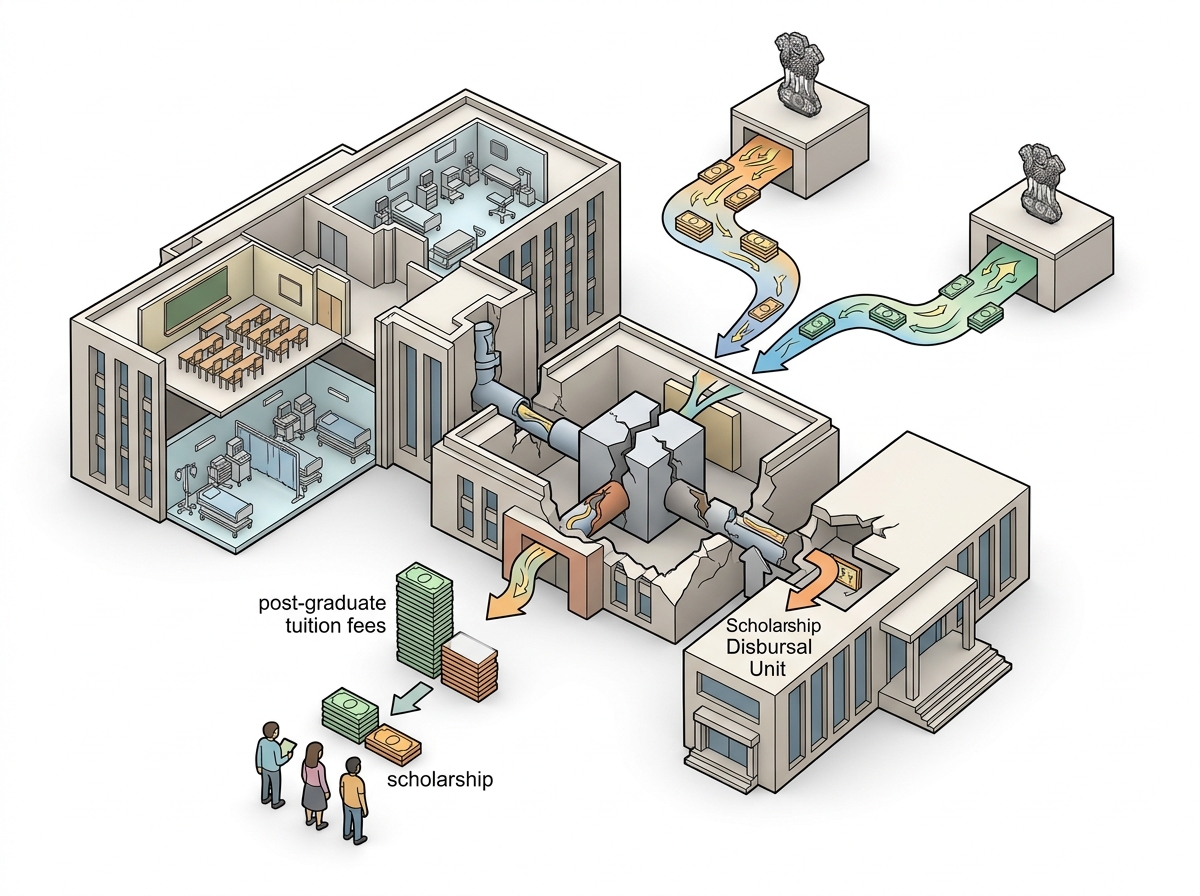
The Supreme Court of India has issued notices to the Union Government, the State Government of Madhya Pradesh, and the State Backward Classes Commission in a case concerning the non-disbursal of post-matric scholarship funds under the centrally sponsored scheme for Other Backward Classes (OBC) and Economically Weaker Sections (EWS) students pursuing postgraduate medical courses. The petitioner, a resident of Madhya Pradesh, alleges that despite fulfilling eligibility criteria, the full scholarship amount of approximately ₹21 lakh for a three-year course was not disbursed, leading to a legal dispute over the division of financial and administrative responsibilities between the Centre and the State.
Background
- The Post-Matric Scholarship Scheme for OBC and EWS students was launched by the Union Government in 2014-15 to provide financial assistance for postgraduate medical education across India.
- Madhya Pradesh, like other States, is required to implement the scheme in accordance with the guidelines issued by the Ministry of Social Justice and Empowerment, Government of India.
- The dispute arises from the allegation that the State Government has failed to disburse the full scholarship amount to eligible students, citing administrative or financial constraints.
- The petitioner, a dental graduate from Madhya Pradesh pursuing a postgraduate medical course in Haryana, approached the State Backward Classes Commission for redressal before moving the High Court and subsequently the Supreme Court.
What is the Post-Matric Scholarship Scheme for OBC and EWS Students?
- The scheme was introduced to provide financial assistance to OBC and EWS category medical students at the post-graduation level.
- The scholarship covers tuition fees, with the amount varying based on the course and institution.
- Eligibility criteria include domicile in the State, belonging to the OBC or EWS category, and securing admission to a recognized postgraduate course.
- The scheme is aligned with the constitutional mandate under Article 15(4) to promote educational opportunities for socially and educationally backward classes.
Key Features
| Feature | Significance |
|---|---|
| Post-Matric Scholarship Scheme (PMSS) for OBC/EWS Medical Students | A centrally sponsored scheme aimed at providing financial assistance to OBC and EWS category students pursuing postgraduate medical education, ensuring equitable access to higher education. |
| State Government as Implementing Agency | The State Government is designated as the nodal agency for disbursing scholarship funds to eligible students, acting as an intermediary between the Centre and beneficiaries. |
| Scholarship Calculation and Disbursement Mechanism | The scheme mandates full reimbursement of tuition fees for three years of postgraduate medical courses, with funds routed through the State Government to the student’s institution. |
| Judicial Intervention via Supreme Court | The apex court’s suo motu or petition-based intervention ensures constitutional accountability of both the Centre and State Governments in matters of scholarship disbursement and grievance redressal. |
| Role of State Backward Classes Commission | The State Backward Classes Commission is statutorily empowered to verify eligibility, process claims, and recommend disbursement, acting as a quasi-judicial body in scholarship matters. |
Why it Matters
Economic Equity
- Mitigates financial barriers for OBC/EWS students pursuing postgraduate medical education, reducing disparities in access to specialised healthcare education.
- Ensures that economically weaker sections are not excluded from high-cost professional courses due to prohibitive tuition fees.
Governance and Accountability
- Highlights the operational challenges in inter-governmental fund flow mechanisms, particularly in centrally sponsored schemes where Centre-State coordination is critical.
- Demonstrates the judiciary’s role in enforcing constitutional obligations of the State to provide equitable educational opportunities.
Judicial Precedent
- Reinforces the principle that scholarship schemes must be implemented in letter and spirit, with strict adherence to timelines and financial commitments.
- Sets a precedent for future cases involving delays or non-disbursement of centrally sponsored scholarships, ensuring judicial oversight.
Social Justice
- Aligns with constitutional directives under Articles 15(4) and 46 to promote educational advancement among socially and educationally backward classes.
- Supports the realisation of Sustainable Development Goal 4 (Quality Education) by ensuring no student is deprived of education due to financial constraints.
Institutional Trust
- Underscores the importance of transparency in scholarship disbursement processes to maintain public trust in government schemes.
- Emphasises the need for robust grievance redressal mechanisms to address systemic failures in implementation.
Challenges
1. Inter-Governmental Fund Flow Delays
- Delays in fund transfer from the Centre to the State Government, leading to partial or non-disbursement of scholarships to eligible students.
- Bureaucratic bottlenecks in the State Government’s disbursement chain, causing further delays in reaching beneficiaries.
UPSC Link: GS-II: Centre-State Relations, Federalism
2. Eligibility Verification and Claim Processing
- Lack of streamlined verification processes for OBC/EWS category students, leading to disputes over eligibility and entitlement.
- Inadequate grievance redressal infrastructure within the State Backward Classes Commission, resulting in prolonged litigation.
UPSC Link: GS-II: Welfare Schemes for Vulnerable Sections
3. Judicial Delays in Grievance Redressal
- Prolonged litigation in lower courts before escalation to the Supreme Court, exacerbating financial hardships for students.
- Inconsistent judicial interpretations of scholarship entitlements, creating uncertainty for future applicants.
UPSC Link: GS-II: Judiciary and Constitutional Remedies
4. Financial Constraints of Students
- Students from economically weaker sections face immediate financial distress due to non-receipt of scholarships, risking discontinuation of education.
- Opportunity cost of pursuing postgraduate education increases, as students may opt for lower-cost alternatives or abandon studies.
UPSC Link: GS-III: Inclusive Growth and Financial Inclusion
5. Lack of Awareness and Outreach
- Insufficient dissemination of scheme details among eligible students, leading to underutilisation of scholarship benefits.
- Poor coordination between educational institutions and scholarship authorities, resulting in delayed or incorrect disbursements.
UPSC Link: GS-II: Social Sector Services Delivery
Challenges — UPSC Perspective
| Issue | Concern |
|---|---|
| Non-disbursement of full scholarship amount | Students bear the financial burden of high tuition fees, defeating the scheme’s purpose of equity. |
| Delays in fund transfer from Centre to State | Creates liquidity crunches for students and institutions relying on timely reimbursements. |
| Inadequate grievance redressal mechanisms | Prolongs litigation and exacerbates financial hardships for students. |
| Lack of transparency in eligibility verification | Leads to disputes and arbitrary rejections of scholarship claims. |
| Poor inter-departmental coordination | Results in fragmented implementation and accountability gaps. |
Government Initiatives — Must-Memorise for Prelims
- {‘name’: ‘Post-Matric Scholarship Scheme for OBC/EWS Medical Students’, ‘description’: ‘A centrally sponsored scheme launched in 2014-15 to provide full tuition fee reimbursement for three years of postgraduate medical education to OBC and EWS category students.’}
Way Forward
- Strengthen inter-governmental fund flow mechanisms to ensure timely disbursement of scholarships, with real-time tracking of transfers.
- Establish a dedicated grievance redressal portal for scholarship applicants, with strict timelines for resolution to prevent judicial delays.
- Conduct periodic awareness campaigns in collaboration with educational institutions to disseminate scheme details and eligibility criteria.
- Enhance the capacity of the State Backward Classes Commission to streamline eligibility verification and claim processing.
- Introduce performance-based incentives for State Governments to improve disbursement efficiency and reduce delays.
- Mandate annual audits of scholarship disbursements to identify systemic bottlenecks and address them proactively.
- Explore the use of Direct Benefit Transfer (DBT) for scholarships to minimise leakages and ensure direct crediting to student accounts.
UPSC Value Addition
Keywords for Mains Answer-Writing
Post-Matric Scholarship Scheme for OBC/EWS students · Supreme Court of India · Constitutional remedies for scholarship denial · Federalism and Centre-State financial devolution · Judicial review of welfare schemes · Backward Classes Commission · Right to Education and higher education financing · Judicial activism in welfare governance · Public Interest Litigation (PIL) · Financial inclusion and educational equity
Constitutional & Policy Linkages
- {‘article’: ‘Article 29(2)’, ‘note’: ‘Prohibits discrimination in educational institutions.’}
- {‘article’: ‘Article 46’, ‘note’: ‘Promotes educational advancement of weaker sections.’}
- {‘article’: ‘Article 15(4)’, ‘note’: ‘Allows special provisions for backward classes.’}
Concept Flow
Centrally sponsored Post-Matric Scholarship Scheme for OBC/EWS medical students announced (2014-15) → State Government designated as nodal agency for disbursement; funds routed through State to students → Eligible students (e.g., OBC category) apply via State Backward Classes Commission → Verification and processing delays; partial or no disbursement of scholarship amount → Student approaches High Court; case dismissed due to procedural gaps → Supreme Court intervention sought; Centre, State, and State Commission summoned for explanation → Judicial scrutiny of Centre-State coordination and scheme implementation gaps → Potential policy reforms in fund flow, grievance redressal, and inter-governmental accountability
Prelims Practice Questions
Q1. Consider the following statements regarding the Post-Matric Scholarship Scheme for OBC/EWS students in India:
1. The scheme is centrally sponsored and implemented by state governments.
2. The scholarship covers tuition fees, maintenance allowance, and other incidental expenses for post-graduate medical education.
3. The scheme is administered under the Ministry of Social Justice and Empowerment.
4. The scholarship amount is directly credited to the student’s bank account under Direct Benefit Transfer (DBT).
How many of the above statements are correct?
- Only one
- Only two
- Only three
- All four
Answer: Only three — Statements 1 and 3 are correct. The scheme is centrally sponsored (1) and administered by the Ministry of Social Justice and Empowerment (3). Statement 2 is incorrect as the scheme primarily covers tuition fees and maintenance allowance, not all incidental expenses. Statement 4 is incorrect as the scholarship is disbursed through state governments, not directly under DBT to students.
Q2. Assertion (A): The Supreme Court of India can issue directions to state governments for the implementation of centrally sponsored welfare schemes.
Reason (R): The Constitution of India empowers the Supreme Court to issue writs under Article 32 for the enforcement of Fundamental Rights, including the right to education.
Options:
A. Both A and R are true, and R is the correct explanation of A.
B. Both A and R are true, but R is not the correct explanation of A.
C. A is true, but R is false.
D. A is false, but R is true.
Answer: ? — Both Assertion (A) and Reason (R) are true. The Supreme Court can issue directions to state governments for implementing welfare schemes under Article 32 (Right to Constitutional Remedies). However, the Reason (R) is not the only basis for Assertion (A), as the Court can also issue directions under Article 142 (power to do complete justice) or Article 136 (special leave petition).
Q3. Match the following institutions with their respective roles in the implementation of the Post-Matric Scholarship Scheme:
Column I (Institution) | Column II (Role)
1. Ministry of Social Justice and Empowerment | A. Formulates the scheme and provides central funds
2. State Government | B. Identifies eligible beneficiaries and disburses scholarships
3. Backward Classes Commission | C. Monitors compliance and addresses grievances
4. Supreme Court | D. Provides legal recourse in case of denial of benefits
Options:
A. 1-A, 2-B, 3-C, 4-D
B. 1-B, 2-A, 3-D, 4-C
C. 1-D, 2-C, 3-A, 4-B
D. 1-C, 2-D, 3-B, 4-A
Answer: ? — 1-A: The Ministry of Social Justice and Empowerment formulates the scheme and provides central funds. 2-B: The State Government identifies eligible beneficiaries and disburses scholarships. 3-C: The Backward Classes Commission monitors compliance and addresses grievances. 4-D: The Supreme Court provides legal recourse in case of denial of benefits.
Mains Practice Question
✍ The denial of Post-Matric Scholarship benefits to eligible students under the centrally sponsored scheme raises critical questions about the efficacy of federal governance in welfare delivery. Critically examine the institutional and constitutional mechanisms available to students for redressal, with particular reference to judicial intervention. Also, analyse the implications of such denials on the constitutional goal of educational equity. (15 Marks)
Approach: MODEL-ANSWER SKELETON:
1. **Introduction (2 Marks)**: Define the Post-Matric Scholarship Scheme (PMSS) for OBC/EWS students, its objectives (financial assistance for higher education), and the constitutional context (Directive Principles of State Policy under Articles 38, 41, and 46; Fundamental Duty under Article 51A(h)).
2. **Institutional Mechanisms for Redressal (5 Marks)**:
– **Judicial Intervention**: Role of the Supreme Court under Article 32 (writs for enforcement of Fundamental Rights) and Article 136 (special leave petition). Cite recent judgments (e.g., *Re: Kerala Education Bill*, *Unnikrishnan v. State of Andhra Pradesh*).
– **Administrative Grievance Redressal**: Role of the Backward Classes Commission (under Article 340) and state-level commissions; mention the *Sachar Committee Report* (2006) on minority educational disparities.
– **Legislative Safeguards**: The *Right of Children to Free and Compulsory Education Act, 2009* (RTE Act) and its limitations for higher education.
3. **Constitutional and Federal Challenges (4 Marks)**:
– **Centre-State Fiscal Federalism**: Discuss the *NITI Aayog’s Three-Year Action Agenda* (2017-19) on centrally sponsored schemes (CSS) and the role of the *Finance Commission* in resource devolution.
– **State Implementation Gaps**: Highlight issues like delayed disbursement, incomplete coverage, and lack of transparency (cite *CAG Reports* on scholarship schemes).
– **Judicial Activism vs. Separation of Powers**: Debate on judicial overreach in welfare governance (reference to *Vineet Narain v. Union of India*, 1996).
4. **Implications for Educational Equity (4 Marks)**:
– **Constitutional Goal**: Link to Article 29(2) (prohibition of discrimination in educational institutions) and Article 15(4) (special provisions for backward classes).
– **Socio-Economic Impact**: Discuss the *All India Survey on Higher Education (AISHE) 2020-21* data on OBC/EWS enrollment disparities.
– **Policy Recommendations**: Suggest measures like real-time monitoring (PRAGATI platform), DBT integration, and state-wise grievance redressal mechanisms.
**Balanced View**: Acknowledge the Centre’s financial constraints but emphasize the state’s obligation under the *Constitution of India* to ensure equitable access to education.
Source: amarujala.com
Madhya Pradesh PCS (MPPSC) — State PCS Practice
Prelims: Recently, the Supreme Court has taken up a case regarding the refund of a fee of ₹21 lakh from which city of Madhya Pradesh?
- A. Indore
- B. Bhopal
- C. Jabalpur
- D. Gwalior
Answer: C. Jabalpur — The case pertains to Jabalpur, where a fee refund issue of ₹21 lakh has been escalated to the Supreme Court.
Mains: Analyze the legal and administrative challenges faced by the Madhya Pradesh government in resolving the ₹21 lakh fee refund case from Jabalpur, highlighting the role of the judiciary, state agencies, and stakeholders involved. Suggest measures to prevent such disputes in the future.
Generated by AanyaAi for educational purpose.
Related guides on our sites
- Current affairs for upsc 2026
- Best PSIR optional coaching for upsc
- Best PSIR optional teacher for upsc
- Best teacher of PSIR optional for upsc

- Civil Defence Network: Vision of PM Modi for Enhanced Security - October 23, 2026
- भारत-रूस नौसैनिक अभ्यास INDRA 2026 संपन्न: रक्षा सहयोग में नया आयाम - October 23, 2026
- Capacity Building Commission: Key to PM Modi’s Governance Reforms - October 23, 2026

No Comments