


11 Aug Supreme Court Questions EC on Delayed Bengal Voter List Appeals
✎ The Supreme Court’s directive highlights the constitutional duty of the Election Commission of India to ensure timely disposal of appeals against deletions in the electoral roll under the Special Intensive Revision process to…
Subject Relevance — Where This Topic Fits
- GS Paper II — Constitutional and Non-Constitutional Bodies (Election Commission of India) | GS Paper III — Electoral Reforms and Governance
- Prelims: Special Intensive Revision (SIR), Electoral Rolls, Appellate Tribunals, Section 22 of the Representation of the People Act, 1950, ECI’s SVEEP Programme
- Essay: Electoral Integrity and Democratic Accountability, The Role of Judiciary in Ensuring Free and Fair Elections
Quick Revision: The Supreme Court’s directive highlights the constitutional duty of the Election Commission of India to ensure timely disposal of appeals against deletions in the electoral roll under the Special Intensive Revision process to prevent disenfranchisement of voters.
Why is this in the news?
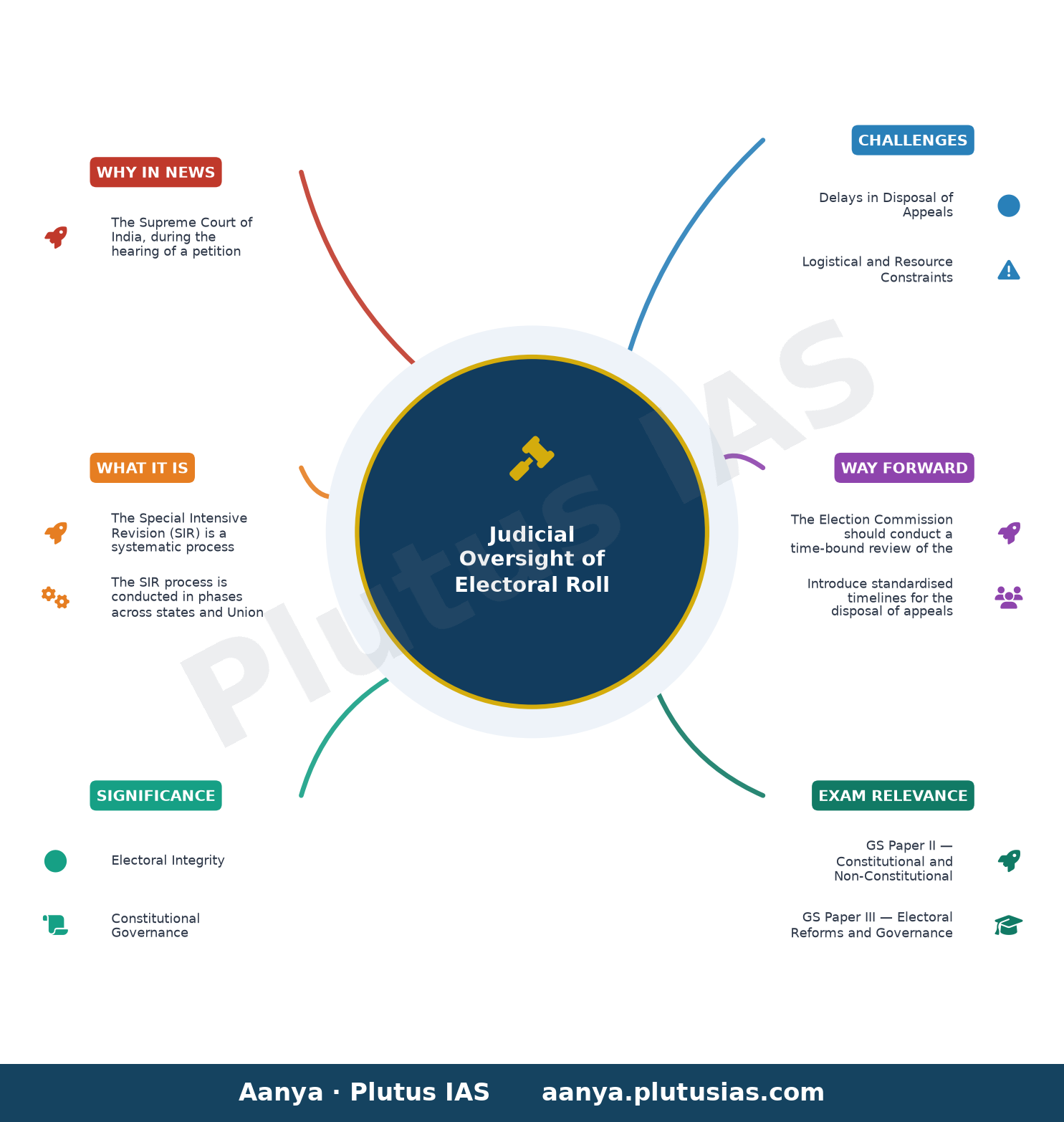
The Supreme Court of India, during the hearing of a petition filed by a political leader, has sought detailed information from the Election Commission of India (ECI) regarding the pendency of appeals before Appellate Tribunals in West Bengal arising from deletions in the voter list under the Special Intensive Revision (SIR) process. The Court expressed concern over the slow disposal rate of these appeals, noting that if the current pace persists, the next general elections may conclude before all appeals are adjudicated, thereby potentially disenfranchising eligible voters.
Background
- The Special Intensive Revision (SIR) is a statutory process under the Representation of the People Act, 1950, aimed at preparing an error-free electoral roll by identifying and rectifying discrepancies such as duplicate, shifted, or deceased voters.
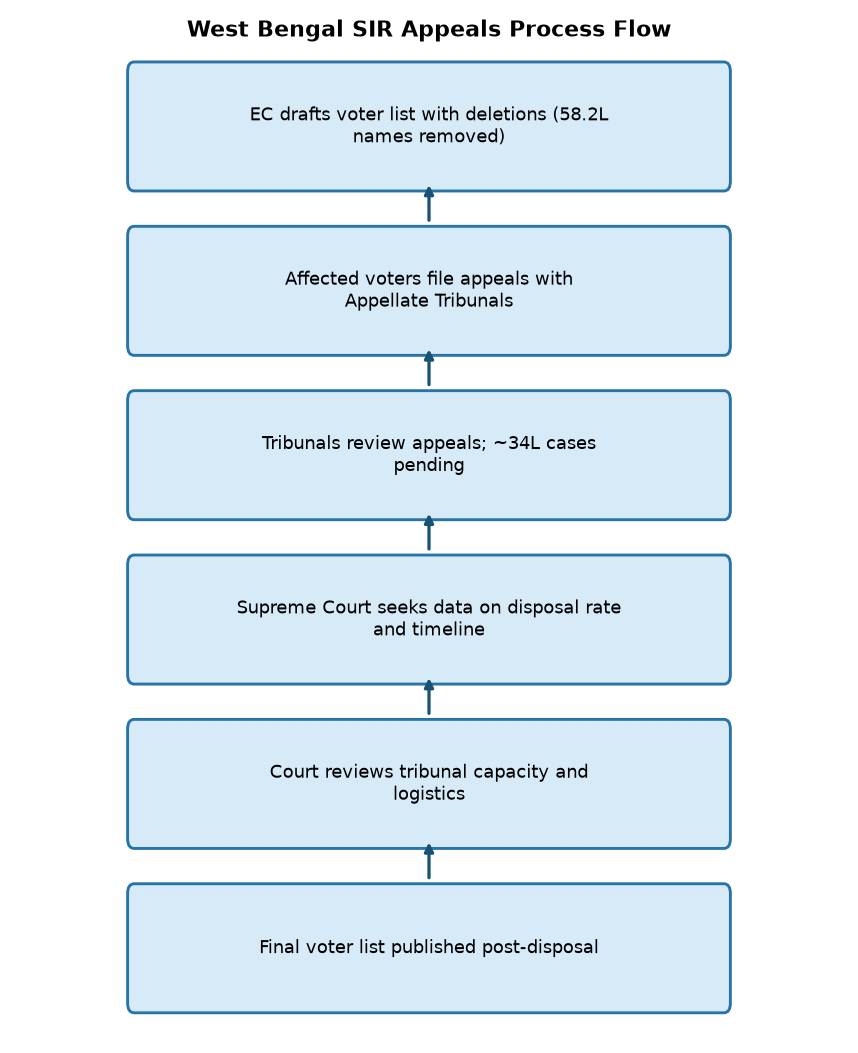
- In West Bengal, the SIR process led to the deletion of 58.20 lakh names from the draft electoral roll, reducing the total voter count from 7.66 crore to 7.08 crore—a reduction rate of approximately 7.6%.
- Of the deleted names, 24.17 lakh were attributed to deceased individuals, 1.38 lakh to duplicates or fraudulent entries, and the remaining 32.65 lakh to shifts, absences, or other administrative reasons.
- Appellate Tribunals are empowered to hear appeals against deletions in the electoral roll and adjudicate on the inclusion or exclusion of names.
- The ECI conducts the SIR process in phases across states and Union Territories, with West Bengal being part of the second phase, which also included Uttar Pradesh, Gujarat, Madhya Pradesh, Rajasthan, and others.
- The Supreme Court’s intervention underscores the constitutional obligation of the ECI to ensure timely disposal of appeals to prevent disenfranchisement and uphold electoral fairness.
What is the Special Intensive Revision (SIR) and Appellate Tribunals?
- The Special Intensive Revision (SIR) is a systematic process mandated by the Election Commission of India (ECI) to update and purify the electoral roll by removing inaccuracies such as duplicate entries, deceased voters, and shifted or missing electors.
- The SIR process is conducted in phases across states and Union Territories, with each phase covering multiple regions to ensure comprehensive revision before elections.
- Under the Representation of the People Act, 1950, the ECI is statutorily obligated to prepare and publish the electoral roll in accordance with the provisions of the Act and the Conduct of Elections Rules, 1961.
- Appellate Tribunals are quasi-judicial bodies to hear appeals against deletions or inclusions in the electoral roll.
- The Tribunals are empowered to direct the inclusion of names if the deletion is found to be erroneous or unjustified, thereby safeguarding the electoral rights of citizens.
- The SIR process includes multiple stages: preliminary revision, public scrutiny, disposal of claims and objections, and final publication of the electoral roll.
- The ECI is required to ensure that the SIR process is conducted in a time-bound manner to avoid disenfranchisement of eligible voters due to procedural delays.
Key Features
| Feature | Significance |
|---|---|
| Special Intensive Revision (SIR) | A statutory process under the Representation of the People Act, 1950, to prepare and update the electoral rolls through door-to-door verification to ensure accuracy and inclusivity. |
| Appeal Tribunals | Quasi-judicial bodies constituted under Section 22 of the Representation of the People Act, 1951, to adjudicate disputes arising from the deletion of names in the electoral rolls. |
| Electoral Roll Purge | The systematic removal of names from the voter list based on criteria such as death, duplication, or migration, as per the Election Commission of India’s guidelines. |
| Disposal Rate of Appeals | The proportion of pending appeals resolved by tribunals within a specified timeframe, critical for electoral justice and voter confidence. |
| Judicial Oversight | The Supreme Court’s constitutional mandate to ensure the Election Commission adheres to statutory timelines and procedural fairness in electoral matters. |
Why it Matters
Electoral Integrity
- Ensures the accuracy of the electoral rolls, a cornerstone of free and fair elections under Article 324 of the Constitution.
- Prevents disenfranchisement by providing a mechanism for aggrieved voters to challenge deletions through appeal tribunals.
- Maintains public trust in the electoral process by addressing grievances in a timely and transparent manner.
Constitutional Governance
- Highlights the role of the Election Commission as an autonomous constitutional body under Article 324, independent of executive interference.
- Demonstrates the judiciary’s constitutional duty to uphold electoral justice and enforce statutory timelines.
- Emphasises the balance between electoral efficiency and due process in democratic governance.
Administrative Efficiency
- Underscores the need for streamlined administrative processes in electoral roll management, particularly in large states like West Bengal.
- Raises questions about the logistical and human resource constraints faced by appeal tribunals in disposing of cases expeditiously.
- Illustrates the challenges of scalability in electoral administration across diverse demographic and geographic contexts.
Challenges
1. Delays in Disposal of Appeals
- Approximately 34 lakh appeals are pending before tribunals in West Bengal, leading to prolonged legal uncertainty for voters.
- Delays disproportionately affect marginalised groups, including those dependent on welfare schemes like ration cards, which require valid voter IDs.
- Undermines the principle of electoral justice by creating a backlog that may persist beyond the next election cycle.
UPSC Link: GS-II: Constitutional bodies (Article 324)
2. Logistical and Resource Constraints
- Tribunals face challenges in managing the sheer volume of appeals due to limited infrastructure, staffing, and digital tools.
- Geographical dispersion in states like West Bengal exacerbates logistical difficulties in conducting hearings and verifying claims.
- Lack of standardised timelines for disposal of appeals contributes to systemic inefficiencies.
UPSC Link: GS-II: Election Commission of India
3. Accuracy of Electoral Rolls
- The Special Intensive Revision (SIR) process, while necessary, must balance thoroughness with timeliness to avoid erroneous deletions.
- Errors in identifying deceased, duplicate, or migrated voters can lead to legitimate voters being disenfranchised.
- Ensuring data integrity during the SIR process requires robust verification mechanisms and public participation.
UPSC Link: GS-II: Electoral Reforms
4. Judicial-Executive Coordination
- The Supreme Court’s intervention highlights the need for proactive measures by the Election Commission to address systemic delays.
- Lack of coordination between judicial bodies and electoral authorities can lead to conflicting orders and prolonged litigation.
- Ensuring judicial oversight does not encroach upon the Election Commission’s autonomy is a delicate balance.
UPSC Link: GS-II: Separation of Powers
5. Public Trust and Perception
- Prolonged delays in resolving appeals erode public confidence in the electoral system, particularly among affected voters.
- Perceptions of partisan bias or administrative negligence can undermine the legitimacy of electoral processes.
- Transparency in the disposal of appeals and clear communication with stakeholders are essential to maintain trust.
UPSC Link: GS-II: Electoral Reforms
Challenges — UPSC Perspective
| Issue | Concern |
|---|---|
| Pending Appeals (34 lakh) | Prolonged legal uncertainty and disenfranchisement of voters. |
| Logistical Constraints | Limited infrastructure and staffing in tribunals. |
| Accuracy of SIR Process | Risk of erroneous deletions affecting legitimate voters. |
| Judicial-Executive Coordination | Potential for conflicting orders and systemic inefficiencies. |
| Public Trust | Erosion of confidence in the electoral system due to delays. |
| Standardised Timelines | Absence of uniform disposal rates for appeals. |
Way Forward
- The Election Commission should conduct a time-bound review of the functioning of appeal tribunals in West Bengal, including staffing, infrastructure, and disposal rates.
- Introduce standardised timelines for the disposal of appeals under the Representation of the People Act, 1951, to ensure predictability and fairness.
- Enhance digital infrastructure for tribunals to streamline case management, including e-filing and virtual hearings where feasible.
- Strengthen the Special Intensive Revision (SIR) process by improving public awareness campaigns to minimise erroneous deletions and facilitate timely corrections.
- Constitute a high-level committee comprising representatives from the Election Commission, judiciary, and civil society to monitor progress and address systemic bottlenecks.
- Ensure transparency in the disposal of appeals by publishing quarterly reports on the status of pending and resolved cases.
- Explore the possibility of expanding the jurisdiction of existing tribunals or establishing additional benches to address the backlog in states with high appeal volumes.
- Conduct periodic training programmes for tribunal members on procedural fairness, legal standards, and efficient case management.
UPSC Value Addition
Keywords for Mains Answer-Writing
Special Intensive Revision (SIR) · Electoral Rolls · Election Tribunals · Voter List Corrections · Constitutional Framework of Elections · Election Commission of India · Supreme Court of India · Electoral Disputes Redressal · Right to Vote · Administrative Delays in Elections · Constitutional Provisions on Elections · Electoral Integrity · Judicial Review of Electoral Processes · Voter Registration and Deletion · Electoral Reforms
Constitutional & Policy Linkages
- Article 324: Superintendence, direction, and control of elections vested in the Election Commission.
- Article 325: Prohibition of discrimination in electoral rolls on grounds of religion, race, caste, or sex.
- Article 326: Elections to the House of the People and Legislative Assemblies to be on the basis of adult suffrage.
Concept Flow
Special Intensive Revision (SIR) process identifies discrepancies in electoral rolls → Names deleted based on criteria (death, duplication, migration) → Aggrieved voters file appeals with tribunals → Tribunals face delays in disposal due to logistical constraints → Supreme Court intervenes to seek data on pending appeals → Judicial oversight highlights systemic inefficiencies → Election Commission mandated to address bottlenecks → Public trust in electoral integrity restored through timely and transparent processes.
Prelims Practice Questions
Q1. Consider the following statements regarding the Special Intensive Revision (SIR) of electoral rolls in India: 1. SIR is conducted in phases across different states. 2. The Election Commission of India is empowered to conduct SIR under Article 324 of the Constitution. 3. SIR is primarily aimed at identifying and removing duplicate or fake voter entries. 4. The final voter list after SIR is subject to judicial review by the Supreme Court. How many of the above statements are correct?
- Only one
- Only two
- Only three
- All four
Answer: All four — Statements 1, 2, and 3 are correct. SIR is conducted in phases (Statement 1), and the Election Commission’s authority to conduct elections, including SIR, is derived from Article 324 (Statement 2). The primary objective of SIR is to clean the electoral rolls by removing duplicates, fake entries, and deceased voters (Statement 3). Statement 4 is incorrect as the final voter list is not directly subject to judicial review unless challenged under specific legal provisions.
Q2. Assertion (A): The Election Commission of India can suo motu initiate the Special Intensive Revision (SIR) of electoral rolls. Reason (R): The Constitution of India, under Article 324, vests the Election Commission with the power of superintendence, direction, and control over elections.
- Both A and R are true, and R is the correct explanation of A.
- Both A and R are true, but R is not the correct explanation of A.
- A is true, but R is false.
- A is false, but R is true.
Answer: Both A and R are true, but R is not the correct explanation of A. — Both the Assertion (A) and Reason (R) are true. The Election Commission of India, under Article 324, has the constitutional mandate to superintend, direct, and control the conduct of elections, which includes initiating SIR suo motu. The Reason (R) correctly explains the Assertion (A).
Q3. Match the following electoral processes with their respective constitutional or statutory provisions: 1. Preparation and revision of electoral rolls 2. Conduct of elections 3. Disposal of election petitions 4. Appointment of Election Commissioners
A. Article 324
B. Article 326
C. Article 329
D. The Chief Election Commissioner and Other Election Commissioners (Conditions of Service) Act, 1991
- 1-A, 2-B, 3-C, 4-D; 1-B, 2-A, 3-C, 4-D; 1-B, 2-A, 3-D, 4-C; 1-C, 2-B, 3-A, 4-D
- answer_string_map_index_0
- explain_match_pairs
- format
- match
- answer_index_mapping_map_0
Answer: 1-A, 2-B, 3-C, 4-D; 1-B, 2-A, 3-C, 4-D; 1-B, 2-A, 3-D, 4-C; 1-C, 2-B, 3-A, 4-D —
Q4. Which of the following best describes the role of Election Tribunals in India?
- They are quasi-judicial bodies that hear and decide election petitions and disputes related to electoral rolls.
- They are constitutional bodies that supervise the conduct of elections and ensure fairness.
- They are statutory bodies that prepare and revise electoral rolls periodically.
- They are advisory bodies that recommend electoral reforms to the Election Commission.
Answer: They are quasi-judicial bodies that hear and decide election petitions and disputes related to electoral rolls. — Election Tribunals are quasi-judicial bodies established under the Representation of the People Act, 1951, to hear and decide election petitions and disputes related to electoral rolls. They are not constitutional or advisory bodies, nor do they prepare electoral rolls.
Mains Practice Question
✍ The Special Intensive Revision (SIR) of electoral rolls, while aimed at ensuring electoral purity, has often been criticised for procedural delays and administrative bottlenecks. In this context, critically examine the constitutional and statutory framework governing the conduct of SIR and the role of Election Tribunals in redressing grievances arising from voter list deletions. Also, analyse the implications of such delays on the right to vote and electoral integrity. (15 Marks)
Approach: MODEL-ANSWER SKELETON:
1. **Introduction (2 Marks)**
– Define SIR: A systematic process to clean and update electoral rolls by removing duplicates, fake entries, deceased voters, and shifting individuals.
– Constitutional basis: Article 324 (superintendence, direction, and control over elections) and Article 326 (universal adult suffrage).
– Statutory basis: Representation of the People Act, 1951, and the Conduct of Election Rules, 1961.
2. **Constitutional and Statutory Framework for SIR (4 Marks)**
– **Role of the Election Commission of India (ECI):**
– ECI is empowered under Article 324 to conduct SIR to ensure the purity of electoral rolls.
– ECI issues guidelines and timelines for SIR, which is conducted in phases across states.
– **Provisions for Voter List Corrections:**
– Section 22 of the Representation of the People Act, 1951, empowers the ECI to prepare and revise electoral rolls.
– Rule 13 of the Conduct of Election Rules, 1961, provides for the Special Revision of Electoral Rolls (SIR).
– **Judicial Safeguards:**
– Article 329 bars courts from interfering in electoral matters except as provided by Parliament (e.g., through election petitions).
– Supreme Court can intervene in cases of maladministration or violation of constitutional provisions.
3. **Role of Election Tribunals (3 Marks)**
– **Quasi-Judicial Function:**
– Election Tribunals, established under Section 86 of the Representation of the People Act, 1951, hear appeals against deletions from electoral rolls.
– They are not permanent courts but are constituted ad hoc for specific disputes.
– **Procedural Delays:**
– Tribunals often face logistical and administrative challenges, leading to delays in disposing of appeals.
– Example: In West Bengal, over 34 lakh appeals are pending, highlighting systemic inefficiencies.
– **Judicial Review:**
– The Supreme Court, in cases like the one cited, has sought data on the disposal rate of appeals to ensure timely justice.
4. **Implications of Delays on Right to Vote and Electoral Integrity (4 Marks)**
– **Right to Vote (Article 326):**
– Delays in disposing of appeals deny eligible voters their constitutional right to vote.
– Example: Individuals whose names are wrongly deleted face disenfranchisement until their appeals are resolved.
– **Electoral Integrity:**
– Prolonged delays undermine public trust in the electoral process and the ECI’s credibility.
– Risk of manipulation: Delayed corrections may allow vested interests to exploit gaps in the electoral rolls.
– **Administrative Bottlenecks:**
– Lack of standardized timelines for tribunals to dispose of appeals.
– Inadequate infrastructure and manpower in tribunals.
5. **Reforms and Way Forward (2 Marks)**
– **Strengthening Tribunals:**
– Increase the number of Election Tribunals and provide them with adequate resources.
– Set clear timelines for disposal of appeals (e.g., 90 days).
– **Digitalization:**
– Use technology to streamline the SIR process and appeal disposal (e.g., online grievance redressal systems).
– **Judicial Reforms:**
– The Supreme Court’s proactive stance in monitoring disposal rates can set a precedent for accountability.
– Regular audits of tribunal performance.
**Conclusion (1 Mark)**
– Balancing electoral purity with timely justice is essential to uphold the democratic principles enshrined in the Constitution. Delays in SIR and tribunal disposals not only violate the right to vote but also erode public confidence in the electoral process. Structural and procedural reforms are imperative to ensure that the SIR process remains efficient, transparent, and inclusive.
Source: bhaskar.com
Generated by AanyaAi for educational purpose.

- केरल पुलिस ने SC के आदेशों का उल्लंघन कर किया गिरफ्तारी, जानिए क्या हैं कानून - August 11, 2026
- Kerala Police Violate SC Orders in Dr. Ram, T.G. Mohandas Arrests: UPSC Exam Analysis - August 11, 2026
- सुप्रीम कोर्ट का बड़ा आदेश: 19 राज्यों को कैंसर को ‘नोटिफिएबल बीमारी’ बनाने का निर्देश - August 11, 2026

No Comments