


16 Sep Supreme Court Restricts Forest Law Case to 2023 Act’s Validity: Key Analysis for UPSC
✎ The Supreme Court, in its order dated 16 September 2026, restricted the scope of the challenge to the Forest (Conservation) Amendment Act, 2023, to the constitutional validity of the definition of 'forest' under Section 1A…
Subject Relevance — Where This Topic Fits
- GS Paper II — Polity and Governance (Judicial Review, Constitutional Validity of Laws) | GS Paper III — Environment and Biodiversity (Forest Conservation, Legal Framework)
- Prelims: Forest (Conservation) Act, 1980, Forest (Conservation) Amendment Act, 2023, Section 1A of the Van (Sanrakshan Evam Samvardhan) Adhiniyam, 1980, TN Godavarman Thirumulpad v. Union of India (1996), Rule 16(1) of the Van (Sanrakshan Evam Samvardhan) Rules, 2023, Compensatory Afforestation Fund Management and Planning Authority (CAMPA), Expert Committee for Forest Land Records, Madras High Court, Central Empowered Committee (CEC)
- Essay: Judicial Review and Legislative Competence: Balancing Environmental Protection and Development, The Role of Courts in Interpreting Environmental Laws: A Study of Forest Conservation
Quick Revision: The Supreme Court, in its order dated 16 September 2026, restricted the scope of the challenge to the Forest (Conservation) Amendment Act, 2023, to the constitutional validity of the definition of ‘forest’ under Section 1A, deferring land-specific disputes to High Courts.
Why is this in the news?
The Supreme Court of India, in a significant order dated 16 September 2026, restricted the scope of a pending case challenging the Forest (Conservation) Amendment Act, 2023, to the constitutional validity of the definition of ‘forest’ under the amended law. The Court clarified that disputes involving individual parcels of land would be adjudicated by High Courts, while directing states and Union Territories to expedite the preparation of consolidated records of forest-like and unclassed lands. This order underscores the judiciary’s role in safeguarding environmental governance amid legislative amendments and highlights the procedural challenges in implementing forest conservation laws.
Background
- The Forest (Conservation) Act, 1980 (FCA, 1980) was enacted to regulate the diversion of forest lands for non-forest purposes, ensuring environmental protection and sustainable development.
- The Supreme Court, in *T.N. Godavarman Thirumulpad v. Union of India* (1996), expanded the definition of ‘forest’ to include not only statutorily notified forests but also areas that conform to the dictionary meaning of ‘forest’, irrespective of official records.
- The amendment has been contested on grounds of diluting environmental safeguards and potentially enabling the diversion of forest-like lands for non-forest uses without adequate scrutiny.
- The Supreme Court’s order aligns with its earlier stance in *Godavarman* while acknowledging Parliament’s legislative competence to define ‘forest’ within constitutional limits.
What is the Forest (Conservation) Amendment Act, 2023, and the Issue of Forest Definition?
- This amendment excludes unrecorded, private, or community forests from the purview of the FCA, 1980, unless they are notified as forests under state laws or court orders.
- The amendment has been challenged on the ground that it contradicts the expansive definition of ‘forest’ laid down by the Supreme Court in *T.N. Godavarman Thirumulpad v. Union of India* (1996), which included all areas meeting the dictionary meaning of ‘forest’.
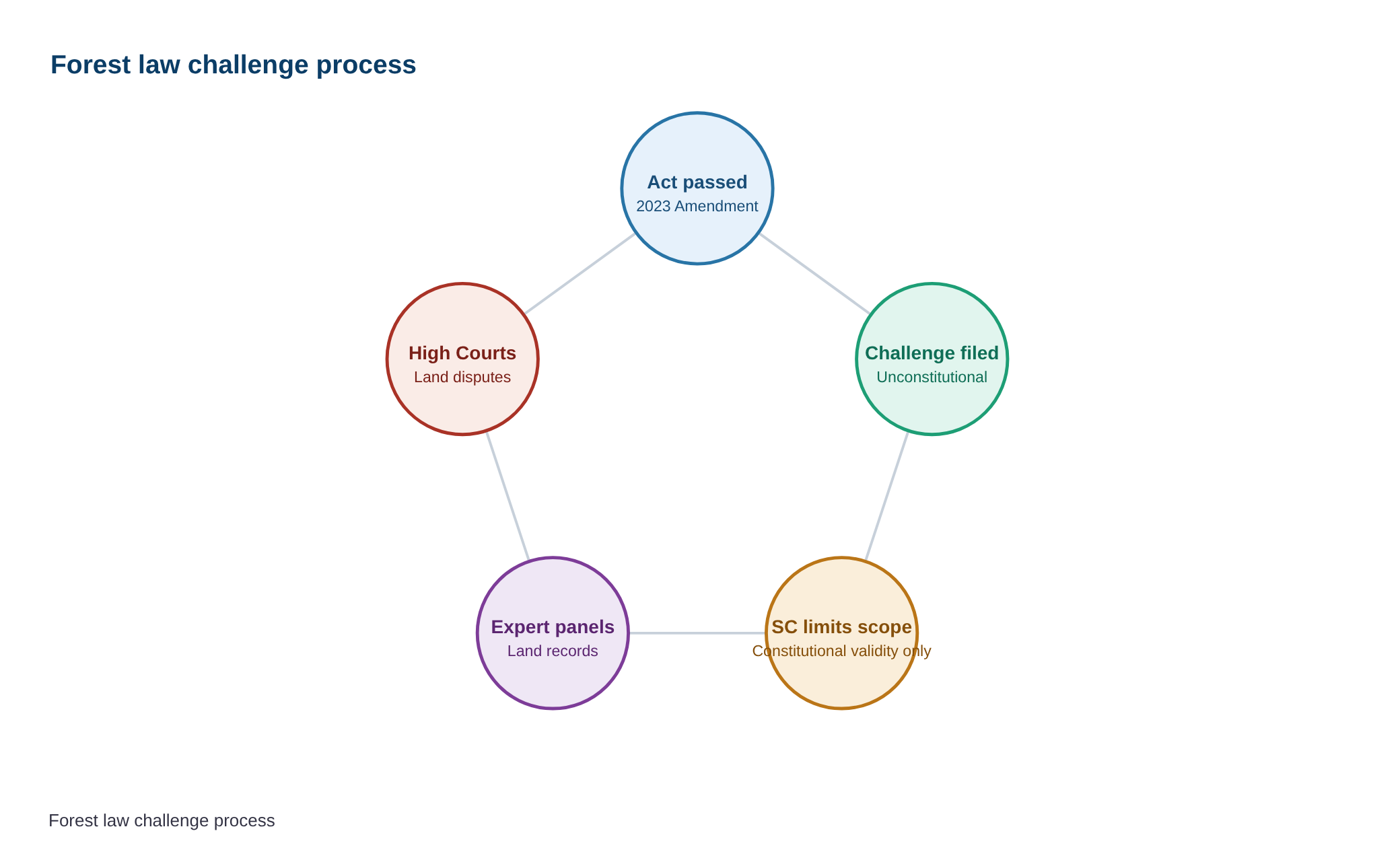
- The Supreme Court, in its order dated 16 September 2026, limited its scrutiny to the constitutional validity of the amended definition, deferring land-specific disputes to High Courts.
- The Court directed states and Union Territories to constitute expert committees to prepare consolidated records of forest-like, unclassed, and community forest lands, as required under Rule 16(1) of the 2023 Rules.
- The amendment also empowers the Central Government to regulate activities in forest lands, including compensatory afforestation and land-use changes, through the Compensatory Afforestation Fund Management and Planning Authority (CAMPA).
- The order highlights the tension between legislative intent and judicial interpretation in environmental governance, particularly in balancing development and conservation.
- The Supreme Court’s approach ensures that while the constitutional validity of the law is examined, individual disputes are resolved at the appropriate judicial forum, i.e., High Courts.
Key Features
| Feature | Significance |
|---|---|
| Constitutional validity of forest definition | The Supreme Court has restricted its examination to whether the 2023 Forest (Conservation) Amendment Act’s definition of ‘forest’ is constitutionally valid, particularly in light of the 1996 TN Godavarman judgment. |
| Exclusion of land-dispute adjudication | The Court clarified that disputes over individual parcels of land will be handled by High Courts, ensuring separation of powers between constitutional courts and subordinate judiciary. |
| Expert panel for consolidated land records | States and UTs must constitute expert panels under Rule 16(1) of the 2023 Rules to prepare a consolidated record of forest-like lands, unclassed forests, and community forests. |
| Referral to High Courts for land disputes | The Court referred a Tamil Nadu land dispute (59 acres) to the Madras High Court, setting a precedent for similar cases involving historical land records. |
| Reference to Central Empowered Committee (CEC) | The Court directed the Maharashtra government’s zoo proposal in Chandrapur to the CEC, allowing public objections under established forest conservation protocols. |
Why it Matters
Legal and Judicial
- The Supreme Court’s decision reinforces the hierarchy of judicial authority, distinguishing constitutional validity challenges from land-dispute adjudication.
- It underscores the binding nature of the 1996 TN Godavarman judgment on forest definitions, which the 2023 Act’s definition may potentially dilute.
- The ruling highlights the judiciary’s role in ensuring that legislative amendments do not contravene established judicial precedents.
Environmental Governance
- The requirement for states/UTs to constitute expert panels ensures a systematic approach to identifying and recording forest-like and community lands.
- The consolidation of land records under Rule 16(1) aims to prevent the loss of forest coverage due to misclassification or exclusion of forest-like areas.
- The Court’s directive addresses gaps in the implementation of the Forest (Conservation) Act, 1980, particularly regarding unclassed and private forests.
Federalism and Intergovernmental Coordination
- The decision mandates coordinated action between the Centre, states, and UTs to harmonize forest definitions and records, balancing legislative and executive roles.
- It clarifies the division of judicial labour between the Supreme Court and High Courts, reducing the burden on the apex court for land-dispute adjudication.
Challenges
1. Potential dilution of forest definition
- The 2023 Act’s definition may exclude certain forest-like lands (e.g., denuded forests, private forests) from the ambit of the Forest (Conservation) Act, 1980.
- This could lead to loss of forest coverage due to misclassification or conversion for compensatory afforestation or other uses.
- The challenge lies in reconciling legislative intent with judicial precedents like TN Godavarman, which emphasize a broader, dictionary-based definition.
UPSC Link: GS-III: Environment & Biodiversity
2. Implementation gaps in land records
- Many states/UTs lack consolidated records of forest-like, unclassed, or community lands, complicating enforcement of forest conservation laws.
- Historical land records (e.g., 1922 notifications in Tamil Nadu) may conflict with modern land-use practices, creating legal ambiguities.
- The requirement for expert panels and Rule 16(1) compliance may face delays due to bureaucratic inertia or resource constraints.
UPSC Link: GS-II: Federalism & Governance
3. Judicial burden on land disputes
- High Courts may face an influx of land-dispute cases, requiring specialized expertise in forest laws and historical land records.
- Delays in adjudication could undermine the effectiveness of forest conservation measures, particularly in ecologically sensitive areas.
- The Supreme Court’s referral policy may lead to inconsistent interpretations across High Courts, necessitating uniform guidelines.
UPSC Link: GS-II: Judiciary & Constitutional Framework
4. Balancing development and conservation
- Projects like the Maharashtra zoo proposal in Chandrapur highlight the tension between development imperatives and forest conservation.
- The CEC’s role in evaluating such proposals must balance ecological concerns with socio-economic benefits, a complex task for regulatory bodies.
- Public objections and expert evaluations add layers of scrutiny, potentially slowing down development projects.
UPSC Link: GS-III: Environment & Sustainable Development
Challenges — UPSC Perspective
| Issue | Concern |
|---|---|
| Definition of ‘forest’ under 2023 Act | Risk of excluding forest-like lands, leading to loss of forest coverage and weakened conservation efforts. |
| Lack of consolidated land records | States/UTs may struggle to identify and protect forest-like areas due to incomplete or outdated records. |
| Judicial burden on High Courts | High Courts may face delays in adjudicating land disputes, affecting enforcement of forest laws. |
| Conflict between historical and modern land records | Discrepancies in land classification (e.g., 1922 notifications) may create legal ambiguities and disputes. |
| Balancing development and conservation | Projects like zoos or compensatory afforestation may face opposition, slowing implementation. |
Way Forward
- States and UTs must expedite the constitution of expert panels under Rule 16(1) to prepare consolidated land records.
- The Centre should issue clear guidelines to harmonize the 2023 Act’s definition of ‘forest’ with the TN Godavarman precedent.
- High Courts should develop specialized benches or guidelines to adjudicate land disputes involving forest-like areas efficiently.
- The Supreme Court may issue further clarifications or directives to ensure uniformity in the interpretation of forest definitions across jurisdictions.
- Environmental impact assessments for development projects (e.g., zoos, afforestation) should incorporate robust public consultation and expert validation.
- Capacity-building initiatives for state forest departments and revenue authorities to improve land-record management and forest identification.
- Parliament may consider amending the 2023 Act to explicitly align its definition of ‘forest’ with judicial precedents, reducing ambiguity.
UPSC Value Addition
Keywords for Mains Answer-Writing
Forest (Conservation) Amendment Act, 2023 · Supreme Court of India · T.N. Godavarman Thirumulpad case (1996) · Forest definition under law · Forest (Conservation) Act, 1980 · Van Sanrakshan Evam Samvardhan Adhiniyam, 1980 · Section 1A of Forest Act · Rule 16(1) of Forest Rules, 2023 · Expert committee for forest land records · Constitutional validity of legislative definitions · High Court jurisdiction over forest disputes · Compensatory afforestation · Unclassed forest lands · Community forest lands · Madras High Court · Central Empowered Committee (CEC) · Judicial review of parliamentary legislation
Constitutional & Policy Linkages
- [‘Article 226: High Court jurisdiction over land disputes’]
- [‘Article 13: Judicial review of laws’]
- [‘Article 51A(g): Fundamental duty to protect forests’]
Concept Flow
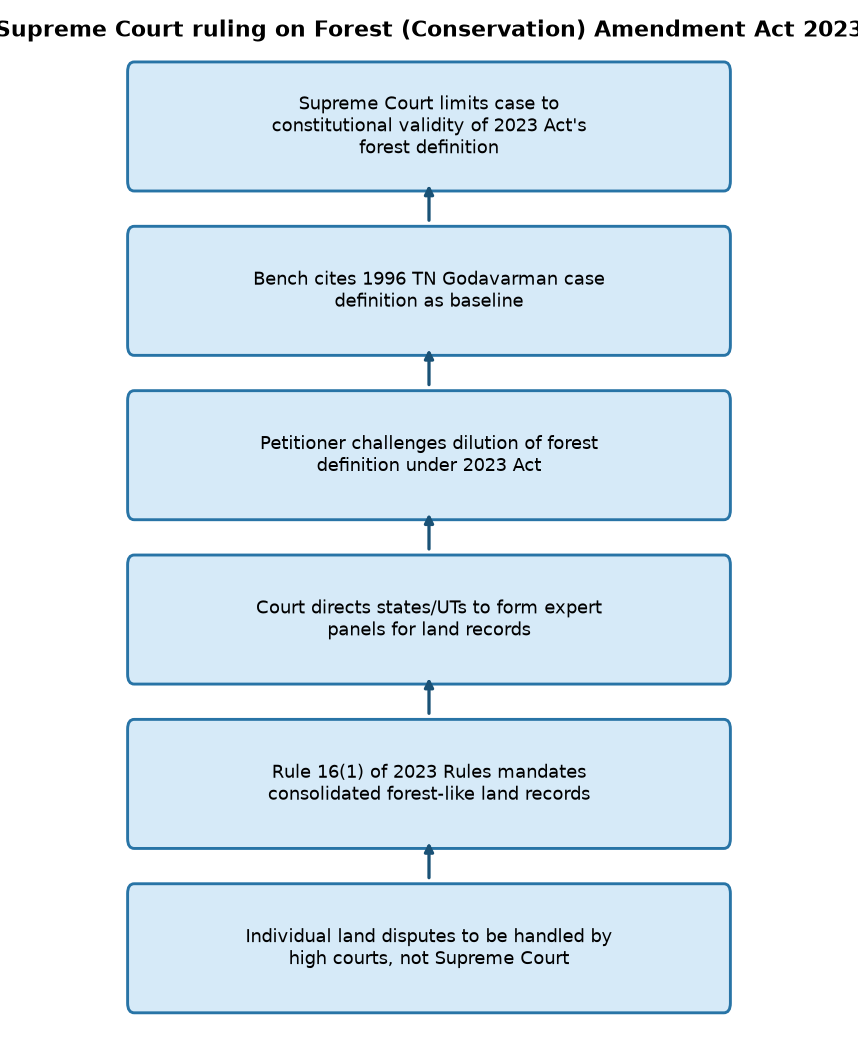
Forest (Conservation) Amendment Act, 2023 introduces a new definition of ‘forest’ → Retired forest officer challenges the Act’s definition as unconstitutional (diluting TN Godavarman precedent) → Supreme Court limits scope to constitutional validity of the definition → Court directs states/UTs to constitute expert panels for land-record consolidation (Rule 16(1)) → High Courts adjudicate individual land disputes; Supreme Court refers specific cases (e.g., Tamil Nadu 59-acre land) → Potential outcomes: Act’s definition upheld, struck down, or amended; land records updated; forest conservation strengthened
Prelims Practice Questions
Q1. Consider the following statements regarding the Forest (Conservation) Amendment Act, 2023:
1. The Act restricts the definition of forests to only those lands recorded as forests in government records.
2. The Act mandates all states and Union territories to constitute an expert panel for preparing a consolidated record of forest-like areas.
3. The Act excludes private forests from the ambit of the Forest (Conservation) Act, 1980.
4. The Act empowers the Supreme Court to adjudicate disputes related to individual parcels of forest land.
How many of the above statements are correct?
- Only one
- Only two
- Only three
- All four
Answer: Only three — Statement 1 is correct: The Act restricts the definition of forests to recorded lands. Statement 2 is correct: Rule 16(1) mandates the constitution of expert panels. Statement 3 is incorrect: Private forests are not explicitly excluded; the Act applies to forest-like areas. Statement 4 is incorrect: The Supreme Court has limited its role to constitutional validity, leaving individual disputes to High Courts.
Q2. Assertion (A): The Supreme Court in the T.N. Godavarman case (1996) held that the definition of forest must be understood in the dictionary sense, not restricted to government records.
Reason (R): The Forest (Conservation) Amendment Act, 2023 aligns with the T.N. Godavarman judgment by expanding the definition of forests to include all forest-like areas.
Options:
A. Both A and R are true, and R is the correct explanation of A.
B. Both A and R are true, but R is not the correct explanation of A.
C. A is true, but R is false.
D. A is false, but R is true.
Answer: ? — Assertion (A) is true: The T.N. Godavarman case (1996) held that the definition of forest must be understood in the dictionary sense. Reason (R) is false: The 2023 Amendment Act restricts the definition to recorded lands, contradicting the judgment.
Q3. Match the following provisions with their respective legal instruments:
Column I (Provision)
A. Definition of forests in dictionary sense
B. Mandate for expert panel to prepare consolidated record of forest-like areas
C. Exclusion of private forests from Forest (Conservation) Act, 1980
D. Supreme Court’s jurisdiction over forest disputes
Column II (Legal Instrument)
1. Forest (Conservation) Amendment Act, 2023
2. Rule 16(1) of Forest Rules, 2023
3. T.N. Godavarman case (1996)
4. Forest (Conservation) Act, 1980
Options:
A. A-3, B-2, C-1, D-4
B. A-3, B-2, C-4, D-1
C. A-2, B-3, C-1, D-4
D. A-1, B-4, C-2, D-3
Answer: ? — A matches with 3 (T.N. Godavarman case). B matches with 2 (Rule 16(1)). C matches with 4 (Forest Act, 1980 excludes private forests). D matches with 1 (Supreme Court’s jurisdiction is limited to constitutional validity under the 2023 Act).
Mains Practice Question
✍ The Supreme Court, in its recent order, has confined its examination to the constitutional validity of the definition of forests under the Forest (Conservation) Amendment Act, 2023, while directing disputes over individual parcels of land to High Courts. Critically examine the implications of this judicial approach on forest governance, environmental jurisprudence, and the balance of powers between the judiciary and the legislature. (15 Marks)
Approach: MODEL-ANSWER SKELETON:
1. **Introduction (2 marks)**:
– Briefly state the Supreme Court’s order and its rationale: limiting judicial review to constitutional validity of the 2023 Act’s definition of forests, while delegating land-specific disputes to High Courts.
– Contextualise with the T.N. Godavarman case (1996) and the Forest (Conservation) Act, 1980.
2. **Judicial Deference to Legislature (3 marks)**:
– Explain the principle of judicial deference to parliamentary legislation under constitutional democracy (e.g., *Kesavananda Bharati v. State of Kerala*, 1973).
– Discuss how the Court respects Parliament’s power to define terms, even while reviewing their constitutional validity.
– Reference: Supreme Court’s observation that Parliament has the domain to define ‘forest’ under the 2023 Act.
3. **Environmental Jurisprudence and Forest Definition (4 marks)**:
– Contrast the dictionary definition of forests (T.N. Godavarman) with the restricted definition in the 2023 Act (Section 1A, recorded lands only).
– Discuss the implications for environmental protection: loss of forest-like areas (denuded forests, private forests) to compensatory afforestation.
– Reference: Rule 16(1) mandate for expert panels to prepare consolidated records of forest-like areas.
4. **Balance of Powers: Judiciary vs. Legislature (3 marks)**:
– Analyse the Court’s approach as a pragmatic division of labour: constitutional validity (Supreme Court) vs. factual disputes (High Courts).
– Discuss the rationale for referring land-specific disputes to High Courts (e.g., historical use, geographical location).
– Reference: Supreme Court’s referral of the 59-acre Tamil Nadu land dispute to the Madras High Court.
5. **Critique and Challenges (3 marks)**:
– Critically examine the potential drawbacks: fragmentation of forest governance, inconsistent application across states, and delays in High Court adjudication.
– Discuss the role of the Central Empowered Committee (CEC) in resolving disputes (e.g., Maharashtra zoo case).
– Conclude with a balanced view: the approach ensures constitutional scrutiny while acknowledging institutional limitations.
Source: orissapost.com
Generated by AanyaAi for educational purpose.
Related guides on our sites
- Current affairs for upsc 2026
- Best PSIR optional coaching for upsc
- Best Law optional coaching for upsc
- Best PSIR optional teacher for upsc

- पीएम मोदी और ट्रंप ने भारत-अमेरिका संबंधों पर चर्चा की - September 30, 2026
- Cabinet approves ITMS for Delhi: Smart Traffic to cut jams & boost safety - September 30, 2026
- आईआईएससी शीर्ष पर, ऑक्सफोर्ड बना रहा दुनिया में नंबर वन: थी विश्व रैंकिंग 2027 - September 30, 2026

No Comments