


23 Sep Supreme Court Slams Rajasthan Over Forest Ranger’s Death, Demands Action on Illegal Mining
✎ Illegal mining in India is a multi-dimensional challenge involving organized crime, environmental degradation, and weak enforcement of forest and environmental laws; judicial activism, such as the Supreme Court’s recent…
Subject Relevance — Where This Topic Fits
- GS Paper II — Governance, Constitution, Polity, Social Justice and International Relations (Environmental Governance) | GS Paper III — Environment, Disaster Management, and Economic Development (Illegal Mining, Environmental Crimes)
- Prelims: Illegal mining, Forest (Conservation) Act 1980, Scheduled Castes and Scheduled Tribes (Prevention of Atrocities) Act 1989, National Green Tribunal (NGT), Environmental Impact Assessment (EIA) Notification 2006, preventive detention, Forest Rights Act 2006, Wildlife Protection Act 1972
- Essay: Environmental governance and judicial activism in India, Balancing economic development with ecological sustainability
Quick Revision: Illegal mining in India is a multi-dimensional challenge involving organized crime, environmental degradation, and weak enforcement of forest and environmental laws; judicial activism, such as the Supreme Court’s recent directives, underscores the need for systemic reforms in governance and institutional capacity.
Why is this in the news?
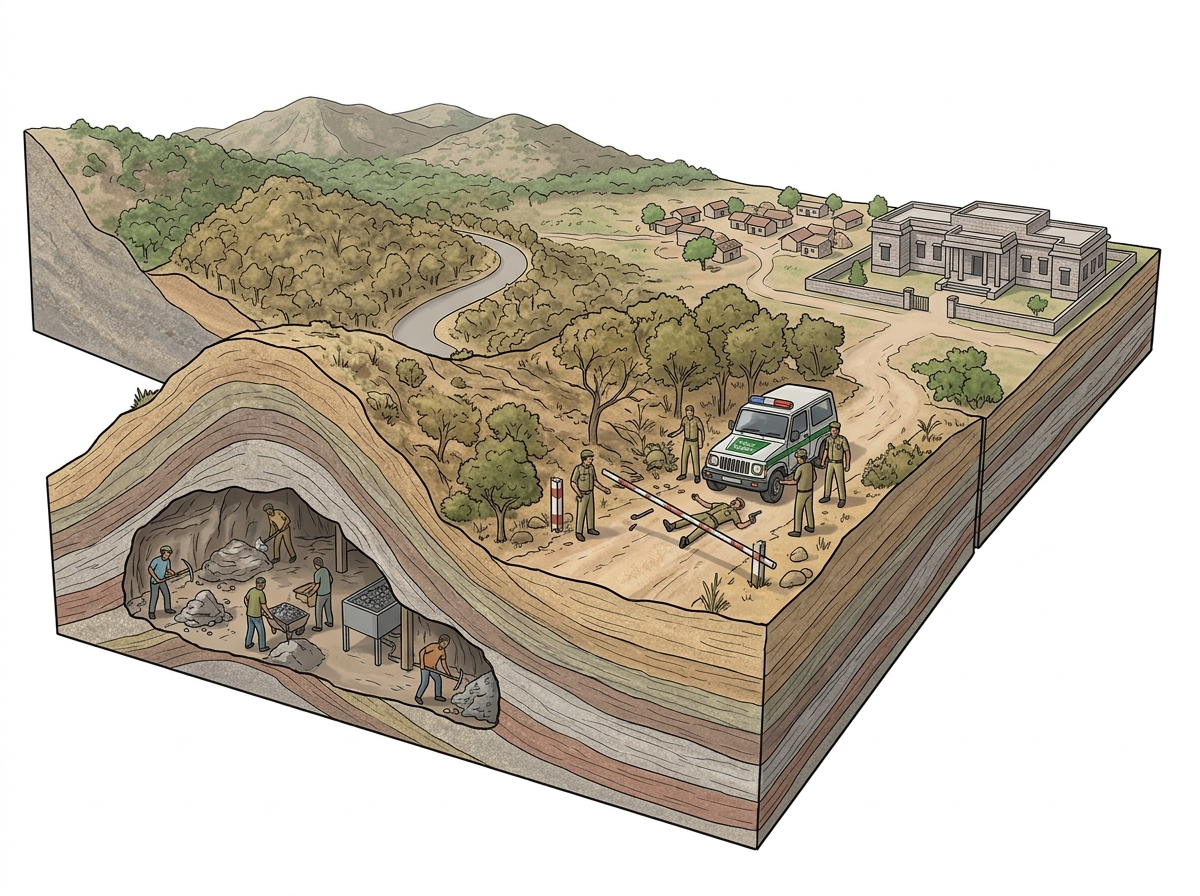
The Supreme Court of India, while hearing a case involving the death of a Forest Ranger in Pratapgarh, Rajasthan, directed the state government to submit a detailed report on the incident and emphasized the need for stringent measures, including preventive detention, against illegal mining and associated organized crime. The Court highlighted the nexus between illegal mining and organized crime, underscoring the inadequacy of routine legal processes in addressing such systemic threats to environmental governance and public safety.
Background
- Illegal mining in India is a pervasive issue, often linked to organized crime, corruption, and environmental degradation, particularly in mineral-rich states like Rajasthan, Jharkhand, and Odisha.
- Forest officials and law enforcement personnel frequently face threats, intimidation, or fatal attacks while attempting to curb illegal mining activities, as highlighted by multiple incidents reported across the country.
- The Wildlife Protection Act, 1972, provide legal frameworks for the protection of forests and wildlife, but enforcement remains a challenge due to systemic gaps and local resistance.
- The National Green Tribunal (NGT) was established in 2010 to address environmental disputes and enforce environmental laws, yet its directives are often delayed or poorly implemented at the ground level.
- Preventive detention laws, such as those under the National Security Act, 1980, or state-specific Public Security Acts, are occasionally invoked to curb organized crime but are controversial due to their potential for misuse and violation of civil liberties.
- The Supreme Court has, on multiple occasions, intervened in cases of illegal mining to direct state governments to take stringent action, reflecting judicial activism in environmental governance.
What is Illegal Mining and Its Governance Framework?
- Illegal mining refers to the extraction of minerals or resources without proper legal authorization, often in violation of environmental laws, forest rights, or mining regulations.
- In India, illegal mining is governed by multiple legislations, including the Mines and Minerals (Development and Regulation) Act, 1957, the Forest (Conservation) Act, 1980, and the Environmental Protection Act, 1986, alongside state-specific rules.
- The nexus between illegal mining and organized crime involves syndicates that operate with impunity, often using violence to intimidate officials, local communities, and law enforcement personnel.
- Forest Rangers and other forest officials are tasked with monitoring and preventing illegal activities within protected areas, but their efforts are frequently obstructed by vested interests and systemic corruption.
- Preventive detention, while a tool for immediate control, is a contentious measure that must balance the need for public safety with constitutional safeguards against arbitrary detention.
- The Environmental Impact Assessment (EIA) Notification, 2006, mandates prior environmental clearance for mining projects, but loopholes and delayed clearances often facilitate illegal operations.
- Judicial interventions, such as those by the Supreme Court or the National Green Tribunal, play a critical role in directing state action, but implementation gaps persist due to weak institutional capacity and political interference.
- Community participation, particularly of forest-dwelling tribes under the Forest Rights Act, 2006, is essential for monitoring and reporting illegal activities, yet their rights are often overlooked in favor of extractive industries.
Key Features
| Feature | Significance |
|---|---|
| Supreme Court intervention in illegal mining | Demonstrates judicial oversight of executive action in environmental governance and reinforces the principle of judicial activism in public interest litigation. |
| Demand for preventive detention measures | Highlights the judiciary’s recognition of organised crime linkages in illegal mining and the need for stringent preventive actions beyond routine legal procedures. |
| Forest Ranger’s death in line of duty | Underscores the risks faced by forest officials in enforcing environmental laws and the human cost of illegal resource extraction. |
| State government accountability | Emphasises the constitutional obligation of state governments to protect forest and environmental resources under Article 48A and the Forest (Conservation) Act, 1980. |
| Organised crime nexus with illegal mining | Illustrates the convergence of environmental crime with organised criminal networks, necessitating multi-agency coordination for effective enforcement. |
Why it Matters
Environmental Governance
- Illegal mining disrupts ecological balance, causes soil erosion, and contaminates water bodies, violating the constitutional mandate under Article 48A to protect and improve the environment.
- Forest officials act as frontline enforcers; their safety is integral to effective environmental governance and compliance with the Forest (Conservation) Act, 1980.
- Judicial intervention ensures that environmental laws are not rendered ineffective due to administrative inaction or collusion.
Judicial Activism & Public Interest Litigation
- The Supreme Court’s suo motu or triggered intervention in this case exemplifies the role of PIL in addressing systemic failures in governance, particularly in environmental protection.
- The directive to submit a detailed report and consider preventive detention reflects judicial scrutiny of executive inaction in combating organised environmental crime.
- Such interventions strengthen the doctrine of judicial review over administrative discretion in matters of public interest.
Organised Crime & National Security
- Illegal mining often funds organised crime and anti-national activities, posing a dual threat to environmental integrity and internal security.
- The nexus between illegal mining and organised crime necessitates coordinated action by forest, police, and revenue departments under the Unlawful Activities (Prevention) Act, 1967, where applicable.
- Preventive detention, while contentious, may be considered under stringent conditions to disrupt criminal networks engaged in environmental crimes.
Constitutional & Legal Framework
- The incident falls under the ambit of the Forest (Conservation) Act, 1980, which mandates prior approval for diversion of forest land and penalises illegal activities.
- The constitutional duty of the State under Article 48A and Article 51A(g) to protect and improve the environment is directly implicated.
- The Forest Rights Act, 2006, also provides safeguards for forest dwellers, which must be balanced with enforcement against illegal mining.
Challenges
1. Weak Enforcement of Environmental Laws
- Administrative apathy and corruption often dilute the implementation of the Forest (Conservation) Act, 1980, and the Environment Protection Act, 1986.
- Lack of inter-departmental coordination between forest, police, and revenue authorities hampers effective crackdown on illegal mining.
- Inadequate technological monitoring (e.g., satellite imagery, drones) delays detection and response to illegal mining activities.
UPSC Link: Forest Conservation Act, 1980
2. Organised Crime Nexus in Illegal Mining
- Illegal mining is frequently controlled by organised criminal syndicates with political and bureaucratic linkages, making enforcement challenging.
- Use of heavy machinery (e.g., JCBs, dumpers) and armed guards by miners escalates violence against enforcement officials.
- Proceeds from illegal mining fund other criminal activities, including smuggling and terrorism, exacerbating internal security threats.
UPSC Link: Organised Crime
3. Safety of Forest Officials
- Forest officials operate in remote and hostile terrains with limited protection, exposing them to threats from illegal miners and organised crime.
- Inadequate training and equipment for forest staff in handling confrontational situations further endanger their lives.
- Lack of witness protection mechanisms discourages officials from reporting threats or participating in investigations.
UPSC Link: Forest Rights Act, 2006
4. Judicial-Executive Balance in Environmental Governance
- Excessive judicial intervention may undermine executive autonomy in policy implementation, while insufficient oversight risks environmental degradation.
- The judiciary’s role in directing preventive detention must balance individual liberties under Article 21 with the need for deterrence.
- Ensuring compliance with judicial directives requires sustained monitoring and follow-up by the Supreme Court.
UPSC Link: Judicial Activism
5. Balancing Development and Environmental Protection
- States often prioritise revenue generation from mining over ecological sustainability, leading to policy contradictions.
- The National Mineral Policy, 2019, aims to balance mining-led growth with environmental safeguards, but implementation remains inconsistent.
- Community participation in monitoring illegal mining (e.g., through gram sabhas) is often underutilised due to lack of awareness or political will.
UPSC Link: National Mineral Policy, 2019
Challenges — UPSC Perspective
| Issue | Concern |
|---|---|
| Administrative apathy in enforcement | Delays in investigation, weak prosecution, and collusion with illegal miners undermine environmental laws. |
| Organised crime linkages | Mining activities are controlled by syndicates with political and bureaucratic protection, complicating enforcement. |
| Technological gaps in monitoring | Inadequate use of satellite imagery, drones, and AI-based surveillance delays detection of illegal mining. |
| Safety of enforcement officials | Forest rangers and police face threats, lack protective gear, and operate without witness protection. |
| Judicial-executive friction | Excessive judicial directives may encroach on executive autonomy, while weak oversight risks environmental harm. |
| Policy contradictions in development vs. environment | States prioritise mining revenue over ecological sustainability, leading to policy incoherence. |
Way Forward
- Constitute a multi-departmental task force (forest, police, revenue, and intelligence) to investigate organised crime linkages in illegal mining in Pratapgarh and similar hotspots.
- Deploy advanced surveillance technologies (drones, satellite imagery) for real-time monitoring of mining activities in ecologically sensitive zones.
- Strengthen witness protection mechanisms and provide armed escorts for forest officials during high-risk operations.
- Conduct mandatory training for forest staff on handling confrontational situations, legal provisions, and use of force under the Indian Penal Code.
- Enforce strict compliance with the Forest (Conservation) Act, 1980, by mandating prior approval for any land diversion and penalising violations with heavy fines and imprisonment.
- Promote community-based monitoring through gram sabhas and local NGOs to report illegal mining activities, with incentives for whistle-blowers.
- Review and rationalise mining policies to align with the National Mineral Policy, 2019, ensuring ecological sustainability alongside economic growth.
- Ensure timely submission of compliance reports to the Supreme Court and follow up on directives to demonstrate executive accountability.
UPSC Value Addition
Keywords for Mains Answer-Writing
Supreme Court directions on illegal mining · Forest Ranger safety and duties · Preventive detention under law · Organised crime and illegal mineral extraction · Constitutional remedies for civil servants’ protection · Environmental governance and judicial activism · Forest Conservation Act 1980 · Mines and Minerals (Development and Regulation) Act 1957 · Article 32 of the Constitution · Judicial review of executive inaction · Sustainable development and mineral governance · Criminalisation of illegal mining · Forest officials’ statutory powers · Judicial activism in environmental governance
Constitutional & Policy Linkages
- Article 48A – Duty of the State to protect and improve the environment
- Article 51A(g) – Fundamental duty of citizens to protect and improve the natural environment
- Article 21 – Right to life and personal liberty (includes right to a healthy environment)
Concept Flow
Illegal mining in ecologically sensitive areas → Environmental degradation and revenue loss → Forest Ranger’s intervention to enforce Forest (Conservation) Act, 1980 → Confrontation with organised crime syndicates → Fatal attack on Forest Ranger → Supreme Court intervention via PIL → Demand for executive accountability and preventive measures → Judicial directives for strict action → State government report submission → Multi-agency enforcement and monitoring
Prelims Practice Questions
Q1. Consider the following statements regarding the legal framework governing illegal mining in India:
1. The Forest Conservation Act, 1980, empowers the Central Government to prohibit the de-reservation of forest lands for mining activities.
2. The Mines and Minerals (Development and Regulation) Act, 1957, vests the State Governments with the authority to grant mineral concessions.
3. The Supreme Court, under Article 32 of the Constitution, can issue directions to State Governments for enforcement of fundamental rights.
4. Preventive detention laws in India are governed exclusively by the National Security Act, 1980, and no other legislation.
How many of the above statements are correct?
- Only one
- Only two
- Only three
- All four
Answer: Only three — Statements 1, 2, and 3 are correct. Statement 4 is incorrect as preventive detention laws include multiple statutes such as the Conservation of Foreign Exchange and Prevention of Smuggling Activities Act, 1974, and state-specific laws, not exclusively the National Security Act, 1980.
Q2. Assertion (A): The Supreme Court of India, under Article 32, can direct State Governments to take preventive detention action against organised crime syndicates involved in illegal mining.
Reason (R): Preventive detention is a constitutional remedy available to the Court to curb activities threatening public order and safety, subject to procedural safeguards.
In the context of the above Assertion and Reason, select the correct code:
A. Both A and R are individually true, and R is the correct explanation of A.
B. Both A and R are individually true, but R is not the correct explanation of A.
C. A is true but R is false.
D. A is false but R is true.
- A
- B
- C
- D
Answer: B — Both Assertion (A) and Reason (R) are true. The Supreme Court can issue directions under Article 32 for preventive detention in cases threatening public order, provided such action complies with constitutional safeguards like Article 22. However, preventive detention is not a remedy exclusive to the Court but a statutory power exercisable by authorities under law.
Q3. Match the following legal provisions with their respective objectives in the context of illegal mining and environmental governance:
Column I (Legal Provision)
A. Forest Conservation Act, 1980
B. Mines and Minerals (Development and Regulation) Act, 1957
C. Article 32 of the Constitution
D. Environmental Protection Act, 1986
Column II (Objective)
1. Regulation of mineral concessions and mining leases
2. Protection and conservation of forests from diversion for non-forestry purposes
3. Enforcement of fundamental rights through judicial directions
4. Prevention of pollution and protection of the environment
Select the correct match:
- A-2, B-1, C-3, D-4
- A-1, B-2, C-3, D-4
- A-4, B-1, C-2, D-3
- A-3, B-4, C-1, D-2
Answer: A-2, B-1, C-3, D-4 — The correct match is: A-2 (Forest Conservation Act, 1980: Protection and conservation of forests), B-1 (Mines and Minerals Act, 1957: Regulation of mineral concessions), C-3 (Article 32: Enforcement of fundamental rights through judicial directions), and D-4 (Environmental Protection Act, 1986: Prevention of pollution and environmental protection).
Mains Practice Question
✍ Illegal mining, often linked with organised crime, poses a severe threat to environmental governance, public safety, and the rule of law in India. In this context, critically examine the constitutional and statutory framework available to protect forest officials and curb illegal mining activities. Also, discuss the judicial role in ensuring accountability of the executive in such cases. (15 Marks)
Approach: MODEL-ANSWER SKELETON:
1. **Constitutional and Statutory Framework for Protection of Forest Officials and Curbing Illegal Mining:**
– **Forest Conservation Act, 1980:** Prohibits diversion of forest land for non-forestry purposes without prior approval of the Central Government. Highlight the role of forest officials under this Act (Section 2, 3, and 3A).
– **Mines and Minerals (Development and Regulation) Act, 1957:** Governs the grant of mineral concessions and mining leases. Discuss the powers of State Governments (Section 13) and the role of District Mineral Foundations (DMFs) under Section 9B for local area development.
– **Environmental Protection Act, 1986:** Provides for the prevention and control of environmental pollution (Section 3 and 5). Discuss the role of State Pollution Control Boards.
– **Indian Forest Act, 1927:** Defines forest offences and empowers forest officials to take action against illegal activities (Section 52-66A).
– **Preventive Detention Laws:** Discuss the constitutional basis (Article 22) and statutory frameworks like the Conservation of Foreign Exchange and Prevention of Smuggling Activities Act, 1974 (COFEPOSA), and state-specific laws. Emphasise the need for procedural safeguards.
2. **Judicial Role in Ensuring Accountability:**
– **Article 32 and 226 of the Constitution:** Discuss the Supreme Court and High Courts’ power to issue writs (habeas corpus, mandamus, prohibition, certiorari, quo warranto) for enforcement of fundamental rights and against executive inaction.
– **Judicial Activism in Environmental Governance:** Cite landmark cases such as:
– *T.N. Godavarman Thirumulpad v. Union of India* (1996) – Directions for protection of forests.
– *Samir Mehta v. Union of India* (2019) – Directions for curbing illegal mining in Aravalli hills.
– *Common Cause v. Union of India* (2018) – Directions for implementation of the Forest Rights Act, 2006.
– **Supreme Court’s Recent Directions:** Discuss the significance of the Supreme Court’s intervention in the Pratapgarh case, including the demand for a detailed report from the State Government and directions for strict action against illegal mining.
3. **Challenges and Gaps:**
– **Executive Inaction:** Discuss the challenges in implementation due to lack of coordination between forest, mining, and police departments.
– **Political Economy of Mining:** Highlight the nexus between politicians, bureaucracy, and mining mafia, which hampers effective enforcement.
– **Judicial Overreach vs. Separation of Powers:** Critically examine the balance between judicial activism and the doctrine of separation of powers.
4. **Way Forward:**
– Strengthening of forest and mining departments with adequate manpower and technology.
– Implementation of the National Mineral Policy, 2019, and the Forest Policy, 1988.
– Use of technology (satellite imagery, drones) for real-time monitoring of illegal mining.
– Sensitisation and protection of forest officials through legal and institutional safeguards.
Source: amarujala.com
Generated by AanyaAi for educational purpose.
Related guides on our sites
- Current affairs for upsc 2026
- Best PSIR optional coaching for upsc
- Best economics optional coaching for upsc
- Best PSIR optional teacher for upsc

- अरुणाचल में सियांग मेगा बाँध सर्वेक्षण के लिए कैबिनेट ने किया पैनल का गठन - September 24, 2026
- Arunachal Cabinet Forms Panel for Siang Mega Dam Survey: Key Facts for UPSC - September 24, 2026
- सुप्रीम कोर्ट का ‘अंपायर’ वाला फैसला: चुनाव आयोग मामले में न्यायमूर्ति दत्ता की भूमिका - September 24, 2026

No Comments