


23 Sep Supreme Court Split Verdict on CEC, EC Appointment Law: Key UPSC Analysis
✎ The *Anoop Baranwal* case (2023) established that the appointment of the CEC and ECs must be insulated from exclusive executive control to ensure free and fair elections, and the 2023 Act’s selection committee composition is now…
Subject Relevance — Where This Topic Fits
- GS Paper II — Polity and Governance | GS Paper II — Constitutional Framework
- Prelims: Election Commission of India (ECI), Article 324, Chief Election Commissioner (CEC), Election Commissioners (ECs), Anoop Baranwal case, constitutional amendments, judicial review, separation of powers, doctrine of basic structure
- Essay: Role of the Election Commission in ensuring free and fair elections, Judicial activism vs. legislative competence in constitutional governance
Quick Revision: The *Anoop Baranwal* case (2023) established that the appointment of the CEC and ECs must be insulated from exclusive executive control to ensure free and fair elections, and the 2023 Act’s selection committee composition is now under judicial scrutiny for its neutrality.
Why is this in the news?
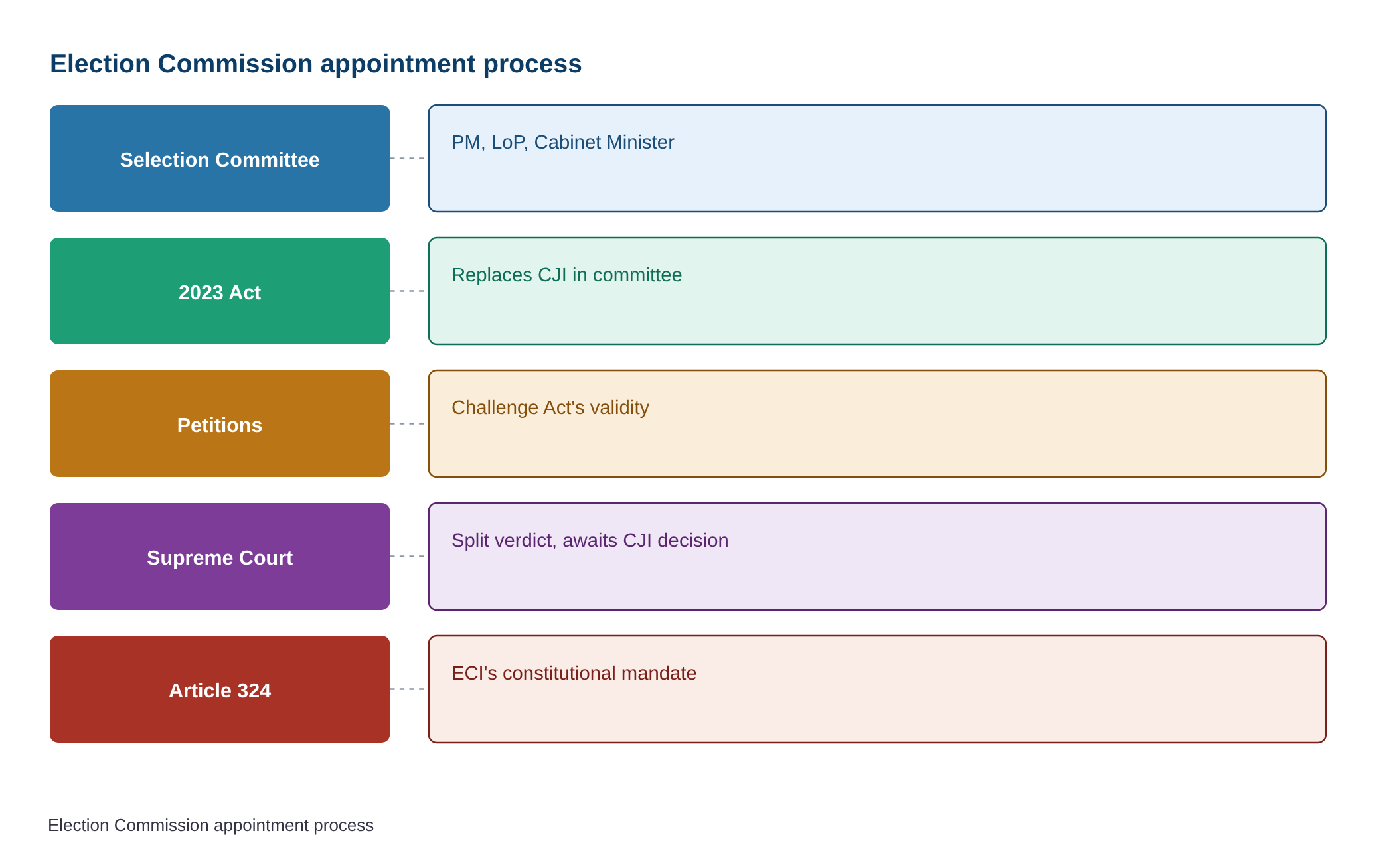
The Act prescribes a selection committee comprising the Prime Minister, the Leader of Opposition in the Lok Sabha, and a Union Cabinet Minister nominated by the Prime Minister for appointing the CEC and ECs. While one judge opined that the issue was already settled by the Anoop Baranwal case (2023), the other held that the question raised a substantial constitutional issue requiring reference to a Constitution Bench. The matter now awaits the Chief Justice of India’s decision on constituting a larger Bench.
Background
- The Election Commission of India (ECI) is a constitutional body mandated under Article 324 to supervise and conduct free and fair elections in India.
- The appointment of the Chief Election Commissioner (CEC) and Election Commissioners (ECs) has historically been subject to executive discretion, raising concerns about independence from political control.
- In the case of *Anoop Baranwal v. Union of India* (2023), the Supreme Court, in a landmark judgment, held that the appointment process for the CEC and ECs must be insulated from exclusive executive control to ensure the integrity of elections.
- The *Chief Election Commissioner and Election Commissioners (Appointment, Conditions of Service and Term of Office) Act, 2023* was subsequently enacted, replacing the CJI with a Union Cabinet Minister nominated by the Prime Minister in the selection committee.
- The present split verdict arises from petitions challenging the constitutional validity of the 2023 Act, arguing that it undermines the independence of the ECI by reintroducing executive dominance in appointments.
What is the Chief Election Commissioner and Election Commissioners (Appointment, Conditions of Service and Term of Office) Act, 2023?
- The Act was enacted in 2023 to regulate the appointment, conditions of service, and term of office of the Chief Election Commissioner (CEC) and Election Commissioners (ECs).
- The selection committee for appointments consists of the Prime Minister, the Leader of Opposition in the Lok Sabha, and a Union Cabinet Minister nominated by the Prime Minister.
- The Act replaced the Chief Justice of India (CJI) with a nominated Cabinet Minister in the selection committee, a change contested for potentially reducing the neutrality of the appointment process.
- The Act prescribes a term of six years for the CEC and ECs or until they attain the age of 65 years, whichever is earlier.
- The Act also specifies the conditions of service, including salaries, allowances, and other privileges, for the CEC and ECs.
- The Act aims to provide a statutory framework for appointments, addressing concerns raised by the Supreme Court in the *Anoop Baranwal* case regarding executive dominance.
- The Act does not alter the constitutional status of the ECI, which remains an autonomous body under Article 324 of the Constitution.
- The Act has been challenged on the grounds that it compromises the independence of the ECI by reintroducing executive influence in the appointment process.
Key Features
| Feature | Significance |
|---|---|
| Split verdict of the Supreme Court | Creates a precedent for intra-court disagreement on constitutional interpretation, necessitating resolution by a larger bench. |
| Appointment mechanism under the CEC and ECs (Appointment, Conditions of Service and Term of Office) Act, 2023 | Establishes a selection committee comprising the Prime Minister, Leader of Opposition in Lok Sabha, and a Union Cabinet Minister nominated by the Prime Minister. |
| Reference to Chief Justice of India (CJI) for Constitution Bench formation | Demonstrates the judicial hierarchy’s mechanism for resolving conflicting judicial opinions on constitutional matters. |
| Anoop Baranwal case (2023) judgment | Provides the foundational judicial precedent on the independence of the Election Commission of India (ECI) from executive control. |
| Doctrine of collective responsibility in cabinet governance | Highlights the constitutional principle that ministers are bound by collective decisions of the council of ministers. |
Why it Matters
Institutional
- The split verdict underscores the judiciary’s role in safeguarding constitutional principles, particularly the independence of constitutional bodies like the Election Commission of India (ECI).
- It reaffirms the Supreme Court’s authority to interpret constitutional provisions related to appointments to high constitutional offices.
- The case may lead to a definitive judicial pronouncement on the balance between executive prerogative and institutional independence in appointments to the ECI.
Constitutional
- The matter revolves around the interpretation of Article 324 of the Constitution, which vests the superintendence, direction, and control of elections in the ECI.
- The case tests the boundaries of parliamentary sovereignty versus judicial oversight in matters concerning constitutional bodies.
- It examines the extent to which the doctrine of separation of powers applies to the appointment process of constitutional authorities.
Democratic
- The appointment process of the CEC and ECs is critical to ensuring the integrity and credibility of electoral processes in India.
- A neutral and independent selection mechanism is essential for maintaining public trust in the ECI’s impartiality.
- The case highlights the tension between political accountability and institutional autonomy in democratic governance.
Challenges
1. Ensuring neutrality in the selection committee
- The inclusion of a Union Cabinet Minister nominated by the Prime Minister may introduce a perception of bias, as the Minister’s allegiance to the Prime Minister could undermine the committee’s neutrality.
- The doctrine of collective responsibility may prevent the nominated Minister from acting independently, raising concerns about the committee’s objectivity.
- The absence of a neutral constitutional authority (e.g., Chief Justice of India) in the selection committee could weaken the ECI’s independence from executive influence.
UPSC Link: GS-II: Constitutional and Non-Constitutional Bodies
2. Balancing parliamentary sovereignty and judicial oversight
- Parliament’s authority to legislate on the appointment process must be balanced against the judiciary’s role in ensuring constitutional compliance.
- The case tests whether the judiciary can intervene in matters deemed to be within the exclusive domain of the legislature.
- A definitive ruling could either reinforce parliamentary supremacy or expand judicial review over legislative processes.
UPSC Link: GS-II: Separation of Powers
3. Maintaining public trust in the ECI
- Perceived or actual lack of independence in the ECI’s appointment process could erode public confidence in the electoral system.
- The ECI’s credibility is vital for the conduct of free and fair elections, which are the cornerstone of Indian democracy.
- Any ambiguity in the appointment process may lead to political controversies, further undermining trust in the institution.
UPSC Link: GS-II: Constitutional and Non-Constitutional Bodies
4. Resolving intra-court disagreements on constitutional interpretation
- Split verdicts create legal uncertainty and necessitate resolution by a larger bench to ensure consistency in judicial pronouncements.
- The case highlights the need for a clear judicial framework to address conflicts between constitutional principles and statutory provisions.
- A definitive ruling will provide clarity on the interpretation of Article 324 and related constitutional provisions.
UPSC Link: GS-II: Judiciary and Constitutional Framework
Challenges — UPSC Perspective
| Issue | Concern |
|---|---|
| Perceived bias in the selection committee | The inclusion of a nominated Cabinet Minister may compromise the neutrality of the appointment process. |
| Lack of a neutral constitutional authority in the committee | Exclusion of the Chief Justice of India (CJI) could weaken the ECI’s independence from executive control. |
| Judicial vs. legislative authority in appointments | The case tests the boundaries of parliamentary sovereignty and judicial oversight in constitutional appointments. |
| Doctrine of collective responsibility | May prevent the nominated Minister from acting independently, raising concerns about objectivity. |
| Public trust in the ECI | Any ambiguity in the appointment process could erode confidence in the electoral system. |
| Legal uncertainty due to split verdict | Intra-court disagreement necessitates resolution by a larger bench to ensure consistency in judicial interpretation. |
Way Forward
- The Chief Justice of India (CJI) should constitute a Constitution Bench of appropriate strength to resolve the split verdict and provide a definitive judicial pronouncement on the constitutional validity of the appointment process.
- Parliament may consider amending the CEC and ECs (Appointment, Conditions of Service and Term of Office) Act, 2023 to include a neutral constitutional authority (e.g., Chief Justice of India) in the selection committee to enhance the ECI’s independence.
- The judiciary should clarify the extent of its oversight over legislative processes in matters concerning constitutional bodies to ensure a balanced separation of powers.
- The Election Commission of India (ECI) should proactively communicate the rationale behind its appointment process to the public to maintain transparency and trust.
- Civil society and legal experts should engage in public discourse to highlight the importance of an independent ECI for democratic governance.
- The government should ensure that the selection committee operates with the highest standards of neutrality and objectivity to uphold the integrity of the appointment process.
- Future judicial appointments to constitutional bodies should be guided by a clear and transparent framework to prevent legal ambiguities.
UPSC Value Addition
Keywords for Mains Answer-Writing
Election Commission of India · Chief Election Commissioner · Appointment mechanism · Constitution Bench · Anoop Baranwal case · free and fair elections · executive control · selection committee · Article 324 · doctrine of basic structure · institutional independence · constitutional interpretation
Constitutional & Policy Linkages
- {‘Article 324 of the Constitution of India (Superintendence, direction and control of elections vested in the Election Commission of India)’: “Core constitutional provision governing the ECI’s mandate.”}
Concept Flow
Constitutional provision (Article 324) vests superintendence of elections in the ECI → Parliament enacts the CEC and ECs (Appointment, Conditions of Service and Term of Office) Act, 2023, establishing a selection committee → Petitions challenge the constitutional validity of the Act, citing lack of neutrality → Supreme Court delivers a split verdict on the referral to a Constitution Bench → Chief Justice of India (CJI) considers forming a larger bench to resolve the disagreement → Resolution of the split verdict will determine the balance between executive prerogative and institutional independence → Final ruling will influence the ECI’s credibility and the integrity of India’s electoral system.
Prelims Practice Questions
Q1. Consider the following statements regarding the appointment of the Chief Election Commissioner (CEC) and Election Commissioners (ECs) in India:
1. The Chief Election Commissioner and Election Commissioners are appointed by the President of India.
2. The selection committee for their appointment consists of the Prime Minister, the Leader of Opposition in the Lok Sabha, and a Union Cabinet Minister nominated by the Prime Minister.
3. The Supreme Court, in the Anoop Baranwal case, held that the inclusion of the Chief Justice of India (CJI) in the selection committee is binding.
4. The doctrine of basic structure of the Constitution ensures the independence of the Election Commission of India (ECI).
How many of the above statements are correct?
- Only one
- Only two
- Only three
- All four
Answer: Only three — Statements 1, 2, and 4 are correct. Statement 3 is incorrect as the Supreme Court in the Anoop Baranwal case did not hold that the inclusion of the CJI is binding; it merely noted the arrangement as transient.
Q2. Assertion (A): The Election Commission of India (ECI) is a constitutional body.
Reason (R): Article 324 of the Constitution vests the superintendence, direction, and control of elections in the ECI.
- Both A and R are true, and R is the correct explanation of A
- Both A and R are true, but R is not the correct explanation of A
- A is true but R is false
- A is false but R is true
Answer: Both A and R are true, but R is not the correct explanation of A — Both the assertion and reason are true, and the reason correctly explains the assertion as Article 324 explicitly establishes the ECI as a constitutional body with superintendence over elections.
Q3. Match the following provisions with their respective constitutional articles:
Column I
1. Appointment of CEC and ECs
2. Superintendence, direction and control of elections
3. Term of office of CEC and ECs
4. Removal of CEC and ECs
Column II
A. Article 324
B. Article 324(5)
C. Article 324(2)
D. Article 324(4)
Select the correct match:
- 1-A, 2-C, 3-D, 4-B
- 1-B, 2-A, 3-D, 4-C
- 1-C, 2-A, 3-B, 4-D
- 1-D, 2-B, 3-A, 4-C
Answer: 1-C, 2-A, 3-B, 4-D — The correct match is: 1-B (Appointment of CEC and ECs under Article 324(5)), 2-A (Superintendence, direction and control of elections under Article 324), 3-D (Term of office under Article 324(4)), 4-C (Removal under Article 324(2)).
Mains Practice Question
✍ The constitutional validity of the Chief Election Commissioner and other Election Commissioners (Appointment, Conditions of Service and Term of Office) Act, 2023 has been challenged on the grounds of undermining the independence of the Election Commission of India (ECI). Critically examine the constitutional principles governing the independence of the ECI and the adequacy of the selection mechanism prescribed under the Act. Also, analyse the implications of the Supreme Court’s split verdict in this context. (15 Marks)
Approach: Introduction: Define the constitutional mandate of the ECI under Article 324 and the principle of free and fair elections as a basic feature of the Constitution. Constitutional Principles: Discuss the doctrine of basic structure, the Anoop Baranwal case (2023), and the need for institutional independence to ensure electoral integrity. Selection Mechanism: Analyse the provisions of the 2023 Act, including the composition of the selection committee (PM, Leader of Opposition, nominated Cabinet Minister), and evaluate its neutrality and effectiveness. Split Verdict Analysis: Examine the differing judicial opinions—Justice Datta’s reliance on settled principles and Justice Sharma’s emphasis on the need for a neutral selector—and their implications for constitutional interpretation. Conclusion: Weigh the arguments and propose a balanced view on whether the Act adequately safeguards the ECI’s independence or requires further judicial or legislative intervention.
Source: orissapost.com
Generated by AanyaAi for educational purpose.
Related guides on our sites
- Best PSIR optional coaching for upsc
- Best Law optional coaching for upsc
- Best PSIR optional teacher for upsc
- Best teacher of PSIR optional for upsc

- Supreme Court Split Verdict on CEC, EC Appointment Law: Key UPSC Analysis - September 23, 2026
- यूके ने AI मानकों और फर्जी ख़बरों पर वैश्विक पहल की घोषणा, जानिए क्या है पूरा मामला - September 23, 2026
- UK Launches Global AI Standards & Disinformation Fight: UPSC 2026 Focus - September 23, 2026

No Comments