


29 Jul Supreme Court Strikes Down 2021 OM on Ex Post Facto Environmental Clearance
Subject Relevance — Where This Topic Fits
- GS Paper II — Polity and Governance (Judicial Review, Separation of Powers) | GS Paper III — Environment and Ecology (Environmental Clearance, Sustainable Development)
- Prelims: Ex post facto clearance, Environmental Protection Act, 1986, Precautionary Principle, Sustainable Development, Article 14 (Right to Equality), Article 21 (Right to Life and Personal Liberty), Delegated Legislation, Office Memorandum (OM), 2006 EIA Notification, Supervening Public Interest
- Essay: Judicial Activism vs. Executive Overreach: Balancing Environmental Protection and Development, The Role of Judiciary in Ensuring Sustainable Development: A Case Study of Environmental Clearances
Quick Revision: The Supreme Court has reiterated that ex post facto environmental clearances cannot be granted via administrative orders like Office Memorandums, as they violate the Environmental Protection Act, 1986, and the principles of Articles 14 and 21 of the Constitution.
Why is this in the news?
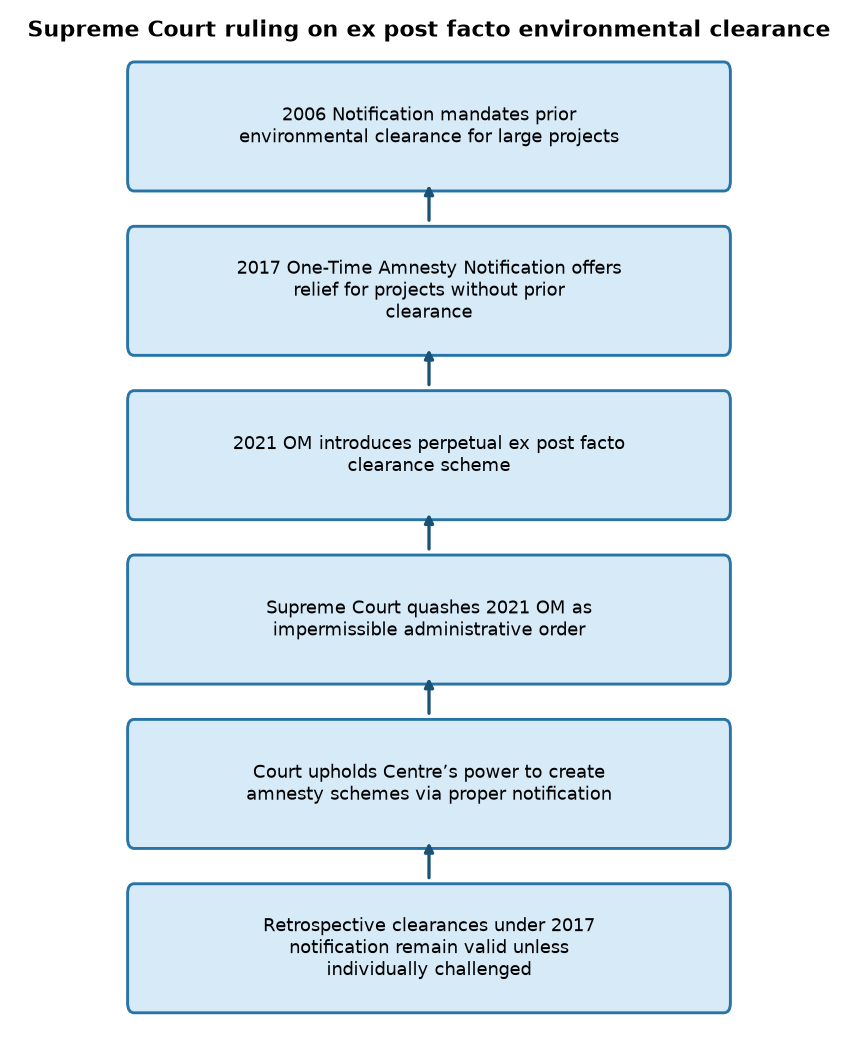
The Supreme Court of India, in a landmark judgment delivered on July 29, 2026, struck down the 2021 Office Memorandum (OM) that permitted ex post facto environmental clearances for infrastructure projects, affirming that the executive cannot dilute statutory environmental safeguards through administrative orders. While quashing the 2021 OM, the Court upheld the Centre’s power to introduce amnesty schemes for select projects, provided they meet the threshold of reasonableness, proportionality, and supervening public interest. This verdict reinforces the primacy of the Environmental Protection Act, 1986, and the 2006 EIA Notification, while delineating the boundaries of executive discretion in environmental governance.
Background
- The Environmental Protection Act, 1986, empowers the Central Government to regulate environmental clearances for projects with potential ecological impact, ensuring compliance with the precautionary principle and sustainable development.
- The 2006 EIA Notification, issued under the Environmental Protection Act, mandates prior environmental clearance for specified categories of projects, including highways, airports, real estate, ports, mining, energy, and heavy industry.
- In 2017, the Central Government introduced a ‘one-time amnesty’ scheme for projects commenced without prior clearance, allowing retrospective approvals under specific conditions.
- The 2021 Office Memorandum (OM) expanded this amnesty regime, proposing a perpetual mechanism for ex post facto clearances, which was challenged before the Supreme Court.
- The Supreme Court’s judgment addresses the tension between developmental imperatives and environmental safeguards, particularly in the context of retrospective clearances.
- The verdict aligns with the judiciary’s role in ensuring that executive actions do not undermine statutory environmental protections, as enshrined in Articles 14 and 21 of the Constitution.
What is Ex Post Facto Environmental Clearance?
- Ex post facto environmental clearance refers to the retrospective approval granted to projects that were initiated without obtaining prior environmental clearance as mandated by law.
- Such clearances are granted after the project has already commenced or even completed construction, thereby legalising past violations of environmental norms.
- The Environmental Protection Act, 1986, and the 2006 EIA Notification explicitly require prior environmental clearance for specified categories of projects to prevent irreversible environmental damage.
- Retrospective clearances are permissible only under exceptional circumstances, such as supervening public interest, and must adhere to the principles of reasonableness and proportionality.
- The Supreme Court has held that ex post facto clearances cannot be granted through administrative orders like Office Memorandums (OMs), as they alter the statutory framework without legislative sanction.
- The precautionary principle and the doctrine of sustainable development underpin the requirement for prior environmental clearance, ensuring that development does not come at the cost of ecological degradation.
- The 2017 ‘one-time amnesty’ scheme and the 2021 OM attempted to institutionalise retrospective clearances, but the Court struck down the latter as ultra vires the Environmental Protection Act, 1986.
- The judgment underscores that environmental governance must balance developmental needs with ecological sustainability, with judicial oversight ensuring adherence to constitutional and statutory mandates.
UPSC Value Addition
Keywords for Mains Answer-Writing
Environmental Protection Act 1986 · ex post facto environmental clearance · Environmental Impact Assessment (EIA) 2006 notification · precautionary principle · sustainable development · Article 14 (Right to Equality) · Article 21 (Right to Life) · Supreme Court of India · Office Memorandum (OM) · amnesty schemes for environmental violations · delegated legislation · judicial review of executive actions · infrastructure projects and environmental compliance · retrospective environmental clearances · public interest litigation (PIL) in environmental governance
Prelims Practice Questions
Q1. Consider the following statements regarding ex post facto environmental clearance in India:
1. The 2021 Office Memorandum (OM) introduced a perpetual regime for granting environmental clearances to projects undertaken without prior clearance.
2. The Environmental Protection Act, 1986, mandates prior environmental clearance for large-scale projects under the 2006 notification.
3. The Supreme Court upheld the 2021 OM as a valid exercise of executive power under Article 77 of the Constitution.
4. The precautionary principle and sustainable development are integral to the Environmental Protection Act, 1986.
How many of the above statements are correct?
- Only one
- Only two
- Only three
- All
Answer: Only three — Statements 1 and 4 are correct. Statement 1 is correct as the 2021 OM introduced a perpetual regime for ex post facto clearances. Statement 4 is correct as the Act incorporates the precautionary principle and sustainable development. Statements 2 is correct as the 2006 notification mandates prior clearance. Statement 3 is incorrect as the Supreme Court quashed the 2021 OM.
Q2. Assertion (A): The Supreme Court held that the 2021 Office Memorandum (OM) granting ex post facto environmental clearances was ultra vires the Environmental Protection Act, 1986.
Reason (R): The OM supplanted delegated legislation (2006 notification) through an administrative order, which is impermissible in law.
In the context of the above two statements, which of the following is correct?
- Both A and R are true, and R is the correct explanation of A.
- Both A and R are true, but R is not the correct explanation of A.
- A is true, but R is false.
- A is false, but R is true.
Answer: Both A and R are true, and R is the correct explanation of A. — Both Assertion (A) and Reason (R) are true, and Reason (R) correctly explains Assertion (A). The Supreme Court held that the OM was ultra vires as it supplanted delegated legislation through an administrative order, which is impermissible under law.
Mains Practice Question
✍ Critically examine the Supreme Court’s judgment in quashing the 2021 Office Memorandum (OM) granting ex post facto environmental clearances. In your answer, address the following dimensions: (i) the legal principles violated by the OM, and (ii) the implications of the judgment for environmental governance and sustainable development in India. (15 Marks)
Approach: MODEL-ANSWER SKELETON:
1. **Legal Principles Violated by the 2021 OM:**
– **Delegated Legislation Supplanted by Administrative Order:** The OM violated the principle that delegated legislation (2006 EIA notification) cannot be supplanted by an administrative order under Article 77 of the Constitution. The court held that the OM created a perpetual regime, altering the nature of enquiry and criteria for environmental clearance, which is impermissible.
– **Violation of Articles 14 and 21:** The OM failed the test of reasonableness and proportionality. It lacked an intelligible differentia for selecting projects for post facto clearance, violating Article 14 (Right to Equality). Additionally, it undermined the right to life (Article 21) by compromising environmental safeguards.
– **Contradiction with Environmental Protection Act, 1986:** The OM disregarded the precautionary principle and sustainable development, core objectives of the Act. The court emphasized that environmental governance must balance development with preservation.
2. **Implications for Environmental Governance and Sustainable Development:**
– **Strengthening of Judicial Review:** The judgment reinforces the judiciary’s role in checking executive overreach, ensuring that environmental governance adheres to statutory and constitutional mandates.
– **Clarity on Amnesty Schemes:** The court upheld the Centre’s power to introduce amnesty schemes but emphasized that such schemes must be selective, rational, and grounded in supervening public interest. This prevents arbitrary exemptions.
– **Impact on Infrastructure Projects:** While the OM is quashed prospectively, retrospective clearances granted under the 2017 notification remain valid unless individually challenged. This ensures stability for ongoing projects while upholding legal compliance.
– **Reinforcement of the Precautionary Principle:** The judgment underscores the necessity of prior environmental impact assessments, aligning with global best practices in sustainable development.
3. **Balancing Development and Environmental Protection:**
– The judgment highlights the need for a balanced approach, where development does not come at the cost of environmental degradation. It reaffirms that economic growth must be pursued within the framework of constitutional and statutory safeguards.
4. **Conclusion:**
– The Supreme Court’s decision is a landmark step in reinforcing the rule of law in environmental governance. It sets a precedent for future executive actions, ensuring that administrative orders do not dilute statutory protections. The judgment also underscores the judiciary’s commitment to sustainable development and the precautionary principle.
Source: The Hindu
Generated by AanyaAi for educational purpose.

- उत्तराखंड फिल्म नीति: 5 साल में 1759 करोड़ निवेश, राज्य बना फिल्म निर्माण केंद्र - September 24, 2026
- Uttarakhand Film Policy: ₹1759 Crore Investment in 5 Years for UPSC Exams - September 24, 2026
- हिमाचल उच्च न्यायालय ने दिल्ली-शिमला-धर्मशाला विमान सेवाओं और हेलीपोर्ट पर ताजा रिपोर्ट मांगी - September 24, 2026

No Comments