


27 Jul Supreme Court to Review Nilekani Task Force Report on Online NEET Exam
Subject Relevance — Where This Topic Fits
- GS Paper II — Governance, Transparency and Accountability in Public Institutions | GS Paper III — Science and Technology in Governance and Cybersecurity
- Prelims: National Eligibility cum Entrance Test (NEET), National Testing Agency (NTA), Nandan Nilekani, Paper Leak, Cybersecurity, Computer-Based Test (CBT), CBI Investigation
- Essay: The Role of Technology in Ensuring Fairness and Security in Public Examinations, Balancing Innovation with Accountability: Lessons from NEET Reforms
Quick Revision: The Supreme Court’s directive to await the Nilekani-led task force recommendations highlights the need for robust cybersecurity and data protection measures as India transitions NEET to an online format.
Why is this in the news?
The Supreme Court of India, on 27 July 2026, indicated that it will await the recommendations of the high-powered task force led by Nandan Nilekani on the feasibility and safeguards required for conducting the NEET examination in an online mode. This directive assumes significance in the context of the recent cancellation of NEET-UG 2026 due to alleged paper leak and the subsequent re-conduct of the examination, highlighting the urgent need for robust technological and procedural reforms to ensure examination integrity.
Background
- The National Eligibility cum Entrance Test (NEET) is a national-level entrance examination for admission to undergraduate medical courses in India, conducted by the National Testing Agency (NTA).
- On 12 May 2026, NEET-UG 2026 was cancelled by the NTA following allegations of a paper leak, marking a significant disruption in the examination process.
- A re-test was conducted on 21 June 2026, but concerns regarding the fairness and security of the examination persisted, leading to legal challenges.
- The Supreme Court, in its earlier order on 1 June 2026, had refused to accept for urgent hearing the plea for conduct of the NEET-UG 2026 re-test on June 21 in computer-based test mode, underscoring the need for a structured transition plan.
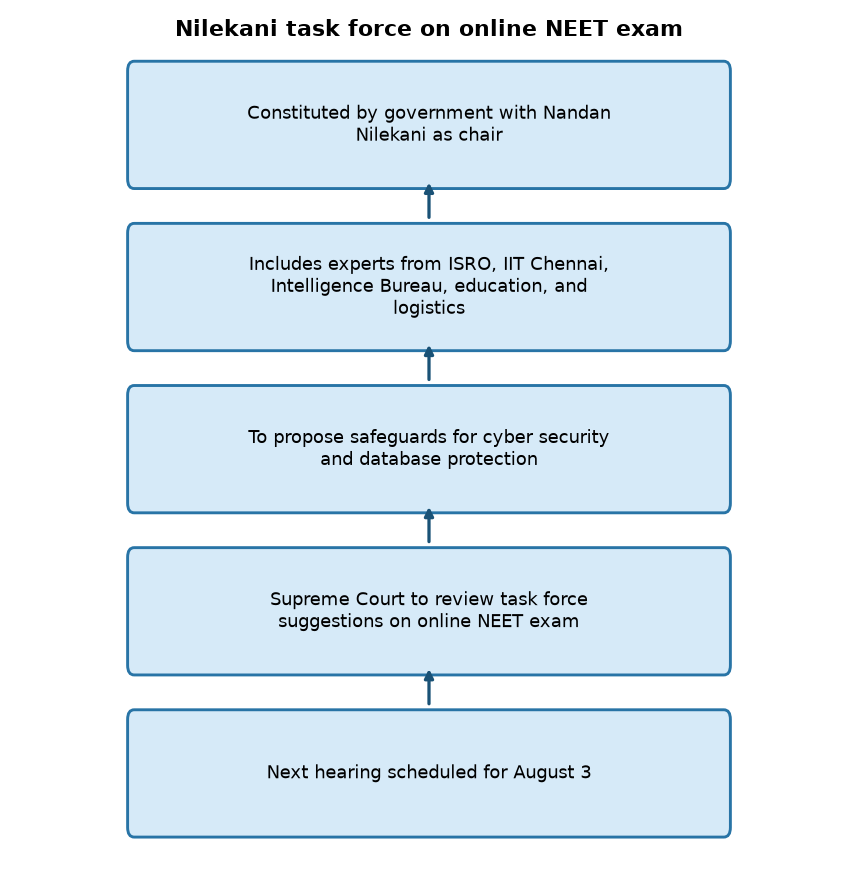
- The Union Government constituted a high-level committee, headed by Nandan Nilekani, to recommend measures for transitioning NEET to an online format, with a focus on cybersecurity and data protection.
- The task force includes experts from technology, space research, intelligence, academia, and logistics, reflecting a multidisciplinary approach to addressing the challenges.
What is the Nandan Nilekani-led Task Force on Online NEET Examination?
- The task force was constituted by the Union Government to recommend measures for transitioning the NEET examination from a pen-and-paper mode to a computer-based test (CBT) format.
- The committee is chaired by Nandan Nilekani, a technology expert and co-founder of Infosys, known for his work in digital governance and identity systems.
- Members of the task force include former ISRO Chairman S. Somanath, former Intelligence Bureau Director Tapan Deka, IIT Chennai Director V. Kamakoti, former Education Secretary Anita Karwal, and logistics expert Amrit Lal Meena, ensuring a blend of technological, administrative, and operational expertise.
- The primary focus of the task force is to address concerns related to cybersecurity, data protection, and the integrity of the examination process during the transition to an online mode.
- The task force is expected to propose additional safeguards, including robust encryption protocols, secure server infrastructure, and real-time monitoring mechanisms to prevent malpractices.
- The recommendations are likely to include provisions for mock tests, candidate authentication protocols, and contingency plans for technical failures during the examination.
- The task force’s suggestions will be crucial in shaping the future of NEET, which has faced multiple challenges related to fairness, transparency, and security in recent years.
- The Supreme Court’s directive to await these recommendations underscores the judiciary’s emphasis on evidence-based reforms and technological solutions to public examination challenges.
Key Features
| Feature | Significance |
|---|---|
| Nandan Nilekani-led task force | Leverages expertise in technology and governance to propose robust mechanisms for transitioning NEET-UG to an online format, addressing cybersecurity and data integrity concerns. |
| Supreme Court’s judicial scrutiny | Ensures adherence to constitutional principles of fairness and transparency in examination reforms, particularly in the context of re-conducting NEET-UG after allegations of malpractice. |
| Cybersecurity safeguards | Critical for protecting examination data from breaches, ensuring confidentiality, and maintaining the integrity of the online NEET-UG process. |
| Database protection protocols | Essential to prevent unauthorized access or tampering with student data, exam questions, and results, thereby upholding the credibility of the examination system. |
| Re-NEET 2026 (June 21) | Demonstrates the procedural response to allegations of paper leaks, highlighting the need for systemic reforms to prevent future occurrences and restore public trust. |
Why it Matters
Administrative Reforms
- The task force represents a structured approach to modernising examination systems, aligning with the government’s Digital India vision and the National Education Policy (NEP) 2020’s emphasis on technological integration in education.
- The Supreme Court’s involvement ensures that reforms are legally sound, balancing innovation with constitutional guarantees of fairness and equity in examinations.
Technological Integration
- Transitioning NEET-UG to an online format aligns with global best practices in standardized testing, reducing logistical burdens and improving scalability.
- The inclusion of experts like S. Somanath (ISRO) and V. Kamakoti (IIT Chennai) ensures that the task force can address technical challenges such as server capacity, latency, and secure data transmission.
Public Trust and Accountability
- The cancellation of NEET-UG 2026 and subsequent re-examination underscores the government’s commitment to addressing malpractices, even at the cost of operational disruptions.
- Judicial oversight by the Supreme Court reinforces public confidence in the examination process, demonstrating a commitment to transparency and accountability in governance.
Challenges
1. Cybersecurity Vulnerabilities
- Risk of data breaches during online examinations, which could compromise student information, exam questions, and results.
- Potential for distributed denial-of-service (DDoS) attacks or ransomware incidents disrupting the examination process.
UPSC Link: GS3: Cybersecurity
2. Digital Divide and Accessibility
- Unequal access to digital infrastructure across socio-economic groups may disadvantage certain candidates, violating the principle of equitable opportunity.
- Need for provisions such as offline modes, low-bandwidth alternatives, and digital literacy support to ensure inclusivity.
UPSC Link: GS2: Social Justice
3. Logistical and Technological Constraints
- High reliance on reliable internet connectivity and power supply, which may be unreliable in remote or rural areas.
- Potential for technical glitches, such as system crashes or software failures, during the examination.
UPSC Link: GS3: Science & Technology
4. Data Privacy and Protection
- Risk of unauthorized access to sensitive student data, including biometric information and personal details, raising concerns under the Personal Data Protection Act (PDPA).
- Need for stringent encryption, anonymization, and secure storage protocols to safeguard data.
UPSC Link: GS2: Governance
5. Public Perception and Trust
- Past instances of paper leaks and malpractices have eroded public trust in examination systems, necessitating robust reforms to restore credibility.
- Risk of resistance from stakeholders, including students, parents, and educational institutions, due to skepticism about the fairness of online examinations.
UPSC Link: GS4: Ethics
Challenges — UPSC Perspective
| Issue | Concern |
|---|---|
| Cybersecurity risks | Potential for data breaches, DDoS attacks, or ransomware disrupting the examination process. |
| Digital divide | Unequal access to digital infrastructure may disadvantage certain socio-economic groups. |
| Technical glitches | System crashes or software failures could compromise the examination experience. |
| Data privacy | Risk of unauthorized access to sensitive student data, including biometric information. |
| Public trust erosion | Past malpractices have led to skepticism about the fairness of online examinations. |
Way Forward
- Constitute a dedicated cybersecurity task force to develop and implement robust security protocols for online examinations, including encryption, intrusion detection, and real-time monitoring.
- Pilot the online NEET-UG in select regions with robust digital infrastructure to identify and address logistical and accessibility challenges before nationwide rollout.
- Develop a comprehensive digital literacy program for students, educators, and examination staff to ensure smooth transition to online formats.
- Strengthen collaboration with the National Informatics Centre (NIC) and CERT-In to enhance cybersecurity measures and incident response capabilities.
- Establish a transparent grievance redressal mechanism for students and stakeholders to report technical issues or malpractices during the examination.
- Conduct regular audits and third-party assessments of the online examination system to ensure compliance with data protection and cybersecurity standards.
- Formulate a clear communication strategy to educate stakeholders about the benefits and safeguards of the online NEET-UG, thereby restoring public trust.
UPSC Value Addition
Keywords for Mains Answer-Writing
NEET-UG 2026 controversy · National Testing Agency (NTA) · Paper leak in competitive examinations · Computer-Based Test (CBT) mode · Cyber security in examinations · Nandan Nilekani task force · Supreme Court and examination reforms · Allegations of malpractice in medical entrance exams · Re-test and re-NEET · Role of CBI in examination frauds
Constitutional & Policy Linkages
- Article 14 (Equality before Law) – Ensuring fairness and non-discrimination in examination processes.
- Article 21 (Right to Life and Personal Liberty) – Protecting the dignity and privacy of students during examinations.
- Article 19(1)(g) (Freedom to Practice any Profession) – Balancing examination reforms with the right to pursue education.
Concept Flow
Allegations of NEET-UG 2026 paper leak → Supreme Court intervention → Government constitutes Nilekani-led task force → Task force proposes online NEET-UG → Supreme Court scrutinises proposals → Focus on cybersecurity and data protection → Implementation challenges (digital divide, technical glitches) → Public trust erosion → Need for systemic reforms → Alignment with NEP 2020 and Digital India initiatives.
Prelims Practice Questions
Q1. Consider the following statements regarding the NEET-UG 2026 controversy: 1) The NEET-UG 2026 was cancelled due to allegations of a paper leak. 2) The Supreme Court has refused to entertain any plea for an urgent hearing on the conduct of a re-test. 3) The CBI is investigating the paper leak allegations. 4) The re-test for NEET-UG 2026 was conducted in offline mode only. Which of the statements given above are correct?
- 1 and 2 only
- 1, 2 and 3 only
- 1 and 3 only
- 2, 3 and 4 only
Answer: 1 and 3 only — Statement 1 is correct as the NEET-UG 2026 was cancelled due to paper leak allegations. Statement 2 is incorrect as the Supreme Court did not refuse to entertain the plea but deferred it. Statement 3 is correct as the CBI is investigating the matter. Statement 4 is incorrect as the re-test was conducted in computer-based test mode.
Q2. Which of the following is NOT a member of the Nandan Nilekani-led task force constituted by the Union Government for suggesting reforms in the conduct of NEET examinations?
- S. Somanath (Former Chairman, ISRO)
- Tapan Deka (Former Director, Intelligence Bureau)
- V. Kamakoti (Director, IIT Madras)
- K. Radhakrishnan (Former Chairman, ISRO)
Answer: K. Radhakrishnan (Former Chairman, ISRO) — K. Radhakrishnan is not listed as a member of the task force. The task force includes S. Somanath, Tapan Deka, V. Kamakoti, Anita Karwal, and Amrit Lal Meena.
Mains Practice Question
✍ Examine the challenges associated with the conduct of competitive examinations like NEET in India, particularly in the context of recent controversies. Suggest measures to enhance the credibility and security of such examinations.
Approach: Begin by outlining the recent controversies surrounding NEET-UG 2026, including the paper leak allegations and the Supreme Court’s observations on cyber security and database protection. Discuss the structural issues in the National Testing Agency (NTA) and the need for institutional reforms. Highlight the role of technology in ensuring transparency, such as Computer-Based Tests (CBT) and blockchain for secure data handling. Conclude with policy recommendations, including the strengthening of investigative agencies like the CBI, the establishment of an independent oversight body, and the implementation of robust cyber security protocols.
Source: The Hindu
Generated by AanyaAi for educational purpose.

- यूपी कैबिनेट ने लिया बड़ा फैसला: अग्निवीरों को मिलेगी 20% आरक्षण, मथुरा मिल बनेगी इथेनॉल प्लांट - September 16, 2026
- UP Cabinet Approves 20% Agniveer Quota & Mathura Ethanol Plant: Key Decisions Explained - September 16, 2026
- यूपी कैबिनेट ने अयोध्या में एनएसजी क्षेत्रीय केंद्र के लिए 65 एकड़ भूमि हस्तांतरण को मंजूरी दी - September 16, 2026

No Comments