


20 Aug Supreme Court Upholds Artistic Freedom in ‘Mahaprabhu Jagannath’ Case
✎ The Supreme Court’s dismissal of the Odisha government’s plea reaffirms that artistic freedom under Article 19(1)(a) is paramount unless the work violates explicit legal restrictions, and judicial review does not extend to…
Subject Relevance — Where This Topic Fits
- GS Paper II — Polity and Governance (Judicial Review, Fundamental Rights) | GS Paper III — Indian Society (Cultural Heritage, Freedom of Expression)
- Prelims: CBFC, Fundamental Rights under Article 19(1)(a), Judicial Review, Puri Rath Yatra, Skanda Purana, Brahma Purana, animated films
- Essay: Balancing artistic freedom and religious sentiment in a pluralistic society, Role of judiciary in safeguarding constitutional freedoms
Quick Revision: The Supreme Court’s dismissal of the Odisha government’s plea reaffirms that artistic freedom under Article 19(1)(a) is paramount unless the work violates explicit legal restrictions, and judicial review does not extend to subjective judgments on religious or cultural interpretations.
Why is this in the news?
The Supreme Court, on 29 July 2026, dismissed the Odisha government’s plea challenging the release of the animated film *Mahaprabhu Jagannath*, observing that it cannot adjudicate matters of artistic expression. The ruling reaffirms the autonomy of the Central Board of Film Certification (CBFC) and underscores the judiciary’s reluctance to interfere in creative interpretations of religious figures. The case also highlights the tension between traditional religious practices and modern modes of cultural expression, particularly in the context of children’s media.
Background
- The film *Mahaprabhu Jagannath*, produced by Ele Animations, received CBFC certification for release across India.
- The Odisha government filed a petition in the Supreme Court, arguing that the animated depiction of Lord Jagannath as a ‘cartoon character’ (allegedly resembling Spiderman or Doraemon) was objectionable and violated religious sentiments.
- The Orissa High Court had earlier stayed the film’s release, even after CBFC clearance, prompting an appeal by the filmmakers to the Supreme Court.
- The Supreme Court, in its July 17, 2026 order, permitted the exhibition of the film after the completion of the Lord Jagannath Rath Yatra on July 27, 2026, and directed that the film could be released on or after July 28.
- Opponents of the film argued that its narrative deviated from the Skanda Purana and Brahma Purana, traditional texts associated with the Jagannath cult.
- The case exemplifies recurring debates on the limits of artistic freedom when depicting religious deities, particularly in animated or fictional formats.
What is the legal and constitutional framework governing artistic expression in India?
- Fundamental Right to Freedom of Speech and Expression (Article 19(1)(a) of the Constitution): Guarantees the right to express ideas, including artistic and creative works, subject to reasonable restrictions under Article 19(2).
- Central Board of Film Certification (CBFC): A statutory body under the Ministry of Information and Broadcasting that certifies films for public exhibition, ensuring compliance with the Cinematograph Act, 1952, and the Cable Television Networks (Regulation) Act, 1995.
- Judicial Review of Artistic Works: Courts generally refrain from adjudicating the artistic merit or religious interpretation of creative works, unless they violate explicit legal prohibitions (e.g., obscenity, defamation, or incitement to violence).
- Balancing Rights: The judiciary often weighs the right to freedom of expression against other constitutional rights, such as the right to freedom of religion (Article 25) and cultural preservation, but avoids subjective judgments on artistic choices.
- Precedents on Religious Depictions: Landmark cases, such as *Ramesh v. Union of India* (1988) on *The Satanic Verses*, and *S. Rangarajan v. P. Jagjivan Ram* (1989), affirm that artistic works cannot be censored solely for offending religious sentiments unless they incite public disorder.
- Role of High Courts: High Courts may intervene in matters of public order or statutory non-compliance, but the Supreme Court’s ruling in this case reinforces the principle that artistic freedom is sacrosanct unless it crosses legal boundaries.
- Cultural Context: The depiction of deities in modern media (e.g., animated films, comics) reflects evolving cultural narratives and the need to engage younger audiences while respecting traditional beliefs.
- Judicial Philosophy: The Supreme Court’s observation that it ‘cannot sit in judgment over art’ aligns with the doctrine of judicial restraint, emphasizing the separation of powers and the primacy of legislative/executive domains in cultural governance.
Key Features
| Feature | Significance |
|---|---|
| Judicial stance on artistic expression | The Supreme Court reaffirmed the principle that judicial review over artistic works must be minimal, aligning with constitutional protections under Article 19(1)(a) (Freedom of Speech and Expression). |
| CBFC clearance as statutory safeguard | The Central Board of Film Certification’s pre-certification process ensures compliance with the Cinematograph Act, 1952, and rules, balancing creative freedom with societal sensitivities. |
| Multiplicity of divine representations | The Court acknowledged that divinity can be depicted in diverse forms, referencing philosophical traditions where God assumes varied avatars to connect with devotees. |
| Temporal restrictions for religious events | The judicial directive to delay the film’s release until after the Rath Yatra underscores the need to respect religious practices and avoid perceived conflicts during sacred periods. |
| Judicial deference to High Court orders | The Supreme Court’s dismissal of the Odisha government’s plea highlights the hierarchy of judicial authority, where High Court orders are subject to appellate review without interference in substantive merits. |
Why it Matters
Legal and Constitutional
- Reinforces the doctrine of judicial restraint in matters of art and expression, preventing courts from substituting subjective artistic judgments for statutory or constitutional standards.
- Clarifies the limits of executive interference in creative domains, particularly where statutory bodies like the CBFC have already certified content.
- Affirms the principle that freedom of expression under Article 19(1)(a) extends to unconventional or modern interpretations of religious themes, provided they do not incite hatred or violate public order.
Cultural and Religious
- Demonstrates the evolving nature of religious iconography in contemporary media, where traditional depictions coexist with modern artistic expressions.
- Highlights the tension between preserving religious sanctity and embracing creative innovation, particularly in the context of digital storytelling for younger audiences.
- Underscores the importance of contextualizing artistic works within broader cultural and philosophical frameworks rather than rigid textual interpretations.
Judicial Process and Governance
- Illustrates the role of higher judiciary in resolving disputes between state governments and statutory bodies, ensuring adherence to procedural fairness and constitutional norms.
- Showcases the interplay between judicial review and executive actions, particularly in cases involving public order and religious sentiments.
- Emphasizes the need for clarity in statutory interpretations, as seen in the Court’s reliance on the Cinematograph Act and CBFC guidelines.
Challenges
1. Balancing artistic freedom with religious sensitivities
- Determining the threshold for what constitutes objectionable depiction of religious figures, especially in animated or fictional formats.
- Avoiding judicial overreach that could stifle creative expression or impose subjective moral judgments.
- Ensuring that statutory bodies like the CBFC are equipped to handle complex cases involving religious themes without arbitrary censorship.
UPSC Link: GS Paper 2: Fundamental Rights (Art. 19, 25)
2. Inter-judicial coordination and hierarchy
- Resolving conflicts between High Court orders and Supreme Court directives, particularly in time-sensitive matters like film releases.
- Ensuring consistency in judicial interpretations across different benches and jurisdictions to prevent conflicting precedents.
UPSC Link: GS Paper 2: Judiciary (Structure and Functions)
3. Public order and religious harmony
- Mitigating potential communal tensions arising from artistic works that reinterpret religious icons, even if intended for children.
- Developing mechanisms for pre-emptive dialogue between artists, religious communities, and statutory bodies to address concerns before release.
UPSC Link: GS Paper 2: Secularism and Religious Freedom
4. Technological and media literacy gaps
- Addressing the challenge of ensuring that modern media formats (e.g., animation) are perceived as legitimate artistic expressions rather than trivializations of sacred themes.
- Promoting media literacy among audiences to distinguish between creative reinterpretation and sacrilege.
UPSC Link: GS Paper 4: Ethics in Governance (Media Ethics)
Challenges — UPSC Perspective
| Issue | Concern |
|---|---|
| Subjective artistic judgments | Risk of courts imposing personal or cultural biases in evaluating artistic works, undermining constitutional protections. |
| Statutory ambiguity in CBFC guidelines | Lack of clear, objective criteria for certifying films with religious themes, leading to inconsistent rulings. |
| Temporal conflicts with religious events | Potential for artistic works to clash with sacred timelines, necessitating judicial or executive interventions. |
| Public perception and backlash | Possibility of misinterpretation or outrage from religious groups, even when artistic intent is benign. |
| Interpretational conflicts in religious texts | Disputes over which scriptural sources should guide artistic depictions, complicating certification processes. |
Way Forward
- Clarify and codify CBFC guidelines to include objective criteria for evaluating artistic depictions of religious figures, ensuring consistency and reducing judicial burden.
- Establish a multi-stakeholder body comprising artists, religious scholars, and legal experts to pre-screen contentious works and mediate disputes before release.
- Promote media literacy campaigns to educate audiences on the distinction between creative reinterpretation and sacrilege, reducing potential backlash.
- Strengthen inter-judicial coordination mechanisms to ensure uniformity in interpretations of constitutional protections for artistic expression.
- Encourage collaborative projects between artists and religious institutions to co-create content that aligns with both creative freedom and cultural sensitivities.
- Develop time-bound judicial processes for resolving disputes related to artistic works, particularly those involving religious themes, to avoid prolonged uncertainties.
- Incorporate ethical training in media and arts education to foster responsible creative practices that respect diverse beliefs while encouraging innovation.
UPSC Value Addition
Keywords for Mains Answer-Writing
Freedom of artistic expression · Constitutional morality · CBFC and film certification · Supreme Court on artistic freedom · Cultural governance and religion · Judicial review versus artistic autonomy · Artistic depiction of deities · Public order and cultural expression · Artistic freedom under Article 19(1)(a) · Balancing devotion and creativity
Constitutional & Policy Linkages
- Article 19(1)(a): Freedom of Speech and Expression (Artistic freedom)
- Article 25: Freedom of Religion (Balancing artistic expression with religious practices)
- Article 26: Cultural and Religious Freedom (Protection of religious institutions)
- Article 14: Equality before Law (Ensuring non-discriminatory treatment of artistic works)
Concept Flow
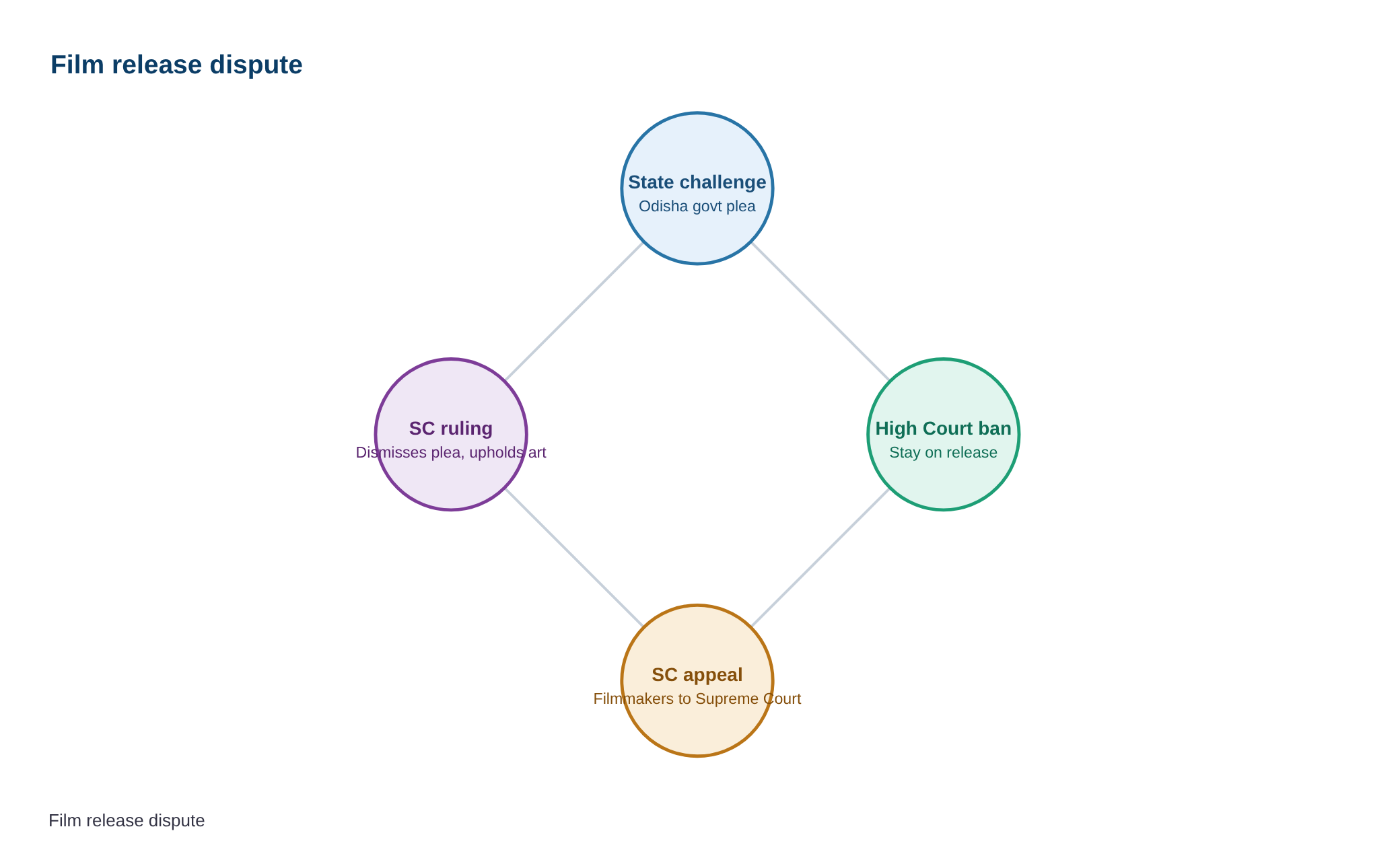
State government challenges CBFC-cleared animated film → High Court imposes ban → Film makers appeal to Supreme Court → Supreme Court dismisses plea, citing judicial restraint over art → Court emphasizes multiplicity of divine representations → Judgment reinforces constitutional protections for artistic expression → Raises questions about balancing religious sensitivities and creative freedom.
Prelims Practice Questions
Q1. Consider the following statements regarding the Central Board of Film Certification (CBFC) in India: 1. The CBFC is a statutory body established under the Cinematograph Act, 1952. 2. The CBFC’s primary function is to certify films for public exhibition based on their suitability for different age groups. 3. The CBFC has the authority to ban films outright if they are deemed to offend religious sentiments. 4. The CBFC’s decisions are final and cannot be challenged in any court of law. How many of the above statements are correct?
- Only one
- Only two
- Only three
- All four
Answer: Only three — Statements 1 and 2 are correct as the CBFC is indeed a statutory body under the Cinematograph Act, 1952, and certifies films for public exhibition. Statement 3 is incorrect because while the CBFC can refuse certification or demand modifications, outright bans are rare and subject to judicial review. Statement 4 is incorrect as CBFC decisions are appealable to the Film Certification Appellate Tribunal (FCAT) and subsequently to courts.
Q2. Assertion (A): The Supreme Court of India has held that artistic freedom is protected under Article 19(1)(a) of the Constitution. Reason (R): The Court has consistently ruled that no authority, including the judiciary, can sit in judgment over the artistic merit or creativity of a work. Examine the assertion and reason.
- Both A and R are individually true, and R is the correct explanation of A
- Both A and R are individually true, but R is not the correct explanation of A
- A is true but R is false
- A is false but R is true
Answer: A is true but R is false — Assertion (A) is true as the Supreme Court has repeatedly affirmed that artistic freedom is a facet of freedom of speech and expression under Article 19(1)(a). However, Reason (R) is an overstatement; while the Court upholds artistic freedom, it does not absolve creators from accountability for content that violates public order, decency, or other constitutional restrictions. The Court may review content for such violations, even if not for artistic merit.
Q3. Match the following pairs related to the regulation of cultural and artistic expression in India: Column I (Legal/Institutional Framework) — Column II (Purpose/Function) 1. Article 19(1)(a) — A. Statutory body for film certification 2. Cinematograph Act, 1952 — B. Constitutional provision for freedom of speech and expression 3. CBFC — C. Judicial review mechanism for film certification 4. Film Certification Appellate Tribunal (FCAT) — D. Regulatory framework for film exhibition and certification
- {‘1-B, 2-D, 3-A, 4-C’: True}
- {‘1-A, 2-B, 3-D, 4-C’: False}
- {‘1-D, 2-A, 3-B, 4-C’: False}
- {‘1-C, 2-D, 3-A, 4-B’: False}
Answer: {‘1-B, 2-D, 3-A, 4-C’: True} — The correct match is: 1-B (Article 19(1)(a) guarantees freedom of speech and expression), 2-D (Cinematograph Act, 1952 provides the legal framework for film regulation), 3-A (CBFC is the statutory body for film certification), and 4-C (FCAT is the appellate tribunal for reviewing CBFC decisions).
Mains Practice Question
✍ ‘The State must not sit in judgment over art.’ Critically examine the constitutional and judicial perspectives on artistic freedom in India, with particular reference to the depiction of religious figures in creative works. (15 Marks)
Approach: MODEL-ANSWER SKELETON:
1. **Constitutional Basis of Artistic Freedom**
– Article 19(1)(a) of the Constitution guarantees freedom of speech and expression, which includes artistic expression.
– Judicial affirmation: Cases such as *R. Rajagopal v. State of Tamil Nadu* (1994) and *S. Rangarajan v. P. Jagjivan Ram* (1989) have upheld artistic freedom while balancing it with reasonable restrictions under Article 19(2).
2. **Judicial Review vs. Artistic Autonomy**
– The Supreme Court has consistently held that courts cannot substitute their artistic judgment for that of the creator (*S. Rangarajan*).
– However, the Court retains the power to review content for violations of public order, decency, morality, or incitement to offence (*Ramesh v. Union of India*, 2017).
3. **Depiction of Religious Figures**
– The depiction of deities in creative works is a complex issue involving religious sentiments, cultural sensitivity, and artistic freedom.
– Landmark cases: *Bijoe Emmanuel v. State of Kerala* (1986) on religious freedom; *S. Duraisamy v. Union of India* (2022) on balancing artistic expression with religious sentiments.
4. **Role of Statutory Bodies**
– The Central Board of Film Certification (CBFC) certifies films but cannot ban them outright; its decisions are subject to judicial review.
– The Film Certification Appellate Tribunal (FCAT) and courts act as checks on arbitrary censorship.
5. **Balancing Competing Interests**
– The State must balance artistic freedom with the protection of religious sentiments and public order.
– The judiciary’s role is to ensure that restrictions are reasonable, narrowly tailored, and grounded in constitutional principles.
6. **Contemporary Context**
– Recent judgments, such as the Supreme Court’s dismissal of Odisha’s plea against the animated film *Mahaprabhu Jagannath*, reinforce the primacy of artistic freedom while acknowledging the multi-faceted nature of religious representation.
7. **Conclusion**
– Artistic freedom is a fundamental right, but it is not absolute. The State and judiciary must ensure that restrictions are justified and proportionate, without stifling creativity or imposing subjective artistic judgments.
Source: The Hindu
Generated by AanyaAi for educational purpose.

- Vettri Payanam Scheme: Free Bus Travel for Women in Tamil Nadu - October 4, 2026
- पेंशन अदालत: 17वीं बैठक की अध्यक्षता करेंगे डॉ. जितेंद्र सिंह, जानिए मुख्य बातें - October 4, 2026
- CBN Rajasthan celebrates National Anti-Drug Day with Gandhi Jayanti events - October 4, 2026

No Comments