


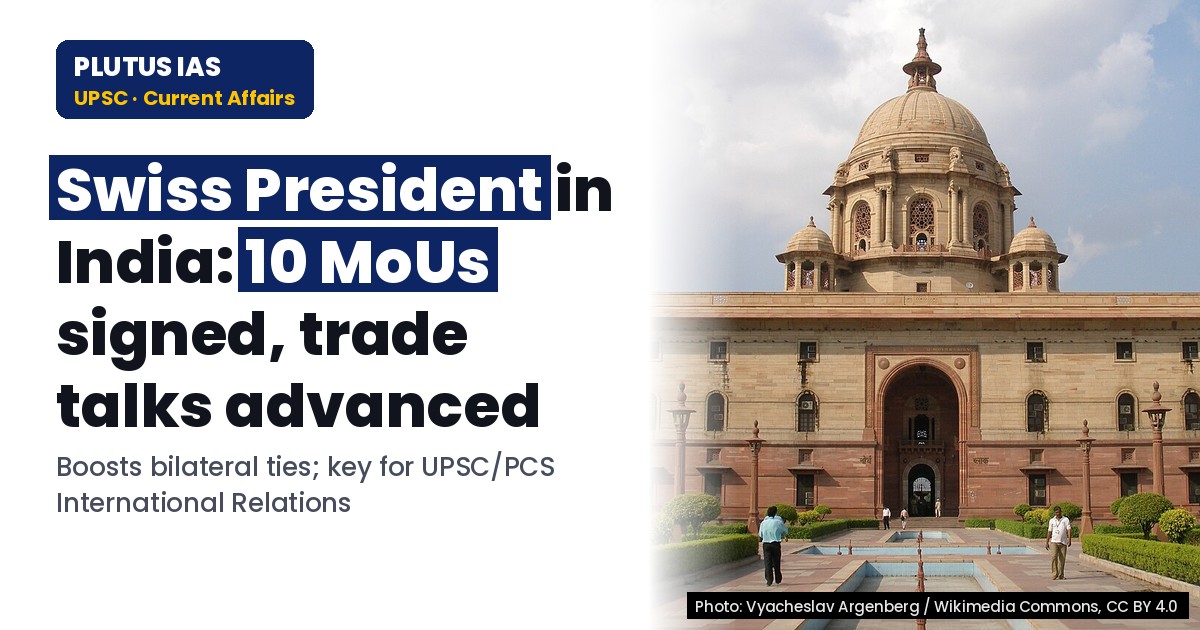
05 Oct Swiss President’s India Visit: Key Outcomes for UPSC & PCS
✎ The state visit of the President of the Swiss Confederation to India signifies a deepening of bilateral ties in trade, technology, and climate action, with key outcomes including MoUs on semiconductor manufacturing, green…
Subject Relevance — Where This Topic Fits
- GS Paper II — International Relations (Bilateral, Regional and Global Groupings and Agreements involving India and/or affecting India’s interests) | GS Paper II — International Relations (India and its neighbourhood) | GS Paper III — Economy (Foreign Trade) | GS Paper III — Environment (Environmental Pollution and Degradation, Climate Change) | GS Paper III — Science and Technology (Developments and their Applications and Effects in Everyday Life)
- Prelims: Swiss Confederation, Bilateral Investment Treaty (BIT), Foreign Direct Investment (FDI), Intellectual Property Rights (IPR), Green Hydrogen, Semiconductor Manufacturing, Paris Agreement, Kuno National Park, Cheetah Reintroduction Project, PM Gram Sadak Yojana (PMGSY), Clean Ganga Mission, Swachh Bharat Mission, Make in India, Atal Innovation Mission
- Essay: India-Switzerland Relations: A Model of Strategic Autonomy and Mutual Benefit, Science, Technology, and Innovation as Catalysts for Sustainable Development
Quick Revision: The state visit of the President of the Swiss Confederation to India signifies a deepening of bilateral ties in trade, technology, and climate action, with key outcomes including MoUs on semiconductor manufacturing, green hydrogen collaboration, and strengthened IPR frameworks.
Why is this in the news?
The state visit of the President of the Swiss Confederation to India in [insert date, if available from source] underscores the deepening strategic partnership between the two nations, with a focus on enhancing cooperation in trade, investment, science and technology, and climate action. The visit is significant for its emphasis on high-technology collaboration, including semiconductor manufacturing and green energy, as well as for reaffirming commitments under international frameworks such as the Paris Agreement. Additionally, the visit highlights India’s ongoing efforts in biodiversity conservation and rural infrastructure development, which intersect with Switzerland’s expertise in environmental sustainability and precision engineering.
Background
- Switzerland is a key European partner for India, with bilateral trade valued at approximately USD 20 billion in 2023, making it one of India’s top trading partners in Europe.
- India and Switzerland have historically maintained strong economic and technological ties, with Swiss investments in India exceeding USD 1 billion across sectors such as pharmaceuticals, machinery, and financial services.
- Switzerland is a global leader in precision engineering, pharmaceuticals, and clean energy technologies, including green hydrogen and carbon capture.
- India’s ‘Make in India’ and ‘Atal Innovation Mission’ initiatives align with Switzerland’s strengths in high-value manufacturing and R&D, creating opportunities for joint ventures and technology transfer.
- India’s commitment to climate action, as outlined in its Nationally Determined Contributions (NDCs) under the Paris Agreement, provides a framework for collaboration with Switzerland in renewable energy and sustainable urban development.
What are the Key Outcomes of the State Visit of the President of the Swiss Confederation to India?
- Enhanced Bilateral Trade and Investment Framework: The visit led to the signing of a Memorandum of Understanding (MoU) to strengthen bilateral trade and investment, with a focus on sectors such as pharmaceuticals, machinery, and clean energy. This aligns with India’s goal of diversifying its trade partners and reducing dependence on traditional markets.
- Technology Collaboration in Semiconductor Manufacturing: A joint statement highlighted cooperation in semiconductor design and manufacturing, leveraging Switzerland’s expertise in precision engineering and India’s growing semiconductor ecosystem. This is critical for India’s ‘Semicon India’ initiative and its push for self-reliance in critical technologies.
- Advancing Green Hydrogen and Renewable Energy: Both countries agreed to collaborate on green hydrogen production and deployment, including joint R&D projects and pilot plants. This supports India’s National Green Hydrogen Mission and Switzerland’s commitment to decarbonising its energy sector.
- Climate Action and Environmental Sustainability: The visit reaffirmed commitments under the Paris Agreement, with a focus on technology transfer for carbon capture, energy efficiency, and sustainable urban planning. Switzerland’s expertise in circular economy models may inform India’s efforts in waste management and resource efficiency.
- Intellectual Property Rights (IPR) and Innovation: A joint working group was established to address IPR challenges in emerging technologies, including AI and biotechnology. This is aligned with India’s ‘National IPR Policy’ and its emphasis on fostering innovation ecosystems.
- Cultural and Educational Exchange: The visit included agreements to expand academic and cultural ties, including student exchange programs and joint research initiatives in science and technology. This builds on existing collaborations between Indian and Swiss universities.
- Strengthening Consular and Mobility Frameworks: Both countries agreed to simplify visa processes for business travellers, students, and professionals, facilitating greater people-to-people exchanges and economic interactions.
- Joint Statements on Global Governance: The visit resulted in a joint statement on reforming global governance structures, including the United Nations Security Council, reflecting shared interests in a rules-based international order.
Key Features
| Feature | Significance |
|---|---|
| State Visit of President of the Swiss Confederation | Highlights India’s diplomatic engagement with Switzerland, a key European partner, fostering bilateral relations in trade, technology, and climate cooperation. |
| Joint Press Statement | Provides a platform for both nations to outline shared priorities, commitments, and future roadmaps in areas of mutual interest. |
| Cultural Diplomacy (Sanskrit Subhashitam) | Reinforces India’s soft power and cultural diplomacy, showcasing its rich intellectual heritage to global audiences. |
| Swiss Investment in India | Potential for enhanced Swiss investments in India’s sectors like finance, pharma, and clean energy, leveraging Switzerland’s expertise. |
| Climate and Sustainability Cooperation | Opportunity to align on climate action, green technology transfer, and sustainable development goals. |
Why it Matters
Economic Diplomacy
- Strengthening bilateral trade ties, particularly in pharmaceuticals, precision engineering, and financial services, where Switzerland holds a competitive edge.
- Exploring avenues for Swiss investments in India’s infrastructure, renewable energy, and smart manufacturing sectors to boost economic growth.
- Discussions on easing trade barriers and enhancing market access for Indian goods in Swiss markets, including agricultural and textile products.
Strategic and Geopolitical
- Reinforcing India’s engagement with Europe, a critical partner in the context of global geopolitical realignments and supply chain diversification.
- Switzerland’s neutral stance and global financial hub status can serve as a bridge for India’s engagements with other European nations and multilateral institutions.
- Potential collaboration in critical and emerging technologies, including semiconductors, AI, and quantum computing, aligning with India’s tech sovereignty goals.
Climate and Sustainability
- Joint initiatives on climate change mitigation, including technology transfer for green hydrogen, carbon capture, and renewable energy integration.
- Collaboration in sustainable urban development, leveraging Switzerland’s expertise in smart cities and circular economy models.
- Alignment with India’s commitment to achieving net-zero emissions by 2070 and Switzerland’s own climate goals.
Cultural and Soft Power
- Promotion of India’s cultural heritage, including classical knowledge systems like Sanskrit, to enhance global appreciation and engagement.
- Facilitating people-to-people ties through educational exchanges, tourism, and cultural programs, strengthening long-term bilateral relations.
Challenges
1. Trade and Investment Barriers
- Differences in regulatory frameworks between India and Switzerland may pose challenges in seamless trade and investment flows.
- Non-tariff barriers, such as technical standards and compliance requirements, could hinder market access for certain sectors.
UPSC Link: GS-II: Bilateral Groupings
2. Climate Policy Alignment
- Divergent approaches to climate action, including differing timelines for emission reductions and reliance on fossil fuels, may complicate joint initiatives.
- Balancing economic growth with environmental sustainability remains a challenge for both nations, requiring careful policy coordination.
UPSC Link: GS-III: Climate Change
3. Technology Transfer and IPR
- Ensuring equitable technology transfer agreements, particularly in critical sectors like semiconductors and AI, while protecting intellectual property rights.
- Addressing concerns related to data sovereignty and cross-border data flows in digital collaborations.
UPSC Link: GS-III: Science & Tech
4. Geopolitical Neutrality vs. Strategic Alignment
- Switzerland’s neutral stance may limit its ability to align fully with India’s strategic interests in certain global forums, including trade blocs and security alliances.
- Balancing Switzerland’s neutrality with India’s aspirations for a multipolar world order requires nuanced diplomacy.
UPSC Link: GS-II: International Relations
5. Public Diplomacy and Awareness
- Ensuring sustained public awareness and support for bilateral initiatives among citizens of both nations to prevent policy fatigue.
- Overcoming historical perceptions and stereotypes that may hinder deeper cultural and economic engagement.
UPSC Link: GS-II: Soft Power
Challenges — UPSC Perspective
| Issue | Concern |
|---|---|
| Regulatory Divergence | Potential delays in trade and investment due to differing compliance standards and bureaucratic hurdles. |
| Climate Policy Mismatch | Risk of misalignment in national climate goals, leading to suboptimal outcomes in joint sustainability projects. |
| Technology Transfer Disputes | Likelihood of disputes over IPR and data governance in high-tech collaborations. |
| Geopolitical Constraints | Switzerland’s neutrality may limit its ability to fully support India’s strategic initiatives in global forums. |
| Public Engagement Gaps | Risk of low public awareness leading to reduced enthusiasm for long-term bilateral projects. |
Way Forward
- Conclude a comprehensive India-Switzerland Free Trade Agreement (FTA) to reduce trade barriers and enhance market access for key sectors.
- Establish a joint working group on climate action to align policies, share best practices, and co-develop green technologies.
- Facilitate Swiss investments in India’s renewable energy and smart manufacturing sectors through targeted incentives and ease of doing business reforms.
- Expand educational and cultural exchange programs, including scholarships and joint research initiatives, to deepen people-to-people ties.
- Strengthen collaboration in critical technologies like semiconductors and AI by setting up joint R&D centers and innovation hubs.
- Develop a bilateral mechanism for dispute resolution in trade and investment to address regulatory and IPR-related challenges promptly.
- Enhance diplomatic coordination in multilateral forums to align on global issues such as climate change, trade, and technology governance.
- Promote sustainable urban development projects in India by leveraging Switzerland’s expertise in smart cities and circular economy models.
UPSC Value Addition
Keywords for Mains Answer-Writing
Swiss Confederation President State Visit · India-Switzerland bilateral relations · Strategic Partnership Agreement · Science and Technology Cooperation · Renewable Energy and Climate Change · Intellectual Property Rights · Trade and Investment · Swiss Federal Council · Constitutional provisions for foreign visits · Parliamentary diplomacy · Soft power diplomacy · Sustainable Development Goals · Bilateral MoUs · Global governance · Neutrality and diplomatic immunity
Concept Flow
State Visit Announcement → Diplomatic Engagement → Joint Press Statement → Identification of Priority Areas → Bilateral Agreements → Implementation → Monitoring and Review → Outcome Assessment → Long-term Strategic Partnership
Prelims Practice Questions
Q1. Consider the following statements regarding the State Visit of the President of the Swiss Confederation to India:
1. The visit is the first of its kind in the last two decades.
2. The visit aims to strengthen bilateral cooperation in science, technology, and renewable energy.
3. Switzerland is a non-permanent member of the United Nations Security Council for the term 2023-2024.
How many of the above statements are correct?
- Only one
- Only two
- Only three
- None
Answer: Only two — Statement 1 is incorrect as the visit is not the first of its kind in two decades; Switzerland has a history of high-level exchanges with India. Statement 2 is correct as the visit focuses on strengthening cooperation in science, technology, and renewable energy. Statement 3 is correct as Switzerland has been a non-permanent member of the UNSC for the term 2023-2024.
Q2. Assertion (A): The President of the Swiss Confederation holds both ceremonial and executive powers under the Swiss Constitution.
Reason (R): The Swiss Federal Council operates as a collegial body, with its members collectively assuming the duties of the head of state.
Options:
A. Both A and R are true, and R is the correct explanation of A.
B. Both A and R are true, but R is not the correct explanation of A.
C. A is true, but R is false.
D. A is false, but R is true.
Answer: ? — Assertion (A) is true as the President of the Swiss Confederation holds both ceremonial and executive powers, though the role is largely symbolic. Reason (R) is also true and correctly explains the assertion, as the Swiss Federal Council functions as a collegial executive body.
Q3. Match the following columns related to the institutional framework of Switzerland and India:
Column I (Institution)
1. Swiss Federal Council
2. Swiss Parliament (Federal Assembly)
3. President of the Swiss Confederation
4. Swiss Supreme Court
Column II (Role/Description)
A. Collective executive body with seven members
B. Bicameral legislature consisting of the National Council and the Council of States
C. Largely ceremonial head of state, elected annually
D. Highest judicial authority, with limited constitutional review powers
Options:
A. 1-A, 2-B, 3-C, 4-D
B. 1-B, 2-A, 3-C, 4-D
C. 1-A, 2-B, 3-D, 4-C
D. 1-D, 2-A, 3-B, 4-C
Answer: ? — 1-A: The Swiss Federal Council is a collective executive body with seven members. 2-B: The Swiss Parliament (Federal Assembly) is bicameral, consisting of the National Council and the Council of States. 3-C: The President of the Swiss Confederation is largely ceremonial and elected annually. 4-D: The Swiss Supreme Court has limited constitutional review powers.
Mains Practice Question
✍ The State Visit of the President of the Swiss Confederation to India underscores the importance of parliamentary diplomacy in contemporary international relations. Critically examine the role of parliamentary diplomacy in strengthening bilateral relations between India and Switzerland, with particular reference to the institutional mechanisms that facilitate such engagements. (15 Marks)
Approach: MODEL-ANSWER SKELETON:
1. **Definition and Significance of Parliamentary Diplomacy**:
– Define parliamentary diplomacy as the engagement between parliamentarians or heads of state/parliament to foster bilateral relations, trade, and cooperation.
– Highlight its role in promoting soft power, trust-building, and long-term strategic partnerships.
2. **Institutional Mechanisms in India-Switzerland Relations**:
– **Swiss Federal Council**: Explain its composition (seven-member collegial executive) and role in foreign policy formulation.
– **Indian Parliament**: Discuss the role of the Parliament of India, including the Ministry of External Affairs (MEA) and the Parliamentary Standing Committee on External Affairs.
– **Bilateral Mechanisms**: Mention the Strategic Partnership Agreement (2016) and the Joint Economic Commission (JEC) as frameworks for parliamentary diplomacy.
3. **Key Areas of Cooperation**:
– **Science and Technology**: Cite the Indo-Swiss Joint Research Programme (ISJRP) and collaborations in AI, semiconductors, and renewable energy.
– **Trade and Investment**: Highlight Switzerland as one of India’s top foreign direct investment (FDI) sources and the role of the Indo-Swiss Chamber of Commerce.
– **Climate Change and Sustainability**: Discuss Switzerland’s support for India’s renewable energy goals under the Paris Agreement.
4. **Challenges and Limitations**:
– **Differing Priorities**: Note Switzerland’s focus on neutrality and India’s emphasis on strategic autonomy.
– **Bureaucratic Hurdles**: Mention delays in ratifying agreements or visa restrictions affecting parliamentary exchanges.
– **Geopolitical Constraints**: Discuss the impact of global tensions (e.g., Russia-Ukraine war) on bilateral engagements.
5. **Comparative Perspective**:
– Compare India-Switzerland parliamentary diplomacy with other bilateral engagements (e.g., India-France, India-Germany) to highlight unique features.
6. **Conclusion**:
– Summarize the effectiveness of parliamentary diplomacy in India-Switzerland relations and suggest measures to further strengthen institutional mechanisms, such as regular parliamentary exchanges and joint committees.
Source: PIB (Press Information Bureau)
Generated by AanyaAi for educational purpose.
Related guides on our sites
- Current affairs for upsc 2026
- Best PSIR optional coaching for upsc
- Best PSIR optional teacher for upsc
- Best teacher of PSIR optional for upsc

- Swiss President’s India Visit: Key Outcomes for UPSC & PCS - October 5, 2026
- संचार साथी पोर्टल: 30 करोड़ विजिट्स, साइबर धोखाधड़ी से लड़ाई में जनभागीदारी बढ़ी - October 5, 2026
- Odisha Launches India’s First MICE Incentive Portal for UPSC Aspirants - October 5, 2026

No Comments