


12 Aug Tamil Nadu Assembly Freezes Lok Sabha Seats at 543: Key Implications for UPSC
✎ The 106th Constitutional Amendment Act, 2023, guarantees 33% reservation for women in Parliament and State Legislatures, but its implementation is stalled pending the next population census and delimitation exercise, which may…
Subject Relevance — Where This Topic Fits
- GS Paper II — Polity and Governance (Constitutional Provisions, Representation of People’s Act) | GS Paper II — Constitutional Amendments and their Implementation | GS Paper III — Social Justice and Empowerment (Women’s Reservation)
- Prelims: Delimitation Commission, Article 82 and Article 170, 106th Constitutional Amendment Act, 2023, Women’s Reservation Bill, Lok Sabha-Rajya Sabha ratio, Inter-State distribution of seats, Population Census, Delimitation Act, 2002, Constitutional Amendment Bills
- Essay: The interplay between constitutional democracy and social justice: A case for gender-inclusive representation, Federalism in India: Balancing inter-state equity and demographic realities
Quick Revision: The 106th Constitutional Amendment Act, 2023, guarantees 33% reservation for women in Parliament and State Legislatures, but its implementation is stalled pending the next population census and delimitation exercise, which may defer its benefits indefinitely.
Why is this in the news?
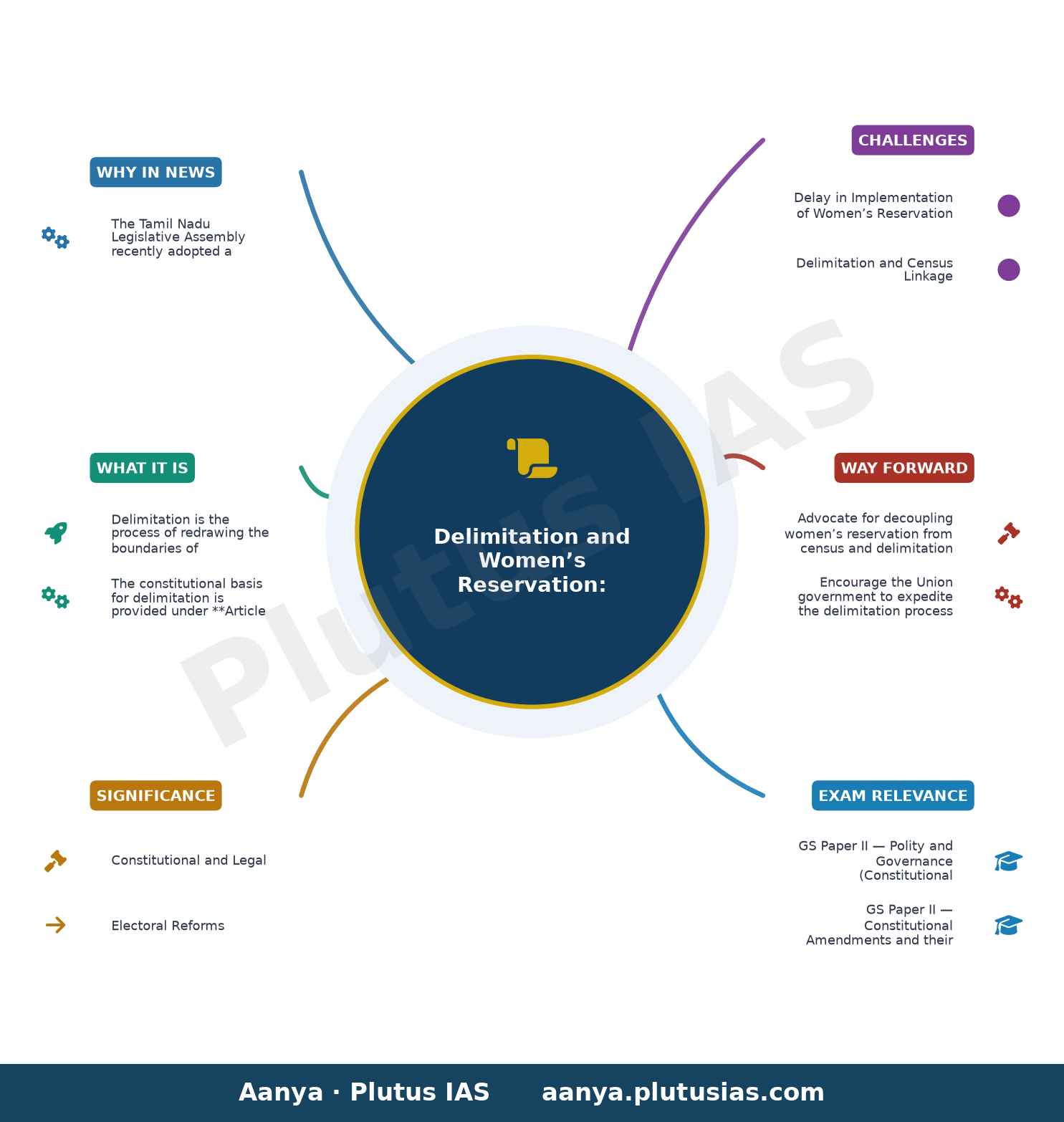
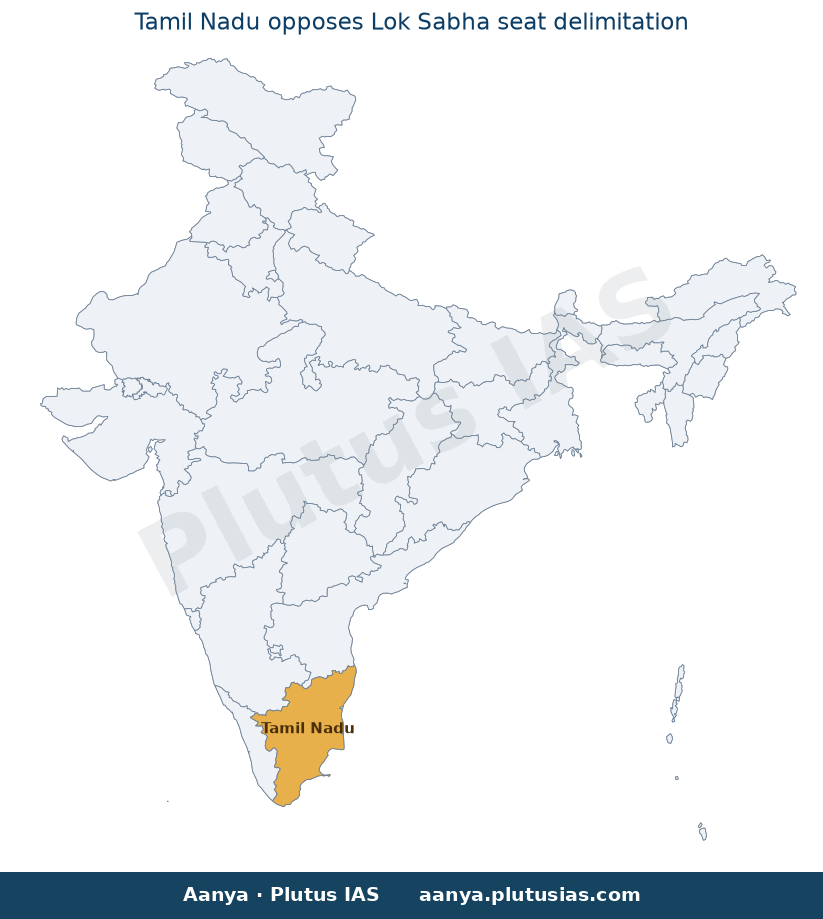
The Tamil Nadu Legislative Assembly recently adopted a resolution urging the Union government to freeze the number of Lok Sabha seats at 543 and maintain the existing inter-State distribution of seats. This development is significant as it intersects with the constitutional mandate for 33% reservation for women in Parliament and State Legislatures, which is currently deferred pending the population census and delimitation exercise. The resolution underscores the tension between demographic growth, constitutional commitments, and the principle of inter-State equity in India’s federal structure.
Background
- The current composition of the Lok Sabha at 543 seats is based on the 1971 Census. This freeze was extended until 2026 by the 84th Constitutional Amendment Act, 2001.
- The 106th Constitutional Amendment Act, 2023, provides for 33% reservation for women in the Lok Sabha and State Legislative Assemblies. However, its implementation is contingent upon the conduct of the next population census and subsequent delimitation exercise.
- Tamil Nadu’s resolution reflects broader concerns about the delay in implementing women’s reservation, which could defer its benefits for decades, particularly in states with lower women’s representation.
- The existing inter-State distribution of Lok Sabha seats is based on the 1971 Census, which has led to disparities in representation per voter across states due to demographic changes over five decades.
- The Lok Sabha-Rajya Sabha ratio of 2.2:1 is a long-standing convention, though not constitutionally mandated. Any alteration in the Lok Sabha’s strength would necessitate a corresponding adjustment in the Rajya Sabha’s composition.
What is Delimitation and its Constitutional Framework?
- Delimitation is the process of redrawing the boundaries of parliamentary and assembly constituencies based on the latest population data to ensure equitable representation. It is conducted by the Delimitation Commission, a statutory body established under the Delimitation Act, 2002.
- The constitutional basis for delimitation is provided under **Article 82** (readjustment after each census) and **Article 170** (composition of State Legislative Assemblies). The 42nd Amendment Act, 1976, froze the delimitation process until 2000, which was later extended by the 84th Amendment Act, 2001, to 2026.
- The current Lok Sabha strength of 543 seats was determined by the 1971 Census. Any increase in seats would require a constitutional amendment, as the total number of seats is capped at 550 (excluding nominated members) under **Article 81**.
- The **Delimitation Commission** consists of a retired Supreme Court judge, the Chief Election Commissioner, and the respective State Election Commissioners. Its decisions are final and cannot be challenged in any court.
- The 106th Constitutional Amendment Act, 2023, mandates 33% reservation for women in the Lok Sabha and State Legislative Assemblies. However, its implementation is deferred pending the next population census and delimitation exercise, creating a paradox where the law exists but its benefits are delayed.
- The Lok Sabha-Rajya Sabha ratio of 2.2:1 is a convention derived from the original constitutional design, where the Rajya Sabha’s strength is capped at 250 members (238 elected + 12 nominated). Altering the Lok Sabha’s strength would require a constitutional amendment to adjust the Rajya Sabha’s composition accordingly.
- States like Tamil Nadu argue that freezing the Lok Sabha seats at 543 preserves inter-State equity, as any increase in seats could disproportionately benefit states with higher population growth, potentially reducing the relative representation of states with slower demographic growth.
Key Features
| Feature | Significance |
|---|---|
| Freezing Lok Sabha seats at 543 | Prevents potential increase in seats that could alter inter-State seat distribution and disrupt existing electoral balances. |
| 33% reservation for women in Lok Sabha | Ensures constitutional mandate for gender representation is implemented without delay, aligning with the 106th Constitutional Amendment Act, 2023. |
| Maintaining Lok Sabha-Rajya Sabha ratio of 2.2:1 | Preserves the established proportional representation between the two Houses of Parliament, ensuring legislative continuity. |
| Opposition to delimitation without census | Highlights concerns over linking women’s reservation to an uncertain and delayed delimitation process. |
| State Assembly resolution as a political instrument | Demonstrates the use of legislative resolutions to influence central policy, particularly on electoral reforms. |
Why it Matters
Constitutional and Legal
- The resolution underscores the tension between constitutional amendments (e.g., 106th Amendment) and their implementation timelines, particularly the linkage to census and delimitation.
Electoral Reforms
- Freezing the number of seats at 543 reflects a preference for stability in electoral representation, avoiding frequent redistricting that could alter voter parity.
Gender Representation
- Emphasizes the urgency of implementing women’s reservation, given its constitutional guarantee, and the societal imperative for equitable political participation.
Federalism
- The resolution exemplifies a state’s role in advocating for policies that align with its electoral and demographic priorities, while engaging with central governance structures.
Challenges
1. Delay in Implementation of Women’s Reservation
- The 106th Amendment Act, 2023, guarantees 33% reservation for women but ties its implementation to the census and delimitation, risking indefinite postponement.
UPSC Link: GS-II: Constitutional Amendments
2. Delimitation and Census Linkage
- Linking delimitation to census data introduces delays, as censuses are decennial and delimitation exercises are politically sensitive and resource-intensive.
UPSC Link: GS-II: Electoral Reforms
3. Inter-State Seat Distribution
- Any change in the total number of Lok Sabha seats could disrupt the existing formula for seat allocation among states, leading to inter-state disputes.
UPSC Link: GS-II: Federalism
4. Political Consensus on Electoral Reforms
- The failure of the 131st Constitutional Amendment Bill, 2026, in the Lok Sabha highlights the challenges in achieving bipartisan support for critical electoral reforms.
UPSC Link: GS-II: Parliament
5. State vs. Central Jurisdiction
- The resolution raises questions about the balance of power between state legislatures and the Union government in matters of electoral policy.
UPSC Link: GS-II: Federalism
Challenges — UPSC Perspective
| Issue | Concern |
|---|---|
| Linkage of women’s reservation to delimitation | Risk of indefinite postponement of a constitutional guarantee due to procedural delays. |
| Potential increase in Lok Sabha seats | Could alter inter-State seat distribution, leading to disputes over representation. |
| Census and delimitation timelines | Decennial census and resource-intensive delimitation may not align with immediate policy needs. |
| Political fragmentation on electoral reforms | Lack of consensus on critical reforms may hinder progress on gender representation and seat distribution. |
| State-centre coordination | Need for harmonised approach between state resolutions and central implementation of electoral policies. |
Way Forward
- Advocate for decoupling women’s reservation from census and delimitation to ensure timely implementation of the 106th Amendment Act.
- Encourage the Union government to expedite the delimitation process while ensuring transparency and stakeholder consultations.
- Strengthen inter-state dialogue to address concerns over seat distribution and maintain federal harmony.
- Promote awareness campaigns to highlight the importance of gender representation in legislative bodies.
- Explore constitutional or legal mechanisms to resolve disputes arising from electoral reforms without undermining democratic principles.
- Encourage states to adopt resolutions that align with national priorities while respecting constitutional mandates.
- Facilitate multi-party discussions to build consensus on electoral reforms, including seat distribution and reservation policies.
UPSC Value Addition
Keywords for Mains Answer-Writing
Delimitation Commission · Lok Sabha seat freeze · Women’s Reservation Act 2023 · Constitutional Amendment 106th · Inter-State seat distribution · Lok Sabha-Rajya Sabha ratio · 33% women’s reservation · Tamil Nadu Legislative Assembly · Delimitation Bill 2026 · Constitutional provisions on delimitation · Parliamentary representation · Federalism in seat allocation · Reservation for women in legislatures · Population census and delimitation linkage · Constitutional amendments on representation
Constitutional & Policy Linkages
- Article 81: Composition of the Lok Sabha and seat distribution among states.
- Article 82: Readjustment of seats after each census.
- Article 153: Office of the Governor and its role in state administration.
- Seventh Schedule: Distribution of legislative powers between Union and States.
- 106th Constitutional Amendment Act, 2023: Women’s reservation in legislatures.
Concept Flow
Constitutional Amendment (106th) guaranteeing 33% women’s reservation in legislatures → Implementation delayed due to linkage to census and delimitation → State Assembly resolution advocating freeze on Lok Sabha seats at 543 → Opposition to delimitation without census → Risk of indefinite postponement of women’s reservation → Need for decoupling reservation from delimitation to ensure timely implementation → Broader debate on electoral reforms and federalism.
Prelims Practice Questions
Q1. Consider the following statements regarding the delimitation process in India:
1. The Delimitation Commission is a statutory body established under the Delimitation Act, 2002.
2. The primary objective of delimitation is to ensure fair representation of constituencies based on population.
3. The 106th Constitutional Amendment Act mandates 33% reservation for women in the Lok Sabha and State Legislative Assemblies.
4. Delimitation exercises are conducted after every decennial census.
How many of the above statements are correct?
- Only one
- Only two
- Only three
- All
Answer: Only three — Statements 2 and 4 are correct. Statement 1 is incorrect because the Delimitation Commission is established under the Delimitation Act, 2002, but it is a statutory body, not a constitutional one. Statement 3 is incorrect as the 106th Amendment provides for women’s reservation but does not mandate it in the Lok Sabha and State Legislative Assemblies; it requires enabling legislation.
Q2. Assertion (A): The 106th Constitutional Amendment Act, 2023, provides for 33% reservation for women in the Lok Sabha and State Legislative Assemblies.
Reason (R): The reservation for women will be implemented immediately after the passage of the Amendment, without any linkage to the delimitation process or population census.
In the context of the above statements, which of the following is correct?
- Both A and R are true, and R is the correct explanation of A
- Both A and R are true, but R is NOT the correct explanation of A
- A is true but R is false
- A is false but R is true
Answer: A is false but R is true — Assertion (A) is correct as the 106th Amendment indeed provides for 33% reservation for women. However, Reason (R) is incorrect because the reservation is not immediate; it is linked to the delimitation process and population census as per the Amendment’s provisions.
Q3. Match the following Constitutional Amendments with their respective provisions:
Column I (Amendment) | Column II (Provision)
— | —
A. 73rd Amendment Act, 1992 | 1. Reservation for women in Panchayats
B. 74th Amendment Act, 1992 | 2. Reservation for women in Municipalities
C. 106th Amendment Act, 2023 | 3. Reservation for women in Lok Sabha and State Legislative Assemblies
D. 104th Amendment Act, 2019 | 4. Abolition of Anglo-Indian reserved seats in Parliament and State Legislatures
Select the correct match:
- A-1, B-2, C-3, D-4
- A-2, B-1, C-3, D-4
- A-1, B-2, C-4, D-3
- A-4, B-3, C-2, D-1
Answer: A-1, B-2, C-3, D-4 — The correct matches are: A-1 (73rd Amendment provides for women’s reservation in Panchayats), B-2 (74th Amendment provides for women’s reservation in Municipalities), C-3 (106th Amendment provides for women’s reservation in Lok Sabha and State Legislative Assemblies), and D-4 (104th Amendment abolished Anglo-Indian reserved seats).
Mains Practice Question
✍ The Tamil Nadu Legislative Assembly has adopted a resolution urging the Union government to freeze the number of Lok Sabha seats at 543 and retain the current inter-State distribution of seats. Examine the constitutional and political implications of such a freeze, particularly in the context of the 106th Constitutional Amendment Act, 2023, which provides for 33% reservation for women in legislatures. Also, discuss the challenges posed by linking women’s reservation to the delimitation process. (15 Marks)
Approach: MODEL-ANSWER SKELETON:
1. **Constitutional Framework of Delimitation and Seat Freeze**:
– Article 82 and Article 170(3) of the Constitution mandate delimitation after every decennial census.
– The 42nd Amendment Act, 1976, froze the total number of Lok Sabha seats at 543 until the first census after 2000. The 84th Amendment Act, 2001, extended this freeze until the first census after 2026.
– The current resolution seeks to extend this freeze beyond 2026, citing concerns over inter-State seat distribution and the implementation of women’s reservation.
2. **Inter-State Seat Distribution and Federalism**:
– The current distribution of seats is based on the 1971 census, with a provision for adjustment after the 2001 census (which was not implemented due to the freeze).
– A freeze at 543 seats could lead to over-representation of states with slower population growth and under-representation of states with higher population growth, raising federalism concerns.
– The current Lok Sabha-Rajya Sabha ratio of 2.2:1 is a political compromise; any freeze could disrupt this balance.
3. **Women’s Reservation Act, 2023 (106th Amendment)**:
– The Act provides for 33% reservation for women in the Lok Sabha and State Legislative Assemblies.
– However, its implementation is linked to the delimitation process and the next population census, creating a potential delay.
– The Tamil Nadu resolution argues that women’s reservation should not be linked to delimitation, as this could deny women their political rights for years.
4. **Challenges of Linking Women’s Reservation to Delimitation**:
– **Delay in Implementation**: The next census is scheduled for 2031, and delimitation could take several years, delaying women’s reservation until at least the 2034 Lok Sabha elections.
– **Political Representation Concerns**: States like Tamil Nadu, which have higher women’s voter turnout and representation, argue that linking reservation to delimitation could dilute the immediate need for gender parity.
– **Constitutional and Legal Hurdles**: The 106th Amendment does not explicitly state that women’s reservation is contingent on delimitation, leaving room for interpretation.
5. **Alternative Approaches and Balancing Views**:
– **Immediate Implementation**: Some argue that women’s reservation should be implemented in the existing 543 seats without waiting for delimitation, using rotation or dual-member constituencies as a temporary measure.
– **State-Level Implementation**: States could implement women’s reservation in their Legislative Assemblies immediately, as the 106th Amendment applies to both Parliament and State Legislatures.
– **Constitutional Safeguards**: The Supreme Court could be approached to clarify whether the linkage of women’s reservation to delimitation is constitutionally valid or a violation of the spirit of the 106th Amendment.
6. **Conclusion**:
– The freeze on Lok Sabha seats at 543 raises questions about federalism, representation, and the timely implementation of constitutional amendments.
– The linkage of women’s reservation to delimitation highlights the tension between procedural fairness and substantive gender justice, requiring a nuanced and balanced approach.
Source: The Hindu
Generated by AanyaAi for educational purpose.

- Gurugram’s groundwater extraction exceeds limit by 212%; HC seeks ban - October 4, 2026
- स्वतंत्रता सेनानी श्यामजी कृष्ण वर्मा की जन्म जयंती पर पीएम का श्रद्धांजलि - October 4, 2026
- KWML’s Feasibility Reports for Water Metro in 18 Cities: UPSC & PCS Insights - October 3, 2026

No Comments