


03 Sep Tamil Nadu Assembly Introduces Bill to Amend Fire & Rescue Services Act 2025
✎ The Tamil Nadu Fire and Rescue Services (Amendment) Bill, 2026, removes references to the withdrawn National Building Code of India (NBC) 2016 to align with BRAP 2026 recommendations, modernising state fire safety regulations…
Subject Relevance — Where This Topic Fits
- GS Paper II — Governance, Constitution and Polity (State Legislatures and State Executive) | GS Paper III — Disaster Management (Fire Safety and Prevention)
- Prelims: Fire and Rescue Services Act, National Building Code of India (NBC) 2016, Business Reforms Action Plan (BRAP) 2026, Bureau of Indian Standards (BIS), Construction Permit and Building Regulations, State Legislative Assembly, Gazette Notification, Fire Safety Standards
- Essay: The Role of State Governance in Modernising Safety Standards: A Case Study of Tamil Nadu’s Fire Safety Reforms, Balancing Regulatory Rigour and Ease of Doing Business in Public Safety Governance
Quick Revision: The Tamil Nadu Fire and Rescue Services (Amendment) Bill, 2026, removes references to the withdrawn National Building Code of India (NBC) 2016 to align with BRAP 2026 recommendations, modernising state fire safety regulations while ensuring compliance with updated national standards.
Why is this in the news?
The Tamil Nadu Assembly introduced a Bill to amend the Tamil Nadu Fire and Rescue Services Act, 2025, with the objective of removing references to the National Building Code of India (NBC) 2016, as mandated by the Business Reforms Action Plan (BRAP) 2026. This amendment reflects a broader policy shift towards aligning state-level fire safety regulations with modernised and liberalised standards, as recommended by the Bureau of Indian Standards (BIS). The move underscores the intersection of disaster management, regulatory compliance, and economic governance in the context of urban development and industrial safety.
Background
- The National Building Code of India (NBC) 2016, formulated by the Bureau of Indian Standards (BIS), served as a comprehensive guideline for building construction, fire safety, and structural integrity across India.
- The Bureau of Indian Standards (BIS) issued a Gazette notification on April 30, 2026, withdrawing the NBC 2016, signalling the need for updated and more flexible fire safety standards.
- State governments are required to align their local laws and regulations with the recommendations of BRAP to streamline construction and fire safety approvals, thereby fostering industrial growth and urban development.
- The Tamil Nadu Fire and Rescue Services Act, 2025, is the primary legislation governing fire safety, rescue operations, and emergency response in the state.
- The amendment reflects a trend of state governments adapting to central policy recommendations while ensuring compliance with evolving national standards in disaster management.
What is the Tamil Nadu Fire and Rescue Services (Amendment) Bill, 2026?
- The Bill seeks to amend the Tamil Nadu Fire and Rescue Services Act, 2025, by removing references to the National Building Code of India (NBC) 2016, which has been withdrawn by the Bureau of Indian Standards (BIS).
- The amendment aligns the state’s fire safety regulations with the recommendations of the Business Reforms Action Plan (BRAP) 2026, which advocates for modernised and liberalised building and fire safety norms.
- The primary objective is to replace the outdated NBC 2016 references with more contemporary and flexible standards, thereby facilitating smoother construction permit processes and reducing regulatory bottlenecks.
- The Bill is part of a broader effort to integrate disaster management policies with economic governance, ensuring that fire safety regulations support both public safety and industrial growth.
- The amendment does not dilute fire safety standards but rather updates the legal framework to reflect current national guidelines and best practices in fire prevention and response.
- The Bill was introduced in the Tamil Nadu Legislative Assembly on September 3, 2026, by the Minister for Energy Resources and Law, C.T.R. Nirmal Kumar, on behalf of the Chief Minister.
- The move is consistent with the central government’s emphasis on ‘Ease of Doing Business’ and the need for states to adopt flexible regulatory frameworks in critical sectors such as construction and industrial safety.
- The amendment process involves legislative scrutiny, including debates and discussions in the Assembly, before it is enacted into law.
Key Features
| Feature | Significance |
|---|---|
| Removal of NBC 2016 references | Aligns state fire safety regulations with updated national standards by replacing outdated technical references. |
| Compliance with BRAP 2026 | Ensures alignment with the Business Reforms Action Plan’s priority on modernising construction permit and building regulations. |
| State-level legislative amendment | Demonstrates the state’s proactive role in adapting to central policy shifts without waiting for statutory mandates. |
| Modernisation of fire norms | Facilitates the adoption of liberalised and contemporary standards in building safety protocols. |
| Gazette notification withdrawal | Acknowledges the central government’s withdrawal of NBC 2016, necessitating legal adjustments in state legislation. |
Why it Matters
Administrative Efficiency
- Streamlines regulatory compliance by eliminating redundant references to a superseded national code.
- Reduces administrative friction in building permit approvals by simplifying fire safety norms.
- Enhances the ease of doing business in Tamil Nadu by aligning with BRAP 2026 recommendations.
Policy Harmonisation
- Ensures consistency between state and central policies in fire safety regulations post-withdrawal of NBC 2016.
- Promotes uniformity in building safety standards across jurisdictions through modernised norms.
- Facilitates inter-state coordination in disaster management and emergency response protocols.
Economic Implications
- Potential reduction in compliance costs for developers and builders due to simplified fire safety regulations.
- May accelerate construction projects by expediting permit approvals tied to modernised norms.
- Supports Tamil Nadu’s industrial and commercial growth by fostering a business-friendly regulatory environment.
Public Safety Governance
- Maintains, and potentially strengthens, fire safety standards through the adoption of contemporary norms.
- Ensures that fire and rescue services remain equipped to handle evolving safety challenges in urban and industrial settings.
- Demonstrates a commitment to evidence-based policy updates in disaster risk reduction.
Challenges
1. Regulatory Transition Risks
- Potential confusion during the interim period as stakeholders adapt to new norms replacing NBC 2016.
- Risk of inconsistent implementation if modernised standards are not uniformly adopted by local authorities.
- Possible gaps in enforcement if fire and rescue services lack training on updated protocols.
UPSC Link: GS-II: Disaster Management
2. Stakeholder Coordination
- Need for extensive consultation with architects, engineers, and builders to ensure smooth transition to new standards.
- Challenge of aligning municipal and state-level enforcement mechanisms with revised norms.
- Ensuring that insurance and financial institutions recognise and accept the updated safety standards.
UPSC Link: GS-III: Ease of Doing Business
3. Technical Capacity Building
- Requirement for upskilling fire and rescue personnel to handle modernised safety protocols and equipment.
- Need for investment in infrastructure to support new fire safety norms in high-risk areas.
- Potential delays if technical manuals and guidelines are not promptly updated and disseminated.
UPSC Link: GS-III: Science & Technology
4. Legal and Compliance Clarity
- Risk of legal ambiguities if the amendment does not clearly delineate the scope of new norms versus existing laws.
- Challenge of ensuring that all relevant state laws (e.g., municipal acts) are harmonised with the amendment.
- Need for periodic reviews to prevent obsolescence of the updated standards.
UPSC Link: GS-II: Centre-State Relations
Challenges — UPSC Perspective
| Issue | Concern |
|---|---|
| Interim regulatory confusion | Stakeholders may face uncertainty during the transition from NBC 2016 to new norms. |
| Inconsistent local enforcement | Municipal bodies may struggle to uniformly implement modernised standards. |
| Training gaps in services | Fire and rescue personnel may lack readiness to enforce updated protocols. |
| Stakeholder consultation delays | Extended deliberations with architects and builders could slow down adoption. |
| Technical infrastructure lag | Inadequate resources to support new safety norms in high-risk zones. |
| Legal ambiguity risks | Unclear delineation of new norms may lead to compliance disputes. |
Way Forward
- Conduct nationwide workshops to sensitise municipal authorities, builders, and fire services on the updated norms.
- Develop a phased rollout plan with clear timelines for transitioning from NBC 2016 to modernised standards.
- Establish a dedicated task force within the Tamil Nadu Fire and Rescue Services to monitor implementation and address grievances.
- Invest in capacity-building programmes for fire personnel, including hands-on training with new safety equipment.
- Publish updated technical manuals and guidelines in regional languages for wide accessibility.
- Collaborate with the Bureau of Indian Standards to ensure alignment with national best practices in fire safety.
- Incorporate feedback from industry associations to refine norms and address practical challenges in compliance.
- Integrate digital tools (e.g., GIS mapping) to streamline permit approvals and enhance enforcement transparency.
UPSC Value Addition
Keywords for Mains Answer-Writing
Tamil Nadu Fire and Rescue Services Act · National Building Code of India 2016 · Business Reforms Action Plan 2026 · Bureau of Indian Standards · Fire safety regulations · Building permit reforms · State-List subjects · Regulatory liberalisation · Fire and rescue services governance · Construction permit modernisation · Statutory amendments · Regulatory compliance · Fire safety standards · State legislative process
Concept Flow
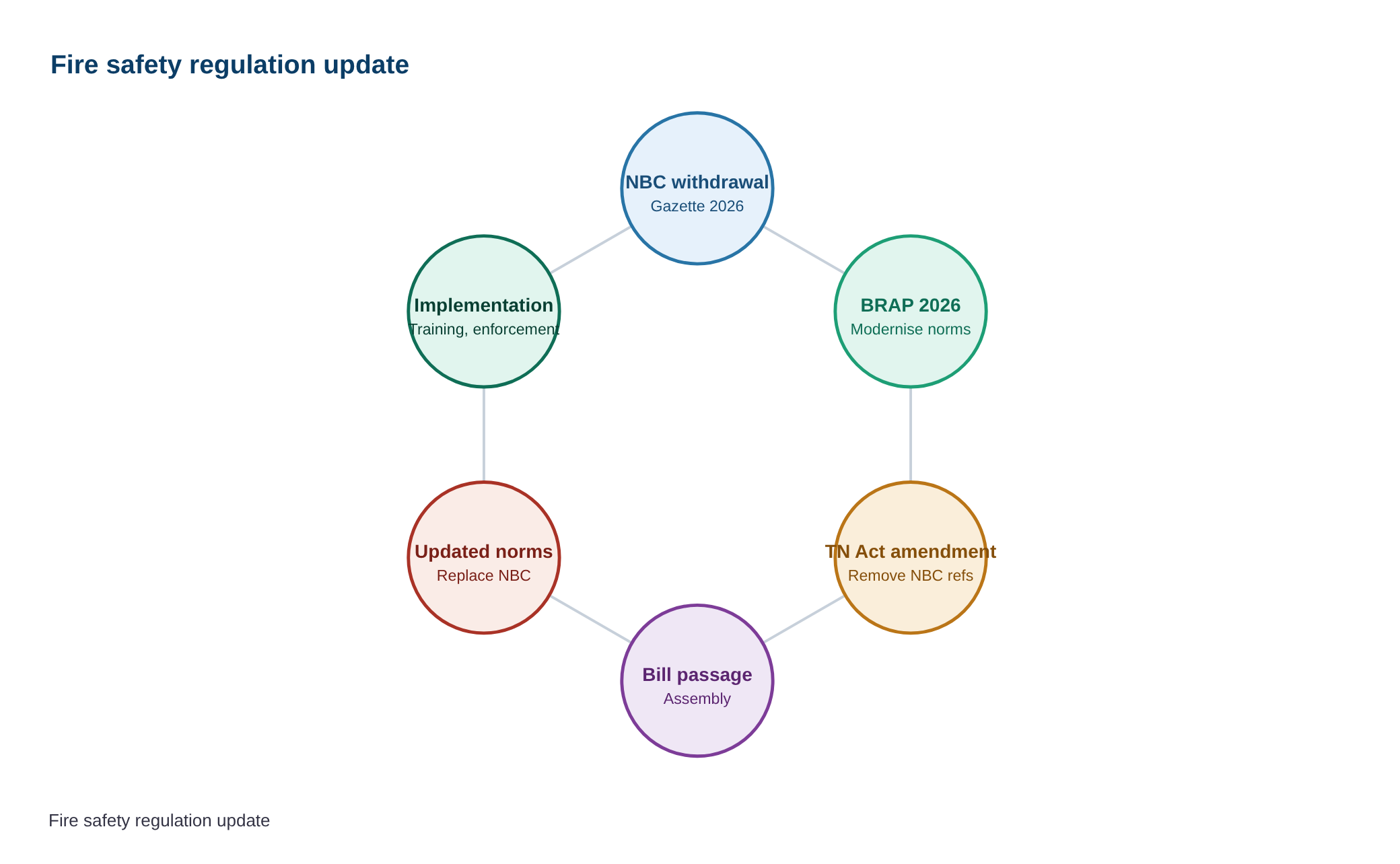
Central withdrawal of NBC 2016 via Gazette notification → → Recommendations of BRAP 2026 for modernising building regulations → → State government’s decision to amend Tamil Nadu Fire and Rescue Services Act → → Legislative process: Bill introduction and passage in Assembly → → Operationalisation: Updated norms replace NBC 2016 references → → Implementation: Training, enforcement, and stakeholder alignment → → Outcome: Enhanced fire safety standards and ease of doing business in Tamil Nadu
Prelims Practice Questions
Q1. Consider the following statements regarding the National Building Code of India (NBC), 2016:
1. The NBC, 2016 was formulated by the Bureau of Indian Standards (BIS).
2. The NBC, 2016 is a mandatory code applicable nationwide.
3. The NBC, 2016 was withdrawn by a Gazette notification issued by the BIS on April 30, 2026.
4. The NBC, 2016 includes provisions related to fire safety in buildings.
How many of the above statements are correct?
- Only one
- Only two
- Only three
- All four
Answer: All four — Statements 1, 2, and 4 are correct. The NBC, 2016 was formulated by the BIS and included fire safety provisions. However, statement 3 is incorrect as the NBC, 2016 was not withdrawn; rather, its references are being removed from state laws as per BRAP 2026 recommendations.
Q2. Assertion (A): The Business Reforms Action Plan (BRAP), 2026, recommends modernising fire and building norms by removing references to the National Building Code (NBC) from state laws.
Reason (R): The Bureau of Indian Standards (BIS) withdrew the NBC, 2016 through a Gazette notification on April 30, 2026.
Options:
A. Both A and R are true, and R is the correct explanation of A.
B. Both A and R are true, but R is not the correct explanation of A.
C. A is true, but R is false.
D. A is false, but R is true.
- A
- B
- C
- D
Answer: B — Both Assertion (A) and Reason (R) are true. The BRAP 2026 recommends modernising norms by removing NBC references, and the BIS issued a Gazette notification on April 30, 2026, withdrawing the NBC, 2016. R correctly explains A.
Q3. Match the following pairs related to fire safety regulations in India:
Column I
1. National Building Code of India, 2016
2. Business Reforms Action Plan (BRAP), 2026
3. Bureau of Indian Standards (BIS)
4. Tamil Nadu Fire and Rescue Services Act, 2025
Column II
A. Formulates standards for construction and fire safety
B. State-level legislation governing fire and rescue services
C. Central code for building construction and safety
D. Central government initiative for ease of doing business
Select the correct match:
- 1-C, 2-D, 3-A, 4-B
- 1-A, 2-B, 3-C, 4-D
- 1-D, 2-A, 3-B, 4-C
- 1-B, 2-C, 3-D, 4-A
Answer: 1-C, 2-D, 3-A, 4-B — The correct match is: 1-C (NBC is a central code), 2-D (BRAP is a central initiative), 3-A (BIS formulates standards), 4-B (Tamil Nadu Act is state legislation).
Mains Practice Question
✍ The Government of Tamil Nadu has introduced a Bill to amend the Tamil Nadu Fire and Rescue Services Act, 2025, with a view to modernising fire safety regulations by removing references to the National Building Code of India, 2016. Critically examine the implications of this amendment for fire safety governance, regulatory coherence, and ease of doing business in the state. (15 Marks)
Approach: MODEL-ANSWER SKELETON:
1. **Context and Rationale**: Explain the purpose of the amendment—removing NBC references to align with BRAP 2026 recommendations and modernise fire safety norms. Highlight the withdrawal of NBC 2016 by BIS via Gazette notification (April 30, 2026).
2. **Governance Implications**:
– **State-List Subject**: Fire and rescue services fall under the State List (7th Schedule, Entry 1). The amendment reinforces state autonomy in regulating fire safety.
– **Regulatory Coherence**: Discuss potential fragmentation in fire safety standards across states if NBC references are removed without a clear alternative framework.
– **Ease of Doing Business**: Argue that modernising norms (as per BRAP) may reduce compliance burdens and expedite construction permits, but risks must be mitigated.
3. **Fire Safety Standards**:
– **Current Framework**: NBC 2016 provided uniform national standards for fire safety in buildings. Its removal necessitates alternative standards (e.g., state-specific codes or updated BIS standards).
– **Gaps and Risks**: Highlight risks of inconsistent enforcement, lack of expertise in state agencies, and potential safety lapses if standards are diluted.
4. **Comparative Perspective**:
– Cite examples of other states or countries where similar reforms were implemented (e.g., Gujarat’s ease-of-doing-business reforms).
– Discuss the role of the National Disaster Management Authority (NDMA) in setting guidelines for fire safety.
5. **Way Forward**:
– Propose a balanced approach: retain core NBC principles while allowing state-level flexibility.
– Emphasise the need for capacity-building in state fire and rescue services to enforce modernised norms.
– Suggest a phased transition with stakeholder consultations (e.g., architects, builders, fire safety experts).
6. **Conclusion**: Balance the benefits of regulatory liberalisation with the imperative of maintaining robust fire safety standards.
Source: The Hindu
Tamil Nadu PCS (TNPSC) — State PCS Practice
Prelims: Which of the following is the primary objective of the ‘Tamil Nadu Fire and Rescue Services (Amendment) Bill, 2023’ introduced in the State Assembly?
- To increase the retirement age of fire personnel from 58 to 60 years
- To integrate drone technology for fire surveillance and rescue operations
- To enhance the penalties for arson and fire-related offenses
- To establish a separate cadre for forest fire management under the Fire and Rescue Services Department
Answer: To establish a separate cadre for forest fire management under the Fire and Rescue Services Department — The Bill aims to amend the Tamil Nadu Fire and Rescue Services Act to include provisions for a dedicated cadre to handle forest fire management, addressing the increasing incidents of wildfires in the state.
Mains: Critically analyze the significance of the ‘Tamil Nadu Fire and Rescue Services (Amendment) Bill, 2023’ in addressing the challenges faced by the state’s fire and rescue services. Suggest measures to improve the operational efficiency and preparedness of the department in the context of climate change and urbanization.
Generated by AanyaAi for educational purpose.
Related guides on our sites
- Best PSIR optional coaching for upsc
- Best PSIR optional teacher for upsc
- Best teacher of PSIR optional for upsc
- Best PSIR optional coaching in delhi for UPSC

- India-Australia AUSTRAHIND 2026 Exercise: Key Highlights for UPSC & State PCS - October 22, 2026
- एससीओ बैठक में भारत का आतंकवाद विरोध: क्षेत्रीय सहयोग पर जोर - October 22, 2026
- SEC Directs Strict SC Order Compliance for Andhra ULB Polls - October 22, 2026

No Comments