


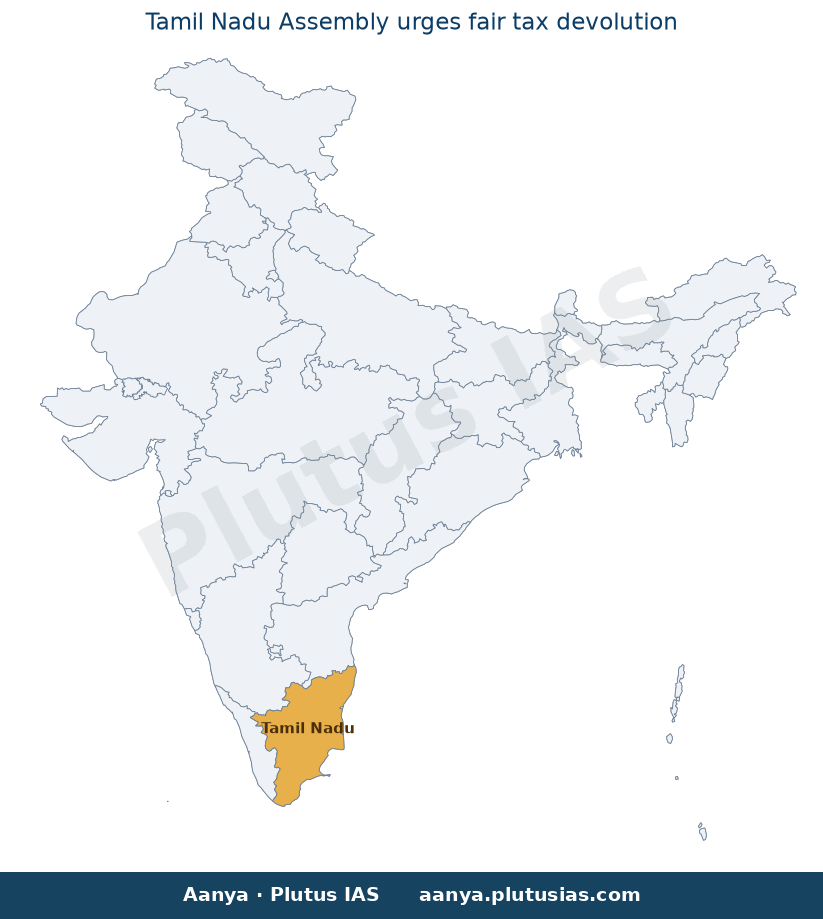
08 Aug Tamil Nadu Assembly Unanimously Demands Fairer Central Tax Devolution Formula
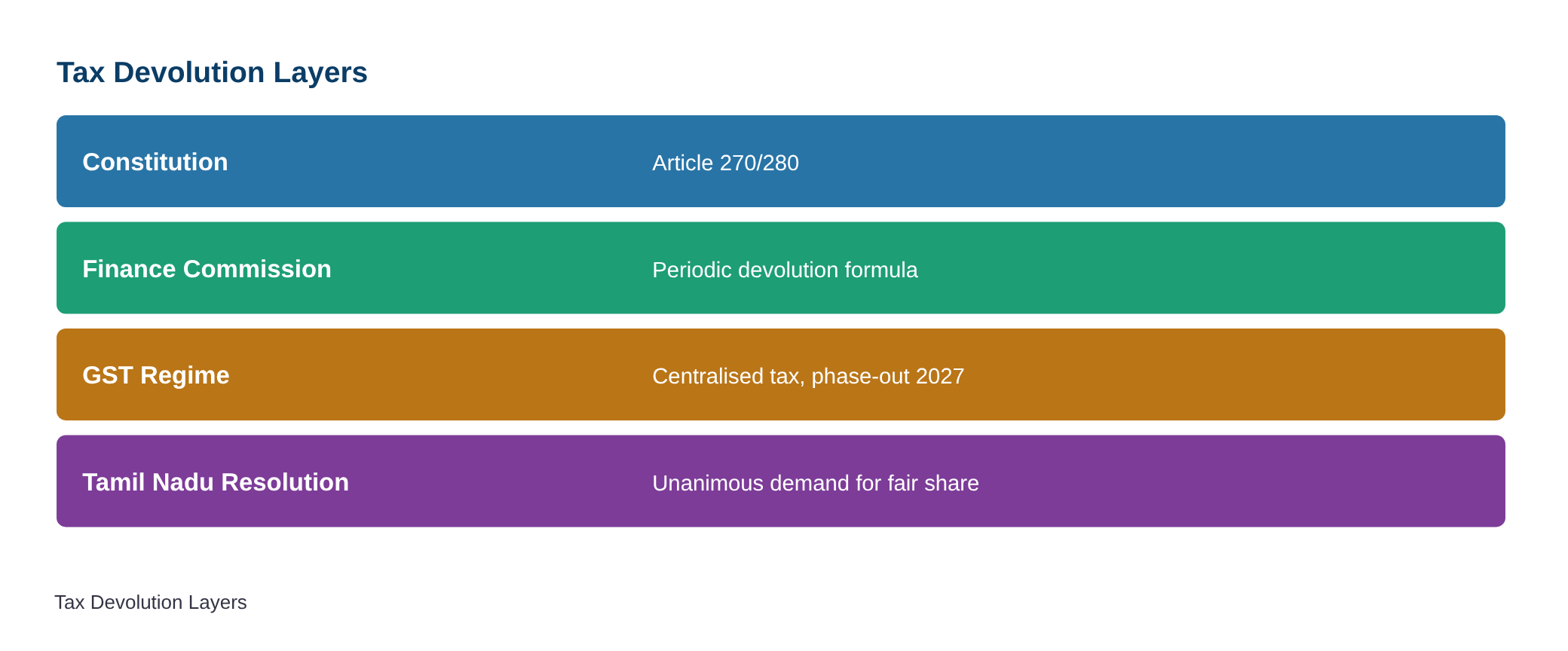
✎ The Finance Commission, under Article 280 of the Constitution, determines the principles for tax devolution, balancing equity, efficiency, and fiscal autonomy in India's federal structure.
Subject Relevance — Where This Topic Fits
- GS Paper II — Functions and Responsibilities of the Union and the States, Issues and Challenges Pertaining to the Federal Structure, Devolution of Powers and Finances up to Local Levels and Challenges Therein | GS Paper III — Indian Economy and Issues Relating to Planning, Mobilisation of Resources, Growth, Development and Employment
- Prelims: Article 270, Article 275, Finance Commission, Tax Devolution, GST Compensation, Fiscal Federalism, Horizontal Devolution, Vertical Devolution, Gadgil Formula, Inter-State Inequality
- Essay: Federalism in India: Challenges and Opportunities, Equity and Efficiency in Fiscal Federalism: Balancing Development and Fiscal Autonomy
Quick Revision: The Finance Commission, under Article 280 of the Constitution, determines the principles for tax devolution, balancing equity, efficiency, and fiscal autonomy in India’s federal structure.
Why is this in the news?
The Tamil Nadu Assembly’s unanimous adoption of a resolution on August 7, 2026, demanding a fair share of Central tax devolution underscores the persistent tensions in India’s fiscal federalism. The resolution, moved by Finance Minister N. Marie Wilson, highlights the need for a transparent, objective, and equitable methodology for tax devolution that recognises states’ fiscal efforts, governance performance, and developmental needs, particularly in the context of population stabilisation and human development achievements.
Background
- The Constitution of India, under Article 270, provides for the distribution of Union tax revenues between the Centre and the states, with the Finance Commission playing a pivotal role in determining the devolution formula.
- The Finance Commission, constituted periodically, is tasked with recommending the principles governing the distribution of net proceeds of taxes between the Union and the states, as well as among the states themselves.
- Tamil Nadu, like other states, has historically argued for a devolution formula that accounts for its demographic and developmental achievements, including its progress in population stabilisation and human development indicators.
- The 15th Finance Commission (2020-2025) recommended a horizontal devolution formula that included criteria such as population, demographic performance, forest cover, and tax effort, which some states, including Tamil Nadu, have contended does not fully reflect their contributions and needs.
- The Goods and Services Tax (GST) regime, introduced in 2017, has further complicated fiscal federalism by centralising tax collection and compensating states for revenue losses, though the compensation mechanism is set to phase out by 2027.
- States with higher human development indices and lower population growth rates, such as Tamil Nadu, have consistently advocated for a devolution formula that rewards performance and mitigates disparities arising from historical and structural factors.
What is Central Tax Devolution and Its Constitutional Framework?
- Central tax devolution refers to the distribution of a portion of the Union government’s tax revenue to the states, as mandated by the Constitution under Article 270.
- The Finance Commission, a constitutional body, is responsible for recommending the principles for this distribution, including the vertical devolution (Centre to states) and horizontal devolution (among states).
- Vertical devolution determines the proportion of the Union’s tax revenue that is shared with states, while horizontal devolution allocates this shared pool among states based on specified criteria.
- The criteria for horizontal devolution typically include population, income distance, area, forest cover, and demographic performance, as recommended by successive Finance Commissions.
- However, states like Tamil Nadu argue that the current methodology does not fully account for their fiscal efforts, governance performance, or the additional costs incurred in providing public services to a more developed population.
- The resolution also underscores the need to protect states’ legitimate financial interests in the context of the upcoming 16th Finance Commission (2026-2031), which will shape the fiscal landscape for the next five years.
- Fiscal federalism in India seeks to balance the Centre’s redistributive role with the states’ autonomy in resource mobilisation and expenditure, ensuring equitable development across regions.
Key Features
| Feature | Significance |
|---|---|
| Unanimous State Assembly Resolution | Demonstrates bipartisan political consensus in Tamil Nadu on the issue of tax devolution, enhancing the resolution’s moral and political weight. |
| Call for Transparent Methodology | Advocates for a predictable, rule-based framework for tax devolution, reducing discretionary allocations and enhancing fiscal federalism. |
| Recognition of Fiscal Effort and Developmental Needs | Emphasises the need to reward states for their governance performance and human development outcomes, aligning with constitutional principles. |
| Protection Against Disincentives for Population Stabilisation | Highlights the risk of penalising states for successful population policies, ensuring equity in devolution criteria. |
| Safeguarding Financial Interests | Asserts the State’s right to protect its legitimate financial claims in future devolution arrangements, reflecting constitutional federalism. |
Why it Matters
Economic
- The resolution underscores the economic imperative of ensuring equitable tax devolution to states, which is critical for balanced regional development and fiscal sustainability.
- A transparent methodology for tax devolution can reduce inter-state fiscal disparities and promote cooperative federalism by aligning contributions with receipts.
- Tamil Nadu’s demand reflects broader concerns about the adequacy of the Finance Commission’s recommendations, particularly in light of the 15th Finance Commission’s evolving criteria.
- The State’s fiscal health is directly impacted by devolution, as it forms a significant portion of its revenue, influencing budgetary allocations for welfare and infrastructure.
Constitutional/Federal
- The resolution invokes constitutional principles of fiscal federalism (Article 280) and equity, reinforcing the need for a fair and objective devolution framework.
- It challenges the Centre’s discretion in determining devolution criteria, advocating for a consultative and participatory process involving states.
- The demand for protecting developmental achievements (e.g., population stabilisation) aligns with the constitutional mandate to promote welfare and social justice.
- The resolution reflects the tension between the Centre’s authority to frame tax devolution criteria and the states’ right to equitable fiscal treatment under the Constitution.
Political
- The unanimous adoption of the resolution signals a rare cross-party consensus in Tamil Nadu, strengthening the State’s bargaining position in Centre-State negotiations.
- It reflects Tamil Nadu’s assertive stance on fiscal federalism, consistent with its historical advocacy for state autonomy in economic matters.
- The resolution may influence national discourse on tax devolution, particularly in the context of the 16th Finance Commission’s impending recommendations.
Administrative
- The call for a transparent methodology aims to reduce administrative opacity in tax devolution, enhancing predictability for state planning and budgeting.
- It highlights the administrative challenges in reconciling diverse state needs with centralised fiscal policies, necessitating a collaborative approach.
Challenges
1. Discretionary Allocation Framework
- The Centre’s reliance on ad-hoc criteria for tax devolution undermines fiscal federalism and creates uncertainty for states.
- Lack of a standardised methodology can lead to inter-state disputes and perceptions of bias, eroding trust in the Centre-State fiscal relationship.
UPSC Link: GS-II: Cooperative Federalism
2. Incentive Misalignment in Devolution Criteria
- Current criteria may inadvertently penalise states for achieving population stabilisation or high human development indices, creating perverse incentives.
- For example, states with lower population growth rates may receive less devolution, despite their developmental achievements.
UPSC Link: GS-II: Fiscal Federalism
3. Vertical and Horizontal Fiscal Imbalances
- Vertical imbalance arises from the Centre’s disproportionate share of tax revenue, while horizontal imbalance stems from unequal distribution among states.
- These imbalances exacerbate regional disparities and constrain state governments’ ability to fund essential services.
UPSC Link: GS-II: Finance Commission
4. Centre-State Fiscal Conflicts
- Divergent priorities between the Centre and states often lead to conflicts over revenue sharing, as seen in disputes over GST compensation and cess utilisation.
- Tamil Nadu’s resolution exemplifies the broader challenge of balancing national priorities with state-specific developmental needs.
UPSC Link: GS-II: Centre-State Relations
5. Implementation Gaps in Finance Commission Recommendations
- Even when the Finance Commission recommends equitable criteria, the Centre may deviate from these in practice, as seen in the utilisation of cess and surcharges.
- This undermines the credibility of the Finance Commission’s role as an independent arbiter of fiscal federalism.
UPSC Link: GS-II: Finance Commission
Challenges — UPSC Perspective
| Issue | Concern |
|---|---|
| Ad-hoc Devolution Criteria | Lack of transparency and predictability in tax devolution undermines fiscal federalism. |
| Penalisation of Population Stabilisation | States achieving demographic goals may face reduced devolution, creating disincentives. |
| Vertical Fiscal Imbalance | Centre retains a disproportionate share of tax revenue, limiting states’ fiscal autonomy. |
| Horizontal Fiscal Disparities | Unequal distribution of devolution exacerbates regional economic inequalities. |
| Centre-State Fiscal Conflicts | Divergent priorities lead to disputes over revenue sharing and utilisation. |
| Implementation Gaps in Finance Commission Recommendations | Deviation from recommended criteria by the Centre undermines trust in the system. |
Way Forward
- The Union government should constitute a high-powered committee with state representatives to review and standardise the methodology for tax devolution, ensuring transparency and objectivity.
- The 16th Finance Commission should explicitly incorporate criteria that reward states for population stabilisation and human development achievements, without penalising progress.
- States should be granted greater autonomy in utilising their share of devolved taxes, subject to constitutional constraints, to align with local developmental priorities.
- The Centre should publish detailed, disaggregated data on tax devolution criteria and allocations to enable public scrutiny and reduce discretionary practices.
- A permanent inter-state fiscal council should be established to facilitate continuous dialogue and consensus-building on devolution-related issues.
- The Finance Commission should be mandated to conduct periodic reviews of the impact of its recommendations on state finances, with corrective mechanisms for deviations.
- States should explore legal recourse, including constitutional challenges, if the Centre’s devolution practices violate the principles of equity and federalism.
- Civil society and academic institutions should be engaged to analyse and propose reforms to the tax devolution framework, ensuring evidence-based policymaking.
UPSC Value Addition
Keywords for Mains Answer-Writing
Fiscal Federalism in India · Devolution of Central Taxes · Finance Commission of India · Article 280 of the Constitution · Terms of Reference of Finance Commission · Horizontal Devolution Criteria · Vertical Devolution Criteria · Equitable Distribution of Resources · State Finance and Development · Constitutional Principles of Fiscal Equity · Performance-based Grants · Population Stabilisation and Human Development · Tamil Nadu’s Fiscal Concerns · Union-State Financial Relations · NITI Aayog’s Role in Resource Allocation
Constitutional & Policy Linkages
- Article 280: Finance Commission – Mandates periodic review of Centre-State financial relations and tax devolution.
- Article 270: Distribution of Union taxes – Provides the constitutional basis for tax sharing between Centre and states.
- Article 275: Grants-in-aid – Allows for specific grants to states, complementing tax devolution.
- Seventh Schedule: Union and State Lists – Defines the division of legislative and fiscal powers between Centre and states.
Concept Flow
Centre’s discretionary allocation of Union taxes → Perceived inequity in devolution → Tamil Nadu Assembly’s unanimous resolution → Demand for transparent, objective methodology → Emphasis on fiscal effort and developmental needs → Protection of legitimate financial interests → Broader debate on fiscal federalism → Potential reforms in Finance Commission recommendations.
Prelims Practice Questions
Q1. Consider the following statements regarding the Finance Commission of India:
1. It is a constitutional body established under Article 280 of the Constitution.
2. Its primary function is to recommend the distribution of net proceeds of taxes between the Union and the States.
3. The Commission is required to use only population data as the sole criterion for horizontal devolution.
4. The recommendations of the Finance Commission are binding on the Union Government.
How many of the above statements are correct?
- Only one
- Only two
- Only three
- All four
Answer: Only three — Statements 1 and 2 are correct. Statement 3 is incorrect as the Commission uses multiple criteria including population, income distance, and area. Statement 4 is incorrect as the recommendations are advisory, not binding.
Q2. Assertion (A): The Finance Commission of India is mandated to ensure that states receive a fair share of Central tax devolution.
Reason (R): The Finance Commission uses a transparent and objective methodology to determine the vertical and horizontal devolution of taxes.
Options:
A. Both A and R are true, and R is the correct explanation of A.
B. Both A and R are true, but R is not the correct explanation of A.
C. A is true, but R is false.
D. A is false, but R is true.
Answer: ? — Both A and R are true. The Finance Commission is tasked with recommending the distribution of Central taxes to states, and it employs a transparent methodology based on constitutional principles.
Q3. Match the following criteria used by the Finance Commission for horizontal devolution with their respective descriptions:
Column I (Criteria)
A. Population
B. Income Distance
C. Area
D. Forest Cover
Column II (Descriptions)
1. Represents the fiscal capacity of states relative to the national average.
2. Accounts for the geographical size of the state.
3. Reflects the demographic size of the state.
4. Recognises the ecological and environmental contributions of states.
Options:
A. A-3, B-1, C-2, D-4
B. A-2, B-1, C-3, D-4
C. A-1, B-3, C-2, D-4
D. A-4, B-2, C-1, D-3
Answer: ? — Population (A) is matched with 3 (demographic size). Income Distance (B) is matched with 1 (fiscal capacity). Area (C) is matched with 2 (geographical size). Forest Cover (D) is matched with 4 (ecological contributions).
Mains Practice Question
✍ The Finance Commission of India is constitutionally mandated to ensure an equitable distribution of Central tax revenues among States. In light of Tamil Nadu’s recent Assembly resolution demanding a fair share of tax devolution, critically examine the principles and criteria governing the horizontal distribution of Central taxes. Also, assess the challenges in balancing fiscal federalism with developmental equity. (15 Marks)
Approach: MODEL-ANSWER SKELETON:
1. **Constitutional and Legal Framework**:
– Article 280 of the Constitution establishes the Finance Commission (FC) as a quasi-judicial body.
– FC’s Terms of Reference (ToR) include vertical (Union-State) and horizontal (State-State) devolution.
– Vertical devolution: Share of States in net proceeds of taxes (Art. 270).
– Horizontal devolution: Criteria such as population (1971 Census), income distance, area, and forest cover (15th FC).
2. **Principles of Fiscal Federalism**:
– Equity: Equal treatment of States with similar fiscal capacities.
– Efficiency: Rewarding fiscal effort and performance (e.g., tax collection, governance).
– Need: Addressing developmental disparities (e.g., human development indices, backwardness).
– Stability: Predictable and transparent criteria to reduce uncertainty.
3. **Criteria for Horizontal Devolution**:
– **Population (1971 Census)**: Ensures stability but penalises States with successful population stabilisation (e.g., Tamil Nadu).
– **Income Distance**: Measures fiscal capacity; states with lower per capita income receive higher shares.
– **Area**: Recognises geographical challenges (e.g., hill states).
– **Forest Cover**: Acknowledges ecological contributions (15th FC).
4. **Challenges in Balancing Equity and Development**:
– **Population vs. Development**: States like Tamil Nadu, with lower fertility rates, argue that population-based criteria disadvantage them despite higher human development achievements.
– **Performance-based Grants**: FC has introduced performance grants (e.g., for GST compliance), but these may not fully address structural inequities.
– **Data Reliability**: Use of outdated census data (1971) vs. contemporary needs.
– **Political Economy**: Centre-State tensions over criteria, especially when States perceive bias in ToR.
5. **Recent Developments and Tamil Nadu’s Concerns**:
– Tamil Nadu’s resolution highlights the need for criteria that recognise human development and fiscal effort beyond population.
– The 15th FC (2020) retained 1971 population data but introduced performance-based incentives.
– States argue for a shift towards ‘inclusive growth’ metrics (e.g., HDI, education, health outcomes).
6. **Way Forward**:
– Revisiting population criteria to include recent data or adopt a dynamic formula.
– Expanding performance-based grants to reward governance outcomes.
– Strengthening inter-State consultations in FC’s ToR formulation.
– Exploring NITI Aayog’s role in data-driven resource allocation.
Source: The Hindu
Generated by AanyaAi for educational purpose.

- आंध्र प्रदेश में चार नए पुलिस आयुक्तालयों को कैबिनेट की मंजूरी, जानिए क्या होंगे फायदे - September 23, 2026
- Andhra Pradesh to get 4 new Police Commissionerates: Key UPSC insights - September 23, 2026
- AI आधारित ‘HEADS’ से भारत में अवसाद जांच में क्रांति: जानिए कैसे होगा मदद - September 23, 2026

No Comments