


01 Sep Tamil Nadu Bans Smartphones in 52 Major Temples: UPSC Exam Insight
✎ The Tamil Nadu temple smartphone ban, effective from 1 September 2026, prohibits the use of smartphones in 52 major temples managed by the HR&CE Department, permitting only non-camera mobile phones to balance technological access…
Subject Relevance — Where This Topic Fits
- GS Paper II — Governance, Constitution and Polity (Administrative Measures for Cultural and Religious Sites) | GS Paper III — Environment and Ecology (Cultural Heritage Preservation)
- Prelims: Temple administration under HR&CE Department, Cultural Heritage (Preservation) Act, Public order and decency in religious spaces, Digital preservation of cultural artifacts, Administrative measures for religious institutions
- Essay: The intersection of technology and tradition: Balancing access with sanctity in cultural spaces, Governance of religious institutions: Autonomy versus state regulation
Quick Revision: The Tamil Nadu temple smartphone ban, effective from 1 September 2026, prohibits the use of smartphones in 52 major temples managed by the HR&CE Department, permitting only non-camera mobile phones to balance technological access with the preservation of religious sanctity.
Why is this in the news?
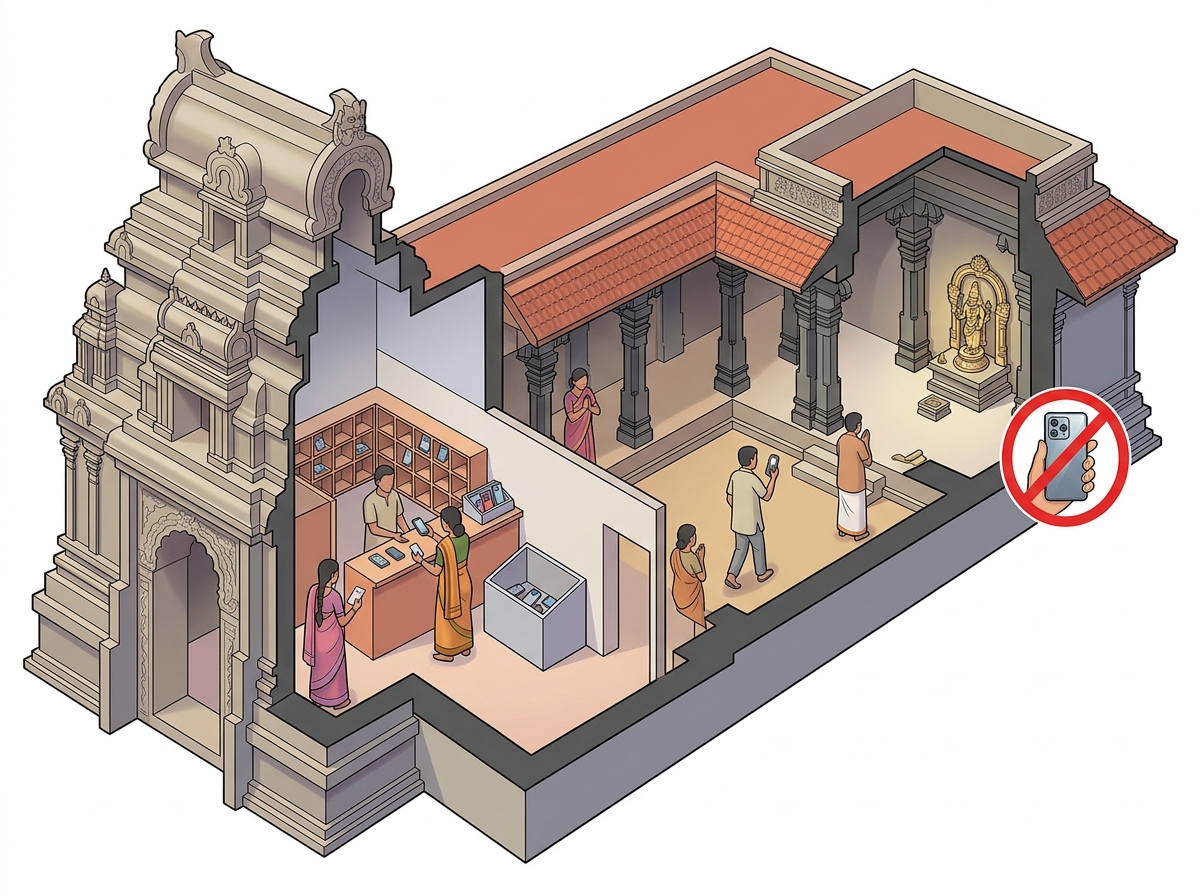
On 1 September 2026, the Government of Tamil Nadu implemented a statewide ban on the use of smartphones inside 52 major temples managed by the Hindu Religious and Charitable Endowments (HR&CE) Department. The restriction, issued under existing judicial directives, aims to preserve the sanctity and peaceful ambiance of temple premises by curbing unauthorised photography and videography of deities and idols. Devotees are now required to deposit their smartphones at designated counters upon entry, with a nominal fee of ₹5, and collect them upon exit. Ordinary mobile phones without cameras are permitted, reflecting a nuanced approach to balancing technological access with religious decorum.
Background
- The HR&CE Department is the nodal agency in Tamil Nadu responsible for the administration, maintenance, and regulation of Hindu religious institutions and charitable endowments under the provisions of the Hindu Religious and Charitable Endowments Act, 1959.
- Tamil Nadu hosts over 36,000 temples, with a significant number under state management, necessitating uniform administrative policies for their governance.
- Concerns over the commercialisation and commodification of religious practices have intensified in recent years, with unauthorised recordings of deities and rituals becoming a recurring issue in public discourse.
- Judicial precedents, including directives from the Madras High Court, have emphasised the need to maintain the sanctity of religious spaces and prevent their use for commercial or entertainment purposes.
- The policy aligns with broader global trends where religious and cultural institutions impose restrictions on digital recording devices to preserve their spiritual and cultural integrity.
- Prior to this statewide ban, individual temples such as Palani, Tiruchendur, Madurai, and Rameswaram had already enforced similar restrictions.
Understanding the Tamil Nadu Temple Smartphone Ban: Policy, Rationale, and Implementation
- **Policy Objective**: The ban seeks to maintain the sanctity, serenity, and spiritual ambiance of temple premises by prohibiting the use of smartphones capable of capturing photographs or videos, thereby preventing unauthorised commercialisation or dissemination of religious imagery.
- **Scope and Coverage**: The restriction applies to 52 major temples under the HR&CE Department’s jurisdiction, including prominent pilgrimage sites such as Arunachaleshwarar Temple in Tiruvannamalai and Vadapalani Andavar Temple in Chennai.
- **Permitted Devices**: Only ordinary mobile phones without camera functionality are allowed inside the temples. Smartphones, by definition, are prohibited due to their advanced recording capabilities.
- **Operational Mechanism**: Devotees are required to deposit their smartphones at designated counters upon entry, where a ₹5 fee is charged for safekeeping. A plastic token is issued, and phones are returned upon exit after verification of the token and mobile number.
- **Judicial Basis**: The policy is grounded in existing judicial directives from the Madras High Court, which have repeatedly underscored the need to protect religious spaces from unauthorised recording and commercial exploitation.
- **Cultural Preservation**: The measure is part of a broader effort to safeguard the intangible cultural heritage of temple traditions, ensuring that rituals and deities are not reduced to digital content for social media or commercial purposes.
- **Challenges in Implementation**: Practical concerns include the logistical burden on temple staff, potential mix-ups of devices during peak hours, and the inconvenience for local devotees who may visit temples daily.
- **Public Reception**: While some devotees appreciate the preservation of sanctity, others have expressed concerns over the cumbersome deposit process, particularly for daily visitors who may find the ₹5 fee repetitive.
Key Features
| Feature | Significance |
|---|---|
| Temple-specific smartphone ban | Ensures sanctity of worship by preventing distractions and commercialisation of religious spaces through unauthorised photography. |
| Camera-free phone allowance | Balances security concerns with practical access for devotees, allowing basic communication while restricting visual documentation. |
| ₹5 deposit fee at phone counters | Covers operational costs of locker facilities and token management, ensuring sustainability of the enforcement mechanism. |
| Locker facilities at temple entrances | Provides secure storage for devices, mitigating theft risks and reducing crowd congestion inside sanctum areas. |
| Existing prohibitions in select temples | Demonstrates precedent-based governance, where prior court directives or administrative orders inform current policy expansion. |
Why it Matters
Religious and Cultural
- Preserves the spiritual ambiance of temples by curbing disruptive practices such as photography and videography of deities, aligning with traditional norms of reverence.
- Reduces instances of commercial exploitation of religious imagery, which can lead to unauthorised sales or dissemination of sacred content.
- Reinforces the principle of ‘darshan’ (auspicious viewing) in Hindu worship, where the deity is experienced through contemplation rather than documentation.
Administrative and Governance
- Highlights the role of the Hindu Religious and Charitable Endowments (HR&CE) Department in regulating temple activities, a function enshrined in the Tamil Nadu Hindu Religious and Charitable Endowments Act, 1959.
- Demonstrates the implementation of court directives or executive orders to address recurring public grievances, showcasing bureaucratic responsiveness.
- Introduces a cost-recovery model (₹5 fee) for temple services, reflecting principles of financial prudence in public administration.
Legal and Constitutional
- Raises questions about the balance between freedom of expression (Article 19(1)(a)) and the right to religious freedom (Article 25), particularly in spaces of public worship.
- Tests the enforceability of temple-specific regulations under the broader framework of public order and morality (Article 19(2) and Article 25(1) exceptions).
Technological and Social
- Reflects societal shifts in digital behaviour, where smartphones have become ubiquitous tools for documentation, even in sacred spaces.
- Highlights the tension between individual convenience and collective cultural norms, particularly in high-footfall religious sites.
Challenges
1. Operational Enforcement
- Risk of overcrowding at deposit counters during peak hours, leading to delays and potential stampedes in temple premises.
- Logistical challenges in managing high volumes of devices, including verification errors, misplaced phones, or disputes over ownership.
- Need for staff training to handle sensitive personal data (phone numbers) while ensuring security and accountability.
UPSC Link: Public Order (L1/GS2)
2. Public Compliance and Resistance
- Potential pushback from devotees accustomed to carrying smartphones, especially those relying on them for navigation, payments, or emergency communication.
- Perception of the ₹5 fee as a regressive levy, particularly among economically weaker sections who visit temples frequently.
- Difficulty in distinguishing between ‘smartphones’ and ‘camera phones’ in practice, leading to confusion and administrative arbitrariness.
UPSC Link: Fundamental Duties (L1/GS4)
3. Legal and Ethical Concerns
- Risk of violating privacy rights if phone numbers or device data are mishandled or misused by temple staff.
- Potential for legal challenges on grounds of discrimination, if the policy disproportionately affects certain groups (e.g., elderly or disabled devotees).
- Uncertainty over the enforceability of the ban in private or non-HR&CE managed temples, creating a regulatory asymmetry.
UPSC Link: Right to Privacy (L1/GS2)
4. Sustainability and Scalability
- Long-term viability of the deposit system, including maintenance costs of lockers and staffing requirements.
- Feasibility of replicating this model in other states or religious sites with higher footfall or limited infrastructure.
- Need for periodic reviews to assess the impact on temple management, devotee experience, and cultural preservation.
UPSC Link: Good Governance (L2/GS4)
Challenges — UPSC Perspective
| Issue | Concern |
|---|---|
| Overcrowding at deposit counters | Delays and safety risks during peak temple hours. |
| Mismanagement of deposited devices | Loss, theft, or verification errors leading to disputes. |
| Public resistance to fee structure | Perception of additional financial burden on devotees. |
| Ambiguity in definition of ‘smartphone’ | Subjectivity in enforcement and potential harassment. |
| Privacy violations | Unauthorised access to personal data stored in phones. |
| Regulatory asymmetry | Inconsistent enforcement across private and public temples. |
Way Forward
- Conduct pilot evaluations in select temples to assess the ban’s impact on devotee experience and administrative efficiency.
- Develop a clear, standardised definition of ‘smartphone’ and ‘camera phone’ to minimise ambiguity in enforcement.
- Introduce digital alternatives, such as QR-code-based locker systems, to streamline device deposit and retrieval.
- Establish grievance redressal mechanisms for disputes over lost or misplaced phones, with transparent accountability protocols.
- Launch public awareness campaigns to educate devotees on the rationale behind the ban and alternative arrangements.
- Explore partnerships with fintech or telecom firms to provide temporary, low-cost phone storage solutions for devotees.
- Integrate the ban into broader temple management guidelines under the HR&CE Department, ensuring uniformity across sites.
- Monitor and publish annual reports on the ban’s enforcement, including statistics on compliance, disputes, and operational challenges.
UPSC Value Addition
Keywords for Mains Answer-Writing
Temple administration · Religious and Charitable Endowments · Public order and morality · Freedom of religion · Temple management boards · Tamil Nadu HR&CE Department · Temple rituals and sanctity · Right to privacy · Temple entry laws · Devotional practices · Temple governance · Religious freedom vs public order
Constitutional & Policy Linkages
- Article 25(1): Freedom of religion and its regulation in public spaces.
- Article 19(1)(a): Freedom of expression and its reasonable restrictions.
- Article 19(2): Grounds for restricting freedom of expression (public order, morality).
Concept Flow
Increasing incidents of unauthorised photography/videography in temples → Public grievances and court directives → HR&CE Department formulates smartphone ban policy → Policy implementation with camera-free phone allowance → Operational challenges in enforcement → Public compliance and legal scrutiny → Long-term sustainability and policy review.
Prelims Practice Questions
Q1. Consider the following statements regarding the administration of Hindu religious institutions in India:
1. The Hindu Religious and Charitable Endowments (HR&CE) Department in Tamil Nadu manages temples under the provisions of the Tamil Nadu Hindu Religious and Charitable Endowments Act, 1959.
2. The Supreme Court of India, in the case of Sri Adi Visheshwara of Kashi Vishwanath Temple v. State of Uttar Pradesh (1997), held that the state can regulate the administration of religious institutions to ensure public order and morality.
3. The Constitution of India, under Article 26, guarantees absolute freedom of religion without any state interference.
How many of the above statements are correct?
- Only one
- Only two
- All three
- None
Answer: Only two — Statement 1 is correct as the HR&CE Department in Tamil Nadu operates under the Tamil Nadu Hindu Religious and Charitable Endowments Act, 1959. Statement 2 is correct as the Supreme Court has upheld state regulation of religious institutions for public order and morality. Statement 3 is incorrect because Article 26 allows state regulation under reasonable restrictions.
Q2. Assertion (A): The imposition of restrictions on the use of smartphones in temples is justified under the doctrine of reasonable restrictions on the right to freedom of religion.
Reason (R): The Constitution of India, under Article 25(1), permits the state to impose restrictions on the freedom of religion in the interest of public order, morality, and health.
Options:
A. Both A and R are true, and R is the correct explanation of A.
B. Both A and R are true, but R is not the correct explanation of A.
C. A is true, but R is false.
D. A is false, but R is true.
- A
- B
- C
- D
Answer: A — Assertion (A) is true as restrictions on smartphone use in temples can be justified under the doctrine of reasonable restrictions. Reason (R) is also true and directly explains the legal basis for such restrictions under Article 25(1) of the Constitution.
Q3. Match the following temple management authorities with their respective states:
Column I (Temple Management Authority) | Column II (State)
1. Travancore Devaswom Board | A. Tamil Nadu
2. Endowments Department | B. Kerala
3. Madhya Pradesh Hindu Religious Trust Board | C. Andhra Pradesh
4. Andhra Pradesh Temple Authorities | D. Madhya Pradesh
- 1-B, 2-A, 3-D, 4-C
- 1-A, 2-B, 3-C, 4-D
- 1-D, 2-C, 3-B, 4-A
- 1-C, 2-D, 3-A, 4-B
Answer: 1-B, 2-A, 3-D, 4-C — 1. Travancore Devaswom Board is in Kerala. 2. Endowments Department is in Tamil Nadu. 3. Madhya Pradesh Hindu Religious Trust Board is in Madhya Pradesh. 4. Andhra Pradesh Temple Authorities is in Andhra Pradesh.
Mains Practice Question
✍ The recent directive banning the use of smartphones in 52 major temples managed by the Hindu Religious and Charitable Endowments (HR&CE) Department in Tamil Nadu has sparked debates on the balance between religious sanctity and individual freedoms. Critically examine the constitutional validity of such restrictions, with reference to the right to freedom of religion under Article 25 and the doctrine of reasonable restrictions. Also, analyse the administrative and ethical implications of implementing such measures in religious institutions. (15 Marks)
Approach: MODEL-ANSWER SKELETON:
1. **Constitutional Framework**:
– Article 25(1): Freedom of conscience and free profession, practice, and propagation of religion.
– Doctrine of reasonable restrictions: State can impose restrictions in the interest of public order, morality, and health (Article 25(1) proviso).
– Landmark judgments: Sri Adi Visheshwara of Kashi Vishwanath Temple v. State of Uttar Pradesh (1997), Ismail Faruqui v. Union of India (1994).
2. **Validity of Restrictions**:
– **Public Order and Morality**: Examine how smartphone use may disrupt the serene environment of temples, affecting the religious experience of devotees.
– **Temple Management**: Discuss the HR&CE Department’s role under the Tamil Nadu Hindu Religious and Charitable Endowments Act, 1959, and its authority to regulate temple activities.
– **Balancing Rights**: Weigh the right to freedom of religion against the right to privacy and freedom of expression (Article 19(1)(a)).
3. **Administrative Implications**:
– **Implementation Challenges**: Discuss the logistical aspects of enforcing the ban, including the deposit counters, fees, and token systems.
– **Ethical Considerations**: Address concerns about the commodification of religious spaces (e.g., charging ₹5 for phone deposits) and the potential for discrimination against economically weaker sections.
– **Alternatives**: Evaluate whether less intrusive measures (e.g., designated phone storage areas, strict no-photography rules) could achieve the same objective without restricting smartphone use.
4. **Comparative Perspective**:
– Reference to other states (e.g., Kerala’s Travancore Devaswom Board, Madhya Pradesh’s Hindu Religious Trust Board) and their approaches to managing temple activities.
5. **Conclusion**:
– Summarise the constitutional validity of the restrictions while acknowledging the need for a balanced approach that respects both religious sanctity and individual freedoms.
Source: The Hindu
Tamil Nadu PCS (TNPSC) — State PCS Practice
Prelims: As per the recent directive by the Tamil Nadu Hindu Religious and Charitable Endowments Department, which of the following types of smartphones are allowed inside temples after the ban on smartphones came into effect?
- Smartphones without cameras
- Smartphones with cameras but without internet
- All smartphones with prior permission
- No smartphones are allowed under any condition
Answer: Smartphones without cameras — The ban permits only smartphones without cameras to be carried inside temples, as per the new directive issued by the Tamil Nadu Hindu Religious and Charitable Endowments Department.
Mains: Examine the rationale behind the Tamil Nadu government’s decision to ban smartphones in temples. Discuss the potential benefits and challenges this policy may pose to devotees, temple management, and the overall religious ecosystem in the state.
Generated by AanyaAi for educational purpose.
Related guides on our sites
- Current affairs for upsc 2026
- How to prepare for GS paper 1 for UPSC CSE mains exam
- Best UPSC coaching for IFOS exam
- Best mentorship programme for upsc

- India-Australia AUSTRAHIND 2026 Exercise: Key Highlights for UPSC & State PCS - October 22, 2026
- एससीओ बैठक में भारत का आतंकवाद विरोध: क्षेत्रीय सहयोग पर जोर - October 22, 2026
- SEC Directs Strict SC Order Compliance for Andhra ULB Polls - October 22, 2026

No Comments