


06 Aug Tamil Nadu Budget 2026: AI for Approvals & One Lakh Homes Scheme Explained
✎ The Tamil Nadu Budget 2026-27 introduces SPEED, an AI-enabled urban planning approval system, and MY-HOME, a PPP-based rental housing scheme targeting one lakh units in seven years, reflecting a strategic shift toward…
Subject Relevance — Where This Topic Fits
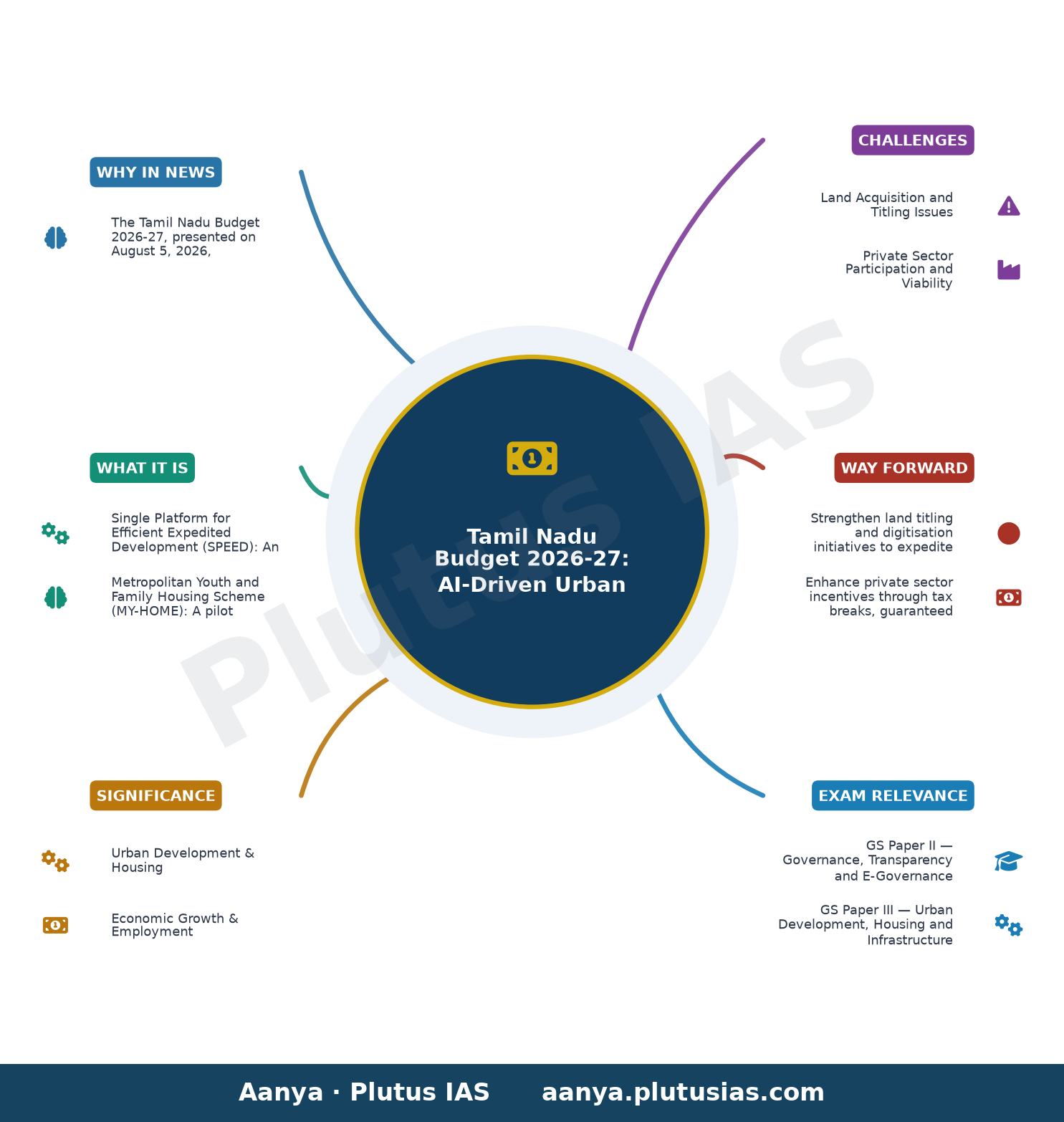
- GS Paper II — Governance, Transparency and E-Governance | GS Paper III — Urban Development, Housing and Infrastructure
- Prelims: AI-enabled urban planning, Single Platform for Efficient Expedited Development (SPEED), Metropolitan Youth and Family Housing Scheme (MY-HOME), Tamil Nadu Shelter Fund, Chennai Metropolitan Development Authority (CMDA), Third Master Plan (2027-2046), Viability Gap Funding (VGF), Public-Private Partnership (PPP), Digital Rental Voucher System
- Essay: The role of technology in transforming urban governance and service delivery, Balancing economic growth with equitable housing policies in metropolitan cities
Quick Revision: The Tamil Nadu Budget 2026-27 introduces SPEED, an AI-enabled urban planning approval system, and MY-HOME, a PPP-based rental housing scheme targeting one lakh units in seven years, reflecting a strategic shift toward technology-driven, equitable urban development.
Why is this in the news?
The Tamil Nadu Budget 2026-27, presented on August 5, 2026, introduces groundbreaking initiatives such as an AI-enabled planning approval system (SPEED) and the Metropolitan Youth and Family Housing Scheme (MY-HOME). These measures aim to enhance urban governance efficiency and address the critical shortage of affordable housing in the Chennai Metropolitan Area (CMA) through innovative public-private partnerships. The budget’s emphasis on technology-driven urban planning and targeted housing schemes reflects a strategic shift toward sustainable and inclusive urban development.
Background
- Tamil Nadu, with Chennai as its capital, faces rapid urbanisation, necessitating advanced urban planning frameworks to manage land use, infrastructure, and housing demand.
- The existing Chennai Metropolitan Development Authority (CMDA) oversees urban planning for the CMA, covering 1,189 sq. km., and is now preparing the Third Master Plan (2027-2046) to guide long-term growth.
- Urban housing shortages, particularly for low-income families and youth, remain a persistent challenge in metropolitan regions, exacerbated by migration and demographic pressures.
- The COVID-19 pandemic highlighted the need for resilient urban infrastructure, including affordable housing and digital governance tools, to ensure equitable service delivery.
- Tamil Nadu’s previous housing schemes, such as the Tamil Nadu Urban Housing Board (TNUHDB) initiatives, have laid the groundwork for public-private partnerships (PPPs) in urban development.
- The budget’s allocation of ₹8,852 crore for the Housing and Urban Development Department marks a significant increase from previous years, reflecting prioritised investment in urban infrastructure.
Key Initiatives in Tamil Nadu Budget 2026-27
- Single Platform for Efficient Expedited Development (SPEED): An AI-enabled online system integrating the CMDA, Directorate of Town and Country Planning (DTCP), and local bodies to streamline and expedite planning approvals across Tamil Nadu. The system aims to enhance transparency, reduce delays, and improve ease of doing business by providing a unified digital interface for developers and citizens.
- Metropolitan Youth and Family Housing Scheme (MY-HOME): A pilot initiative under the Tamil Nadu Urban Housing Board (TNUHDB) to develop one lakh housing units in the Chennai Metropolitan Area (CMA) over seven years through a public-private partnership (PPP) model. The scheme targets low-income families and youth, with an estimated investment of ₹15,000 crore, supported by ₹3,500 crore in Viability Gap Funding (VGF) via the Tamil Nadu Shelter Fund.
- Third Master Plan (2027-2046) and Comprehensive Master Plan: The CMDA is preparing a Third Master Plan for the existing CMA (1,189 sq. km.) and a Comprehensive Master Plan for the expanded CMA (5,904 sq. km.). These plans will serve as roadmaps for long-term urban growth, benchmarked against internationally acclaimed metropolitan planning frameworks.
- Urban Housing Completion Targets: The budget allocates ₹1,253 crore to complete 24,131 under-construction multi-storeyed tenements in 2026-27 and commence construction on another 14,194 tenements, addressing immediate housing shortages in urban areas.
- Expansion of CMA: The proposed Comprehensive Master Plan for the expanded CMA (5,904 sq. km.) reflects the government’s intent to address urban sprawl and integrate peri-urban areas into the metropolitan planning framework, ensuring balanced regional development.
- Increased Budgetary Allocation: The Housing and Urban Development Department’s allocation has risen to ₹8,852 crore in 2026-27, up from ₹7,547 crore in the Interim Budget and ₹8,737.71 crore in 2025-26, indicating a sustained focus on urban infrastructure and housing development.
- Integration of Technology in Governance: The budget underscores the state’s commitment to leveraging artificial intelligence (AI) and digital platforms to enhance governance efficiency, reduce bureaucratic bottlenecks, and improve citizen-centric service delivery.
Key Features
| Feature | Significance |
|---|---|
| AI-enabled planning approval system (SPEED) | Integrates CMDA, DTCP, and local bodies to ensure transparent, timely, and efficient planning permissions, reducing bureaucratic delays in urban development. |
| Metropolitan Youth and Family Housing Scheme (MY-HOME) | Aims to develop one lakh housing units over seven years via PPP model, providing safe and affordable housing for low-income families and youth in the Chennai Metropolitan Area. |
| Digital Rental Voucher system | Facilitates access to affordable rental housing through vouchers, ensuring targeted subsidies for eligible beneficiaries under MY-HOME. |
| Comprehensive Master Plan for expanded CMA | Covers 5,904 sq. km. (vs. current 1,189 sq. km.) to guide long-term urban growth, benchmarked against global metropolitan planning frameworks. |
| Viability Gap Funding (VGF) under Tamil Nadu Shelter Fund | Provides ₹3,500 crore in VGF to make MY-HOME financially viable, attracting private investment of ₹15,000 crore for housing projects. |
Why it Matters
Urban Development & Housing
- Addresses acute housing shortages in Chennai Metropolitan Area, particularly for low-income families and youth, aligning with Sustainable Development Goal 11 (Sustainable Cities and Communities).
- Leverages PPP model to mobilise private capital, reducing fiscal burden on the state while ensuring scalability and efficiency in housing delivery.
- Introduces digital governance tools (SPEED) to streamline approvals, reducing corruption and improving ease of doing business in urban planning.
Economic Growth & Employment
- Estimated investment of ₹15,000 crore in housing projects is expected to generate significant employment in construction, allied industries, and services sectors.
- Enhanced urban infrastructure under the Comprehensive Master Plan can boost real estate, retail, and logistics sectors, fostering economic multiplier effects.
- Digital Rental Voucher system may stimulate demand in the rental market, creating opportunities for small landlords and property managers.
Governance & Digital Transformation
- SPEED platform exemplifies the integration of AI and digital governance to enhance transparency, reduce discretionary delays, and improve citizen service delivery.
- Benchmarking against international metropolitan planning frameworks (e.g., Singapore’s Urban Redevelopment Authority, Tokyo’s Metropolitan Plan) ensures best practices in urban governance.
- Allocation of ₹40 crore for SPEED and ₹25 crore for Master Plan preparation signals prioritisation of digital and long-term strategic planning.
Social Equity & Inclusion
- MY-HOME targets low-income families and youth, addressing housing insecurity and promoting social mobility in urban areas.
- Digital Rental Voucher system ensures targeted subsidies, preventing leakage of benefits and ensuring affordability for intended beneficiaries.
Challenges
1. Land Acquisition and Titling Issues
- Acquiring land for housing projects in Chennai’s high-density areas may face legal and bureaucratic hurdles, delaying implementation.
- Ambiguities in land titling and encroachments could complicate project execution, necessitating robust legal frameworks and stakeholder consultations.
UPSC Link: Land Reforms (GS-II)
2. Private Sector Participation and Viability
- Ensuring adequate private sector participation in PPP models requires attractive risk-sharing mechanisms and guaranteed returns on investment.
- Viability Gap Funding (₹3,500 crore) may be insufficient if project costs escalate due to inflation, supply chain disruptions, or regulatory changes.
UPSC Link: Public-Private Partnerships (GS-III)
3. Digital Divide and Implementation Gaps
- Reliance on digital platforms (SPEED, Digital Rental Vouchers) may exclude marginalised communities lacking digital literacy or access to technology.
- Ensuring last-mile connectivity and user-friendly interfaces is critical to prevent exclusion of intended beneficiaries.
UPSC Link: Digital Divide (GS-II)
4. Urban Sprawl and Infrastructure Strain
- Expansion of the Chennai Metropolitan Area to 5,904 sq. km. risks unplanned urban sprawl, straining existing infrastructure (water, transport, waste management).
- Inadequate public transport integration could negate housing benefits by increasing commuting costs and time for residents.
UPSC Link: Urbanisation (GS-I)
5. Climate Resilience and Sustainability
- Rapid urbanisation without climate-sensitive planning may exacerbate heat islands, flooding, and air pollution in Chennai, a coastal city vulnerable to climate change.
- Incorporating green building norms and disaster-resilient infrastructure in the Master Plan is essential but may increase project costs.
UPSC Link: Climate Change (GS-III)
Challenges — UPSC Perspective
| Issue | Concern |
|---|---|
| Land Titling Ambiguities | Delays in project execution due to legal disputes or unclear ownership records. |
| Private Sector Reluctance | Insufficient incentives may deter private participation in PPP housing projects. |
| Digital Exclusion | Marginalised groups may face barriers in accessing digital services like SPEED or rental vouchers. |
| Infrastructure Bottlenecks | Unplanned expansion could overwhelm existing transport, water, and waste management systems. |
| Climate Vulnerability | Coastal urbanisation increases risks of flooding and heat stress without adaptive planning. |
Government Initiatives — Must-Memorise for Prelims
- Metropolitan Youth and Family Housing Scheme (MY-HOME)
- Single Platform for Efficient Expedited Development (SPEED)
- Tamil Nadu Shelter Fund (Viability Gap Funding)
Way Forward
- Strengthen land titling and digitisation initiatives to expedite land acquisition for housing projects.
- Enhance private sector incentives through tax breaks, guaranteed returns, or blended finance models to attract investment.
- Develop a digital inclusion strategy, including community outreach and training, to ensure equitable access to SPEED and rental vouchers.
- Integrate climate-resilient design principles (e.g., green buildings, flood-resistant infrastructure) into the Comprehensive Master Plan.
- Prioritise public transport expansion (e.g., metro, bus rapid transit) to support housing development in peripheral areas of the CMA.
- Establish a monitoring framework with quarterly reviews to track progress on housing units, approval timelines, and beneficiary outreach.
- Collaborate with academic institutions (e.g., IIT Madras) for AI-driven urban planning tools and data analytics to optimise resource allocation.
UPSC Value Addition
Keywords for Mains Answer-Writing
Tamil Nadu Budget 2026-27 · AI-enabled planning approval system (SPEED) · Single Platform for Efficient Expedited Development (SPEED) · Metropolitan Youth and Family Housing Scheme (MY-HOME) · Comprehensive Master Plan for Chennai Metropolitan Area (CMA) · Third Master Plan (2027-2046) · Urban planning and governance · Public-Private Partnership (PPP) in housing · Viability Gap Funding (VGF) · Digital Rental Voucher system · Tamil Nadu Shelter Fund · Urban local bodies and planning approvals · Housing for low-income families and youth · Third Master Plan for Chennai Metropolitan Area
Constitutional & Policy Linkages
- Article 243G (Urban Local Bodies – 74th Amendment Act)
- Article 243W (Functions of Municipalities)
Concept Flow
Urban housing demand in Chennai → Government announces MY-HOME scheme with PPP model and VGF → Private investment mobilised (₹15,000 crore) → Digital Rental Voucher system launched for affordability → SPEED platform introduced to streamline approvals → Comprehensive Master Plan prepared for expanded CMA → Long-term urban transformation initiated.
Prelims Practice Questions
Q1. Consider the following statements regarding the Tamil Nadu Budget 2026-27:
1. The Budget allocates ₹8,852 crore for the Housing and Urban Development Department.
2. The AI-enabled planning approval system named SPEED integrates the CMDA, DTCP, and rural and urban local bodies.
3. The MY-HOME scheme aims to develop 1 lakh housing units in 5 years through public-private partnership.
4. The Comprehensive Master Plan for the expanded CMA covers 5,904 sq. km.
How many of the above statements are correct?
- Only one
- Only two
- Only three
- All four
Answer: Only three — Statements 1, 2, and 4 are correct. Statement 3 is incorrect as the MY-HOME scheme targets 1 lakh housing units over 7 years, not 5 years.
Q2. Assertion (A): The Tamil Nadu Budget 2026-27 introduces a Digital Rental Voucher system under the MY-HOME scheme.
Reason (R): The Digital Rental Voucher system aims to provide safe and affordable housing for low-income families and youth.
In the context of the above two statements, which one of the following is correct?
- Both A and R are true, and R is the correct explanation of A.
- Both A and R are true, but R is not the correct explanation of A.
- A is true, but R is false.
- A is false, but R is true.
Answer: Both A and R are true, but R is not the correct explanation of A. — Both the assertion and reason are true. The Digital Rental Voucher system is indeed introduced under the MY-HOME scheme, and its purpose is to provide safe and affordable housing for low-income families and youth, making R the correct explanation of A.
Q3. Match the following initiatives under the Tamil Nadu Budget 2026-27 with their respective allocations:
Column I (Initiative) Column II (Allocation in ₹ crore)
A. AI-enabled planning approval system (SPEED) 1. ₹25 crore
B. Comprehensive Master Plan for expanded CMA 2. ₹40 crore
C. Completion of under-construction tenements 3. ₹1,253 crore
D. MY-HOME scheme (Viability Gap Funding) 4. ₹3,500 crore
- A-2, B-1, C-3, D-4
- A-1, B-2, C-3, D-4
- A-3, B-4, C-1, D-2
- A-4, B-3, C-2, D-1
Answer: A-2, B-1, C-3, D-4 — The correct matching is: A (SPEED) – ₹40 crore, B (Comprehensive Master Plan) – ₹25 crore, C (Completion of tenements) – ₹1,253 crore, D (VGF for MY-HOME) – ₹3,500 crore.
Mains Practice Question
✍ The Tamil Nadu Budget 2026-27 introduces transformative urban governance tools such as the AI-enabled planning approval system (SPEED) and the Metropolitan Youth and Family Housing Scheme (MY-HOME). Critically examine the potential of these initiatives to address urban housing shortages and streamline planning approvals in the Chennai Metropolitan Area. Also, discuss the challenges in their implementation. (15 Marks)
Approach: MODEL-ANSWER SKELETON:
1. **Introduction (2 Marks)**
– Context: Urbanisation pressure in Chennai Metropolitan Area (CMA) and housing shortages for low-income families and youth.
– Overview of Tamil Nadu Budget 2026-27 allocations: ₹8,852 crore for Housing and Urban Development Department; ₹40 crore for SPEED; ₹3,500 crore VGF for MY-HOME.
2. **AI-enabled Planning Approval System (SPEED) (4 Marks)**
– **Mechanism**: Integration of CMDA, DTCP, and local bodies for transparent and timely planning permissions.
– **Potential**: Reduces bureaucratic delays, enhances accountability, and aligns with global best practices (e.g., Singapore’s CORENET).
– **Challenges**: Data privacy concerns, resistance from bureaucratic inertia, and need for robust AI infrastructure.
3. **Metropolitan Youth and Family Housing Scheme (MY-HOME) (5 Marks)**
– **Mechanism**: PPP model with 1 lakh housing units over 7 years; Digital Rental Voucher system for affordability.
– **Potential**: Addresses housing deficit for low-income groups; leverages private investment (₹15,000 crore) and VGF (₹3,500 crore).
– **Challenges**: Land acquisition bottlenecks, regulatory hurdles, and ensuring equitable distribution of benefits.
4. **Comparative Advantage and Limitations (3 Marks)**
– **Advantage**: SPEED and MY-HOME represent a shift towards data-driven governance and inclusive urban planning.
– **Limitations**: Dependence on private sector participation; risk of gentrification in MY-HOME areas; need for continuous monitoring.
5. **Conclusion (1 Mark)**
– Summary: These initiatives, if implemented effectively, can significantly improve urban governance and housing accessibility in Tamil Nadu. However, their success hinges on addressing implementation challenges and ensuring inclusive outcomes.
Source: The Hindu
Generated by AanyaAi for educational purpose.

- कर्नाटक में ‘वंदे मातरम’ विवाद: राज्यपाल ने सीएम से आदेश वापस लेने को कहा - September 22, 2026
- Karnataka Governor vs CM: Vande Mataram GO row explained for UPSC - September 22, 2026
- मध्यप्रदेश कैबिनेट का बड़ा फैसला: हर विधानसभा में स्पोर्ट्स कॉम्प्लेक्स, 15 हजार बसें 2030 तक - September 22, 2026

No Comments