


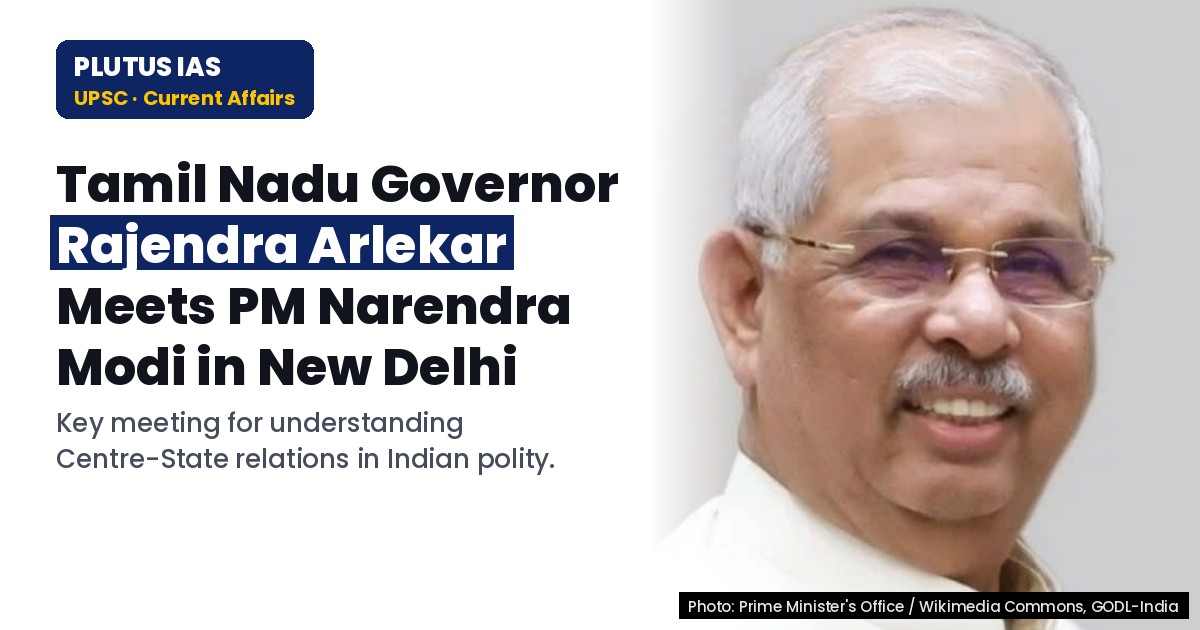
06 Nov Tamil Nadu Governor Meets PM: UPSC General Studies
✎ The Governor is the constitutional head of a state, appointed by the President, serving as a vital link between the Union and the State, with both advisory and limited discretionary powers, crucial for maintaining constitutional…
Subject Relevance — Where This Topic Fits
- GS Paper II — Indian Polity and Governance: Functions and Responsibilities of the Union and the States, Issues and Challenges Pertaining to the Federal Structure, Devolution of Powers and Finances up to Local Levels and Challenges Therein. | GS Paper II — Indian Constitution: Historical Underpinnings, Evolution, Features, Amendments, Significant Provisions and Basic Structure. | GS Paper II — Separation of Powers between various organs Dispute Redressal Mechanisms and Institutions.
- Prelims: Governor’s appointment, Article 153, Article 155, Governor’s discretionary powers, Centre-state relations, Federalism in India, Constitutional Head of State, Council of Ministers (State), President’s Rule, Article 356
- Essay: The evolving nature of Indian federalism: Challenges and opportunities., Constitutional morality and the role of institutions in a democracy., The Governor as a crucial link in India’s federal structure: An analysis of powers and controversies.
Quick Revision: The Governor is the constitutional head of a state, appointed by the President, serving as a vital link between the Union and the State, with both advisory and limited discretionary powers, crucial for maintaining constitutional order and federal balance.
Why is this in the news?
The recent meeting between the Governor of Tamil Nadu and the Prime Minister in New Delhi has brought renewed attention to the constitutional role and functions of the Governor within India’s federal framework. Such interactions, while routine, often underscore the intricate dynamics of Centre-state relations and the Governor’s position as a vital constitutional link between the Union and the State government.
Background
- The office of the Governor is a crucial institution in India’s parliamentary federal system, serving as the constitutional head of a state and a representative of the Union government.
- Article 153 of the Indian Constitution mandates that there shall be a Governor for each state, though the same person can be appointed as Governor for two or more states (7th Constitutional Amendment Act, 1956).
- The Governor is appointed by the President of India by warrant under his hand and seal (Article 155) and holds office during the pleasure of the President (Article 156).
- The Governor acts on the aid and advice of the Council of Ministers headed by the Chief Minister, except in matters where the Constitution requires him to act in his discretion.
- The Governor’s role is often debated, particularly concerning the balance between being a constitutional head of the state and an agent of the Union government, especially in situations involving political stability or policy disagreements.
- Key constitutional provisions defining the Governor’s powers include those related to the appointment of the Chief Minister, dissolution of the Legislative Assembly, assent to bills, and the power to reserve bills for the consideration of the President.
What is the role of the Governor in the Indian federal system?
- The Governor serves as the constitutional head of the state executive, analogous to the President at the Union level, and is bound by the advice of the Council of Ministers, except in certain discretionary matters.
- As a representative of the Union government, the Governor acts as a vital link, facilitating communication and cooperation between the Centre and the State, and ensuring that the state administration is carried on in accordance with the provisions of the Constitution.
- The Governor plays a critical role in the legislative process of the state, including summoning and proroguing the state legislature, addressing it, and giving assent to bills passed by the legislature, or reserving them for the President’s consideration.
- In situations of political instability, the Governor exercises significant discretionary powers, such as determining which party or coalition commands a majority to form the government, or recommending the imposition of President’s Rule under Article 356.
- The Governor also has significant executive powers, including the appointment of the Chief Minister and other ministers, the Advocate General, and the Chairman and members of the State Public Service Commission.
- Judicial powers include granting pardons, reprieves, respites, and remissions of punishment or suspending, remitting, or commuting the sentence of any person convicted of any offense against any law relating to a matter to which the executive power of the state extends.
- The Governor receives reports from various state constitutional bodies, such as the State Finance Commission and the State Public Service Commission, and causes them to be laid before the state legislature.
- The office is intended to uphold constitutional norms and ensure the smooth functioning of democratic governance within the federal structure, balancing state autonomy with national unity.
Key Features
| Feature | Significance |
|---|---|
| Governor’s Role | Serves as the constitutional head of the state, acting on the aid and advice of the Council of Ministers, except in certain discretionary matters. |
| Centre-State Relations | The meeting underscores the formal communication channels and collaborative spirit essential for the effective functioning of India’s federal structure. |
| Constitutional Office | The Governor is appointed by the President and holds office during the pleasure of the President, signifying a link between the Union and State governments. |
| Inter-Governmental Dialogue | Such interactions facilitate direct communication on matters of state administration, policy implementation, and resolution of inter-governmental issues. |
| Federalism in Practice | The meeting exemplifies the practical aspects of cooperative federalism, where state and central functionaries engage to address governance challenges. |
Why it Matters
Governance and Administration
- Facilitates direct communication between the state’s constitutional head and the head of the Union government.
- Allows for the exchange of information on state-specific issues, developmental projects, and administrative challenges.
- Provides an opportunity to discuss the implementation of central schemes and policies within the state.
Centre-State Coordination
- Reinforces the institutional mechanisms for dialogue and coordination between the Union and State governments.
- Contributes to the resolution of potential inter-governmental disputes or policy divergences through high-level consultation.
- Promotes a unified approach to national development goals while respecting state autonomy.
Constitutional Propriety
- Upholds the constitutional role of the Governor as a crucial link between the Union and the State.
- Demonstrates adherence to established protocols for inter-governmental interactions within the federal framework.
- Ensures that the Union government is apprised of the state’s situation through its constitutional representative.
Challenges
1. Role of Governor in Federal Polity
- Balancing the constitutional role as the state’s head with the responsibility as a representative of the Union government.
- Potential for discretionary powers to be perceived as infringing upon the elected state government’s authority.
UPSC Link: Indian Constitution—historical underpinnings, evolution, features, amendments, significant provisions and basic structure.
2. Centre-State Relations
- Maintaining harmonious relations amidst differing political ideologies of the Union and State governments.
- Ensuring equitable distribution of resources and responsibilities without central overreach.
UPSC Link: Functions and responsibilities of the Union and the States, issues and challenges pertaining to the federal structure
3. Accountability and Transparency
- Ensuring that such high-level meetings contribute to transparent governance outcomes.
- Communicating the substance of discussions to the public without compromising confidentiality where necessary.
UPSC Link: Transparency & accountability and institutional and other measures.
Challenges — UPSC Perspective
| Issue | Concern |
|---|---|
| Governor’s Discretionary Powers | Potential for misuse or perceived bias, leading to friction with the elected state government. |
| Political Neutrality | Maintaining an impartial stance, especially when the Union and State governments are led by different political parties. |
| Scope of Discussion | Ensuring that discussions remain within constitutional bounds and do not bypass the elected state government on policy matters. |
| Federal Tensions | Managing differences in policy approaches or administrative priorities between the Union and the State. |
Way Forward
- Promote regular and structured dialogues between the Governor and the Prime Minister to enhance understanding and coordination.
- Uphold constitutional conventions and established protocols to ensure the smooth functioning of federal relations.
- Strengthen inter-state council mechanisms for resolving disputes and fostering cooperative federalism.
- Encourage transparency in the Governor’s office, balancing confidentiality with public accountability.
- Emphasize the Governor’s role as a constitutional bridge, facilitating communication rather than acting as an adversarial figure.
- Review recommendations of various commissions on Centre-State relations to refine the Governor’s role and powers.
- Foster a spirit of cooperative federalism where both Union and State governments work collaboratively for national development.
UPSC Value Addition
Keywords for Mains Answer-Writing
Governor’s discretionary powers · Centre-state relations · Constitutional office of Governor · Article 153 · Article 163 · Sarkaria Commission · Punchhi Commission · Cooperative federalism · Executive powers of Governor · Role of Governor in state administration · President’s Rule · Constitutional morality
Constitutional & Policy Linkages
- Article 153: Governors of States
- Article 154: Executive power of State
- Article 155: Appointment of Governor
- Article 156: Term of office of Governor
- Article 163: Council of Ministers to aid and advise Governor
- Article 256: Obligation of States and the Union
Concept Flow
Governor appointed by President → Governor acts as constitutional head of state → Governor meets Prime Minister → Dialogue on state administration and policies → Enhances Centre-State coordination → Reinforces cooperative federalism
Prelims Practice Questions
Q1. Consider the following statements regarding the office of the Governor in India:
1. The Governor is appointed by the President of India and holds office during the pleasure of the President.
2. The Governor acts as the constitutional head of the state and also as a link between the Union and the State.
3. Article 163 of the Constitution states that the Governor shall act on the aid and advice of the Council of Ministers, except insofar as he is by or under this Constitution required to exercise his functions in his discretion.
How many of the above statements are correct?
- Only one
- Only two
- All three
- None
Answer: All three — Statement 1 is correct: Article 155 and 156 outline the appointment and tenure of the Governor. Statement 2 is correct: The Governor performs a dual role as the constitutional head of the state and as a representative of the Union government. Statement 3 is correct: Article 163 explicitly provides for the Governor’s discretionary powers.
Q2. Which of the following committees/commissions recommended reforms regarding the appointment and role of the Governor?
- Sarkaria Commission
- Punchhi Commission
- Administrative Reforms Commission (ARC)
- All of the above
Answer: All of the above — The Sarkaria Commission (1983), Punchhi Commission (2007), and the First Administrative Reforms Commission (1966) have all made recommendations concerning the Governor’s office, particularly regarding appointments, discretionary powers, and Centre-state relations.
Mains Practice Question
✍ Critically examine the constitutional role of the Governor in the context of contemporary Indian federalism. Discuss the challenges posed by the exercise of discretionary powers by the Governor, citing relevant constitutional provisions and committee recommendations. (15 Marks)
Approach: MODEL-ANSWER SKELETON: Introduction: Briefly define the Governor’s office as per Article 153 and its dual role. Constitutional Role: Elaborate on the Governor’s functions as the constitutional head (Article 154, 163(1)) and as a link between Union and State. Discretionary Powers: Discuss Article 163(2) and specific instances where discretion is exercised (e.g., appointment of Chief Minister, dismissal of ministry, reservation of bills for President’s consideration under Article 200, recommendation for President’s Rule under Article 356). Challenges: Detail issues such as political partisanship, undermining elected governments, delayed assent to bills, and frequent use of Article 356. Cite Supreme Court judgments like S.R. Bommai v. Union of India (1994) and Rameshwar Prasad v. Union of India (2006). Committee Recommendations: Refer to the Sarkaria Commission (e.g., Governor should be a distinguished person from outside the state, not active in politics), Punchhi Commission (e.g., ‘Doctrine of Pleasure’ should be deleted, fixed five-year term, impeachment by state legislature), and Administrative Reforms Commission. Conclusion: Summarise the need for constitutional propriety, upholding cooperative federalism, and ensuring the Governor acts as a neutral constitutional functionary rather than an agent of the Centre.
Source: PIB (Press Information Bureau)
Tamil Nadu PCS (TNPSC) — State PCS Practice
Prelims: Which of the following statements is/are correct regarding the recent meeting between the Governor of Tamil Nadu and the Prime Minister of India?
I. The meeting was a routine courtesy call.
II. The meeting likely involved discussions on the administrative and developmental affairs of Tamil Nadu.
III. The Governor is appointed by the President of India and acts as a link between the State and the Union Government.
IV. The Prime Minister is the constitutional head of the Union Government.
- A. I and II only
- B. II and III only
- C. I, II and III only
- D. I, II, III and IV
Answer: C. I, II and III only — Statements I, II, and III are correct. The Prime Minister is the head of the Union Government, but the constitutional head is the President of India.
Mains: Discuss the constitutional role and responsibilities of the Governor in a state like Tamil Nadu, particularly in the context of interactions with the Union Government, as exemplified by a meeting with the Prime Minister.
Generated by AanyaAi for educational purpose.
Related guides on our sites
- Current affairs for upsc 2026
- Best PSIR optional coaching for upsc
- Best PSIR optional teacher for upsc
- Best teacher of PSIR optional for upsc

- Tamil Nadu Governor Meets PM: UPSC General Studies - November 6, 2026
- उपराष्ट्रपति श्री सी.पी. राधाकृष्णन 7 नवंबर को अयोध्या में दीपोत्सव 2026 में शामिल होंगे - November 6, 2026
- ओबीसी क्रीमी लेयर: सुप्रीम कोर्ट का नियुक्ति पर अहम फैसला - November 6, 2026

No Comments