


08 Aug Tamil Nadu Govt Directs Public Access to English Report on Union-State Relations
✎ The Tamil Nadu government’s directive to make the English version of the Union-State Relations report publicly accessible reinforces the constitutional principles of federalism, transparency, and public accountability.
Subject Relevance — Where This Topic Fits
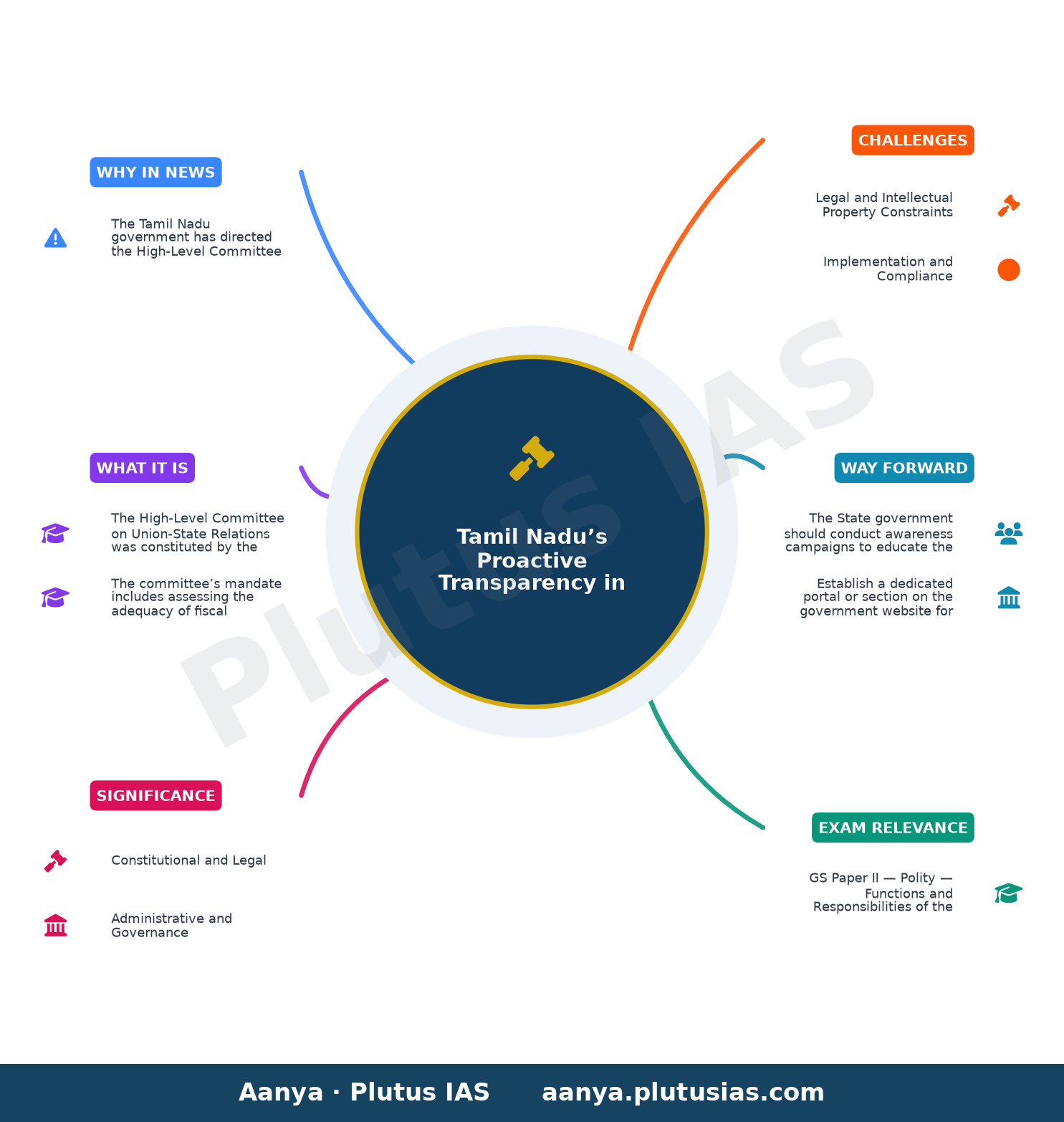
- GS Paper II — Polity — Functions and Responsibilities of the Union and the States, Issues and Challenges Pertaining to the Federal Structure, Devolution of Powers and Finances up to Local Levels and Challenges Therein
- Prelims: Federalism, Union-State Relations, Constitutional Provisions on Centre-State Relations, Government of India Act, 1935, Sarkaria Commission, Punchhi Commission, Article 263 of the Constitution, Public Accountability, Right to Information (RTI) Act
- Essay: Federalism and Democratic Governance in India, Transparency and Accountability as Pillars of Good Governance
Quick Revision: The Tamil Nadu government’s directive to make the English version of the Union-State Relations report publicly accessible reinforces the constitutional principles of federalism, transparency, and public accountability.
Why is this in the news?
The Tamil Nadu government has directed the High-Level Committee on Union-State Relations to grant open access to the English version of Part I of its report by hosting it in the public domain, mirroring the Tamil version. This directive, issued via a Government Order on July 30, 2026, underscores the state’s commitment to transparency in governance and aligns with constitutional principles of federalism and public accountability. The move also revokes the exclusive copyright over the English version, reinforcing the state’s emphasis on disseminating critical policy documents to the broader public.
Background
- The High-Level Committee on Union-State Relations was constituted by the Tamil Nadu government on April 15, 2025, under the leadership of retired Supreme Court judge Justice Kurian Joseph, with retired IAS officer K. Ashok Vardhan Shetty and former Vice-Chairman of the Tamil Nadu State Planning Commission M. Naganathan as members.
- The committee submitted Part I of its report to the then Chief Minister M.K. Stalin on February 16, 2026, which was subsequently tabled in the Assembly on February 18, 2026.
- The report examines the dynamics of Union-State relations, including fiscal federalism, administrative cooperation, and constitutional disputes, with a focus on Tamil Nadu’s perspectives and grievances.
- The Tamil Nadu government’s decision to make the English version of the report publicly accessible follows a broader trend of states asserting their rights in the federal structure, particularly in matters of fiscal devolution and administrative autonomy.
- The move is consistent with the principles enshrined in the Constitution of India, particularly Articles 263 (Inter-State Council) and the spirit of cooperative federalism outlined in the Seventh Schedule.
- This initiative also reflects the state’s alignment with the Right to Information (RTI) Act, 2005, which mandates transparency and accountability in governance.
What is the High-Level Committee on Union-State Relations?
- The High-Level Committee on Union-State Relations was constituted by the Tamil Nadu government to examine and address issues pertaining to the federal structure, particularly those affecting Tamil Nadu’s interests in its relations with the Union government.
- The committee’s mandate includes assessing the adequacy of fiscal devolution, examining constitutional provisions related to Centre-State relations, and recommending measures to enhance cooperative federalism.
- The committee is headed by a retired Supreme Court judge, Justice Kurian Joseph, ensuring a judicial perspective in its deliberations and recommendations.
- The committee’s report, Part I, focuses on the structural and institutional aspects of Union-State relations, including the distribution of legislative and executive powers under the Constitution.
- The committee’s work is grounded in the constitutional framework, particularly the Seventh Schedule (Division of Powers) and the principles of federalism enshrined in the Preamble and other provisions of the Constitution.
- The committee’s recommendations are advisory in nature but carry significant weight due to the stature of its members and the relevance of its findings to Tamil Nadu’s governance challenges.
- The committee’s report is a critical input for policymakers, legislators, and civil society in understanding the nuances of Centre-State relations and advocating for reforms.
- The decision to make the report publicly accessible underscores the state’s commitment to transparency and participatory governance, enabling citizens to engage with the policy discourse.
Key Features
| Feature | Significance |
|---|---|
| Publication of English version of Part I of the Union-State Relations report | Enhances transparency by making the report accessible to a broader audience, including non-Tamil speakers, thereby facilitating informed public discourse and scrutiny. |
| Immediate hosting on government website (hlcusr.tn.gov.in) | Ensures unrestricted and free access to the report, eliminating barriers to information dissemination and promoting digital governance. |
| Cancellation of exclusive copyright for the English version | Removes legal impediments to the report’s use, reproduction, and dissemination, aligning with principles of open governance and public accountability. |
| Constitution of the High-Level Committee on Union-State Relations (HLCUSR) | Demonstrates the State government’s commitment to examining intergovernmental relations systematically, with a retired Supreme Court judge as chairperson to ensure impartiality. |
| Multi-disciplinary composition of the HLCUSR | Incorporates legal, administrative, and planning expertise, ensuring a comprehensive analysis of Union-State relations from multiple perspectives. |
Why it Matters
Constitutional and Legal
- Reinforces the principle of federalism by promoting transparency in intergovernmental relations, a cornerstone of India’s constitutional structure under Articles 245-255 (Distribution of Legislative Powers).
- Aligns with the constitutional mandate for open governance, as envisaged in Article 19(1)(a) (Freedom of Speech and Expression) and Article 21 (Right to Information), interpreted expansively by the Supreme Court.
Administrative and Governance
- Sets a precedent for other States to adopt similar measures, fostering a culture of transparency and accountability in intergovernmental reporting.
- Facilitates evidence-based policymaking by providing stakeholders—including opposition parties, civil society, and academia—access to critical analysis of Union-State dynamics.
Political and Democratic
- Demonstrates the State government’s commitment to democratic principles by making intergovernmental reports publicly accessible, thereby enhancing public trust in governance.
- Encourages constructive dialogue between the Union and State governments by providing a shared factual basis for discussions on federal issues.
Economic
- Promotes economic efficiency by reducing information asymmetry between the Union and State governments, potentially lowering transaction costs in intergovernmental negotiations.
Societal and Educational
- Enables civil society organizations, researchers, and students to analyse Union-State relations, thereby enriching public discourse and academic research on federalism.
- Supports the Right to Education (Article 21A) by providing accessible resources for understanding constitutional and administrative frameworks.
Challenges
1. Legal and Intellectual Property Constraints
- Ensuring that the cancellation of exclusive copyright does not inadvertently infringe on proprietary rights or third-party interests in the report’s content.
- Addressing potential concerns from authors or contributors regarding the re-use and dissemination of their work under open-access terms.
UPSC Link: Constitutional provisions on IPR (Part III, Directive Principles)
2. Implementation and Compliance
- Monitoring adherence to the directive across all government departments and ensuring that future reports are published in a timely manner.
- Preventing delays or resistance from government officials accustomed to restrictive information-sharing practices.
UPSC Link: Good Governance (Lokpal & Lokayukta)
3. Public Engagement and Utilisation
- Encouraging meaningful public engagement with the report to ensure that transparency translates into tangible democratic outcomes.
- Avoiding the risk of the report becoming a mere formality without fostering substantive public debate or policy reform.
UPSC Link: Citizen Participation in Governance
4. Federal Tensions and Centre-State Relations
- Navigating potential sensitivities in the Union-State relationship, particularly if the report contains critical assessments of the Union government’s policies.
- Ensuring that the report does not exacerbate existing federal tensions by providing ammunition for political or legal disputes.
UPSC Link: Cooperative vs. Competitive Federalism
5. Technical and Digital Divide
- Addressing disparities in digital access that may prevent certain segments of the population from utilising the online report.
- Ensuring the report is accessible in multiple formats (e.g., print, audio) to cater to diverse user needs.
UPSC Link: Digital India and E-Governance
Challenges — UPSC Perspective
| Issue | Concern |
|---|---|
| Intellectual Property Rights | Risk of legal challenges from contributors or third parties regarding ownership and re-use of the report. |
| Bureaucratic Resistance | Potential reluctance among government officials to fully comply with transparency directives due to institutional inertia. |
| Public Apathy | Lack of awareness or interest among the public in engaging with the report, reducing its impact. |
| Federal Friction | Possibility of the report being used to escalate political or legal disputes between the Union and State governments. |
| Digital Accessibility | Unequal access to the internet or digital devices may limit the report’s reach to marginalised communities. |
| Quality Assurance | Ensuring the report’s content remains accurate, unbiased, and free from factual errors despite open-access dissemination. |
Way Forward
- The State government should conduct awareness campaigns to educate the public, civil society, and media on the availability and significance of the report.
- Establish a dedicated portal or section on the government website for regular updates on Union-State relations, including future reports from the HLCUSR.
- Encourage academic institutions and research bodies to analyse the report and publish peer-reviewed studies, thereby enriching public discourse.
- Formulate guidelines for government departments to proactively publish reports on intergovernmental issues in a timely and accessible manner.
- Strengthen mechanisms for public feedback on the report to identify gaps, inaccuracies, or areas requiring further analysis.
- Collaborate with the Union government to explore the possibility of a national-level platform for hosting State-specific reports on Union-State relations.
- Monitor and evaluate the impact of the report’s publication on Centre-State relations, federalism debates, and policy outcomes.
- Ensure the report is translated into regional languages beyond Tamil to maximise its reach and inclusivity.
UPSC Value Addition
Keywords for Mains Answer-Writing
Union-State Relations · High-Level Committee on Union-State Relations · Justice Kurian Joseph · federalism in India · intergovernmental relations · transparency in governance · public domain access to reports · Tamil Nadu government · constitutional provisions on Centre-State relations · fiscal federalism · cooperative federalism · administrative federalism · reporting obligations of committees · right to information · executive-legislative relations in states
Constitutional & Policy Linkages
- {‘link’: ‘Article 19(1)(a) – Freedom of Speech and Expression’, ‘note’: ‘Supports transparency and public discourse’}
- {‘link’: ‘Article 21 – Right to Information’, ‘note’: ‘Interpreted to include access to governance documents’}
- {‘link’: ‘Articles 245-255 – Distribution of Legislative Powers’, ‘note’: ‘Defines Union-State legislative relations’}
- {‘link’: ‘Article 263 – Inter-State Council’, ‘note’: ‘Framework for Centre-State coordination’}
Concept Flow
State government constitutes HLCUSR to examine Union-State relations → HLCUSR submits Part I of its report to the Chief Minister → Report is tabled in the State Assembly, initiating public discourse → Government directs publication of English version in public domain → Cancellation of exclusive copyright to enable free dissemination → Report is hosted online, enhancing accessibility and transparency → Public engagement and academic analysis enrich federalism debates
Prelims Practice Questions
Q1. Consider the following statements about the High-Level Committee on Union-State Relations constituted by Tamil Nadu:
1. The committee was headed by a retired Supreme Court judge.
2. The committee submitted Part I of its report to the then Chief Minister M.K. Stalin on February 16, 2026.
3. The committee was constituted under the provisions of Article 263 of the Constitution of India.
4. The English version of Part I of the report was made publicly accessible on the website of the High-Level Committee.
How many of the above statements are correct?
- Only one
- Only two
- Only three
- All four
Answer: Only three — Statement 1 is correct as the committee was headed by retired Supreme Court judge Justice Kurian Joseph. Statement 2 is correct as the report was submitted on February 16, 2026. Statement 3 is incorrect as the committee was constituted by the Tamil Nadu government and not under Article 263. Statement 4 is correct as the English version was hosted on the committee’s website.
Q2. Assertion (A): The Tamil Nadu government directed the High-Level Committee on Union-State Relations to cancel the exclusive copyright for the English version of Part I of its report.
Reason (R): The directive was issued to ensure transparency and public access to the report, aligning with the principles of cooperative federalism.
In the context of the above two statements, which one of the following is correct?
- Both A and R are true, and R is the correct explanation of A
- Both A and R are true, but R is not the correct explanation of A
- A is true, but R is false
- A is false, but R is true
Answer: Both A and R are true, and R is the correct explanation of A — Both the assertion and reason are factually correct. The Tamil Nadu government issued a directive to cancel exclusive copyright to ensure transparency and public access, which is consistent with the principles of cooperative federalism.
Q3. Match the following committees with their respective jurisdictions or domains of operation:
Column I (Committee) | Column II (Jurisdiction/Domain)
1. Sarkaria Commission | A. Centre-State Relations
2. Punchhi Commission | B. Electoral Reforms
3. Dinesh Goswami Committee | C. Inter-State Water Disputes
4. Rajamannar Committee | D. Centre-State Relations (State-specific)
Select the correct match:
- 1-A, 2-B, 3-C, 4-D
- 1-A, 2-C, 3-B, 4-D
- 1-B, 2-A, 3-D, 4-C
- 1-D, 2-A, 3-B, 4-C
Answer: 1-A, 2-C, 3-B, 4-D — The Sarkaria Commission (1983) and Punchhi Commission (2007) were appointed to examine Centre-State relations. The Dinesh Goswami Committee (1990) focused on electoral reforms, while the Rajamannar Committee (1969) was a state-specific committee on Centre-State relations for Madras State (now Tamil Nadu).
Mains Practice Question
✍ The Tamil Nadu government’s decision to place the English version of Part I of the High-Level Committee on Union-State Relations report in the public domain reflects a broader commitment to transparency and cooperative federalism in India. Critically analyse the constitutional and political significance of this move in the context of Centre-State relations. (15 Marks)
Approach: MODEL-ANSWER SKELETON:
1. **Constitutional Framework**:
– Briefly outline Articles 263 (Inter-State Council) and 356 (President’s Rule) to contextualise Centre-State relations.
– Highlight the absence of a statutory mechanism for regular Centre-State dialogue, making ad-hoc committees like the High-Level Committee significant.
2. **Cooperative Federalism**:
– Define cooperative federalism as per the 73rd and 74th Constitutional Amendments and Punchhi Commission (2010).
– Argue that transparency in governance (e.g., public access to reports) strengthens cooperative federalism by fostering trust and accountability.
3. **Political Significance**:
– Discuss how the move aligns with Tamil Nadu’s historical emphasis on federal autonomy (e.g., Justice Rajamannar Committee, 1969).
– Contrast with recent centralising tendencies (e.g., GST compensation disputes, Article 370 abrogation) to show the state’s assertion of federal rights.
4. **Challenges and Criticisms**:
– Address potential criticisms: Does public access to reports risk undermining deliberative confidentiality in federal negotiations?
– Cite the Supreme Court’s stance on transparency (e.g., Right to Information Act, 2005) to balance openness with governance needs.
5. **Conclusion**:
– Summarise that the move is a progressive step toward institutionalising transparency in federal relations, but its long-term impact depends on implementation and central response.
Source: The Hindu
Generated by AanyaAi for educational purpose.

- प्रतापगढ़ में फॉरेस्ट रेंजर की मौत: सुप्रीम कोर्ट ने अवैध खनन पर तुरंत कार्रवाई का दिया आदेश - September 23, 2026
- Supreme Court Slams Rajasthan Over Forest Ranger’s Death, Demands Action on Illegal Mining - September 23, 2026
- हिमाचल में बाल पोषण योजना: अब सप्ताह में दो बार मिलेगा अंडा या फल - September 23, 2026

No Comments