


08 Aug Tamil Nadu releases English version of Union-State Relations Report Part I for public access
✎ The Tamil Nadu government’s directive to release the English version of the High-Level Committee on Union-State Relations report in the public domain reinforces the constitutional principle of transparency in governance and…
Subject Relevance — Where This Topic Fits
- GS Paper II — Polity — Federalism, Centre-State Relations, Constitutional and Non-Constitutional Bodies | GS Paper II — Polity — Role of State Governments in Policy Implementation and Governance
- Prelims: Union-State Relations, High-Level Committee on Union-State Relations, Article 263 of the Constitution, Federalism, Transparency in Governance, Copyright Act, 1957, Tamil Nadu Public Department, Justice Kurian Joseph, Government Order (GO), Public Domain, Open Access, DMK Government, Tamil Nadu Assembly
- Essay: Federalism and Cooperative Governance in India: Challenges and Reforms, Transparency as a Pillar of Democratic Governance: The Role of State Initiatives
Quick Revision: The Tamil Nadu government’s directive to release the English version of the High-Level Committee on Union-State Relations report in the public domain reinforces the constitutional principle of transparency in governance and underscores the state’s role in fostering cooperative federalism.
Why is this in the news?
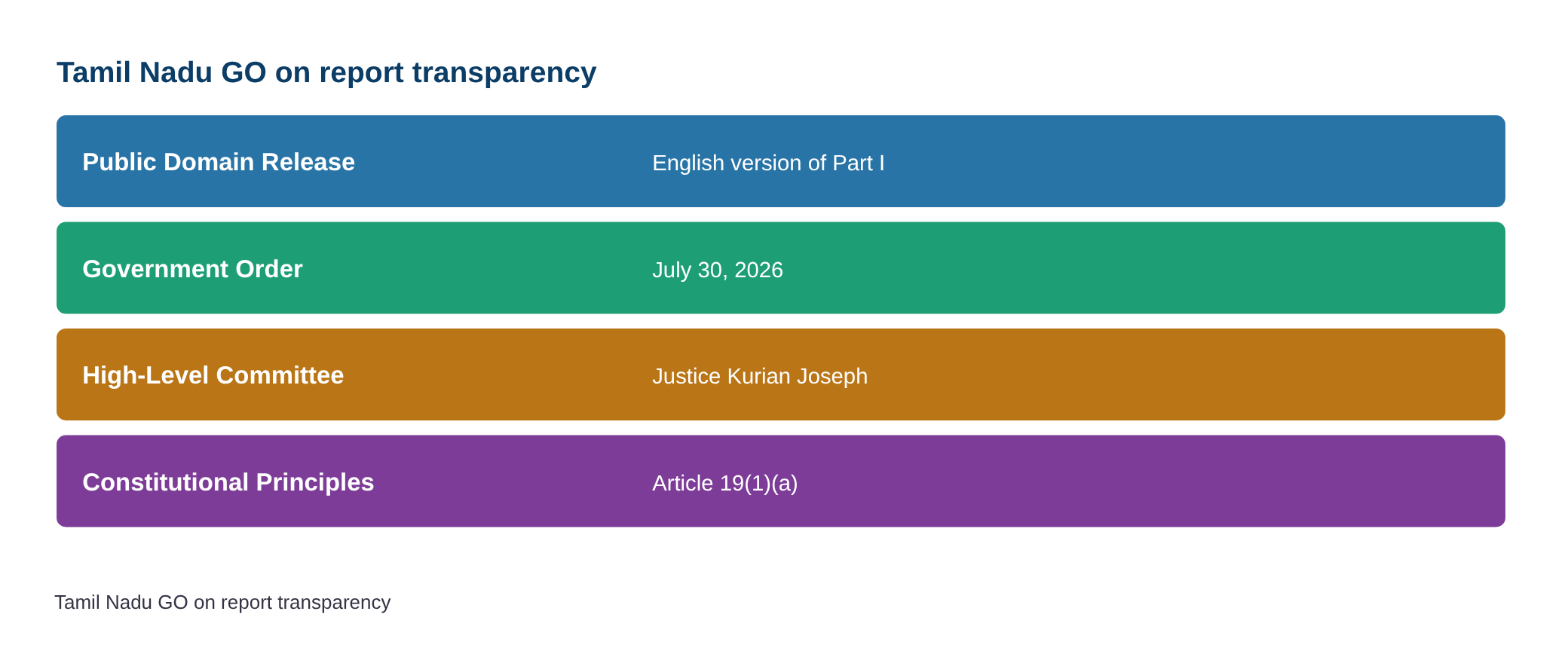
The Tamil Nadu government’s issuance of a Government Order (GO) on July 30, 2026, mandating the public release of the English version of Part I of the High-Level Committee on Union-State Relations report marks a significant stride in institutional transparency. This directive, aligning the accessibility of the report in both Tamil and English, underscores the state’s commitment to democratic accountability and federal cooperation, particularly in the context of Centre-State relations. The decision also reflects evolving jurisprudential and administrative practices concerning the dissemination of government reports and the legal implications of copyright over public documents.
Background
- The High-Level Committee on Union-State Relations was constituted by the Tamil Nadu government on April 15, 2025, under the leadership of retired Supreme Court judge Justice Kurian Joseph, to examine the federal balance and Centre-State relations.
- The committee included retired IAS officer K. Ashok Vardhan Shetty and former Vice-Chairman of the Tamil Nadu State Planning Commission M. Naganathan as members, indicating a blend of judicial, administrative, and planning expertise.
- Part I of the committee’s report was submitted to the then Chief Minister M.K. Stalin on February 16, 2026, and tabled in the Tamil Nadu Assembly on February 18, 2026, demonstrating legislative engagement with the report’s findings.
- The Tamil Nadu government’s decision to host the English version of the report in the public domain follows the precedent set by the Tamil version, emphasizing linguistic parity and accessibility in governance.
- The cancellation of exclusive copyright for the English version of the report aligns with constitutional principles of transparency and the public’s right to access government information, as enshrined in Article 19(1)(a) of the Constitution.
- The directive is issued under the authority of the Public Department, Tamil Nadu, highlighting the state’s proactive role in fostering federal dialogue and institutional transparency.
What is the High-Level Committee on Union-State Relations, and why is its report significant?
- The High-Level Committee on Union-State Relations is a non-statutory body constituted by the Tamil Nadu government to assess the dynamics of Centre-State relations, including fiscal federalism, administrative cooperation, and constitutional provisions governing federalism.
- Part I of the report likely focuses on structural and institutional aspects of Union-State relations, such as the distribution of legislative and executive powers, financial devolution, and mechanisms for dispute resolution between the Centre and states.
- The committee’s composition, including a retired Supreme Court judge, ensures a judicious and impartial assessment of federal issues, aligning with the principles of constitutional morality and the rule of law.
- The report’s public release in both Tamil and English enhances accessibility for policymakers, researchers, and citizens, fostering informed discourse on federalism and governance.
- The cancellation of exclusive copyright for the English version of the report underscores the state’s commitment to open governance, aligning with the Right to Information (RTI) Act, 2005, which mandates transparency in government functioning.
- The committee’s work reflects Tamil Nadu’s proactive engagement in Centre-State relations, a critical dimension of India’s federal structure, and sets a precedent for other states to emulate.
- The report’s findings may inform legislative and administrative reforms at the state level, particularly in areas such as inter-state coordination, resource allocation, and conflict resolution mechanisms.
Key Features
| Feature | Significance |
|---|---|
| Open access to English version of Part I of the Union-State Relations report | Enhances transparency and accessibility of governance-related documentation for stakeholders, including civil servants, researchers, and the public. |
| Cancellation of exclusive copyright for the English version | Ensures public ownership of government-commissioned reports, aligning with principles of open governance and democratic accountability. |
| Hosting on official portal (hlcusr.tn.gov.in) | Facilitates seamless dissemination and retrieval of the report, reducing barriers to information access for non-Tamil speakers. |
| Constitution of High-Level Committee on Union-State Relations | Demonstrates the state government’s institutional commitment to addressing federalism-related issues through expert-led analysis. |
| Submission and tabling in the Assembly | Fulfills constitutional and parliamentary norms of executive accountability and legislative oversight. |
Why it Matters
Constitutional and Federal
- Reinforces the principle of cooperative federalism by enabling state-level scrutiny of Union-State relations, a critical dimension of India’s quasi-federal structure.
- Highlights the role of state governments in initiating independent reviews of central-state dynamics, a practice encouraged under Articles 263 and 356(1) of the Constitution.
- Demonstrates Tamil Nadu’s proactive stance in leveraging institutional mechanisms to address federal imbalances, particularly in areas like fiscal federalism and administrative autonomy.
Governance and Transparency
- Sets a precedent for open governance by making intergovernmental reports publicly accessible, reducing information asymmetry between the state and its citizens.
- Underscores the importance of multilingual accessibility in governance, ensuring inclusivity for non-Tamil-speaking stakeholders.
- Aligns with the Right to Information (RTI) Act’s spirit by proactively disclosing government-commissioned reports without formal requests.
Institutional and Procedural
- Illustrates the functioning of high-powered committees in addressing complex intergovernmental issues, a mechanism often used for constitutional reviews (e.g., Sarkaria Commission).
- Showcases the role of retired judges in adjudicating federal disputes, reflecting the judiciary’s indirect influence on constitutional governance.
- Highlights the procedural rigor in report submission and legislative tabling, ensuring democratic oversight of executive actions.
Challenges
1. Information Asymmetry in Federal Governance
- Despite proactive measures, disparities in access to intergovernmental reports persist across linguistic and regional divides, necessitating broader digital inclusion initiatives.
- The state’s unilateral action may face resistance from the Union government if it perceives such reports as encroaching on its constitutional prerogatives under Articles 245-246.
- Ensuring sustained public engagement with technical reports on federalism requires targeted awareness campaigns and simplified summaries.
UPSC Link: Federalism: Articles 245-263
2. Copyright and Intellectual Property in Government Reports
- Balancing public access with proprietary rights in commissioned reports remains a grey area, particularly when reports contain third-party data or expert inputs.
- The cancellation of exclusive copyright may invite legal scrutiny if it conflicts with existing contractual agreements or intellectual property norms.
- States must navigate the fine line between transparency and protecting sensitive information in reports on intergovernmental relations.
UPSC Link: IPR and Governance
3. Implementation and Enforcement of High-Level Recommendations
- The report’s recommendations, if not statutorily binding, may face challenges in implementation due to lack of legal enforceability or Union government concurrence.
- Political transitions could dilute the momentum for reforms, as seen in past instances where high-level committee reports were shelved.
- Ensuring inter-departmental coordination for implementation requires robust institutional mechanisms at both state and Union levels.
UPSC Link: Cooperative Federalism
Challenges — UPSC Perspective
| Issue | Concern |
|---|---|
| Linguistic barriers in governance | Limited accessibility of reports for non-Tamil speakers, despite English translations. |
| Legal ambiguity in copyright waiver | Potential conflicts with existing IPR norms or contractual obligations of report contributors. |
| Union-state jurisdictional tensions | Risk of perceived overreach by states in reviewing Union-State relations without Union concurrence. |
| Sustainability of public engagement | Low awareness or interest among citizens in technical reports on federalism. |
| Political continuity of reforms | Possible dilution of recommendations due to changes in government or administrative priorities. |
Way Forward
- State governments should institutionalize multilingual accessibility for all intergovernmental reports to ensure inclusivity.
- The Union government could collaborate with states to standardize formats for high-level committee reports, enhancing comparability and utility.
- Civil society organizations and academic institutions should be encouraged to analyze and disseminate the report’s findings for broader public discourse.
- States should explore legal safeguards to prevent misuse of waived copyright while ensuring unrestricted public access.
- Parliamentary committees (e.g., Standing Committee on Federal Relations) could invite state representatives to discuss such reports, fostering cooperative federalism.
- Digital literacy programs should be launched to improve public engagement with governance-related documents.
- A national portal for intergovernmental reports could be envisaged to centralize and streamline access across states.
- States should prioritize the implementation of recommendations through inter-departmental task forces to ensure accountability.
UPSC Value Addition
Keywords for Mains Answer-Writing
Union-State Relations · High-Level Committee on Union-State Relations · Justice Kurian Joseph Committee · Federalism in India · Inter-State Council · Constitutional Provisions on Centre-State Relations · Public Access to Government Reports · Copyright and Public Domain · Tamil Nadu Government Order · Centre-State Cooperative Federalism · Article 263 of the Constitution · Inter-State Disputes Resolution
Constitutional & Policy Linkages
- {‘Article 263’: ‘Inter-State Council and related bodies.’}
- {‘Article 245-246’: ‘Distribution of legislative powers between Union and States.’}
- {‘Article 262’: ‘Adjudication of inter-state water disputes.’}
Concept Flow
State government constitutes High-Level Committee on Union-State Relations → Committee submits Part I of report → Report tabled in Assembly → Government orders open access to English version → Report hosted on official portal → Public scrutiny and analysis ensue.
Prelims Practice Questions
Q1. Consider the following statements regarding the High-Level Committee on Union-State Relations constituted by the Tamil Nadu government:
1. The committee was headed by a retired Supreme Court judge.
2. The committee submitted Part I of its report to the Chief Minister on February 16, 2026.
3. The committee included a former Vice-Chairman of the Tamil Nadu State Planning Commission.
4. The committee was constituted under Article 263 of the Constitution.
How many of the above statements are correct?
- Only one
- Only two
- Only three
- All
Answer: Only three — Statements 1, 2, and 3 are correct. Statement 4 is incorrect as the committee was constituted by the Tamil Nadu government and not under Article 263, which pertains to the Inter-State Council.
Q2. Assertion (A): The Tamil Nadu government directed the cancellation of exclusive copyright for the English version of Part I of the Union-State Relations report.
Reason (R): The government aimed to ensure transparency and public access to the report.
Options:
A. Both A and R are true, and R is the correct explanation of A.
B. Both A and R are true, but R is not the correct explanation of A.
C. A is true, but R is false.
D. A is false, but R is true.
Answer: ? — Both the assertion and reason are true, and the reason correctly explains the assertion. The government’s directive to cancel copyright was explicitly to ensure transparency and public access.
Mains Practice Question
✍ The Tamil Nadu government’s decision to place the English version of Part I of the Union-State Relations report in the public domain reflects a broader discourse on federalism and transparency in India. Critically examine the significance of this decision in the context of Centre-State relations and constitutional provisions governing inter-governmental cooperation. Also, assess the role of such reports in strengthening cooperative federalism. (15 Marks)
Approach: MODEL-ANSWER SKELETON:
1. **Introduction (2 Marks)**
– Briefly define Centre-State relations and the constitutional framework (Articles 262, 263, and the Seventh Schedule).
– Mention the Tamil Nadu government’s decision and its immediate objective (transparency and public access).
2. **Significance of the Decision (5 Marks)**
– **Federalism**: Highlight how public access to such reports aligns with the principles of cooperative federalism (e.g., Sarkaria Commission recommendations, NITI Aayog’s role).
– **Transparency and Accountability**: Discuss the importance of transparency in governance, especially in Centre-State disputes (e.g., GST disputes, water-sharing issues).
– **Public Participation**: Emphasise the role of civil society, scholars, and policymakers in engaging with such reports to foster informed debate.
3. **Constitutional and Legal Dimensions (4 Marks)**
– **Article 263**: Explain the Inter-State Council’s role in Centre-State relations and how public reports can aid its functioning.
– **Copyright and Public Domain**: Discuss the legal implications of cancelling exclusive copyright (e.g., Right to Information Act, 2005, and public interest).
– **Judicial Precedents**: Cite relevant judgments (e.g., *State of U.P. v. Raj Narain*, 1975) on the right to information and transparency.
4. **Challenges and Criticisms (3 Marks)**
– **Selective Transparency**: Argue that such measures may not address deeper structural issues in Centre-State relations (e.g., financial devolution, Article 370 abrogation debates).
– **Implementation Gaps**: Highlight potential challenges in ensuring universal access and utilisation of such reports.
5. **Conclusion (1 Mark)**
– Summarise the decision’s role in fostering a more informed and participatory federal structure, while acknowledging its limitations.
Source: The Hindu
Generated by AanyaAi for educational purpose.

- आंध्र प्रदेश में चार नए पुलिस आयुक्तालयों को कैबिनेट की मंजूरी, जानिए क्या होंगे फायदे - September 23, 2026
- Andhra Pradesh to get 4 new Police Commissionerates: Key UPSC insights - September 23, 2026
- AI आधारित ‘HEADS’ से भारत में अवसाद जांच में क्रांति: जानिए कैसे होगा मदद - September 23, 2026

No Comments